



Corneal Scars
🧠 Quick Answer
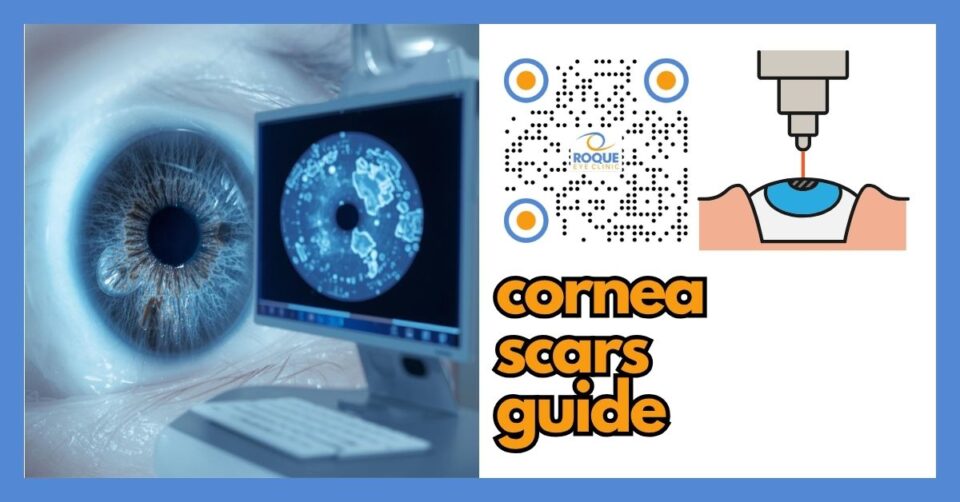
Corneal scars are cloudy or opaque areas on the clear front window of the eye. They can blur vision, cause glare, reduce contrast, and sometimes make refractive surgery unsafe or less predictable. Small peripheral scars may not affect vision much, but central or irregular scars can change corneal shape, lower visual quality, and require treatment or a different surgical plan.
The cornea is the clear dome at the front of the eye. To see well, it must stay both clear and smooth. A corneal scar can affect either one or both. Some scars mainly reduce clarity. Others also distort the corneal surface, creating irregular astigmatism, ghosting, glare, and unstable measurements during refractive surgery screening.
In a refractive surgery setting, corneal scars matter because laser vision correction depends on accurate measurements and a healthy corneal structure. If the scar changes the corneal contour or healing response, the final visual result may become less predictable. In some eyes, a corneal scar is only a note in the chart. In other eyes, it becomes the main reason surgery is postponed, changed, or avoided.
🧩 Focus: Corneal scars and their relevance to vision, refractive surgery candidacy, and treatment
👁 Goal: Help patients understand what corneal scars are, why they matter, how they are evaluated, and how they may affect laser or lens-based vision correction
🛡 Evidence-Based: Preferred Practice Patterns • Standards of Care • Systematic Reviews • Meta-Analyses
REFRACTIVE SURGERY Knowledge Hub
Start with the complete guide:
🔬 Corneal Scars Anatomy Micro-Primer
- Corneal epithelium: This is the thin outer skin of the cornea. Injuries or infections that begin here can sometimes heal with surface irregularity.
- Corneal stroma: This is the thick middle layer that provides strength and shape. Many visually significant corneal scars involve this layer.
- Bowman’s layer: This thin layer sits under the epithelium. Damage near this zone can contribute to visible scarring.
- Visual axis: This is the part of the cornea directly in the path of incoming light. Scars in or near this area are more likely to affect vision.
📘 Corneal Scars Terminology Glossary
- Corneal opacity: Loss of corneal clarity that makes the cornea look cloudy or white.
- Irregular astigmatism: Distorted corneal shape that causes blurred or doubled vision not fully corrected by ordinary glasses.
- Visual axis: The central viewing zone of the eye where light passes for sharp vision.
- Topography: A map of the corneal surface shape.
- Tomography: A more detailed structural scan that shows both the front and back cornea and corneal thickness pattern.
- PTK: Phototherapeutic keratectomy, a laser treatment sometimes used to remove superficial corneal irregularity or opacity.
Quick Navigation
Related Reading
Key Learning Points
- A corneal scar is not just a mark on the eye. It can reduce clarity, change shape, or do both.
- Scars near the center of the cornea are more likely to affect vision than small peripheral scars.
- Corneal scars can reduce the accuracy and predictability of laser refractive surgery planning.
- Some superficial scars can be treated, but deeper or irregular scars may require a different refractive strategy.
- A scarred cornea does not automatically mean “no surgery,” but it always deserves careful individualized evaluation.
What Corneal Scars Are
A corneal scar is an area of altered transparency or structure in the cornea. Instead of remaining perfectly clear and smooth, the tissue heals with some degree of clouding, irregularity, or both. The scar may be tiny and barely visible, or dense and white enough to block light significantly. Some scars stay superficial, while others extend more deeply into the corneal stroma.
Not all corneal scars behave the same way. A small faint scar near the edge of the cornea may not affect vision much at all. A central scar, even if not very large, may reduce best-corrected vision, increase glare, and create distorted optics. When the scar also changes the corneal contour, patients may notice ghost images, double outlines, poor night vision, or blurred vision that glasses cannot fully sharpen.
💡 Analogy
Imagine looking through a clean car windshield. If there is a small scratch at the far edge, you may barely notice it. But if there is a cloudy scratch directly in front of you, your view becomes hazy and distorted. The same idea applies to corneal scars: location matters just as much as size.
Common Causes of Corneal Scars
Corneal scars can follow many different problems. The most common causes include infection, trauma, prior surgery, severe inflammation, and some corneal diseases. Even a problem that seemed minor at the start can leave a lasting scar if the cornea heals irregularly or if deeper tissue becomes involved.
1) Corneal infections
Bacterial, fungal, viral, or parasitic keratitis can leave permanent opacity after the active infection settles. The risk is higher when the infection is deep, delayed in treatment, or centrally located.
2) Eye trauma
Foreign bodies, scratches, chemical injuries, welding injuries, fingernail trauma, and contact lens–related injuries can all heal with corneal scarring.
3) Previous surgery or procedures
Some scars form after prior corneal surgery, cross-linking, pterygium surgery with corneal involvement, or healing complications after refractive or therapeutic procedures.
4) Corneal inflammation and disease
Conditions such as recurrent erosions, severe dry eye with surface breakdown, autoimmune disease, neurotrophic keratopathy, or corneal dystrophies can lead to surface damage and later scarring.
5) Ulcers and delayed healing
A corneal ulcer or persistent epithelial defect can heal with fibrosis or opacity, especially if the stromal layer becomes involved.
Symptoms and Visual Effects
The symptoms depend on how dense the scar is, where it sits, and whether it changes corneal shape. Some patients have no symptoms at all and learn about the scar only during an eye exam. Others notice substantial visual impairment.
- Blurred vision
- Glare and halos
- Reduced contrast sensitivity
- Ghosting or shadow images
- Irregular astigmatism
- Light sensitivity
- Persistent foreign-body sensation if the surface is irregular
One important point for patients is that corneal scars do not always behave like ordinary glasses power. A scar can distort light in a way that spectacles cannot fully fix. That is why someone may still feel unsatisfied even when their glasses prescription looks reasonable on paper.
How Corneal Scars Are Diagnosed
Diagnosis usually begins with history-taking and slit-lamp examination. Your ophthalmologist looks at the depth, density, location, extent, and activity of the lesion. The goal is not just to label the scar, but to determine whether it is stable, whether it affects vision, and whether it changes corneal shape.
Common tests may include:
- Slit-lamp examination: To inspect the scar directly and assess surface health.
- Corneal topography: To see whether the scar causes surface irregularity or irregular astigmatism.
- Corneal tomography: To evaluate both front and back corneal shape and thickness distribution.
- Pachymetry: To measure corneal thickness, especially if surgery is being considered.
- Anterior segment OCT: In selected cases, to estimate scar depth and layer involvement.
- Refraction and visual acuity testing: To measure how much the scar affects vision functionally.
How Corneal Scars Affect Refractive Surgery
In refractive surgery, the question is not simply “Is there a scar?” The real questions are: Where is it? How deep is it? Is the cornea still stable and regular? Will the scar interfere with laser tracking, flap quality, healing, or final visual quality?
Significant corneal scarring is a well-recognized concern in corneal laser procedures because it can affect the accuracy of treatment and healing response. A central scar may reduce the predictability of LASIK or PRK. A dense or irregular scar may also make corneal measurements less reliable during screening. Some FDA patient-information materials and refractive surgery guidance documents specifically list central corneal scarring or irregular unstable keratometry as unfavorable findings for candidacy. :contentReference[oaicite:0]{index=0}
When a scar may be less concerning
- The scar is small, peripheral, and stable
- It does not affect the visual axis
- Topography and tomography remain regular
- Best-corrected vision is good
- There is no sign of active disease or ongoing inflammation
When a scar may be more concerning
- The scar is central or paracentral
- It affects best-corrected visual acuity
- It creates irregular astigmatism
- It interferes with keratometry, topography, or tomography
- It is associated with thin cornea, ectasia risk, or unstable healing
- There is a history of recurrent infection or inflammation
Some patients with corneal scars are better suited to lens-based refractive options than corneal laser surgery, especially when the corneal problem is the main limiting factor. Others may need therapeutic treatment first, with refractive planning only after the surface and shape become stable. The correct plan is highly individualized. The AAO’s current refractive surgery guidance emphasizes careful case selection, ocular surface assessment, corneal imaging, and risk evaluation before refractive procedures. :contentReference[oaicite:1]{index=1}
🚨 Emergency Warning
Seek urgent eye care if you have a painful red eye, sudden drop in vision, new corneal whitening, discharge, or light sensitivity that is rapidly worsening. A scar is usually a healed problem, but an active ulcer or infection is an emergency and should not be mistaken for an old stable scar.
Treatment Options for Corneal Scars
Treatment depends on the cause, depth, location, and effect on vision. The goal may be to improve clarity, smooth the surface, reduce symptoms, or improve contact lens fitting. Not every scar needs treatment. Some need only observation and protection from future injury.
1) Observation
If the scar is stable, peripheral, and not affecting vision, the best treatment may be no treatment at all—just follow-up and eye protection.
2) Ocular surface optimization
Lubrication, treatment of blepharitis, management of dry eye, and control of inflammation can improve symptoms even when the scar itself remains.
3) Specialty contact lenses
Rigid gas-permeable, hybrid, or scleral lenses may help neutralize an irregular corneal surface and improve vision better than spectacles in selected patients.
4) Phototherapeutic keratectomy (PTK)
Some superficial scars or irregularities may be amenable to PTK. This is different from ordinary refractive PRK because the aim is therapeutic smoothing or superficial opacity reduction rather than routine refractive correction alone.
5) Lamellar or full-thickness corneal transplantation
In severe cases, especially when scarring is deep or visually disabling, corneal transplantation may be considered. This is usually reserved for more significant disease.
6) Alternative refractive planning
If a patient wants less dependence on glasses but the scar makes corneal laser surgery less ideal, the surgeon may discuss alternatives such as lens-based correction instead of corneal refractive treatment.
Newer regenerative and biologic approaches to corneal scarring are also being studied, but they are not yet routine replacements for established treatment pathways. :contentReference[oaicite:2]{index=2}
Prevention
Not every scar can be prevented, but many can. Fast treatment of corneal infections and injuries is critical. Delays allow deeper tissue damage and increase the chance of permanent opacity.
- Do not sleep in contact lenses unless specifically prescribed to do so
- Seek prompt care for red painful eyes or contact lens–related problems
- Use protective eyewear during welding, grinding, laboratory work, and sports
- Treat dry eye, eyelid disease, and recurrent erosions early
- Do not self-medicate with steroid drops unless prescribed
- Attend follow-up visits after corneal injury, infection, or surgery
Can a Patient with a Corneal Scar Still Have Refractive Surgery?
Sometimes yes, sometimes no, and sometimes not yet. A small stable peripheral scar with normal corneal imaging may not prevent refractive surgery. A central dense scar with irregular topography may make corneal laser surgery a poor choice. Another eye with the same-looking scar on casual inspection may turn out to be acceptable only after more detailed imaging. That is why proper screening matters so much.
For patients, the key message is this: the answer should not be based on the appearance of the scar alone. It should be based on scar location, scar depth, corneal regularity, best-corrected vision, imaging quality, healing risk, and the procedure being considered.
Continue Reading
🏁 Take-Home Message
Corneal scars are important because they can affect both corneal clarity and corneal shape. Some scars are minor and compatible with safe refractive planning. Others make corneal laser surgery too risky or too unpredictable. The right next step is not guessing from the mirror—it is a full corneal evaluation with topography, tomography, refraction, and a careful discussion of safer alternatives when needed.
FAQ
1) Can a corneal scar go away on its own?
Some very superficial marks may fade with time, but many true corneal scars do not disappear completely. Once stromal scarring forms, it often leaves at least some permanent change.
2) Does every corneal scar blur vision?
No. Small peripheral scars may cause little or no visual problem. Scars closer to the center of the cornea are more likely to affect vision.
3) Can glasses fully correct the vision loss from a corneal scar?
Not always. If the scar causes irregular astigmatism or surface distortion, ordinary glasses may not completely sharpen vision.
4) Does a corneal scar automatically mean I cannot have LASIK or PRK?
No. Some scars may still be compatible with surgery, but significant central or irregular scars can make corneal laser treatment less safe or less predictable.
5) Can a scarred cornea still be treated to improve vision?
Yes. Depending on the case, treatment options may include lubrication, specialty contact lenses, PTK, or in severe cases corneal transplantation.
6) Why does my surgeon want topography and tomography if the scar is already visible?
Because the appearance of the scar alone does not show the whole story. Imaging helps reveal whether the scar changes corneal shape, thickness, or structural stability in ways that affect treatment planning.
📚 References
- American Academy of Ophthalmology. Refractive Surgery Preferred Practice Pattern®. Updated guidance on screening, case selection, and corneal evaluation. :contentReference[oaicite:3]{index=3}
- U.S. Food and Drug Administration. When is LASIK not for me? FDA patient guidance on candidacy and refractive instability. :contentReference[oaicite:4]{index=4}
- FDA patient information and LASIK safety/effectiveness documents noting that corneal scars may affect treatment accuracy, healing, and visual outcome. :contentReference[oaicite:5]{index=5}
- American Academy of Ophthalmology. Introduction to SMILE. Notes that significant corneal scarring is a contraindication in LASIK and relevant in refractive planning. :contentReference[oaicite:6]{index=6}
- Chandran C, et al. Regenerative Therapy for Corneal Scarring Disorders. Review of current and emerging approaches to corneal stromal scarring. :contentReference[oaicite:7]{index=7}
🤝 Roque Eye Clinic Patient Education Series
Dr. Manolette Roque | Dr. Barbara Roque
St. Luke's Medical Center Global City | Asian Hospital Medical Center
Philippines
Medical Review: Roque Advisory Council
Last Updated: March 2026
Medical Disclaimer
This article is intended for educational purposes only and does not replace professional medical consultation.