



Lens-Based Vision Correction: ICL vs Lens Replacement Surgery
🧠 Quick Answer
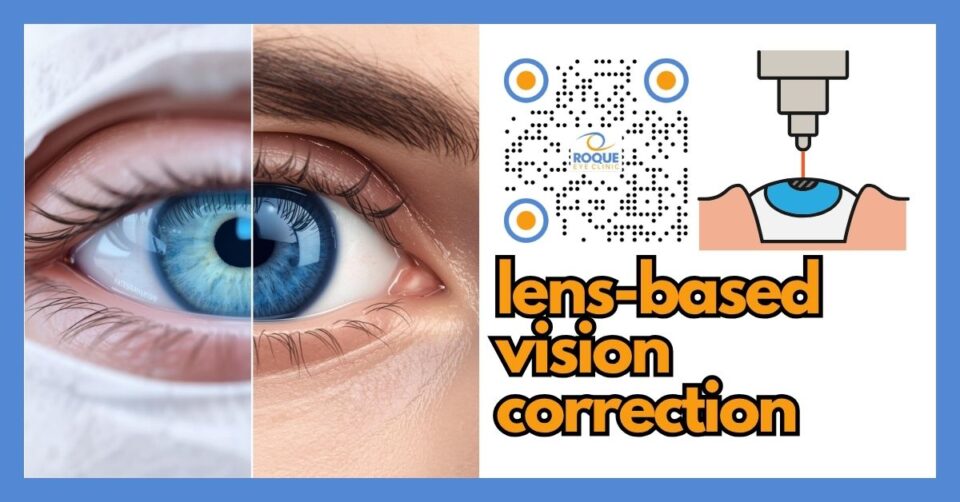
Lens-based vision correction includes two main options: ICL, which adds a lens inside the eye while keeping your natural lens, and lens replacement surgery, which removes your natural lens and replaces it with an artificial one. ICL is often discussed for younger patients with myopia and enough internal eye space, while lens replacement is more often considered when presbyopia, early cataract, or lens aging already matter.
Many patients asking about refractive surgery think only about LASIK, PRK, or SMILE. However, some eyes are better served by lens-based vision correction. Instead of reshaping the cornea, these procedures work by placing or exchanging a lens inside the eye. For the right patient, that can be a very strong option.
The two main lens-based refractive choices are ICL and lens replacement surgery. They are not interchangeable in every patient. One preserves the natural lens. The other removes it. That single difference affects age suitability, focusing ability, presbyopia, retinal considerations, and long-term planning.
🧩 Focus: Comparing ICL and lens replacement surgery as lens-based refractive options
👁 Goal: Help patients understand what each procedure does, who may benefit, major trade-offs, and how surgeons decide between them
🛡 Evidence-Based: Preferred Practice Patterns • Standards of Care • Systematic Reviews • Meta-Analyses
REFRACTIVE SURGERY Knowledge Hub
Start with the complete guide:
🔬 Lens-Based Vision Correction Anatomy Micro-Primer
- Natural lens: This is the clear structure inside the eye that helps focus. In ICL surgery, it stays. In lens replacement surgery, it is removed.
- Anterior chamber and posterior chamber: These are spaces in the front part of the eye. Their dimensions matter greatly when planning ICL surgery.
- Capsular bag: This is the thin natural envelope that holds the natural lens. In lens replacement surgery, the artificial lens is usually placed here.
- Retina: This light-sensitive tissue lines the back of the eye. Retinal health matters before any intraocular refractive procedure, especially in high myopia.
📘 Lens-Based Vision Correction Terminology Glossary
- ICL: Implantable collamer lens, a lens placed inside the eye without removing the natural lens.
- Phakic IOL: Another term for a lens implanted while the natural lens remains in place.
- RLE: Refractive lens exchange, a form of lens replacement surgery done mainly for refractive reasons rather than a visually significant cataract.
- Presbyopia: Age-related loss of near focusing ability.
- Vault: The space between an ICL and the natural lens. Proper vault is important for safety.
- Premium IOL: An artificial lens designed to address distance vision only or a broader range of vision, depending on the model.
Quick Navigation
Related Reading
Key Learning Points
- ICL adds a lens while keeping your natural lens.
- Lens replacement surgery removes your natural lens and places an artificial lens inside the eye.
- ICL is often discussed in younger patients who still value their natural focusing ability and have suitable anatomy.
- Lens replacement becomes more relevant when presbyopia, early cataract, or aging-lens issues already matter.
- The best choice depends on age, refraction, anterior chamber measurements, retinal status, lens status, and lifestyle goals.
What Lens-Based Vision Correction Means
Lens-based vision correction refers to refractive procedures that improve focusing by working with a lens inside the eye rather than reshaping the cornea. This category matters most when corneal laser surgery is not ideal, when refractive error is high, or when age-related lens changes shift the balance toward intraocular solutions.
A simple analogy helps. The eye is like a camera. Corneal laser surgery changes the front window. Lens-based surgery changes or adds an internal focusing lens. Both can improve vision, but they do so in very different ways.
💡 Analogy
ICL is like placing an extra precision lens inside a camera while keeping the original camera lens. Lens replacement surgery is like removing the original camera lens and installing a new one built for your long-term visual plan.
What ICL Is
ICL, or implantable collamer lens, is a type of phakic intraocular lens. “Phakic” means your natural lens stays in place. The ICL is implanted inside the eye, behind the iris and in front of the natural lens. Because the natural lens remains, the eye keeps its own age-related focusing status at the time of surgery.
ICL is often discussed for patients with moderate to high myopia, especially when corneal laser surgery is less attractive because of refractive magnitude, corneal thickness, or structural concerns. Proper sizing and anterior chamber assessment are essential because the implanted lens must sit in the eye with a safe relationship to nearby structures.
What Lens Replacement Surgery Is
Lens replacement surgery removes the eye’s natural lens and replaces it with an artificial intraocular lens. When done mainly for refractive reasons before a major cataract becomes the main problem, it is often called refractive lens exchange. When cataract is already visually significant, the same basic surgical platform becomes cataract surgery with refractive planning.
This option is especially relevant when the natural lens is already losing flexibility, when presbyopia is a major concern, or when early cataract changes are present. Because the natural lens is removed, the future risk of cataract from that lens is also removed.
Key Differences Between ICL and Lens Replacement Surgery
1) Natural lens preservation
ICL preserves the natural lens. Lens replacement surgery removes it. This is one of the biggest differences because it affects accommodation, presbyopia planning, and long-term trade-offs.
2) Age and presbyopia
Younger patients who still have meaningful natural focusing ability may lean toward ICL if anatomy and refractive error fit. Older patients who already struggle with reading vision, or who have early lens aging, may lean more naturally toward lens replacement.
3) Refractive range and corneal limits
ICL can be especially attractive when refractive error is too high for a comfortable corneal-laser solution or when the cornea is not an ideal laser candidate. Lens replacement may also treat high refractive error, but its trade-offs differ because it is a full lens-exchange procedure.
4) Future cataract planning
After ICL, the natural lens remains and may still develop cataract later in life. After lens replacement surgery, the natural lens has already been removed, so that future cataract pathway no longer applies.
5) Retinal context in high myopia
High myopia already raises retinal concerns, so retinal status matters in both pathways. That discussion can become especially important when considering intraocular surgery in highly myopic eyes.
Who May Be a Better Fit for ICL?
- Younger adult with stable refraction
- Moderate to high myopia or myopic astigmatism
- Cornea not ideal for LASIK, PRK, or SMILE
- Enough internal eye space for safe ICL sizing
- Desire to preserve the natural lens and current focusing status
Who May Be a Better Fit for Lens Replacement Surgery?
- Patient with presbyopia who wants a lens-based strategy
- Patient with early cataract or aging-lens changes
- Patient whose refractive goals align with monofocal, toric, EDOF, or multifocal lens planning
- Older patient in whom preserving the natural lens offers less functional advantage
- Patient who accepts the trade-offs of lens exchange in exchange for broader long-term refractive planning
Why Some Younger Patients Prefer ICL
For younger myopic patients, the strongest attraction of ICL is often that it preserves the natural lens. That means the patient is not “using up” lens replacement surgery early. It can also be appealing in high myopia when corneal laser tissue limits become uncomfortable. In the United States, FDA approval information for EVO/EVO+ Visian ICL specifically covers myopic use in adults 21 to 45 years old within defined refractive and astigmatic ranges, which helps explain why ICL is commonly discussed in that age group. :contentReference[oaicite:1]{index=1}
Why Some Older Patients Prefer Lens Replacement Surgery
Once presbyopia is established and the natural lens is already aging, preserving that lens may become less valuable. In that setting, lens replacement may offer a more logical long-term plan, especially when early cataract is already present or when the patient wants refractive correction tied to a premium-IOL discussion. This is why the same patient who would have been steered toward ICL at age 28 may be steered toward lens replacement at age 52.
Risks and Trade-Offs
ICL trade-offs
- Requires suitable anterior chamber dimensions and sizing
- Still involves intraocular surgery
- Needs long-term monitoring of vault and internal eye health
- The natural lens remains and may still develop cataract later
- Can still involve glare, halos, pressure issues, or lens-related complications in selected cases
Lens replacement trade-offs
- Removes the natural lens permanently
- Changes the eye’s focusing status in a way that must be planned carefully
- Can involve dysphotopsia, residual refractive error, or IOL-selection trade-offs
- In high myopia, retinal counseling is especially important
- It is usually a bigger lifetime decision than corneal laser surgery because the natural lens is gone
🚨 Emergency Warning
After any intraocular refractive procedure, urgent review is needed for severe pain, marked redness, sudden blur, flashes, many new floaters, a curtain over vision, nausea with eye pain, or rapidly worsening vision. These may signal retinal, pressure-related, inflammatory, or infectious problems.
How Surgeons Decide Between ICL and Lens Replacement Surgery
The decision usually comes down to a combination of factors rather than a single measurement. These include age, refraction, corneal status, anterior chamber depth, lens status, presbyopia, retinal findings, visual goals, tolerance for trade-offs, and the patient’s willingness to preserve or exchange the natural lens. A complete screening visit is essential before either path is chosen.
In practical terms, surgeons often ask: Is this patient still getting meaningful benefit from the natural lens? Is the anatomy suitable for a phakic lens? Is early cataract already part of the story? What kind of visual range does the patient want?
Questions Patients Should Ask
- Why are you recommending ICL or lens replacement for me instead of laser vision correction?
- Am I preserving a useful natural lens, or is my lens already becoming part of the problem?
- How does my age affect this recommendation?
- Do my retinal findings change the risk discussion?
- What kind of night vision or dysphotopsia should I expect?
- What is the long-term plan if my vision changes later?
Continue Reading
🏁 Take-Home Message
ICL and lens replacement surgery are both powerful lens-based refractive options, but they solve different problems. ICL is often attractive when a younger patient wants to keep the natural lens and has anatomy suitable for implantation. Lens replacement becomes more attractive when presbyopia, lens aging, or early cataract already matter. The safest choice is the one that matches your age, anatomy, retina, lens status, and long-term goals—not just your glasses prescription.
FAQ
1) Is ICL the same as lens replacement surgery?
No. ICL keeps your natural lens and adds another lens inside the eye. Lens replacement surgery removes your natural lens and replaces it with an artificial one.
2) Which is better for younger patients, ICL or lens replacement?
In many younger patients, ICL is often discussed first if anatomy is suitable because it preserves the natural lens. However, the best answer depends on refraction, chamber measurements, retinal status, and overall candidacy.
3) Which is better for presbyopia, ICL or lens replacement surgery?
Lens replacement surgery is often more relevant when presbyopia is already a major concern because it allows full intraocular lens planning around distance, intermediate, and near goals.
4) Can high myopia be treated with either ICL or lens replacement?
Yes, both may be discussed in high myopia, but they have different trade-offs. Retinal health and full screening are especially important in highly myopic eyes.
5) Does ICL remove the future need for cataract surgery?
No. Because the natural lens stays in place, cataract can still develop later in life. By contrast, lens replacement surgery removes the natural lens, so that lens can no longer form a cataract.
6) Why would someone choose lens replacement even without a major cataract?
Some patients choose refractive lens exchange because presbyopia, lens aging, or long-term refractive planning make lens replacement more logical than preserving the natural lens.
📚 References
- American Academy of Ophthalmology. Refractive Surgery Preferred Practice Pattern®. Updated refractive surgery guidance describing corneal reshaping and intraocular lens approaches.
- U.S. Food and Drug Administration. EVO/EVO+ Visian Implantable Collamer Lens approval information.
- U.S. Food and Drug Administration. Summary of Safety and Effectiveness Data for EVO/EVO+ Visian ICL.
- Cheng M, et al. Seven-year clinical outcomes and optical quality of implantable collamer lens versus keratorefractive lens extraction for high myopia. 2025.
- Sinha R, et al. Visual outcomes with implantable collamer lens versus small-incision lenticule extraction in moderate-high myopia. 2024/2025 comparative literature.
🤝 Roque Eye Clinic Patient Education Series
Dr. Manolette Roque | Dr. Barbara Roque
St. Luke's Medical Center Global City | Asian Hospital Medical Center
Philippines
Medical Review: Roque Advisory Council
Last Updated: March 2026
Medical Disclaimer
This article is intended for educational purposes only and does not replace professional medical consultation.