
Refractive Surgery Screening: Complete Evaluation Guide
🧠 Dr. Roque's Quick Answer
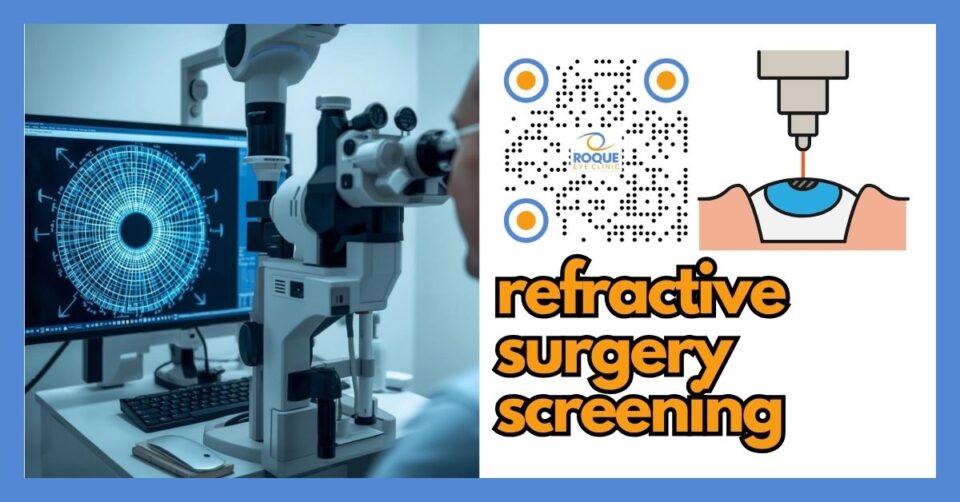
Refractive surgery screening is a detailed preoperative eye evaluation that checks whether laser or lens-based vision correction is safe and suitable for you. It reviews your prescription stability, cornea, tear film, retina, eye pressure, general eye health, and lifestyle goals so your surgeon can recommend the right procedure—or advise against surgery when the risk is too high.
Many patients think refractive surgery screening is just a quick glasses check. It is much more than that. A proper screening visit tries to answer two major questions: Is surgery safe for this eye? and Which option is the best fit for this patient’s anatomy, age, lifestyle, and expectations?
This matters because refractive errors such as myopia, hyperopia, astigmatism, and presbyopia are common, but the same prescription can still belong to very different eyes. One patient may be a strong LASIK candidate. Another may be safer with PRK, SMILE, ICL, lens-based surgery, or no surgery at all. Good screening helps avoid the mistake of treating the eyeglass number instead of evaluating the whole eye.
🧩 Focus: Refractive surgery screening and preoperative evaluation
👁 Goal: Confirm candidacy, match the safest procedure to the patient, reduce avoidable complications, and set realistic expectations
🛡 Evidence-Based: Preferred Practice Patterns • Standards of Care • Systematic Reviews • Meta-Analyses
ROQUE REFRACTIVE SURGERY Knowledge Hub
Start with the complete guide:
🔬 Refractive Surgery Screening Anatomy Micro-Primer
- Cornea: The clear front window of the eye. Many refractive procedures reshape this tissue, so its thickness, shape, and stability matter greatly.
- Tear film: The thin layer of tears covering the eye surface. If it is unstable, measurements may become less reliable and postoperative discomfort may be worse.
- Lens: The natural lens sits behind the iris. If it already shows age-related changes, lens-based surgery may be more logical than corneal laser surgery.
- Retina: The light-sensitive tissue at the back of the eye. Holes, tears, degeneration, or other retinal disease can change surgical planning and may need treatment first.
📘 Refractive Surgery Screening Terminology Glossary
- Manifest refraction: The prescription measured during the “Which is better, one or two?” exam.
- Cycloplegic refraction: A refraction done after eye drops relax focusing muscles, helping uncover hidden prescription or latent hyperopia.
- Topography/tomography: Imaging tests that map the cornea’s shape and structure and help detect irregular corneas or ectasia risk.
- Pachymetry: Measurement of corneal thickness.
- Candidacy: Whether a patient is a safe and suitable match for a particular refractive procedure.
- Refractive instability: Prescription fluctuation over time, which can make surgery timing inappropriate.
Quick Navigation
Related Reading
Dr. Roque's Key Learning Points
- Refractive surgery screening is about safety first, not just convenience.
- The visit checks your prescription, cornea, ocular surface, lens, retina, eye pressure, and overall eye health.
- Stable refraction, healthy corneal structure, and realistic expectations are central to good candidacy.
- Dry eye, keratoconus risk, retinal pathology, unstable prescription, and certain medical conditions may affect eligibility.
- A good screening result may lead to several safe outcomes: proceed, optimize first, change procedure, postpone, or avoid surgery.
What Refractive Surgery Screening Is
Refractive surgery screening is the full preoperative evaluation done before procedures such as LASIK, PRK, TransPRK, SMILE, ICL, and lens-based refractive surgery. It gathers measurements, looks for hidden risk factors, and compares different treatment pathways. In simple terms, this is the quality-control step before any permanent vision correction procedure.
A useful analogy is buying a custom suit. Measuring only the sleeve length is not enough. The tailor must check your shoulders, chest, waist, posture, and how you want the suit to fit. Refractive surgery works the same way. A glasses prescription alone is not enough. Your surgeon must understand the entire eye and how you use vision in daily life.
💡 Dr. Roque's Analogy
Choosing refractive surgery without full screening is like renovating a house after looking only at the front gate. The foundation, wiring, and plumbing still matter. In the eye, the “foundation” includes the cornea, tear film, lens, retina, and healing profile.
Why Screening Matters
Good screening lowers the chance of avoidable disappointment and avoidable harm. It can detect unstable prescription, dry eye, suspicious corneal shape, thin corneas, early lens changes, retinal tears, glaucoma concerns, and medical or lifestyle issues that influence healing and long-term outcomes.
Just as important, screening helps match the patient to the right procedure. One patient may be ideal for LASIK, another for PRK or SMILE, another for ICL, and another may be safer staying with glasses or contact lenses for now. A pilot, athlete, frequent night driver, or older presbyopic patient may need a very different recommendation from someone with the same refraction on paper.
What Your Surgeon Checks During Screening
1) Your vision and refraction
The evaluation usually starts with careful vision testing. This includes uncorrected vision, best-corrected vision, manifest refraction, and often cycloplegic refraction. The aim is to confirm your true prescription and see whether it has been stable enough for surgery.
2) Contact lens history
Contact lenses can temporarily alter corneal shape. That is why surgeons often ask patients to stop wearing contact lenses before key testing. If this step is skipped, topography, tomography, and refraction can become misleading.
3) Corneal structure and thickness
The cornea is central to most laser refractive procedures. Screening checks whether its front and back surfaces are regular, whether thickness is adequate, and whether any signs suggest keratoconus or risk of postoperative ectasia. This is one of the most important safety checkpoints before corneal laser surgery.
4) Lid margin, tear film, and ocular surface
Dry eye disease, meibomian gland dysfunction, blepharitis, and surface irritation are common in refractive surgery candidates. The surface of the eye must be healthy enough to give reliable measurements and support healing after surgery. Treating the ocular surface first often improves comfort and may even change the measured refraction or astigmatism.
5) Pupil size and visual quality factors
Large pupils, higher-order aberrations, glare sensitivity, and heavy night-driving demands can influence counseling and procedure choice. Patients who are especially sensitive to halos, contrast loss, or night-vision symptoms should discuss that clearly during screening.
6) Lens and anterior chamber
For lens-based options, the surgeon examines the natural lens and measures the anterior chamber. If early cataract or dysfunctional lens changes are already present, lens-based refractive surgery may make more sense than corneal laser treatment.
7) Eye pressure and optic nerve
Screening often includes intraocular pressure measurement and optic nerve assessment. This matters particularly when there is glaucoma, glaucoma suspicion, suspicious cupping, steroid-response history, or a strong family history.
8) Retina and peripheral fundus
A dilated retinal examination is especially important in myopic patients. Peripheral retinal holes, tears, lattice degeneration, or other retinal disease may need treatment or co-management before refractive surgery is considered safe.
9) General health, medications, and healing profile
The screening visit should review diabetes, autoimmune disease, wound-healing issues, pregnancy or breastfeeding status, previous eye surgery, and medications that may affect vision stability, tears, or healing. These details can change candidacy or alter timing.
10) Lifestyle and expectations
The best procedure on paper is not always the best procedure for the person. Your surgeon may ask about your work, sports, screen use, reading needs, night driving, age, and willingness to accept trade-offs such as temporary dryness, longer recovery, or the future need for reading glasses.
Common Screening Tests Before Refractive Surgery
Not every patient needs every test, but a complete screening commonly includes:
- Uncorrected and best-corrected visual acuity
- Manifest refraction and often cycloplegic refraction
- Keratometry
- Corneal topography or tomography
- Pachymetry
- Tear film and ocular surface evaluation
- Slit-lamp examination
- Intraocular pressure measurement
- Dilated fundus examination
- Wavefront or aberrometry in selected patients
- Anterior chamber measurements for ICL candidates
- Biometry and lens assessment for lens-based procedures
What Makes Someone a Good Candidate?
Although every procedure has its own criteria, strong candidates usually share several features: relatively stable prescription, healthy corneal structure, no uncontrolled eye disease, realistic expectations, and the ability to follow postoperative instructions. Being a “good candidate” is never a universal yes-or-no label for all procedures. A person who is not a good LASIK candidate may still be a very good ICL or lens-based surgery candidate.
Who May Not Qualify—or May Need More Workup First
Some patients do not qualify immediately. Others qualify only after additional treatment or repeat testing. Common reasons include:
- Prescription that is still changing
- Very young age with ongoing refractive instability
- Pregnancy or breastfeeding with temporary vision fluctuation
- Dry eye disease, blepharitis, or meibomian gland dysfunction that needs treatment first
- Keratoconus, forme fruste keratoconus, suspicious tomography, or structurally thin corneas
- Active infection, inflammation, or a history requiring special caution
- Glaucoma, glaucoma suspicion, or ocular hypertension requiring individualized review
- Retinal tears, lattice degeneration, or other posterior segment concerns
- Lens changes that make lens-based surgery more suitable than corneal laser surgery
- Medical conditions or medications that may affect healing or refractive stability
🚨 Dr. Roque's Emergency Warning
If a screening exam reveals sudden new floaters, flashes of light, a curtain over vision, painful red eye, severe loss of vision, or significant inflammation, the priority is urgent ophthalmic assessment—not elective refractive surgery planning.
Why “No” Can Be Good News
Many patients feel disappointed when screening ends with “not yet” or “not advisable.” In reality, this can be the safest and most valuable part of the consultation. A good screening exam protects patients from surgery that carries too much risk or too little likely benefit. It may also redirect them toward a better solution, such as ocular surface treatment first, retinal care first, ICL instead of LASIK, or lens-based surgery instead of corneal laser surgery.
How Screening Guides Procedure Choice
Screening is not only about ruling patients out. It also guides selection. For example:
- Healthy cornea with suitable thickness: LASIK, PRK, TransPRK, or SMILE may be considered depending on refractive error and lifestyle.
- Dry eye tendency or contact sports exposure: Surface ablation or another flap-free approach may sometimes be discussed instead of flap-based LASIK.
- High refractive error or corneal limitations: ICL may be more suitable than corneal laser surgery.
- Presbyopia or early lens changes: Lens-based options may make more sense than corneal refractive surgery.
What Happens After Screening
After the exam, the outcome usually falls into one of five categories:
- Proceed: Findings are favorable and surgery can be planned.
- Proceed after optimization: Treat the ocular surface, repeat measurements, or obtain more testing first.
- Change procedure: Another refractive option appears safer or more suitable.
- Postpone: Wait for refraction to stabilize or for a temporary condition to resolve.
- Do not proceed: The risks outweigh the likely benefits.
Patients should leave a good screening visit understanding not only the recommendation, but also the reasoning behind it. That helps prevent the common mistake of comparing procedures by price alone without considering anatomy, long-term safety, and quality of vision.
Questions Worth Asking During Your Screening Visit
- Is my prescription stable enough for surgery?
- Do I have any dry eye, lid disease, or corneal irregularity that needs treatment first?
- Am I a better candidate for LASIK, PRK, SMILE, ICL, or lens-based surgery?
- What visual trade-offs should I expect, especially at night?
- Do my work, hobbies, age, or eye anatomy change your recommendation?
- What factors would make you advise against surgery in my case?
Continue Reading
🏁 Dr. Roque's Take-Home Message
Refractive surgery screening is one of the most important parts of the entire vision-correction journey. A careful screening visit does not simply ask, “Can we do surgery?” It asks, “Is it safe, is it suitable, and is this the best option for this patient?” Patients benefit most when they allow enough time for complete testing, honest counseling, and treatment of any ocular surface or retinal issues before making a final decision.
FAQ
1) Is refractive surgery screening the same as a regular eye check-up?
No. A routine eye exam checks general vision and eye health, while refractive surgery screening is more detailed and focused on candidacy, safety, corneal structure, procedure matching, and long-term visual goals.
2) Why do I need so many tests before refractive surgery?
Each test answers a different safety question. One checks prescription stability, another checks corneal shape, another evaluates the ocular surface, and another looks at the retina. Together they reduce the chance of choosing the wrong procedure.
3) Can dry eye affect my screening results?
Yes. Dry eye can make measurements less reliable and may worsen symptoms after surgery. Many patients benefit from treating the ocular surface first and repeating key measurements later.
4) Why might my surgeon dilate my pupils during screening?
Dilation helps the surgeon examine the retina and optic nerve more thoroughly. This is especially important in myopic patients, who may have peripheral retinal findings that need attention before surgery.
5) Can I be rejected for LASIK but still qualify for another procedure?
Yes. Some patients are not good LASIK candidates because of corneal thickness, shape, dryness, or lifestyle factors, but may still qualify for PRK, SMILE, ICL, or lens-based surgery.
6) Should I stop wearing contact lenses before my screening visit?
Often yes. Contact lenses can temporarily change corneal shape, which may affect the accuracy of your tests. Your clinic will usually give specific instructions based on the lens type.
📚 References
- American Academy of Ophthalmology. LASIK — Laser Eye Surgery. Updated January 9, 2026.
- U.S. Food and Drug Administration. When is LASIK not for me?
- National Eye Institute. Refractive Errors. Updated December 19, 2025.
- American Academy of Ophthalmology. Refractive Surgery Preferred Practice Pattern®.
- American Academy of Ophthalmology. Corneal Ectasia Preferred Practice Pattern®.
🤝 Roque Eye Clinic Patient Education Series
Dr. Manolette Roque | Dr. Barbara Roque
St. Luke's Medical Center Global City | Asian Hospital Medical Center
Philippines
Medical Review: Roque Advisory Council
Last Updated: March 2026
Medical Disclaimer
This article is intended for educational purposes only and does not replace professional medical consultation.