



Corneal Cross-Linking Guide
🧠 Quick Answer
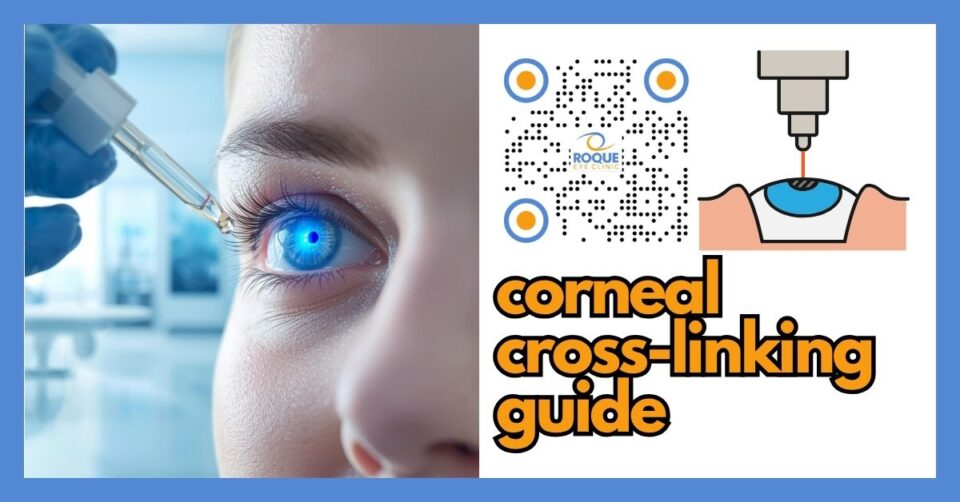
Corneal cross-linking is a treatment that uses riboflavin drops and ultraviolet-A light to strengthen the cornea and slow or stop worsening keratoconus or corneal ectasia. It is not mainly designed to remove glasses, but to protect the eye from further bulging, worsening irregular astigmatism, and possible future vision loss or corneal transplant.
Corneal cross-linking is one of the most important advances in modern corneal care. Before this treatment became available, many patients with progressive keratoconus or post-refractive ectasia had limited choices beyond glasses, contact lenses, specialty lenses, or eventually corneal transplantation. Cross-linking changed that pathway because it directly targets the problem of corneal weakening.
In simple language, the goal of cross-linking is to make the cornea more stable. It does this by combining riboflavin, which is a vitamin B2 solution, with carefully controlled ultraviolet-A light. This process increases bonding within the corneal collagen framework so the cornea becomes more resistant to further bulging and distortion.
🧩 Focus: Corneal cross-linking for progressive corneal ectasia
👁 Goal: Explain what cross-linking is, who may need it, how it works, what recovery is like, and what patients should realistically expect
🛡 Evidence-Based: Preferred Practice Patterns • Standards of Care • Systematic Reviews • Meta-Analyses
REFRACTIVE SURGERY Knowledge Hub
Start with the complete guide:
🔬 Corneal Cross-Linking Anatomy Micro-Primer
- Cornea: The clear front window of the eye. In keratoconus and ectasia, it becomes weaker, thinner, and more irregular.
- Corneal collagen: The structural protein framework that helps the cornea keep its shape. Cross-linking aims to strengthen this framework.
- Epithelium: The thin outer skin of the cornea. Some cross-linking methods remove it, while others leave it in place.
- Stroma: The main structural layer of the cornea. This is where the strengthening effect of cross-linking is most important.
📘 Corneal Cross-Linking Terminology Glossary
- Keratoconus: A condition in which the cornea becomes thinner and bulges forward into an irregular cone-like shape.
- Ectasia: Progressive weakening and bulging of the cornea, sometimes after laser refractive surgery.
- Riboflavin: Vitamin B2 drops used during cross-linking before ultraviolet light exposure.
- UVA light: Ultraviolet-A light used in a controlled way to activate riboflavin during the procedure.
- Epi-off: A method where the corneal epithelium is removed first.
- Epi-on: A method where the epithelium is left in place, usually to improve comfort, though effectiveness may differ.
Quick Navigation
Related Reading
Key Learning Points
- Corneal cross-linking is designed mainly to stabilize a weak, progressive cornea.
- It is used most often for progressive keratoconus and corneal ectasia after refractive surgery.
- The treatment combines riboflavin drops and UVA light to strengthen corneal collagen.
- Cross-linking may reduce the risk of continued worsening, but it does not guarantee perfect vision or eliminate the need for glasses or specialty lenses.
- Different protocols exist, including standard, accelerated, epi-off, and epi-on approaches.
What Corneal Cross-Linking Is
Corneal cross-linking, often shortened to CXL, is a procedure used to strengthen a cornea that is becoming progressively weaker or more unstable. It is most commonly recommended for keratoconus and for corneal ectasia that develops after refractive surgery such as LASIK. In both conditions, the cornea loses structural stability and becomes more irregular, which can cause increasing myopia, irregular astigmatism, distorted vision, glare, and reduced best-corrected vision.
The treatment works by saturating the cornea with riboflavin and then exposing it to controlled ultraviolet-A light. This chemical and light interaction increases bonding between collagen fibers in the cornea, helping the tissue resist further deformation.
💡 Analogy
Imagine the cornea like a flexible tent canopy whose support fibers are becoming loose. Cross-linking does not replace the tent, but it helps tighten and reinforce the fabric so it is less likely to keep sagging or warping.
Who May Need Corneal Cross-Linking
Not every patient with keratoconus needs immediate cross-linking. The main reason to recommend it is progression. That means the cornea is showing evidence of continued worsening over time. Progression may be seen through increasing corneal steepness, changing refraction, worsening irregular astigmatism, declining vision, or tomographic changes that suggest the cornea is becoming more unstable.
Cross-linking is often discussed sooner in younger patients because keratoconus may progress more rapidly in adolescence and early adulthood. It is also relevant for patients who develop post-LASIK or post-refractive ectasia, because the goal is to halt further worsening before the cornea becomes even more distorted.
When Cross-Linking May Be Especially Important
- Documented progressive keratoconus
- Progressive corneal ectasia after refractive surgery
- Young patients with clear signs of worsening
- Eyes becoming more dependent on specialty contact lenses because the cornea is changing
- Cases where the goal is to reduce the chance of future severe ectasia and corneal transplant
How the Procedure Works
Step 1: Preparation
The eye is numbed with anesthetic drops. Depending on the protocol, the outer corneal epithelium may be removed or left in place.
Step 2: Riboflavin application
Riboflavin drops are applied for a specific period so the cornea can absorb the solution. This riboflavin acts as the photosensitizer for the next step.
Step 3: UVA exposure
The cornea is then exposed to controlled UVA light. The interaction between riboflavin and UVA creates photochemical changes that strengthen the corneal collagen structure.
Step 4: Surface protection and healing
In epi-off treatments, a bandage contact lens is often placed while the surface heals. Eye drops are used after the procedure to support healing and reduce infection risk.
What Epi-Off and Epi-On Mean
One of the most important differences among protocols is whether the epithelium is removed. In epi-off cross-linking, the epithelium is removed first to help riboflavin penetrate into the cornea more effectively. In epi-on cross-linking, the epithelium is left in place, usually with the goal of improving comfort and speeding recovery.
Patients often assume epi-on must always be better because it sounds gentler. In reality, the choice is more complex. Epi-on techniques may be more comfortable, but studies have often found differences in effectiveness compared with conventional epi-off protocols. That is why the right choice depends on the clinical goal, the protocol being used, and the surgeon’s experience.
What Dresden vs Accelerated Means
The classic “Dresden” protocol uses lower-intensity UVA over a longer treatment time. Accelerated protocols use higher-intensity UVA over shorter periods while trying to deliver a similar total energy dose. Many centers now use accelerated approaches, but the strength of evidence may vary depending on the exact protocol and follow-up duration.
These protocol details matter, but the core patient message stays the same: cross-linking aims to strengthen the cornea and slow further worsening. Exact settings differ by platform, indication, thickness profile, and surgeon preference.
What Cross-Linking Can and Cannot Do
What it can do
- Reduce the chance that keratoconus or ectasia will continue to worsen
- Improve corneal stability
- Sometimes improve topography, corneal steepness, or vision modestly
- Help preserve future treatment options such as specialty lenses, ring segments, or other staged care
What it cannot promise
- Perfect vision
- Freedom from glasses or contact lenses
- Guaranteed reversal of existing corneal irregularity
- Identical results in every patient
This is one of the most important counseling points. Cross-linking is usually a stabilization treatment first, not a refractive “lifestyle” procedure first.
Recovery and Healing
Recovery depends heavily on whether the treatment is epi-off or epi-on. Epi-off recovery is usually more uncomfortable because the corneal surface must heal. Patients may have pain, tearing, light sensitivity, blurred vision, and a foreign-body sensation during the first few days. Vision often fluctuates during early healing and may take weeks to months to stabilize fully.
Epi-on methods may have a faster and more comfortable early recovery, but the expected course still varies by protocol. In all cases, patients need close follow-up, careful use of prescribed drops, and patience while the cornea remodels.
🚨 Emergency Warning
Seek urgent ophthalmic review if you develop severe worsening pain after the expected early postoperative period, marked redness, pus-like discharge, a sudden major drop in vision, or a white spot on the cornea. These may signal infection or another serious complication.
Risks and Complications
Corneal cross-linking is widely used and generally considered effective for appropriate indications, but it is still a real medical procedure with real risks. Possible complications include:
- Pain, light sensitivity, and temporary blurred vision
- Delayed epithelial healing
- Corneal haze or scarring
- Infectious keratitis, which is uncommon but serious
- Sterile infiltrates or inflammation
- Dry eye symptoms or visual fluctuation
- Failure to halt progression in some cases
Risk depends on the baseline disease, the protocol used, corneal thickness, surface healing, hygiene, and adherence to follow-up instructions.
Who May Need Additional or Combined Treatment
Cross-linking is sometimes only one part of the treatment plan. Some patients still need rigid gas permeable lenses, scleral lenses, or glasses after stabilization. Others may later need intracorneal ring segments, topography-guided treatments in selected settings, or other staged procedures. The exact sequence depends on the cornea’s stability, thickness, shape, and visual goals.
That is why a cross-linking consultation should not focus only on the day of the procedure. It should also cover the longer journey of corneal care.
Questions Patients Should Ask
- Do I have documented progression, or are we treating based on high concern for progression?
- Are you recommending epi-off or epi-on cross-linking, and why?
- Is this mainly to stabilize my cornea, or do you expect some vision improvement too?
- How long will recovery likely take in my case?
- Will I still need glasses or specialty contact lenses afterward?
- What signs after surgery should make me contact the clinic immediately?
Continue Reading
🏁 Take-Home Message
Corneal cross-linking is a corneal-stabilizing treatment, not mainly a glasses-removal treatment. Its most important job is to help stop keratoconus or ectasia from getting worse. In the right patient, done at the right time, it can protect vision, preserve future options, and reduce the risk of more severe corneal damage over time.
FAQ
1) Is corneal cross-linking the same as LASIK?
No. LASIK is mainly a refractive procedure that reshapes the cornea to reduce dependence on glasses. Corneal cross-linking is mainly a strengthening procedure used to stabilize a weak or progressive cornea.
2) Will cross-linking improve my vision immediately?
Usually no. The main goal is to stop worsening. Some patients later notice modest visual improvement, but that is not the main promise of treatment.
3) Can cross-linking cure keratoconus?
It does not “cure” keratoconus in the sense of returning the cornea to a perfectly normal state. Its main role is to reduce progression and improve stability.
4) Will I still need glasses or contact lenses after cross-linking?
Often yes. Many patients still need glasses, rigid lenses, or scleral lenses after treatment, although the cornea may become more stable over time.
5) Is epi-on better than epi-off cross-linking?
Not automatically. Epi-on may be more comfortable, but effectiveness may differ depending on the protocol. The better option depends on your case and your surgeon’s treatment plan.
6) How long does cross-linking recovery take?
Early surface healing usually takes days, especially in epi-off treatment, but visual recovery and corneal remodeling can continue for weeks to months.
📚 References
- American Academy of Ophthalmology. Corneal Ectasia Preferred Practice Pattern®. Ophthalmology. 2024;131(4):P205-P246.
- U.S. Food and Drug Administration. Photrexa Viscous, Photrexa, and KXL System approval materials for progressive keratoconus and corneal ectasia following refractive surgery.
- Greenstein SA, Hersh PS. Corneal Crosslinking for Progressive Keratoconus and Corneal Ectasia: Summary of US Multicenter and Subgroup Clinical Trials. Transl Vis Sci Technol. 2021;10(5):13.
- Ng SM, et al. Transepithelial versus epithelium-off corneal crosslinking for progressive keratoconus. Cochrane Database Syst Rev. 2021.
- Kandel H, et al. Five-year outcomes from the Save Sight Keratoconus Registry. Eye. 2024.
🤝 Roque Eye Clinic Patient Education Series
Dr. Manolette Roque | Dr. Barbara Roque
St. Luke's Medical Center Global City | Asian Hospital Medical Center
Philippines
Medical Review: Roque Advisory Council
Last Updated: March 2026
Medical Disclaimer
This article is intended for educational purposes only and does not replace professional medical consultation.