



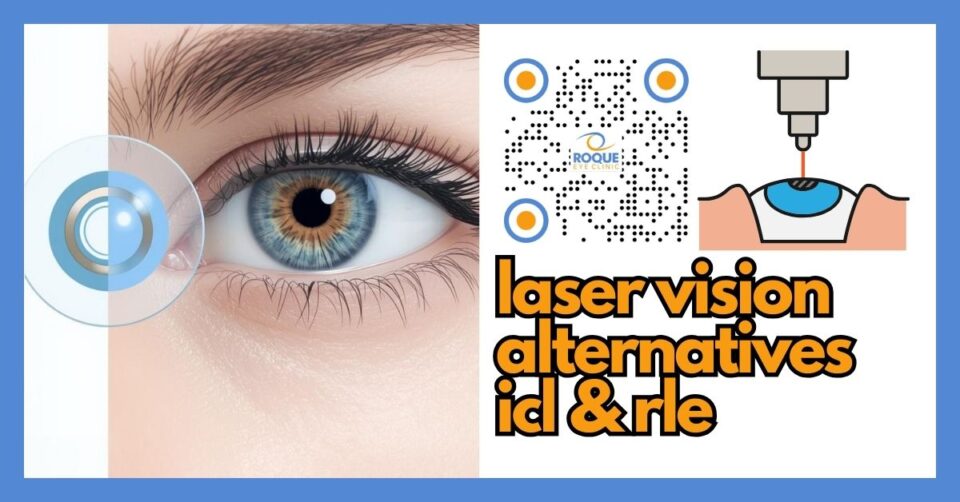
Laser Vision Correction Alternatives (ICL, RLE)
🧠 Quick Answer
If laser vision correction is not the best fit, common alternatives include ICL and refractive lens exchange or replacement (RLE). ICL places a lens inside the eye while keeping your natural lens. RLE replaces your natural lens with an artificial one. The best choice depends on your age, prescription, cornea, lens status, eye anatomy, and visual goals.
Not every patient who wants freedom from glasses or contact lenses is best served by LASIK, PRK, TransPRK, or SMILE. Some patients have prescriptions that are too high for laser treatment, corneas that are too thin or irregular, dry eye that makes laser recovery less attractive, or early lens changes that make a lens-based procedure more logical. In those cases, your surgeon may discuss laser vision correction alternatives, especially ICL and refractive lens exchange.
These procedures are not “backup plans” in a negative sense. For the right eye, they may be the safer or more effective first choice. The key is matching the procedure to the patient—not forcing every eye into a laser category.
🧩 Focus: Lens-based alternatives to laser vision correction
👁 Goal: Help patients understand when ICL or RLE may be considered instead of corneal laser surgery
🛡 Evidence-Based: Preferred Practice Patterns • Standards of Care • Systematic Reviews • Meta-Analyses
REFRACTIVE SURGERY Knowledge Hub
Start with the complete guide:
📘 Laser Vision Correction Alternatives Terminology Glossary
- ICL: Implantable Collamer Lens, a lens placed inside the eye without removing the natural lens.
- Phakic eye: An eye that still has its natural lens.
- RLE: Refractive lens exchange, also called lens replacement surgery or clear lens exchange.
- IOL: Intraocular lens, the artificial lens implanted during lens replacement surgery.
- Accommodation: The eye’s natural focusing ability for near tasks, which comes from the natural lens.
- Anterior chamber depth: A front-of-the-eye measurement that is important when evaluating ICL suitability.
Quick Navigation
Related Reading
Key Learning Points
- ICL and RLE are common alternatives when corneal laser surgery is not ideal.
- ICL keeps the natural lens in place, while RLE removes the natural lens and replaces it with an artificial one.
- ICL is often discussed in younger adults with moderate to high myopia and suitable anterior chamber anatomy.
- RLE is often discussed in older adults, presbyopic patients, or those with early lens dysfunction or cataract changes.
- The best choice depends on age, prescription, corneal measurements, lens status, retinal risk, work needs, and visual expectations.
Why Some Patients Need Alternatives to Laser Vision Correction
Laser vision correction works by reshaping the cornea. That can be excellent when the prescription is within treatable range and the cornea is healthy, thick enough, and structurally safe. But some patients do not fit that profile. A patient may have high myopia, high hyperopia, thin corneas, suspicious corneal topography, previous corneal problems, severe dry eye, or lens-related visual issues that make a corneal approach less attractive.
In simple language, laser surgery changes the front window of the eye. Lens-based alternatives work inside the eye instead. That shift in strategy can be helpful when the main limitation is not on the corneal side.
💡 Analogy
Think of your eye like a camera. Laser surgery adjusts the front glass. ICL adds a new lens inside the camera without removing the original lens. RLE removes the camera’s natural lens and replaces it with an artificial one. Each approach can work well, but the best one depends on what part of the system is limiting performance.
What ICL Is
ICL stands for Implantable Collamer Lens. It is a lens placed inside the eye while leaving the natural lens in place. Because the natural lens remains, the eye is still considered phakic. The lens is typically positioned behind the iris and in front of the natural lens.
This option is often considered for patients with moderate to high myopia, with or without astigmatism, especially when laser correction would require too much corneal tissue removal or when the corneal structure makes laser treatment less ideal. An important part of ICL screening is confirming that the front-of-the-eye anatomy is suitable. Measurements such as anterior chamber depth, angle status, endothelial cell count, and lens sizing parameters matter a great deal.
One important advantage of ICL is that it does not remove the natural lens. That means younger patients still keep their natural focusing mechanism for near vision, although this does not stop presbyopia from developing later with age. Another often-cited benefit is that the cornea is not permanently reshaped. However, ICL is still an intraocular surgery, so it must be approached with the same seriousness as any surgery performed inside the eye.
Potential advantages of ICL
- Useful for moderate to high myopia when laser treatment is less suitable
- Preserves the natural lens
- Does not remove corneal tissue
- May be attractive in patients with thin or borderline corneas
- Often associated with excellent optical quality in appropriately selected patients
Important considerations with ICL
- Requires intraocular surgery
- Needs careful sizing and anatomical measurements
- May require monitoring for vault, pressure issues, lens status, and endothelial health
- Can be associated with cataract formation, intraocular pressure elevation, or angle-related problems in some cases
- Not every patient has anatomy that is suitable for implantation
What RLE Is
RLE stands for refractive lens exchange. It is also called lens replacement surgery or clear lens exchange. In this procedure, the natural lens is removed and replaced with an artificial intraocular lens, even if the patient does not yet have a visually significant cataract.
In practical terms, RLE is very similar in surgical technique to modern cataract surgery. The difference is the reason for doing it. Cataract surgery treats a cloudy lens. RLE is usually done to reduce refractive error, decrease dependence on glasses, address presbyopia, or solve a lens-based optical problem before a cataract becomes advanced.
Because the natural lens is removed, RLE eliminates any future cataract in that eye. That is one reason it may be attractive in older patients, presbyopic adults, or patients with early dysfunctional lens changes. On the other hand, removing the natural lens in a younger patient also removes natural accommodation. That trade-off matters.
Potential advantages of RLE
- Can treat refractive error without depending on corneal reshaping
- Can address presbyopia with selected lens strategies
- Removes the natural lens, so cataract will not later develop in that eye
- Can be useful when early lens dysfunction is already part of the problem
- Offers a lens-based pathway when laser correction is not ideal
Important considerations with RLE
- It is intraocular surgery
- The natural lens is permanently removed
- Younger patients lose natural accommodation
- Visual trade-offs depend on IOL choice, including monofocal, toric, EDOF, or multifocal designs
- As with cataract-type surgery, complications such as infection, inflammation, retinal problems, or other intraocular risks must be discussed carefully
ICL vs RLE: The Big Practical Differences
1) Natural lens preservation
This is the most important difference. ICL keeps the natural lens. RLE removes it. In a younger adult who still has useful accommodation, that difference can strongly affect decision-making.
2) Age and presbyopia
ICL is commonly discussed in younger adults with good natural lens clarity. RLE is more often discussed in older patients, especially if presbyopia or early lens dysfunction is already present. Once a patient is already losing accommodation, the logic for lens replacement may become more appealing.
3) Corneal dependence
Both ICL and RLE are attractive partly because they do not require major corneal tissue removal. That can help patients whose corneas are too thin, too steep, suspicious, or otherwise less suitable for laser treatment.
4) Range of treatable refractive error
ICL is often considered when myopia is high enough that laser ablation may be less desirable. RLE can also address large refractive errors, but the choice must take into account age, retinal risk, and the consequences of removing the natural lens.
5) Long-term trade-offs
ICL preserves the natural lens but requires ongoing awareness of lens position, vault, cataract risk, and intraocular pressure issues. RLE removes future cataract risk but commits the patient to an artificial lens strategy and removes natural accommodation. Neither option is “perfect.” Each solves some problems while creating its own set of long-term considerations.
Who May Benefit More From Each Option?
Patients who may be discussed for ICL
- Younger adults with moderate to high myopia
- Patients with corneas that are too thin or less suitable for laser treatment
- Patients who want to keep their natural lens
- Patients with suitable anterior chamber depth, angle anatomy, and endothelial cell count
- Patients whose surgeon feels a corneal laser procedure would not be the safest optical plan
Patients who may be discussed for RLE
- Presbyopic adults who already need near-vision correction
- Patients with early lens dysfunction or early cataract change
- Patients seeking a lens-based solution rather than corneal treatment
- Patients for whom future cataract surgery is already likely to become relevant soon
- Selected hyperopic or presbyopic patients where lens-based planning makes more sense than corneal planning
🚨 Emergency Warning
If you have sudden flashes, new floaters, a curtain over your vision, severe eye pain, or sudden vision loss before or after any refractive evaluation or surgery, seek urgent ophthalmic assessment. These are not routine refractive symptoms.
Why Screening Matters Even More With Lens-Based Alternatives
ICL and RLE are both inside-the-eye procedures, so patient selection is critical. A good work-up should include full refraction, corneal measurements, ocular surface review, anterior chamber assessment, lens evaluation, intraocular pressure measurement, and a careful retinal examination. High myopes, in particular, often need detailed peripheral retinal evaluation because retinal risk matters when planning any refractive surgery.
Patients should also be screened for realistic expectations. Some patients want total freedom from glasses in every lighting condition and at every distance. That is not always realistic. Others may do very well with a strategy that prioritizes distance clarity and accepts the possibility of reading glasses or occasional task-specific eyewear.
Common Reasons a Surgeon Might Prefer ICL Over RLE
- The patient is relatively young
- The natural lens is still clear
- Preserving accommodation remains valuable
- The refractive error is high but the anatomy is suitable for ICL
- The surgeon wants to avoid removing the natural lens unnecessarily
Common Reasons a Surgeon Might Prefer RLE Over ICL
- The patient is already presbyopic
- There are early cataract or dysfunctional lens changes
- There is less value in preserving accommodation
- A premium IOL strategy may better address the patient’s goals
- Lens-based surgery is more logical than continuing to work around a problematic natural lens
Questions to Ask Your Surgeon
- Why are you recommending ICL or RLE instead of laser surgery for my eyes?
- Is the issue mainly my cornea, my prescription range, my age, or my natural lens?
- What trade-offs would I accept with each option?
- Would I still need glasses for reading, computer work, or night driving?
- What are the short-term and long-term risks in my specific case?
- How does my retinal status affect the recommendation?
Continue Reading
🏁 Take-Home Message
Laser surgery is not the only path to better unaided vision. For the right patient, ICL or RLE may be the more sensible option. ICL usually makes more sense when the goal is to correct vision while keeping the natural lens. RLE usually makes more sense when age, presbyopia, or lens dysfunction shifts the problem from the cornea to the lens. The safest choice comes from careful screening—not from choosing the most popular procedure.
FAQ
1) What is the main difference between ICL and RLE?
ICL places a lens inside the eye but keeps the natural lens. RLE removes the natural lens and replaces it with an artificial intraocular lens.
2) Is ICL better than LASIK for high myopia?
In some patients with moderate to high myopia, ICL may be a better option than laser treatment because it does not depend on removing corneal tissue. That decision depends on corneal safety, anatomy, age, and surgeon judgment.
3) Why would someone choose RLE instead of laser surgery?
RLE may be considered when presbyopia, early cataract changes, or lens dysfunction already play a major role, or when a lens-based solution is more logical than corneal reshaping.
4) Can younger patients have RLE?
Sometimes, but this requires careful counseling because removing the natural lens also removes natural accommodation. In many younger adults, preserving the natural lens remains a major advantage.
5) If I have thin corneas, does that automatically mean I need ICL?
No. Thin corneas may reduce laser suitability, but the final recommendation still depends on full screening, including refraction, topography or tomography, ocular surface status, age, and internal eye anatomy.
6) Are ICL and RLE permanent procedures?
Both are intended as long-term surgical solutions. ICL can be removed surgically if needed, but that does not guarantee the eye returns to its original state. RLE permanently removes the natural lens.
📚 References
- American Academy of Ophthalmology. Refractive Surgery Preferred Practice Pattern®.
- American Academy of Ophthalmology. Alternative Refractive Surgery Procedures.
- U.S. Food and Drug Administration. What are phakic lenses?
- U.S. Food and Drug Administration. EVO/EVO+ Visian Implantable Collamer Lens Professional Use Information.
- Barsam A, Allan BDS. Excimer laser versus phakic intraocular lenses for the correction of moderate to high myopia. Cochrane Database Syst Rev.
- Chen H, et al. Excimer laser refractive surgery versus phakic intraocular lenses for refractive errors. Meta-analysis.
- The Royal College of Ophthalmologists. Refractive Lens Exchange: Patient Information.
🤝 Roque Eye Clinic Patient Education Series
Dr. Manolette Roque | Dr. Barbara Roque
St. Luke's Medical Center Global City | Asian Hospital Medical Center
Philippines
Medical Review: Roque Advisory Council
Last Updated: March 2026
Medical Disclaimer
This article is intended for educational purposes only and does not replace professional medical consultation.