


Laser Vision Correction: PRK vs LASIK vs SMILE
🧠 Dr. Roque's Quick Answer
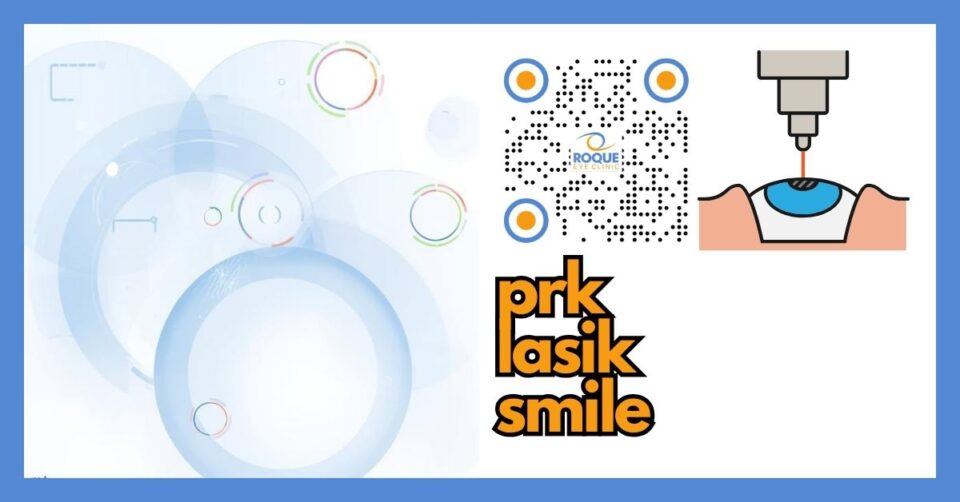
PRK, LASIK, and SMILE are all laser vision correction procedures, but they are not interchangeable. PRK treats the corneal surface and usually has slower recovery. LASIK creates a flap and often gives faster visual recovery. SMILE removes a small lenticule through a tiny incision and avoids a flap. The best choice depends on screening, corneal anatomy, lifestyle, and visual goals.
Patients often ask a simple question: Which is best—PRK, LASIK, or SMILE? The honest answer is that there is no single “best” procedure for everyone. Each option can work very well in properly selected eyes. The safest and most satisfying result usually comes from matching the procedure to the patient, not from choosing the most popular name.
Laser vision correction aims to reduce dependence on glasses or contact lenses by reshaping the cornea so light focuses more accurately on the retina. PRK, LASIK, and SMILE all try to achieve that same goal, but they do it in different ways. Those differences affect healing, comfort, biomechanics, flap-related issues, dry eye risk discussions, and recovery speed.
🧩 Focus: Comparing PRK, LASIK, and SMILE for laser vision correction
👁 Goal: Help patients understand how these procedures differ in method, candidacy, recovery, benefits, trade-offs, and safety
🛡 Evidence-Based: Preferred Practice Patterns • Standards of Care • Systematic Reviews • Meta-Analyses
ROQUE REFRACTIVE SURGERY Knowledge Hub
Start with the complete guide:
🔬 Laser Vision Correction Anatomy Micro-Primer
- Corneal epithelium: This is the thin surface skin of the cornea. PRK treats through the surface by removing or passing through this layer first.
- Corneal stroma: This is the main structural layer of the cornea. All three procedures change this tissue to adjust focusing power.
- LASIK flap plane: LASIK creates a hinged flap in the cornea before excimer laser treatment underneath.
- SMILE lenticule plane: SMILE uses a femtosecond laser to create a small piece of tissue inside the cornea, which is then removed through a tiny incision.
📘 Laser Vision Correction Terminology Glossary
- PRK: Photorefractive keratectomy, a surface laser treatment with no LASIK flap.
- LASIK: Laser-assisted in situ keratomileusis, a procedure that creates a corneal flap before laser reshaping.
- SMILE: Small incision lenticule extraction, a flap-free laser procedure that removes a lenticule through a small incision.
- Excimer laser: The laser used to reshape corneal tissue in PRK and LASIK.
- Femtosecond laser: The laser used to create a LASIK flap or create the lenticule and incision in SMILE.
- Refractive error: A focusing problem such as myopia, hyperopia, astigmatism, or presbyopia.
Quick Navigation
Related Reading
Dr. Roque's Key Learning Points
- PRK is a surface treatment with no flap, but early healing is usually slower and less comfortable.
- LASIK often provides the fastest visual recovery, but it involves a corneal flap and flap-related counseling.
- SMILE is a flap-free small-incision procedure for suitable cases, but it is not automatically better for every eye or every refractive error.
- The best procedure depends on screening, corneal shape, refractive error, occupation, sports exposure, dry eye status, and patient priorities.
- Patients should choose based on safety and fit, not just popularity, price, or marketing language.
What PRK, LASIK, and SMILE Are
PRK, LASIK, and SMILE are all corneal refractive procedures. They reduce or eliminate dependence on glasses or contact lenses by changing the shape of the cornea. That change helps incoming light focus more accurately on the retina.
Although the goal is similar, the method is not. PRK works from the surface. LASIK creates and lifts a flap before laser reshaping. SMILE creates a small lenticule inside the cornea and removes it through a small incision. Those technical differences are why the three procedures feel different during recovery and why the same patient may be an excellent candidate for one option but not another.
💡 Dr. Roque's Analogy
Imagine three ways to reshape a room. PRK is like working directly from the surface after removing the wallpaper. LASIK is like opening a hinged panel, doing the work underneath, then closing it. SMILE is like removing a small piece from inside through a narrow side opening. The destination may be similar, but the route is different.
How the Procedures Differ
PRK
PRK, or photorefractive keratectomy, is a surface ablation procedure. The epithelial layer is removed, then an excimer laser reshapes the cornea. A bandage contact lens is usually placed while the surface heals. PRK avoids a stromal flap, which is one of its major practical advantages.
LASIK
LASIK uses a femtosecond laser or microkeratome to create a flap, lifts that flap, then uses an excimer laser to reshape the cornea underneath. The flap is repositioned at the end. LASIK is widely known for quick visual recovery and relatively less early discomfort than PRK, but the flap is a permanent structural feature that matters in counseling and long-term trauma considerations.
SMILE
SMILE, or small incision lenticule extraction, uses a femtosecond laser to create a lenticule inside the cornea. That lenticule is then removed through a small incision. Because there is no large flap, SMILE is often discussed as a flap-free alternative for appropriate myopic and myopic astigmatism cases, depending on platform approval and patient anatomy.
Procedure Comparison at a Glance
| Feature | PRK | LASIK | SMILE |
|---|---|---|---|
| Flap | No | Yes | No |
| Surface healing | Yes | Less surface healing burden | Small-incision healing |
| Early recovery speed | Usually slowest | Usually fastest | Often between PRK and LASIK |
| Early discomfort | Usually highest | Usually lower | Usually lower than PRK |
| Flap-related issues | No | Possible | No large flap |
Recovery and Comfort
One of the biggest real-world differences among PRK, LASIK, and SMILE is recovery. Patients care deeply about how soon they can see clearly, return to work, drive, and feel comfortable. This is where the procedures separate themselves most clearly.
PRK recovery
PRK usually has the slowest early recovery. The first few days can involve pain, light sensitivity, tearing, foreign-body sensation, and blurred vision while the surface epithelium heals. Final visual quality can still be excellent, but it usually requires more patience.
LASIK recovery
LASIK often gives the fastest visual recovery of the three. Many patients notice functional improvement quickly, sometimes within a day or two, although healing still continues after that. Early discomfort is often milder than PRK.
SMILE recovery
SMILE often falls somewhere between PRK and LASIK in early recovery discussions. It avoids flap-related issues but does not always match LASIK’s fastest early clarity in every case. Patients still need realistic expectations because “less invasive-sounding” does not always mean “instant perfect vision.”
Who May Fit Each Option Best
The right procedure depends on your measurements and your priorities. Screening matters more than branding.
Patients who may lean toward PRK
- Patients in whom flap avoidance is preferred
- Patients whose corneal anatomy makes a surgeon more cautious about LASIK flap creation
- Patients involved in activities where eye trauma is a concern
- Patients willing to accept slower recovery for a flap-free approach
Patients who may lean toward LASIK
- Patients who want the fastest functional recovery
- Patients with suitable corneal thickness, shape, and overall screening profile
- Patients who understand and accept flap-related counseling
Patients who may lean toward SMILE
- Patients who want a flap-free procedure but faster recovery than PRK is often associated with
- Patients with suitable myopia or myopic astigmatism, depending on platform and approval details
- Patients whose surgeon believes SMILE fits the measured anatomy and visual goals well
Benefits and Limitations
PRK: strengths and trade-offs
Strength: No flap. Trade-off: More pain and slower early visual recovery.
LASIK: strengths and trade-offs
Strength: Fast recovery and broad track record. Trade-off: It creates a flap, so flap-related risks and trauma considerations remain part of long-term counseling.
SMILE: strengths and trade-offs
Strength: Small incision and no large flap. Trade-off: It is not ideal for every refractive pattern, every laser platform, or every customization need. It also has its own learning curve and enhancement discussions.
Dry Eye and Visual Quality Discussions
Patients commonly ask which procedure causes less dryness or fewer night-vision symptoms. The answer depends on pre-existing dry eye, meibomian gland function, ocular surface health, amount of correction, pupil characteristics, and surgical details. Broadly, LASIK has long been associated with dry eye counseling because flap creation affects corneal nerves. PRK and SMILE are also not dry-eye-proof procedures, but the pattern and recovery of symptoms may differ.
Visual quality matters too. A patient who drives at night, works in low-contrast settings, or expects “superhuman” vision needs careful counseling no matter which procedure is chosen. The goal is better functional vision, not perfection in every lighting condition for every eye.
🚨 Dr. Roque's Emergency Warning
Urgent review is needed after refractive surgery if there is rapidly worsening pain, marked redness, sudden major drop in vision, significant discharge, or new flashes and floaters. These are not routine healing symptoms and may need immediate ophthalmic assessment.
Risks and Complications
All refractive surgery has risks. A good consultation does not hide that. Instead, it puts those risks in context and uses screening to reduce avoidable harm.
- PRK: pain during early healing, delayed epithelial healing, corneal haze, regression, dry eye symptoms, visual fluctuation
- LASIK: flap-related complications, dry eye symptoms, glare/halos, residual refractive error, epithelial ingrowth in some cases, ectasia risk in vulnerable corneas
- SMILE: suction-related issues, interface concerns, residual refractive error, visual symptoms, dry eye symptoms, ectasia risk in vulnerable corneas, enhancement planning questions
No procedure is “risk-free.” The real goal is to choose the procedure with the best safety-fit profile for the specific eye in front of the surgeon.
How to Choose Wisely
The smartest question is not “Which procedure is newest?” or “Which one do more people talk about online?” The smarter question is: Which procedure best fits my cornea, my prescription, my work, my sports, my eye surface, and my expectations?
In practical terms, a good decision often comes from discussing:
- Your refractive error and whether it is stable
- Your corneal thickness and tomography pattern
- Your dry eye status and lid health
- Your job, hobbies, and trauma exposure
- Your tolerance for slower recovery versus flap creation
- Your expectations for nighttime quality of vision
- Your openness to enhancement if needed later
Patients do best when they choose with full information, not with fear, hype, or pressure.
Continue Reading
🏁 Dr. Roque's Take-Home Message
PRK, LASIK, and SMILE can all produce excellent outcomes in the right patient. PRK is flap-free but usually slower to recover. LASIK often recovers fastest but includes flap-related counseling. SMILE avoids a large flap and can be an excellent option for suitable eyes, but it is not automatically the best choice for everyone. The safest answer comes from complete screening and honest discussion of trade-offs.
FAQ
1) Which is safer: PRK, LASIK, or SMILE?
No procedure is universally safest for every patient. Safety depends on screening, corneal anatomy, refractive error, ocular surface health, and whether the chosen procedure truly fits the eye.
2) Which has the fastest recovery: PRK, LASIK, or SMILE?
LASIK usually has the fastest early recovery. PRK is usually the slowest. SMILE often falls between them, though individual experiences vary.
3) Which hurts more: PRK, LASIK, or SMILE?
PRK usually causes more discomfort in the first few days because the corneal surface needs to heal. LASIK and SMILE are often more comfortable early on, though they can still cause dryness, pressure sensations, and temporary blur.
4) Is SMILE better than LASIK?
Not automatically. SMILE has the advantage of avoiding a large flap, but LASIK often offers faster recovery and broader customization options in many practices. The better choice depends on the case.
5) Why would someone choose PRK instead of LASIK?
Patients may choose PRK when flap avoidance is preferred, when trauma exposure matters, or when the surgeon believes the corneal profile is better suited to a surface procedure.
6) Can all three procedures treat astigmatism?
Yes, but treatment range, platform capability, and suitability vary by procedure and machine. Your surgeon must confirm what fits your measured refractive pattern.
📚 References
- American Academy of Ophthalmology. Refractive Surgery Preferred Practice Pattern®. Updated 2024.
- U.S. Food and Drug Administration. LASIK.
- Cochrane. LASIK compared to PRK for correcting short-sightedness.
- Chang JY, et al. Comparison of clinical outcomes of LASIK, Trans-PRK, and SMILE. 2022.
- American Academy of Ophthalmology. Refractive Surgery educational resources on PRK, LASIK, and SMILE.
🤝 Roque Eye Clinic Patient Education Series
Dr. Manolette Roque | Dr. Barbara Roque
St. Luke's Medical Center Global City | Asian Hospital Medical Center
Philippines
Medical Review: Roque Advisory Council
Last Updated: March 2026
Medical Disclaimer
This article is intended for educational purposes only and does not replace professional medical consultation.