

Neuro-Ophthalmology: When Vision Problems May Be Coming From the Brain, Nerves, or Eye Muscles
Many people assume that every visual complaint starts in the eyeball itself. That is a mistake. Sometimes the surface of the eye, the lens, and even the retina may not fully explain what the patient is experiencing. The trouble may instead involve the optic nerve, the pathways that carry vision to the brain, or the nerves and muscles that control eye movement.
This page explains what neuro-ophthalmology is, what symptoms should raise concern, how doctors investigate these problems, and when you should seek urgent care. It is an overview page, not a substitute for a full examination.
This page is an overview. It helps patients recognize the pattern, but it does not replace more focused symptom pages or emergency guidance.
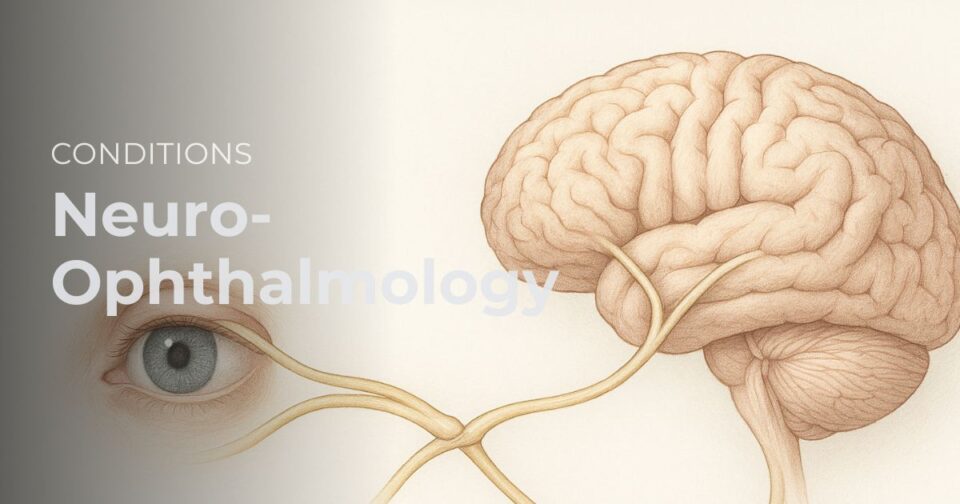
The optic nerve is the cable that carries visual signals from the eye to the brain.
The optic chiasm is the crossing point where some of those nerve fibers meet behind the eyes.
The brain’s visual pathways process what you see after the signal leaves the eye.
The eye movement nerves and muscles keep both eyes aligned so you see one clear image instead of two.
When any part of this system malfunctions, a patient may develop blurred vision, dim vision, side-vision loss, double vision, drooping eyelids, abnormal pupils, or difficulty moving the eyes normally.
Optic nerve: the nerve that carries vision from the eye to the brain.
Visual field: everything you can see straight ahead and off to the sides.
Diplopia: double vision.
Pupil: the dark center of the eye that changes size with light.
Ptosis: a droopy upper eyelid.
Optic neuritis: inflammation of the optic nerve.
Visual pathway: the “route” the image takes from the eye to the brain.
What is neuro-ophthalmology?
Neuro-ophthalmology sits at the crossroads of ophthalmology and neurology. It focuses on vision problems linked to the nervous system. That includes the optic nerve, the brain’s visual pathways, the nerves that move the eyes, and the muscles that keep the eyes aligned.
A patient may say, “My glasses are not helping,” “I suddenly see two of everything,” “I keep bumping into objects on one side,” or “My eyelid suddenly drooped.” These are not ordinary complaints to dismiss. Some causes are minor or temporary. Others can signal optic nerve inflammation, reduced blood flow to the optic nerve, pituitary tumors, stroke, aneurysm, myasthenia gravis, thyroid eye disease, or raised pressure around the brain.
Common symptoms that may point to a neuro-ophthalmic problem
- Sudden vision loss in one or both eyes
- Vision that looks dim, faded, or “washed out”
- Loss of side vision or missing areas in the visual field
- Double vision, especially if it goes away when one eye is covered
- Pain with eye movement
- A droopy eyelid
- Unequal pupils
- Abnormal eye movements or eyes that do not line up properly
- Brief episodes of blacking out or graying out of vision
- Blurred vision with headache, weakness, numbness, balance trouble, or speech difficulty
The pattern matters. For example, double vision that disappears when one eye is covered usually means the eyes are misaligned. Sudden painless dimming of vision in one eye raises a different level of concern. Peripheral vision loss may suggest a problem further back in the visual pathway, such as the optic chiasm.
Common conditions seen in neuro-ophthalmology
1) Optic neuritis
This is inflammation of the optic nerve. Patients often notice vision loss, pain with eye movement, reduced color vision, and washed-out contrast. It may occur by itself or in association with conditions such as multiple sclerosis, neuromyelitis optica spectrum disorder, or other inflammatory disorders.
2) Ischemic optic neuropathy
This happens when blood flow to the optic nerve is reduced. It can cause sudden vision loss, often in one eye. Some forms are linked to vascular risk factors such as hypertension, diabetes, sleep apnea, and age. One urgent subtype, arteritic ischemic optic neuropathy related to giant cell arteritis, can threaten both vision and overall health and needs immediate treatment.
3) Pituitary tumors and chiasmal compression
Because the optic nerves cross near the pituitary gland, a mass in that region can cause side-vision loss, blurred vision, headaches, hormone problems, and sometimes double vision or droopy eyelids.
4) Cranial nerve palsies
The third, fourth, and sixth cranial nerves help move the eyes. If one of them stops working properly, the eyes may no longer align, and the patient may develop sudden double vision, abnormal head posture, or eyelid drooping.
5) Myasthenia gravis
This is a condition that affects communication between nerves and muscles. Around the eyes, it may cause fluctuating droopy eyelids and variable double vision that worsens with fatigue.
6) Thyroid eye disease
Although many people think of thyroid eye disease as an eyelid or bulging-eye problem, it can also cause double vision and, in severe cases, compression of the optic nerve.
7) Raised pressure around the brain
Increased pressure inside the skull can lead to optic nerve swelling, headaches, pulsatile tinnitus, brief vision blackouts, and sometimes permanent damage if neglected.
How doctors investigate neuro-ophthalmic symptoms
A proper assessment usually starts with a careful history. The doctor will ask:
- Was the vision loss sudden or gradual?
- Is one eye affected or both?
- Is there pain, especially with eye movement?
- Is the double vision vertical, horizontal, or diagonal?
- Does covering one eye eliminate the double vision?
- Are headaches, weakness, numbness, speech difficulty, or imbalance also present?
- Are there systemic illnesses such as diabetes, hypertension, thyroid disease, autoimmune disease, or neurologic disease?
The examination may include visual acuity, color vision, pupils, eyelid position, eye movements, alignment, optic nerve appearance, and visual field testing. Depending on the suspected cause, additional tests may include OCT, automated visual fields, blood work, MRI or CT imaging, and sometimes referral to neurology, endocrinology, or emergency care.
Why neuro-ophthalmic problems are often missed
These disorders are easy to underestimate because some patients still read the chart fairly well early on. A patient may say only, “Colors look dull,” “My side vision feels strange,” or “I feel off-balance when I walk.” Others are told their eyes look fine even though the real problem lies deeper in the optic nerve or brain pathways. That is why the story, the pupils, the optic nerve, the visual fields, and the eye movements matter so much.
What treatment depends on
There is no single “neuro-ophthalmology treatment” because treatment depends entirely on the cause.
- Inflammation may require steroids or other immune-directed treatment.
- Compression from a tumor or mass may require imaging, neurosurgery, endocrine care, or close monitoring.
- Double vision may be managed with observation, prisms, patching, treatment of the underlying cause, or surgery in selected cases.
- Vascular optic nerve problems require risk-factor control and urgent assessment when giant cell arteritis is suspected.
- Myasthenia gravis needs systemic evaluation and directed medical therapy.
The first goal is not to chase a quick fix. The first goal is to identify the correct diagnosis and separate urgent from non-urgent causes.
- Not all vision problems start in the eyeball itself.
- Neuro-ophthalmology evaluates the optic nerve, visual pathways, pupils, eyelids, and eye movement system.
- Sudden vision loss, side-vision loss, or new double vision should never be shrugged off.
- Pain with eye movement can point toward optic nerve inflammation.
- A droopy eyelid with a new pupil change is especially concerning.
- Headache plus visual symptoms may need urgent work-up.
- The correct diagnosis often depends on history, pupil findings, visual fields, optic nerve examination, and imaging when indicated.
- Treatment depends on the cause, not just on the symptom.
When to see an eye doctor soon, and when to go urgently
Book a prompt eye consultation if you notice:
- Persistent or recurrent double vision
- Gradual visual field loss
- One eyelid that newly droops
- Colors that seem less vivid in one eye
- Vision that looks dim even after updating glasses
Seek urgent or emergency care if you have:
- Sudden vision loss
- New severe headache with visual symptoms
- Double vision with weakness, facial droop, slurred speech, or imbalance
- A painful red eye with major vision loss
- Transient blacking out of vision, especially if recurrent
- Scalp tenderness, jaw pain, fever, or body aches together with sudden vision symptoms in an older adult
Frequently Asked Questions
1) Is neuro-ophthalmology the same as neurology?
No. Neuro-ophthalmology is a subspecialty that focuses on vision and eye movement problems related to the nervous system.
2) Can I have a neuro-ophthalmic problem even if my eye looks normal?
Yes. That is one reason these problems can be missed early. The issue may be in the optic nerve, visual pathway, or eye movement nerves rather than in the front of the eye.
3) Is all double vision a neuro-ophthalmology problem?
No. Double vision can also come from cataract, corneal irregularity, dry eye, or refractive issues. But double vision from eye misalignment or nerve problems deserves careful assessment.
4) Why do doctors ask whether the double vision disappears when one eye is covered?
Because that helps separate double vision caused by eye misalignment from image distortion coming from one eye alone.
5) What does it mean if colors look washed out in one eye?
That can happen with optic nerve disease, including optic neuritis. It is an important clue and should not be ignored.
6) Can a brain problem show up first as an eye complaint?
Yes. Visual field loss, abnormal pupils, eye movement problems, and unexplained vision loss may be the first sign of a neurologic condition.
7) Do all patients need an MRI?
No. Imaging depends on the history and examination. Some patients need it urgently. Others do not.
8) Can neuro-ophthalmic problems be treated?
Many can be treated or stabilized, but success depends on the exact diagnosis and how quickly the problem is recognized.
9) When should I worry about a droopy eyelid?
A new droopy eyelid deserves evaluation, especially if it comes with double vision, pupil change, headache, or eye pain.
10) Should I wait and see if sudden vision loss improves on its own?
No. Sudden vision loss is an urgent symptom. It needs prompt evaluation.
- North American Neuro-Ophthalmology Society (NANOS). Patient Information: What is a Neuro-Ophthalmologist?
- Cleveland Clinic. Neuro-Ophthalmology service overview.
- Johns Hopkins Medicine. Neuro-visual disorders overview.
- NANOS. Optic Neuritis patient brochure and educational materials.
- NANOS. Pituitary Tumor patient brochure and infographic.
- NANOS. Non-Arteritic Anterior Ischemic Optic Neuropathy patient brochure.
- National Institute of Neurological Disorders and Stroke (NINDS). Neuromyelitis Optica Spectrum Disorder.
ROQUE Eye Clinic Patient Education Series
Reviewed by the Roque Advisory Council
Dr. Manolette Roque | Dr. Barbara Roque
St. Luke’s Medical Center Global City | Asian Hospital Medical Center
Philippines
Medical Disclaimer: This page is for patient education only. It does not diagnose, treat, or replace a proper medical consultation. If you have sudden vision loss, new double vision, severe headache with visual symptoms, or any other urgent warning sign, seek prompt medical care.