
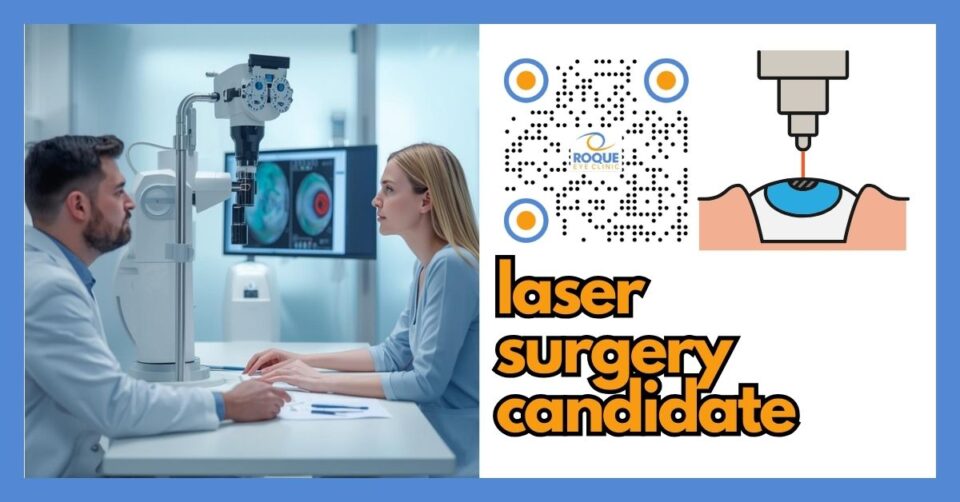
Who Is a Candidate for Laser Surgery
🧠 Dr. Roque's Quick Answer
A good candidate for laser eye surgery usually has a stable glasses or contact lens prescription, healthy corneas, no active eye disease, and realistic expectations. Candidacy also depends on your age, tear film, corneal thickness and shape, pupil behavior, retinal health, work needs, and whether LASIK, PRK, TransPRK, or SMILE is the safest match for your eyes.
Many patients ask a simple question: “Am I qualified for laser eye surgery?” The honest answer is that candidacy is never decided by prescription alone. A patient may have the “right grade” but still be a poor candidate because of dry eye, thin or irregular corneas, unstable refraction, retinal problems, or unrealistic expectations. On the other hand, a patient who is not suitable for one laser procedure may still qualify for another.
Laser surgery candidacy is really a matching process. The goal is not just to find a patient who can have surgery, but to find the safest and most appropriate procedure for that individual eye. Good screening protects patients from preventable disappointment and preventable harm.
🧩 Focus: Candidacy for corneal laser vision correction
👁 Goal: Explain who may qualify for LASIK, PRK, TransPRK, SMILE, and related laser procedures, and why some patients should wait or choose another option
🛡 Evidence-Based: Preferred Practice Patterns • Standards of Care • Systematic Reviews • Meta-Analyses
ROQUE REFRACTIVE SURGERY Knowledge Hub
Start with the complete guide:
🔬 Laser Surgery Candidacy Anatomy Micro-Primer
- Cornea: This is the clear front window of the eye. Laser surgery reshapes it, so its thickness, curvature, and stability are critical.
- Epithelium: This thin outer skin of the cornea matters especially in PRK and other surface procedures because it must heal after treatment.
- Tear film: A healthy tear layer helps measurements stay accurate and supports comfort and healing after surgery.
- Retina: The light-sensitive tissue at the back of the eye must also be healthy because laser surgery corrects focus, but does not fix retinal disease.
📘 Laser Surgery Candidacy Terminology Glossary
- Stable refraction: A prescription that has not significantly changed over time.
- Topography/tomography: Imaging tests that map the cornea’s front and deeper structure.
- Pachymetry: Measurement of corneal thickness.
- Ocular surface disease: Problems affecting the tear film, eyelids, or front surface of the eye, such as dry eye or blepharitis.
- Keratoconus: A corneal weakening disorder that can make laser corneal surgery unsafe.
- Realistic expectations: Understanding what surgery can improve, what it cannot fix, and what trade-offs may remain.
Quick Navigation
Related Reading
Dr. Roque's Key Learning Points
- A good laser surgery candidate usually has a stable prescription, healthy corneas, and no active eye disease.
- Screening must evaluate the tear film, corneal shape, corneal thickness, retina, and overall eye health.
- Being qualified for laser surgery does not automatically mean you are qualified for every laser procedure.
- Dry eye, keratoconus risk, unstable refraction, pregnancy, some systemic illnesses, and unrealistic expectations can affect candidacy.
- The safest recommendation may be to proceed, optimize first, postpone, choose another procedure, or avoid laser surgery entirely.
What Makes Someone a Good Candidate for Laser Surgery?
A good candidate is someone whose eyes can likely undergo laser reshaping safely and whose expected benefit is worth the trade-offs. In practice, this usually means the prescription has been stable, the cornea is structurally sound, the surface of the eye is healthy enough for good measurements and healing, and there is no untreated eye disease likely to reduce the quality of the outcome. Strong candidates also understand that surgery reduces dependence on glasses or contact lenses, but does not create a perfect, ageless eye.
A simple real-world example helps. Two patients may both have -4.00 diopters of myopia. One has healthy corneas, a stable refraction, good tear film, and realistic expectations. The other has fluctuating diabetes, significant dry eye, and suspicious corneal tomography. Their glasses grade is similar, but their candidacy is very different.
💡 Dr. Roque's Analogy
Choosing laser eye surgery is like repainting a wall. The paint color matters, but the wall itself matters even more. If the surface is weak, damp, or cracked, the nicest paint will not solve the real problem. In refractive surgery, the “wall” is the cornea and ocular surface.
Main Criteria for Laser Surgery Candidacy
1) Stable prescription
One of the most basic candidacy rules is refractive stability. If a patient’s glasses or contact lens prescription has been changing recently, surgery may be postponed because the target is still moving. The FDA specifically warns that recent prescription changes, younger age, pregnancy, breastfeeding, hormonal fluctuation, diabetes-related variation, and certain medications may be linked to refractive instability.
2) Adequate age and maturity of refraction
Most laser procedures are considered only after the refraction has matured and shown stability. Being legally old enough is not the same as being refractively stable enough. A patient in the early 20s may still be changing, especially if there is progressing myopia.
3) Healthy corneal shape and structure
Laser surgery reshapes the cornea, so the cornea must be structurally reliable. Screening commonly includes topography or tomography and pachymetry to look for keratoconus, forme fruste keratoconus, suspicious asymmetry, abnormal posterior elevation, or inadequate thickness. These findings can make laser corneal surgery unsafe or push the recommendation toward a different procedure.
4) Healthy ocular surface and tear film
Dry eye is one of the most common reasons to pause and optimize before surgery. A poor tear film can distort measurements before surgery and worsen symptoms after surgery. Surface disease, meibomian gland dysfunction, blepharitis, and exposure problems should be addressed before deciding on candidacy.
5) No active eye disease that would limit outcome
Laser surgery can improve optical focus, but it does not treat cataract, glaucoma damage, diabetic retinopathy, macular disease, retinal tears, active inflammation, or corneal infection. A patient may technically undergo a laser procedure and still be unhappy because the true vision-limiting issue was never refractive to begin with.
6) Realistic expectations
Good candidates understand the likely benefits and the possible compromises. For example, they understand that some patients may still need glasses for certain tasks, that dry eye or nighttime visual symptoms can occur, and that presbyopia still affects aging eyes even after successful refractive correction. The AAO PPP emphasizes that outcomes should be judged by how well the result meets the patient’s functional needs with minimum risk and side effects.
Common Features of Good Candidates
- Adult with relatively stable refraction
- Healthy corneal thickness and tomography pattern
- No untreated significant dry eye or lid disease
- No active infection or inflammation
- No major untreated retinal or optic nerve problem
- Expectations aligned with real-world outcomes
- Willingness to follow preoperative and postoperative instructions
Who May Not Qualify for Laser Surgery?
Some patients are poor candidates right away. Others may become candidates later after treatment or after waiting for stability. Examples of situations that may affect candidacy include:
- Prescription changes in the last year
- Pregnancy or breastfeeding with fluctuating refraction
- Uncontrolled diabetes or other systemic conditions affecting healing or refraction
- Thin, irregular, or ectasia-prone corneas
- Keratoconus or suspicious corneal imaging
- Significant dry eye or untreated eyelid disease
- Active herpes eye disease, inflammation, or infection
- Glaucoma or retina disease requiring individualized assessment
- Cataract or dysfunctional lens changes that make lens-based surgery more appropriate
The FDA also advises caution if vision is changing due to medications or hormones, and notes that some patients are more likely to have refractive instability.
🚨 Dr. Roque's Emergency Warning
If screening reveals sudden flashes, new floaters, a curtain over vision, marked redness with pain, or a sudden drop in vision, urgent eye evaluation comes first. Refractive surgery planning should wait until the urgent problem has been assessed and treated.
Why One Patient May Qualify for One Laser Procedure but Not Another
Laser surgery is not a single treatment. LASIK, PRK, TransPRK, and SMILE each have different strengths and limitations. A patient who is a poor LASIK candidate because the surgeon wants to avoid a flap may still be a reasonable PRK or TransPRK candidate. A patient with ocular surface concerns or certain visual priorities may be steered toward one platform over another. Procedure selection is individualized and should come after complete screening, not before.
Recent review literature also suggests that dry-eye effects and contrast sensitivity changes may differ among procedures, which is one reason candidacy is not simply “yes or no” for all laser options.
What the Screening Visit Is Really Trying to Decide
- Is laser surgery safe for this eye?
- If yes, which laser procedure is the best fit?
- If not, should the patient be optimized, postponed, or redirected to another option such as ICL or lens-based surgery?
This is why candidacy discussions should include the cornea, tear film, retina, age, job, sports, night-driving needs, healing profile, and future presbyopia concerns—not just the patient’s current glasses grade.
Good Candidates Also Accept the Trade-Offs
A patient may be medically suitable but emotionally unprepared for normal postoperative symptoms, temporary blur, dry eye treatment, or the possibility of still using glasses for certain tasks later on. That person may not be an ideal candidate until expectations are better aligned. The best candidates are not just anatomically suitable; they are also well informed and prepared.
Questions to Ask Before Deciding
- Is my prescription stable enough for surgery right now?
- Are my corneas thick and regular enough for laser treatment?
- Do I have dry eye or eyelid disease that should be treated first?
- Which procedure fits me best: LASIK, PRK, TransPRK, or SMILE?
- Do my job, sports, or night-driving needs change your recommendation?
- Would another option, such as ICL, be safer or more suitable for me?
Continue Reading
🏁 Dr. Roque's Take-Home Message
A good candidate for laser surgery is not defined by prescription alone. The safest candidates have stable refraction, healthy corneas, good ocular surface health, and realistic expectations. A complete screening visit should answer not only whether you qualify, but also which procedure fits you best—or whether another option is safer.
FAQ
1) What is the ideal age for laser eye surgery?
There is no single ideal age for everyone. What matters more is whether your prescription has stabilized and whether the rest of the eye is healthy enough for the chosen procedure.
2) Can I qualify for laser surgery if I have dry eyes?
Sometimes yes, but many patients need dry eye treatment first. Ocular surface optimization can improve both measurement accuracy and comfort after surgery.
3) Can I qualify for PRK if I am not a good LASIK candidate?
Yes. Some patients are better suited to a flap-free surface procedure than LASIK. The answer depends on your corneal anatomy, surface health, and lifestyle.
4) Does a high glasses grade automatically mean I am not a candidate?
No. High refractive error does not automatically rule out surgery, but it may change which procedure is safest or most effective. Some high prescriptions are better served by ICL or another lens-based option.
5) Why do I need corneal imaging before surgery?
Corneal imaging helps detect hidden irregularity, keratoconus risk, or structural weakness that could make laser corneal surgery unsafe.
6) Can pregnancy affect laser surgery candidacy?
Yes. Pregnancy and breastfeeding can be associated with hormonal changes and refractive instability, so surgery is often postponed until vision stabilizes.
📚 References
- American Academy of Ophthalmology. Refractive Surgery Preferred Practice Pattern®. Updated 2024.
- Jacobs DS, et al. Refractive Surgery Preferred Practice Pattern®. Ophthalmology. 2023;130(3):P61-P135.
- U.S. Food and Drug Administration. When is LASIK not for me?
- National Institute for Health and Care Excellence. Photorefractive (laser) surgery for the correction of refractive errors. 2025 update.
- Gurnani B, et al. Recent Advances in Refractive Surgery: An Overview. 2024.
🤝 Roque Eye Clinic Patient Education Series
Dr. Manolette Roque | Dr. Barbara Roque
St. Luke's Medical Center Global City | Asian Hospital Medical Center
Philippines
Medical Review: Roque Advisory Council
Last Updated: March 2026
Medical Disclaimer
This article is intended for educational purposes only and does not replace professional medical consultation.