

SMILE Surgery Guide
🧠 Dr. Roque's Quick Answer
SMILE surgery is a flap-free laser vision correction procedure that treats suitable cases of myopia and myopic astigmatism by creating a tiny lenticule inside the cornea and removing it through a small incision. Many patients like it because it avoids a LASIK flap, but it still needs careful screening, realistic expectations, and proper follow-up.
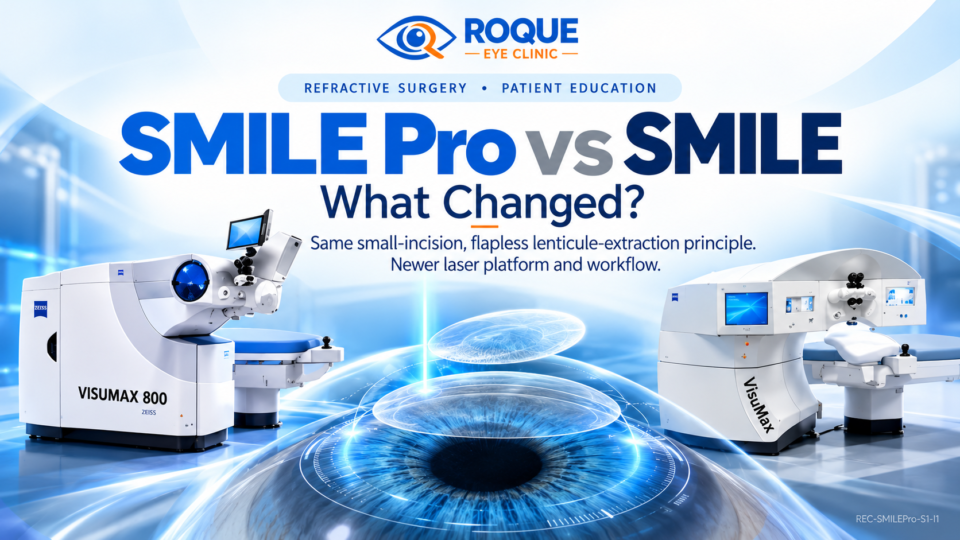
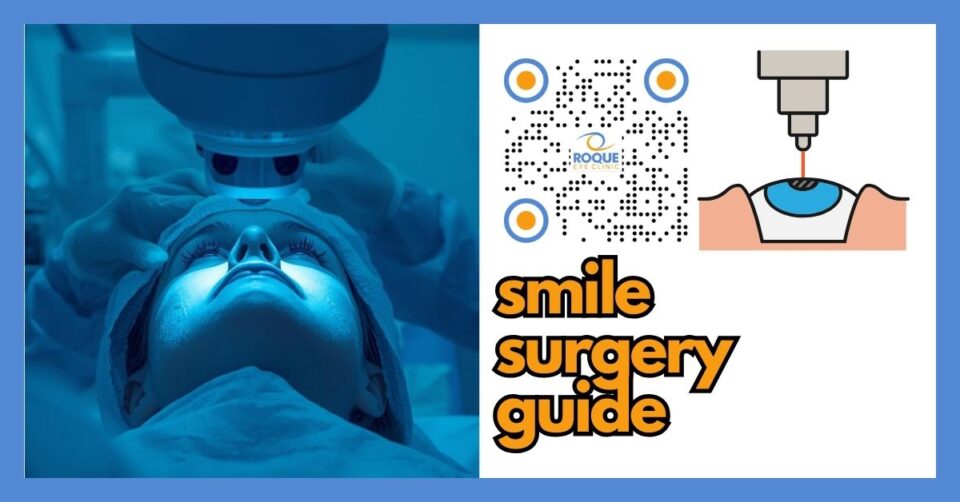
SMILE stands for small incision lenticule extraction. It is one of the major modern laser vision correction procedures and is often discussed alongside LASIK and PRK. Instead of creating a corneal flap like LASIK, SMILE uses a femtosecond laser to create a small lens-shaped piece of tissue inside the cornea. The surgeon then removes that lenticule through a small incision. This changes the cornea’s shape and helps light focus more accurately on the retina.
For many patients, the appeal of SMILE is easy to understand. It is a laser refractive procedure, it is flap-free, and it can reduce or eliminate dependence on glasses or contact lenses in suitable candidates. Still, not every patient is a good SMILE candidate. A full screening visit remains essential because safety, corneal shape, tear film health, retinal status, lifestyle, and visual goals all matter.
🧩 Focus: SMILE surgery for myopia and myopic astigmatism
👁 Goal: Explain how SMILE works, who may qualify, benefits, limitations, recovery, risks, and how it compares with other refractive surgery options
🛡 Evidence-Based: Preferred Practice Patterns • Standards of Care • Systematic Reviews • Meta-Analyses
ROQUE REFRACTIVE SURGERY Knowledge Hub
Start with the complete guide:
🔬 SMILE Surgery Anatomy Micro-Primer
- Corneal epithelium: This is the outer skin of the cornea. In SMILE, the surgeon does not remove this entire surface like PRK, but a small incision still passes through it.
- Corneal stroma: This is the main structural layer of the cornea. SMILE creates and removes a lenticule from this layer to change the eye’s focusing power.
- Lenticule: This is the small disc-shaped piece of corneal tissue created by the laser and removed during SMILE.
- Retina: This is the light-sensitive layer at the back of the eye. The goal of refractive surgery is to help light focus properly on the retina for clearer vision.
📘 SMILE Surgery Terminology Glossary
- SMILE: Small incision lenticule extraction, a flap-free laser refractive procedure.
- Myopia: Nearsightedness, where distant objects look blurry.
- Myopic astigmatism: A refractive error where the eye is nearsighted and also has uneven corneal curvature.
- Femtosecond laser: The laser used in SMILE to create the lenticule and small incision.
- Residual refractive error: Remaining nearsightedness, farsightedness, or astigmatism after surgery.
- Suction loss: Loss of docking or vacuum contact during the laser portion of surgery.
Quick Navigation
Related Reading
Dr. Roque's Key Learning Points
- SMILE is a flap-free laser vision correction procedure.
- It is mainly used for myopia and myopic astigmatism in suitable patients.
- SMILE may offer less flap-related concern than LASIK, but it is still real eye surgery with real risks.
- Screening remains critical because corneal shape, ocular surface health, retinal health, and expectations all matter.
- Good outcomes depend on the right patient, the right measurements, the right surgeon, and careful follow-up.
What SMILE Surgery Is
SMILE surgery is a femtosecond laser refractive procedure that changes the shape of the cornea by creating a small lenticule within the corneal stroma and removing it through a small incision. Unlike LASIK, SMILE does not create a broad corneal flap. Unlike PRK, it does not involve removing the full corneal surface epithelium over the treatment zone. Because of this, many patients think of SMILE as sitting somewhere between LASIK and PRK in terms of approach, although it is its own distinct procedure.
The main goal is simple: reduce the amount of refractive error so that distant vision becomes clearer with less dependence on eyeglasses or contact lenses. In current mainstream practice, SMILE is primarily used for myopia and myopic astigmatism rather than for hyperopia or presbyopia.
💡 Dr. Roque's Analogy
Imagine the cornea as a clear dome with layers. In LASIK, a flap is opened like a lid before treatment underneath. In SMILE, the laser creates a tiny lens-shaped piece inside the dome, and the surgeon removes it through a small side opening. The dome changes shape without making a large flap.
How SMILE Works
The procedure is usually done under topical anesthetic eye drops. During surgery, the femtosecond laser creates the refractive lenticule and the small incision. The surgeon then separates and removes the lenticule manually through that incision. Once the lenticule is removed, the cornea adopts a new contour that changes how light focuses inside the eye.
Although SMILE sounds simple when explained this way, it remains a highly precise refractive procedure. Good centration, accurate docking, stable fixation, careful lenticule dissection, and proper case selection all matter. It is not “minor” just because the incision is small.
What SMILE Tries to Treat
- Myopia (nearsightedness)
- Myopic astigmatism in suitable eyes
Patients should understand that refractive surgery treats refractive error. It does not prevent future age-related changes such as presbyopia or cataract. A successful SMILE patient may still need reading glasses later in life.
Who May Be a Candidate for SMILE
Good candidacy depends on a full refractive surgery screening work-up. In general, a surgeon looks for adult patients with stable refraction, healthy corneal structure, no active infection or inflammation, and realistic expectations. Corneal imaging, pachymetry, tear film evaluation, retinal examination, refraction, and general eye health review all remain essential.
SMILE may be attractive for patients who want a flap-free laser option and whose refractive error and eye measurements are suitable. Some patients also like the idea that the surface treatment zone is not handled the same way as in PRK, and that a large LASIK flap is not created.
Who May Not Be an Ideal Candidate
- Patients with unstable refraction
- Suspicious corneal tomography or ectasia risk
- Untreated dry eye or significant ocular surface disease
- Retinal pathology that needs management first
- Unrealistic expectations about “perfect” vision
- Patients whose refractive pattern is better suited to another procedure
Being a poor candidate for SMILE does not automatically mean a patient is a poor candidate for all refractive surgery. Some patients are better suited to LASIK, PRK, ICL, or lens-based surgery. Others should avoid surgery altogether.
Potential Benefits of SMILE Surgery
1) Flap-free treatment
The best-known benefit of SMILE is that it does not create a LASIK flap. For many patients and surgeons, this is a meaningful difference.
2) Strong visual outcomes in suitable patients
Modern studies and reviews generally show that SMILE can provide visual, refractive, and safety outcomes comparable to LASIK in appropriate candidates.
3) A valuable option in the refractive toolbox
SMILE gives surgeons and patients another laser refractive option. That matters because not every eye is best served by the same procedure.
4) Possible dry-eye and biomechanical advantages in some discussions
Some studies and surgeons discuss potential benefits related to corneal nerves, ocular surface symptoms, or biomechanics. These points are still best explained carefully, because individual results vary and SMILE does not eliminate dry eye or other postoperative complaints.
Trade-Offs and Limitations
SMILE is not risk-free
A smaller incision does not mean zero risk. Patients can still experience residual refractive error, visual fluctuations, glare, halos, dry eye symptoms, interface issues, epithelial problems, infection, and rare but serious complications.
Enhancement planning can be different
If a significant residual refractive error remains, enhancement planning after SMILE may differ from LASIK. This is an important counseling point before surgery.
Technique and platform matter
SMILE is highly dependent on surgeon experience, centration, docking stability, and laser settings. The procedure has its own learning curve and its own intraoperative challenges.
Recovery and Aftercare
Many patients notice functional vision fairly quickly, but recovery is not identical in every case. Some see well early, while others experience temporary blur, fluctuating clarity, or mild discomfort before vision stabilizes. Healing patterns vary with ocular surface status, refractive magnitude, and individual response.
Postoperative care commonly includes prescription eye drops, lubrication, activity guidance, and follow-up visits. Patients should avoid rubbing the eyes and should follow the clinic’s instructions closely. Even when vision seems good on day one, follow-up remains important because healing and visual quality continue to evolve.
What Many Patients Feel After SMILE
- Mild irritation, tearing, or foreign-body sensation
- Temporary blur or fluctuating clarity
- Light sensitivity
- Night-vision symptoms such as glare or halos during early healing
- Dryness or awareness of the treated eye surface
🚨 Dr. Roque's Emergency Warning
Seek urgent ophthalmic review if you develop severe worsening pain, marked redness, pus-like discharge, a sudden major drop in vision, trauma to the eye, or symptoms such as flashes, many new floaters, or a curtain over vision. These are not routine postoperative symptoms and may need urgent treatment.
Risks and Complications of SMILE
Like all refractive surgery, SMILE requires informed consent. Commonly discussed risks and complications include:
- Undercorrection, overcorrection, or residual astigmatism
- Dry eye symptoms or fluctuating vision
- Glare, halos, starbursts, or reduced contrast quality
- Suction loss during the procedure
- Difficulty with lenticule dissection or extraction
- Epithelial abrasion or surface problems
- Interface inflammation or infection
- Rare corneal ectasia in susceptible eyes
The safest way to reduce risk is not to focus only on the procedure itself. It is to start with good screening, honest counseling, and the right match between the patient and the operation.
SMILE vs LASIK vs PRK
Patients often ask which is “best.” In truth, the answer depends on the eye. LASIK usually offers very fast visual recovery but involves a flap. PRK is flap-free but has slower and often more uncomfortable early healing. SMILE is also flap-free, but it works through a small incision and does not remove the broad corneal surface the way PRK does. Each procedure has strengths, limitations, and ideal use cases.
That is why refractive surgery should not be treated like buying a gadget online. A proper recommendation must come from measurements, anatomy, healing risk, occupation, activities, and expectations.
Questions Worth Asking Before SMILE
- Why are you recommending SMILE instead of LASIK, PRK, or ICL for me?
- Is my cornea structurally suitable for SMILE?
- What is my risk of dry eye, glare, halos, or residual astigmatism?
- How long before I can work, drive, exercise, or travel?
- What happens if my result is undercorrected or overcorrected?
- What kind of enhancement strategy do you use after SMILE if needed?
Continue Reading
🏁 Dr. Roque's Take-Home Message
SMILE surgery is a modern flap-free laser vision correction option for suitable patients with myopia and myopic astigmatism. It can provide excellent results, but it is still real surgery and not a one-size-fits-all shortcut to perfect vision. The best outcome starts with careful screening, realistic expectations, and choosing the procedure that fits your eye—not just the one with the best marketing.
FAQ
1) What does SMILE stand for in eye surgery?
SMILE stands for small incision lenticule extraction. It is a flap-free laser refractive procedure used mainly for myopia and myopic astigmatism in suitable patients.
2) Is SMILE better than LASIK?
Not automatically. SMILE and LASIK can both provide excellent outcomes in the right patient. The better procedure depends on your cornea, refractive error, dry eye status, lifestyle, and surgeon’s assessment.
3) Does SMILE surgery hurt?
Most patients feel pressure or awareness rather than sharp pain during the procedure because anesthetic eye drops are used. Mild irritation, tearing, or foreign-body sensation may occur afterward.
4) How long does SMILE recovery take?
Many patients notice useful vision early, but sharpness and visual quality may continue to improve over time. Exact recovery differs from person to person.
5) Can SMILE treat farsightedness?
In routine mainstream practice, SMILE is mainly used for myopia and myopic astigmatism. Other procedures may be more appropriate for farsightedness, presbyopia, or lens-related refractive problems.
6) Can I still need glasses after SMILE?
Yes. Some patients may still need glasses for certain tasks, may have a small residual refractive error, or may later need reading glasses because of age-related presbyopia.
📚 References
- American Academy of Ophthalmology. Refractive Surgery Preferred Practice Pattern®. Updated 2024.
- American Academy of Ophthalmology. What Is Small Incision Lenticule Extraction?
- U.S. Food and Drug Administration. Patient Information Booklet for Small Incision Lenticule Extraction (SMILE).
- Moshirfar M, et al. Small Incision Lenticule Extraction. StatPearls. Updated 2024/2025.
- Bamahfouz AY. Femtosecond-laser-assisted Small Incision Lenticule Extraction to Treat Refractive Error: A Narrative Review. Middle East Afr J Ophthalmol. 2024.
- Teo ZL, et al. Femtosecond laser-assisted in situ keratomileusis versus small incision lenticule extraction for refractive error correction. Curr Opin Ophthalmol. 2024.
🤝 Roque Eye Clinic Patient Education Series
Dr. Manolette Roque | Dr. Barbara Roque
St. Luke's Medical Center Global City | Asian Hospital Medical Center
Philippines
Medical Review: Roque Advisory Council
Last Updated: March 2026
Medical Disclaimer
This article is intended for educational purposes only and does not replace professional medical consultation.