
Retina and Eye Health Examination Before Refractive Surgery
🧠 Dr. Roque's Quick Answer
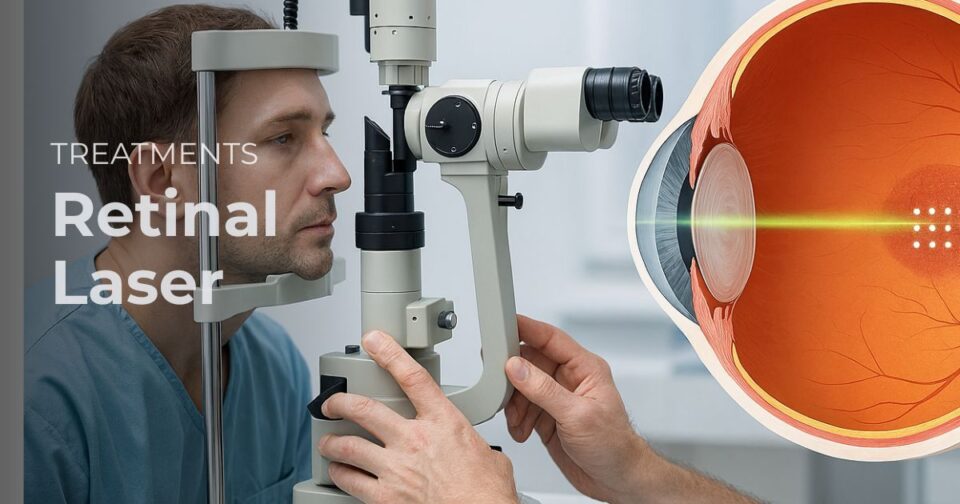
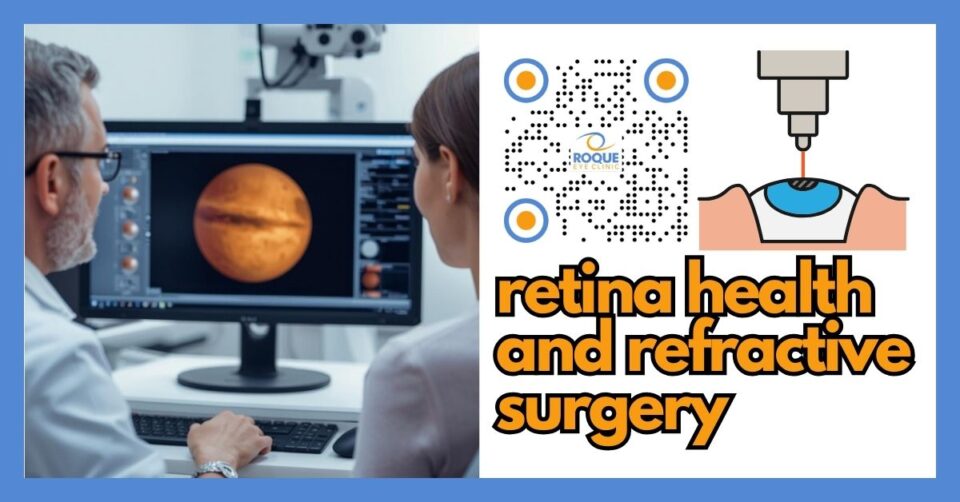
A retina and eye health examination before refractive surgery checks the back of the eye, optic nerve, macula, and peripheral retina for hidden problems such as retinal tears, holes, lattice degeneration, glaucoma concerns, or early cataract. This matters because laser or lens-based vision correction should only proceed when the whole eye—not just the cornea and prescription—has been carefully assessed.
Many patients focus on corneal scans, thickness measurements, and refraction when preparing for refractive surgery. Those are essential, but they are not the whole story. A beautiful corneal topography map does not guarantee that the rest of the eye is healthy. Before LASIK, PRK, SMILE, ICL, or lens-based refractive surgery, the retina and overall eye health still need a careful evaluation.
This is especially important in myopic patients. Eyes with myopia are more likely to have peripheral retinal changes, lattice degeneration, retinal holes, tears, and other vitreoretinal issues. If these are missed, a patient may blame the surgery for a retinal event that was already brewing in the background. A proper preoperative retina and eye health examination helps reduce that risk and improves decision-making.
🧩 Focus: Retina and whole-eye assessment before refractive surgery
👁 Goal: Detect retinal, optic nerve, lens, and other ocular problems that may affect safety, timing, candidacy, or procedure choice
🛡 Evidence-Based: Preferred Practice Patterns • Standards of Care • Systematic Reviews • Meta-Analyses
ROQUE REFRACTIVE SURGERY Knowledge Hub
Start with the complete guide:
🔬 Retina and Eye Health Anatomy Micro-Primer
- Retina: The light-sensitive lining at the back of the eye. It works like the camera sensor that receives the image.
- Macula: The central part of the retina responsible for sharp, detailed vision used for reading and recognizing faces.
- Peripheral retina: The outer retina, where lattice degeneration, holes, and tears are often found in myopic eyes.
- Optic nerve: The nerve that carries visual information from the eye to the brain. It is also assessed for glaucoma-related damage.
📘 Retina and Eye Health Terminology Glossary
- Lattice degeneration: Thinned, stretched peripheral retina that can sometimes be associated with retinal holes or tears.
- Retinal tear: A break in the retina that may lead to retinal detachment if not treated appropriately.
- Posterior vitreous detachment (PVD): Separation of the vitreous gel from the retina, sometimes linked to flashes, floaters, or retinal tears.
- Dilated fundus examination: A retinal exam done after dilating drops widen the pupil so the surgeon can examine the back of the eye better.
- Maculopathy: Disease affecting the macula, the center of sharp vision.
- Optic disc cupping: A change in optic nerve appearance that may suggest glaucoma or glaucoma risk.
Quick Navigation
Related Reading
Dr. Roque's Key Learning Points
- A preoperative retinal exam helps detect hidden problems that may affect refractive surgery safety.
- Myopic patients have a higher chance of peripheral retinal findings, so a dilated exam is especially important.
- The eye health exam also checks the macula, optic nerve, lens, and pressure-related concerns—not just the retina.
- Finding a retinal problem does not always cancel surgery, but it may delay surgery, change the plan, or require retina co-management first.
- Good refractive surgery decisions depend on the health of the entire eye, not just corneal measurements.
Why the Retina Check Matters Before Refractive Surgery
Refractive surgery changes how light focuses in the eye. It does not treat retinal disease, macular disease, glaucoma, or early cataract. That means a patient can have a technically successful refractive procedure and still be unhappy with the outcome if another eye condition limits vision. A retina and eye health examination helps uncover those hidden reasons why “perfect laser treatment” might still fail to deliver “perfect vision.”
This is particularly relevant for myopic eyes. Myopia is not only a glasses-power issue. It is often linked to a longer eyeball and can be associated with peripheral retinal degenerations, retinal tears, posterior vitreous changes, myopic maculopathy, and higher lifetime retinal risks. That is why a retina check is not an optional extra—it is part of responsible screening.
💡 Dr. Roque's Analogy
Planning refractive surgery without checking the retina is like repainting the front door of a house without checking whether the back wall has cracks. The front may look better, but a serious hidden problem can still limit the final result.
What Is Examined During the Retina and Eye Health Evaluation
1) Peripheral retina
The surgeon or retina specialist looks for lattice degeneration, retinal holes, operculated breaks, horseshoe tears, thinning, and other peripheral retinal changes. These findings matter because some need observation, while others may need treatment before surgery.
2) Macula
The central retina is checked for macular disease, myopic maculopathy, epiretinal membrane, vitreomacular traction, or subtle changes that could limit postoperative visual quality. In some cases, OCT may be added if the surgeon suspects macular pathology.
3) Vitreous status
The vitreous gel changes with age and myopia. A history of flashes, floaters, or posterior vitreous detachment can influence how carefully the retina is examined and how the patient is counseled.
4) Optic nerve
The optic nerve is assessed for disc cupping, asymmetry, pallor, or other suspicious features. Refractive surgery can reduce dependence on glasses, but it does not protect a patient from glaucoma. If glaucoma is suspected, more testing may be needed before proceeding.
5) Lens and anterior segment health
The exam also considers lens clarity, cataract changes, corneal health, inflammation, and ocular surface quality. If early cataract is already reducing quality of vision, corneal laser surgery may not be the most logical choice.
6) Intraocular pressure and whole-eye context
Pressure, optic nerve appearance, and the broader eye health picture help determine whether surgery is safe and whether another treatment path may be better.
Common Retinal and Eye Health Findings Before Refractive Surgery
- Lattice degeneration
- Atrophic retinal holes
- Operculated retinal breaks
- Horseshoe retinal tears
- Posterior vitreous detachment
- Myopic peripheral retinal degeneration
- Myopic macular changes
- Optic disc cupping or glaucoma suspicion
- Early cataract or dysfunctional lens changes
- Other retinal scars, inflammatory findings, or vascular changes
Why Dilation Is Important
Dilating drops widen the pupil so the back of the eye can be examined more completely. In myopic patients especially, peripheral retinal pathology can be easy to miss without a careful dilated view. This matters because not all retinal problems cause symptoms. A patient can feel completely fine and still have a retinal finding that changes the timing or safety of surgery.
Some patients dislike dilation because vision stays blurred for a few hours. Even so, the value is high. This is one of the most important parts of screening, particularly in eyes with higher myopia, a history of flashes or floaters, previous retinal laser, trauma, or a family history of retinal detachment.
Does Every Retinal Finding Need Treatment Before Surgery?
No. That is where specialist judgment matters. Not every hole, thinning area, or lattice patch automatically needs prophylactic retinal laser. Some lesions are observed. Others clearly require treatment. For example, acute horseshoe retinal tears and traumatic retinal breaks are usually treated, while asymptomatic atrophic or operculated retinal breaks often do not require treatment. The decision depends on the type of lesion, symptoms, risk profile, and the judgment of the treating ophthalmologist or retina specialist.
What Can Delay or Change Surgery
A retina and eye health examination may delay surgery for good reasons. These include:
- Retinal tears or suspicious peripheral lesions needing treatment first
- Recent flashes or floaters requiring closer retinal evaluation
- Macular disease that could limit visual results
- Glaucoma suspicion requiring further work-up
- Early cataract that makes lens-based surgery more appropriate than corneal laser surgery
- Inflammation, infection, or other active eye disease
Sometimes surgery is not cancelled but redirected. For example, a patient initially interested in LASIK may turn out to be better suited to ICL, lens replacement, or even continued optical correction depending on the whole-eye findings.
What Happens If a Problem Is Found
There are several common pathways:
- Proceed as planned: If the retina and the rest of the eye are healthy.
- Proceed after treatment: If a retinal lesion or another problem needs attention first.
- Proceed with co-management: If the case requires joint care with a retina or glaucoma specialist.
- Change the procedure: If whole-eye findings suggest a different refractive option.
- Postpone or avoid surgery: If the risk is too high or vision is limited by another disease.
This is why the exam should not be viewed as a hurdle. It is a safety filter. The goal is not to “disqualify” patients unfairly. The goal is to avoid preventable mistakes and to guide patients toward the safest and most sensible decision.
🚨 Dr. Roque's Emergency Warning
If you notice new flashes of light, a shower of floaters, a dark curtain in your vision, or sudden loss of part of your visual field before or after screening, seek urgent ophthalmic care. These can be warning signs of a retinal tear or retinal detachment.
Questions Patients Should Ask
- Did my exam include a careful dilated retinal check?
- Do I have lattice degeneration, retinal holes, or other peripheral retinal changes?
- Would you recommend a retina specialist review before surgery?
- Do I have any macular or optic nerve problem that could limit my results?
- Would another procedure make more sense based on my overall eye health?
- What symptoms after surgery should make me seek urgent evaluation?
Continue Reading
🏁 Dr. Roque's Take-Home Message
Before refractive surgery, the surgeon should not only study the front of the eye but also examine the retina and the overall health of the whole eye. This is especially important in myopic patients, who are more likely to have peripheral retinal changes. A good retina and eye health examination helps prevent surprises, improves procedure selection, and protects patients from avoidable risk.
FAQ
1) Why do I need a retinal examination before LASIK or SMILE?
Because refractive surgery does not treat retinal disease. A retinal exam helps detect hidden problems such as tears, lattice degeneration, or macular disease that may affect safety or visual results.
2) Is dilation really necessary before refractive surgery?
In many patients, yes. Dilation helps the surgeon or retina specialist examine the peripheral retina more carefully, which is especially important in myopic eyes.
3) If I have lattice degeneration, does that mean I cannot have refractive surgery?
Not necessarily. Some patients with lattice degeneration can still proceed, but the decision depends on the details of the retinal findings, symptoms, and specialist judgment.
4) What if a retinal tear is found before surgery?
Surgery is often postponed until the retina issue is properly evaluated and treated when necessary. The priority is making the eye safer before elective vision correction.
5) Can a healthy cornea still mean I am a poor surgical candidate?
Yes. A patient can have a healthy cornea but still have retinal disease, optic nerve damage, glaucoma risk, or early cataract that changes the best treatment plan.
6) Who needs the most careful retina screening before refractive surgery?
Patients with high myopia, symptoms such as flashes or floaters, prior retinal laser, eye trauma, family history of retinal detachment, or known retinal disease usually deserve especially careful screening.
📚 References
- American Academy of Ophthalmology. Refractive Surgery Preferred Practice Pattern®. Updated 2024.
- American Academy of Ophthalmology. Posterior Vitreous Detachment, Retinal Breaks, and Lattice Degeneration Preferred Practice Pattern®.
- U.S. Food and Drug Administration. Laser Vision Correction Patient Information Booklets.
- American Academy of Ophthalmology. Summary Benchmarks for Refractive Management/Intervention.
- Clinical reviews on peripheral retinal changes and retinal risk assessment in myopic patients undergoing refractive surgery.
🤝 Roque Eye Clinic Patient Education Series
Dr. Manolette Roque | Dr. Barbara Roque
St. Luke's Medical Center Global City | Asian Hospital Medical Center
Philippines
Medical Review: Roque Advisory Council
Last Updated: March 2026
Medical Disclaimer
This article is intended for educational purposes only and does not replace professional medical consultation.