


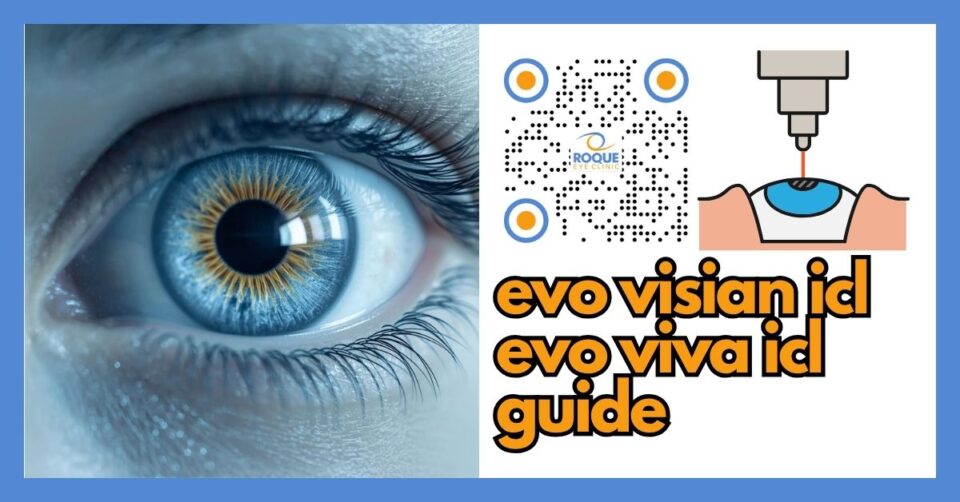
EVO Visian ICL and EVO Viva ICL
🧠 Quick Answer
EVO Visian ICL and EVO Viva ICL are implantable Collamer lenses placed inside the eye to reduce dependence on glasses or contact lenses while keeping the natural lens in place. EVO Visian ICL is mainly used for myopia, with or without astigmatism depending on the model. EVO Viva ICL adds an extended depth-of-focus design intended to help suitable patients with myopia and presbyopia. Availability and regulatory approval can vary by country.
EVO Visian ICL and EVO Viva ICL belong to the same broad family of phakic intraocular lenses. That means the lens is implanted inside the eye without removing your natural lens. This is very different from LASIK, SMILE, and PRK, which reshape the cornea, and also different from lens replacement surgery, which removes the natural lens and replaces it with an artificial one.
For many patients, the appeal is easy to understand. These lenses can treat a wide range of refractive error, are not corneal laser procedures, and are often discussed when a patient is not an ideal candidate for corneal laser surgery. The main questions patients usually ask are simple: What is EVO ICL? What is EVO Viva? How are they different? and Who is the right candidate?
🧩 Focus: EVO Visian ICL and EVO Viva ICL as lens-based refractive surgery options
👁 Goal: Explain what these implantable lenses are, how they differ, who may benefit, and what patients should understand before choosing them
🛡 Evidence-Based: Preferred Practice Patterns • FDA device information • Manufacturer directions for use • Peer-reviewed refractive surgery literature
REFRACTIVE SURGERY Knowledge Hub
Start with the complete guide:
🔬 EVO Visian ICL and EVO Viva ICL Anatomy Micro-Primer
- Cornea: The clear front window of the eye. ICL surgery does not reshape the cornea the way LASIK or PRK does.
- Iris: The colored part of the eye. The implanted lens sits behind the iris, so patients usually cannot see it in normal day-to-day life.
- Natural crystalline lens: Your own lens remains in place during phakic ICL surgery. That is one of the biggest differences from lens replacement surgery.
- Anterior chamber and sulcus space: These measurements matter because the implanted lens must fit safely inside the eye with appropriate sizing and vault.
📘 EVO Visian ICL and EVO Viva ICL Terminology Glossary
- Phakic IOL: An implanted lens placed inside the eye while the natural lens is left in place.
- Collamer: STAAR Surgical’s collagen copolymer lens material used in ICL technology.
- Vault: The space between the implanted lens and the natural lens. Proper vault is an important safety target.
- Toric: A lens design that also corrects astigmatism.
- Presbyopia: Age-related loss of near focusing ability, usually noticed in the 40s and beyond.
- EDOF: Extended depth of focus, an optical concept designed to broaden the range of usable vision rather than produce a sharply separate near and distance focus like some multifocal designs.
Quick Navigation
Related Reading
Key Learning Points
- EVO Visian ICL is a phakic implantable Collamer lens used mainly for myopia, with toric options for astigmatism in appropriate cases.
- EVO Viva ICL is an EDOF-style ICL design intended to help suitable myopic patients who also want help with presbyopia.
- These are lens-based, not corneal laser procedures.
- Good candidacy depends on detailed screening, especially anterior chamber measurements, sizing, vault planning, and overall eye health.
- Regional availability and regulatory approval can differ, so not every model is offered in every country.
What EVO Visian ICL and EVO Viva ICL Are
EVO Visian ICL is an implantable Collamer lens placed inside the eye to correct refractive error while preserving the natural lens. In plain language, it works like placing a permanent contact lens inside the eye rather than on the surface. Because the cornea is not being reshaped, this option is often discussed for patients who are not ideal candidates for LASIK, PRK, or SMILE, or who prefer a lens-based approach.
EVO Viva ICL comes from the same ICL platform but is designed with an aspheric extended depth-of-focus optic. That means it is intended not only to reduce myopia, but also to broaden the range of vision in suitable patients who are dealing with presbyopia. Patients often ask whether that makes it “the same as a multifocal lens.” Not exactly. The optical concept is different, and the goal is usually to create a broader useful range of vision rather than the exact visual experience of a multifocal intraocular lens.
💡 Analogy
If laser vision correction is like changing the shape of your eyeglass lenses permanently, ICL surgery is more like placing a custom lens inside the eye itself. EVO Viva is like a custom internal lens that also tries to widen the range of useful focus for the right patient.
How EVO Visian ICL and EVO Viva ICL Differ
EVO Visian ICL
This is the more familiar myopia-focused EVO ICL platform. Depending on the model, it can address myopia alone or myopia with astigmatism. In the U.S., official FDA labeling covers specific ranges and indications, and those details matter when surgeons talk about candidacy.
EVO Viva ICL
EVO Viva is positioned by STAAR as a presbyopia-correcting or presbyopia-addressing extension of the ICL platform using an EDOF optic. The main practical message for patients is this: it is discussed for people who want lens-based correction of myopia but also need help with age-related near vision demands. Because this model is not universally available in all regions, candidacy discussions must include the local market and regulatory environment.
What They Still Have in Common
- They are implanted behind the iris and in front of the natural lens.
- They preserve the natural lens, unlike refractive lens exchange.
- They depend on careful sizing and vault planning.
- They are typically considered lens-based refractive solutions for selected patients.
- They require intraocular surgery, so the risk profile is different from corneal laser procedures.
Who May Benefit from EVO Visian ICL or EVO Viva ICL
Patients most often ask about EVO ICL when they have moderate to high myopia, thinner corneas, dry eye concerns, or other reasons that make corneal laser surgery less attractive. Some patients simply prefer not to have their cornea reshaped. In these situations, a phakic lens can be an important alternative.
EVO Viva enters the conversation when a patient has both myopia and presbyopia and wants to explore a lens-based option without removing the natural lens. However, not every presbyopic patient is automatically a good match. Visual goals matter. A patient who wants perfect sharpness at every distance under all lighting conditions may still need careful counseling about the limitations of real-world optics.
Why Screening Matters So Much
ICL surgery is not just about your glasses prescription. The surgeon must also measure the anterior chamber depth, white-to-white size, sulcus-related sizing considerations, corneal health, endothelial status when relevant, eye pressure history, lens clarity, and retinal status. Proper sizing is critical because an ICL that is too large or too small can create problems with vault and intraocular anatomy.
This is especially important with advanced optics and presbyopia-focused expectations. A technically successful surgery can still feel disappointing if the patient’s visual priorities were not discussed properly before surgery. That is why candidacy involves both anatomy and lifestyle.
Typical Questions Screening Tries to Answer
- Is the refractive error within a treatable range for the available model?
- Is the anterior chamber deep enough?
- Is the eye healthy enough for intraocular refractive surgery?
- Would a corneal laser procedure, ICL, or lens replacement make more sense?
- For presbyopic patients, are the expectations for near, intermediate, and distance vision realistic?
Potential Benefits
No corneal tissue removal
One major appeal of ICL surgery is that the cornea is not reshaped or thinned like in LASIK or PRK. That can be attractive in appropriately screened patients.
Useful for higher refractive errors
ICL platforms are often discussed when refractive error is higher than what many surgeons would prefer to treat with corneal laser surgery alone.
Reversibility concept
Patients often like that the implanted lens can, in principle, be exchanged or removed if needed. That does not mean the decision should be taken lightly, but it is different from the permanence of corneal laser tissue removal.
Presbyopia-focused option with EVO Viva
For selected patients, EVO Viva is attractive because it tries to address distance and a broader range of functional vision without removing the natural lens. That said, it still requires highly individualized counseling.
Trade-Offs and Limitations
The most important limitation is that this is still intraocular surgery. That means the discussion is not the same as LASIK. Even though recovery can be relatively quick in many patients, the procedure carries a different category of risk because the surgery happens inside the eye.
Another important issue is that not every patient’s visual goals will match what the optics can realistically deliver. This is especially true in presbyopia discussions. Some people hear “EDOF” and imagine perfect reading vision, perfect computer vision, and perfect distance vision with no trade-offs. Real life is more nuanced. Optical quality, contrast, night symptoms, and patient adaptation all matter.
Safety and Risks
Modern EVO designs include a central port intended to improve aqueous flow compared with older designs that often required peripheral iridotomy. Even so, ICL surgery still requires the same serious respect given to any intraocular procedure. Patients should understand possible risks such as elevated eye pressure, improper vault, cataract formation, inflammation, infection, glare and halos, residual refractive error, lens rotation in toric cases, and the possible need for additional procedures.
🚨 Emergency Warning
Urgent ophthalmic review is needed after ICL surgery if you develop severe pain, marked redness, rapidly worsening blur, nausea with headache, or a sudden major drop in vision. These may signal pressure rise, inflammation, or another serious postoperative problem.
EVO Visian ICL vs EVO Viva ICL in Practical Terms
If your main problem is myopia, the standard EVO Visian ICL discussion is usually the more straightforward one. If your problem is myopia plus presbyopia, and your surgeon offers EVO Viva in your market, then EVO Viva may come into the conversation. The right answer depends on your age, reading needs, night driving demands, tolerance for visual trade-offs, and local device availability.
For some patients, the best solution may still be standard EVO ICL with later reading glasses. For others, EVO Viva may be worth exploring. And for still others, lens replacement surgery may eventually make more sense, especially if there are early lens changes or age-related reasons to shift toward a different strategy.
What Patients Should Ask Before Choosing One
- Am I a good anatomical candidate for ICL surgery?
- Is EVO Viva available and appropriate in my country and in my surgeon’s practice?
- Would standard EVO ICL or a presbyopia-focused option fit my lifestyle better?
- What range of vision should I realistically expect after surgery?
- What are my personal risks for pressure problems, vault issues, cataract, or night symptoms?
- If the result is not ideal, what are the next-step options?
Continue Reading
🏁 Take-Home Message
EVO Visian ICL and EVO Viva ICL are lens-based refractive options for selected patients who want an alternative to corneal laser surgery. Standard EVO ICL mainly targets myopia, while EVO Viva is designed for myopia with presbyopia using an EDOF-style optic. The best choice depends on anatomy, lifestyle, expectations, and local device availability—not just the name of the lens.
FAQ
1) What is the difference between EVO Visian ICL and EVO Viva ICL?
EVO Visian ICL is mainly used for myopia, with some models also addressing astigmatism. EVO Viva ICL uses an EDOF-style optic intended to help suitable patients who have myopia and presbyopia.
2) Is EVO Viva the same as a multifocal lens?
Not exactly. EVO Viva is described as an aspheric EDOF optic rather than a typical multifocal design. The goal is to broaden the useful range of vision, but the visual experience is not identical to every multifocal technology.
3) Do these lenses replace the natural lens?
No. These are phakic lenses, which means the natural lens stays in place. That is one of the main differences from refractive lens exchange or cataract surgery.
4) Can everyone with high myopia get EVO ICL?
No. A high prescription alone does not make someone a good candidate. The eye must still be suitable in terms of chamber depth, sizing, overall health, and retinal safety.
5) Will EVO Viva remove the need for reading glasses forever?
Not necessarily. Presbyopia solutions should be discussed carefully. Some patients may still need glasses for certain tasks, especially in dim light or for small print.
6) Is EVO Viva available everywhere?
No. Availability and regulatory approval can vary by country and market, so patients should ask their surgeon what is actually offered in their region.
📚 References
- U.S. Food and Drug Administration. EVO/EVO+ Visian Implantable Collamer Lens device information.
- U.S. Food and Drug Administration. PMA supplement for expanded EVO/EVO+ ICL age range.
- STAAR Surgical. EVO ICL product information.
- STAAR Surgical. EVO Viva directions for use and product information.
- American Academy of Ophthalmology. Refractive Surgery Preferred Practice Pattern®.
🤝 Roque Eye Clinic Patient Education Series
Dr. Manolette Roque | Dr. Barbara Roque
St. Luke's Medical Center Global City | Asian Hospital Medical Center
Philippines
Medical Review: Roque Advisory Council
Last Updated: March 2026
Medical Disclaimer
This article is intended for educational purposes only and does not replace professional medical consultation.