
LASIK vs SMILE vs ICL: Which Vision Correction Option Fits You Best?
Last Updated: April 10, 2026
🧠 Dr. Roque’s Quick Answer
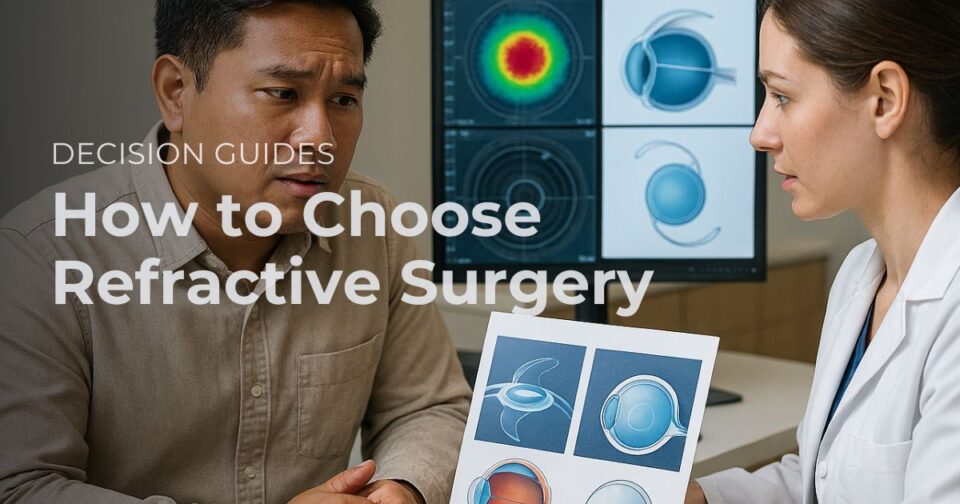
LASIK, SMILE, and ICL can all reduce dependence on glasses, but they do not solve the same problem in the same way. LASIK is often a strong fit for patients who want fast visual recovery and have enough healthy corneal tissue. SMILE is often attractive for myopia with or without astigmatism when a flapless corneal approach is preferred. ICL is often strongest for higher prescriptions, thinner corneas, dry-eye-prone eyes, or patients who are poor laser candidates. The right question is not “Which one is best?” The right question is “Which one is safest and most logical for your eyes?”
Many patients come in already leaning toward one procedure. That is understandable, but it is also where mistakes begin. A procedure should not be chosen because it is popular, newer, cheaper, or heavily marketed. It should be chosen because your cornea, prescription, tear film, age, lens status, retinal risk, and lifestyle all point in the same direction. This guide is built to help you compare LASIK, SMILE, and ICL clearly, without pretending that one option wins for everyone.
🎯 Focus
Help you compare three major refractive surgery options in a way that is practical, patient-centered, and medically honest.
🧩 Goal
Move you from confusion to a shortlist: likely laser candidate, likely lens candidate, or likely not ready yet.
🛡️ Evidence-Based
Built around current AAO and FDA patient guidance, device labeling, and recent comparative refractive surgery literature.
🚨 Dr. Roque’s Emergency Warning
This page is about elective vision correction, not emergency care. If you have sudden vision loss, severe eye pain, flashes with a shower of floaters, a curtain over your vision, chemical injury, or a recent eye trauma, do not use this guide to self-triage. Seek urgent ophthalmic evaluation.
ROQUE Eye Clinic Refractive Surgery Knowledge Hub
This page is a decision guide. It helps you compare options, but it does not replace the deeper treatment pages.
👁️ Anatomy Micro-Primer
Your eye focuses light using two main optical parts: the cornea in front and the natural lens inside the eye. LASIK and SMILE reshape the cornea. ICL does not reshape the cornea. Instead, it places a thin lens inside the eye, behind the iris and in front of your natural lens. That difference matters. Corneal procedures depend heavily on corneal thickness, shape, and surface health. Lens-based procedures depend more on eye anatomy inside the eye, including anterior chamber depth and sizing.
A simple way to think about it: LASIK and SMILE remodel the eye’s front window. ICL adds a custom optical lens inside the eye while keeping your natural lens in place.
📘 Terminology Glossary
- Myopia: Nearsightedness. Far objects look blurry.
- Astigmatism: Uneven focusing, often from an irregular corneal shape.
- Corneal flap: A thin layer created in LASIK before laser reshaping.
- Lenticule: A small disc of corneal tissue removed during SMILE.
- ICL: Implantable Collamer Lens, a lens placed inside the eye without removing your natural lens.
- Dry eye: An unstable tear film that can cause irritation and blur.
- Higher-order aberrations: Optical imperfections that can affect quality of vision, glare, or halos.
- Vault: The space between an ICL and your natural lens. Too little or too much can be a problem.
🧠 Dr. Roque’s Key Learning Points
- LASIK and SMILE are corneal laser procedures. ICL is an intraocular lens procedure.
- LASIK usually offers very fast recovery, but flap creation and dry-eye worsening matter.
- SMILE avoids a flap and may be attractive in myopia, especially when corneal nerve disruption and flap concerns matter.
- ICL is often strongest in higher myopia, thinner corneas, dry-eye-prone patients, or eyes outside safe laser limits.
- No option is “best” in the abstract. The safer fit depends on your eye measurements and risk profile.
- Older patients or those with early lens changes may need a different conversation altogether, including lens replacement rather than LASIK, SMILE, or ICL.
- Good screening matters more than good marketing.
At-a-Glance Comparison
LASIK
How it works: Creates a corneal flap, then reshapes the cornea with an excimer laser.
Usually strongest for: Patients with suitable corneas who want rapid visual recovery.
Main watch-outs: Dry eye, flap-related issues, ectasia risk if screening is poor, glare/halos in some patients.
SMILE
How it works: Uses a femtosecond laser to create a lenticule inside the cornea, removed through a small incision.
Usually strongest for: Myopia ± astigmatism when a flapless corneal option is preferred.
Main watch-outs: Still depends on corneal suitability; enhancement strategy can be more nuanced; not every prescription pattern is ideal.
ICL
How it works: Places a custom lens inside the eye without removing your natural lens.
Usually strongest for: Higher myopia, thinner corneas, dry-eye-prone eyes, or patients outside safe laser limits.
Main watch-outs: It is intraocular surgery, so the risk profile differs; sizing, vault, pressure, cataract, and long-term follow-up matter.
How Each Procedure Differs in Plain Language
1) LASIK: fast, familiar, and still very effective
LASIK remains one of the most established laser vision correction procedures. It can treat a broad range of refractive errors, recovery is often fast, and many patients function well quite early. That is why it stays popular.
But do not let familiarity fool you. LASIK is not a default option. It requires enough corneal thickness, a stable prescription, healthy topography, and a reasonable tear film. If the screening is weak, LASIK can be the wrong operation for the wrong cornea.
LASIK usually makes most sense when the eye is otherwise suitable, the patient wants fast recovery, and there is no major reason to avoid flap creation.
2) SMILE: flapless, elegant, but not magically better for everyone
SMILE is attractive because it is flapless. For many patients, that is the headline feature. The smaller incision and different tissue mechanics may help preserve corneal biomechanics and may reduce some postoperative dry-eye burden compared with LASIK in selected comparisons.
Still, some patients hear “flapless” and assume “safer” or “better.” That shortcut is too simplistic. SMILE is still corneal refractive surgery. It still removes tissue. It still needs healthy screening. It still can produce glare, dryness, residual refractive error, or the need for enhancement.
SMILE often shines when the prescription pattern fits, the cornea is suitable, and the patient likes the logic of avoiding a LASIK flap. It is not an automatic upgrade over LASIK.
3) ICL: often the smartest answer when the cornea is the limiting factor
ICL is different because it does not solve the problem by shaving the cornea. Instead, it adds an optical lens inside the eye. That makes ICL especially valuable when the cornea is too thin, too steep, too irregular, too dry, or the prescription is too high for comfortable laser reshaping.
This is where many patients make a faulty assumption: they think laser must always be “simpler” and therefore better. Not necessarily. If laser pushes the cornea too hard, a lens-based solution may be the more conservative and safer refractive strategy.
That said, ICL is intraocular surgery. It deserves respect. You are entering the eye. Screening, sizing, vault, pressure checks, cataract risk counseling, endothelial considerations, and long-term follow-up all matter.
💡 Dr. Roque’s Analogy
Think of your eye like a camera system. LASIK and SMILE reshape the front lens cover to improve focus. ICL inserts an additional precision lens inside the camera without sanding down the front surface. If the front glass is strong and suitable, reshaping may work beautifully. If the front glass is limited, inserting a lens may be the smarter engineering choice.
Which Patients Tend to Fit Each Option?
A patient who may fit LASIK
- Stable prescription
- Sufficient corneal thickness
- Normal corneal topography and tomography
- No major ocular surface disease
- Wants fast recovery
- No strong reason to avoid a corneal flap
A patient who may fit SMILE
- Myopia with or without astigmatism in a suitable range
- Normal corneal shape and adequate thickness
- Interest in a flapless corneal procedure
- Concern about dryness or corneal nerve disruption
- Comfort with the fact that enhancement planning may differ from LASIK
A patient who may fit ICL
- Higher myopia or larger refractive correction
- Thin or borderline cornea for laser
- Dry-eye-prone eyes
- Corneal laser contraindication or poor laser profile
- Adequate anterior chamber anatomy for safe implantation
- Comfort with intraocular surgery and long-term follow-up
Who should slow down before deciding?
You should slow down if any of the following apply: unstable prescription, significant dry eye, abnormal topography, keratoconus suspicion, thin cornea, high myopia, large pupils with night-vision complaints, autoimmune issues affecting healing, pregnancy or breastfeeding, unrealistic expectations, or early lens changes.
Patients in their 40s and older also need a more honest counseling conversation. If presbyopia is already becoming important, “Which is best: LASIK, SMILE, or ICL?” may be the wrong question. Sometimes the better question is whether a lens-based strategy or blended-vision plan makes more sense.
Side-by-Side Stress Test
| Question | LASIK | SMILE | ICL |
|---|---|---|---|
| Is the cornea reshaped? | Yes | Yes | No |
| Is a flap created? | Yes | No | No corneal flap |
| Inside the eye? | No | No | Yes |
| Often chosen for higher myopia? | Sometimes, but corneal limits matter | Sometimes, but corneal limits matter | Often yes |
| Dry-eye concern? | Important consideration | May be somewhat kinder in some patients, but not zero-risk | Often attractive when ocular surface is a concern |
| Recovery speed? | Often very fast | Fast, though early recovery may vary | Good recovery, but intraocular follow-up matters |
| Main strategic limitation? | Corneal thickness, flap, dryness, ectasia screening | Corneal suitability, enhancement complexity, range fit | Intraocular risks, sizing, vault, pressure, cataract counseling |
The wrong ways to choose
- “My friend had LASIK, so I should too.”
- “SMILE is newer, so it must be better.”
- “ICL sounds invasive, so laser must be safer.”
- “I just want the cheapest option.”
- “I do not need full screening if my prescription is simple.”
Those shortcuts are dangerous because refractive surgery is not a fashion choice. It is structural eye surgery. A weak candidate can still be a very motivated patient. Motivation does not make the cornea thicker. It does not fix dry eye. It does not normalize topography. It does not remove retinal risk in a high myope.
A practical decision pathway
- Start with your cornea. Is it thick enough, regular enough, and healthy enough for laser?
- Check your ocular surface. Is dry eye mild, moderate, or already clinically important?
- Measure the prescription honestly. Is the refractive error in a comfortable laser range, or is it pushing corneal limits?
- Check age and lens status. If early cataract or presbyopia is already shaping daily life, your counseling pathway changes.
- Consider lifestyle. Night driving, contact sports, screen-heavy work, and tolerance for recovery details all matter.
- Match the procedure to the anatomy. Do not try to force the anatomy to fit the procedure you already wanted.
Related Reading
✅ Dr. Roque’s Take-Home Message
LASIK, SMILE, and ICL can all be excellent procedures. The trap is asking which one is best in general. The smarter question is which one gives your eyes the safest path to strong vision with the least structural compromise. If your cornea is healthy and the numbers fit, laser may be appropriate. If your cornea or dry eye pushes back, ICL may be the wiser choice. Good refractive surgery starts with good refusal: the discipline to say no to the wrong procedure.
Frequently Asked Questions
1) Which is safest: LASIK, SMILE, or ICL?
There is no universal winner. The safest option is the one that best fits your anatomy and risk profile. A poor laser candidate may be safer with ICL. A poor intraocular candidate may be better served by corneal laser or by waiting.
2) Which procedure has the fastest recovery?
LASIK is often known for very fast functional recovery. SMILE also recovers quickly, but the first few days can vary. ICL recovery can also be good, but because it is intraocular, the follow-up logic is different.
3) Which is better for dry eyes?
Patients with significant dry eye need careful evaluation first. In general, SMILE may be more favorable than LASIK in some dry-eye comparisons, and ICL can be appealing when the ocular surface makes corneal laser less attractive. But severe untreated dry eye should not be brushed aside.
4) Which is better for high myopia?
ICL is often a strong option for higher myopia because it avoids removing large amounts of corneal tissue. This is one of the most common reasons a patient shifts from laser thinking to lens-based counseling.
5) Is SMILE better than LASIK because it is flapless?
Not automatically. Flapless is an advantage in some contexts, but it does not mean SMILE is superior for every patient, every refractive pattern, or every surgeon workflow.
6) Is ICL reversible?
ICL is removable in principle, which is one reason some patients like it. However, that should not be treated casually. It is still intraocular surgery and still requires proper long-term monitoring.
7) Can all three procedures treat astigmatism?
Yes, but not in exactly the same way, and not every amount or pattern is equally ideal. Precision matters. This is another reason detailed diagnostics come before procedure selection.
8) What if I am in my 40s or older?
Age changes the conversation because presbyopia and early lens changes start to matter more. Some patients in this age group need a broader discussion than LASIK vs SMILE vs ICL alone.
9) Will I definitely stop needing glasses forever?
No ethical surgeon should promise that. Refractive surgery can reduce dependence on glasses, but aging, healing, residual refractive error, and future lens changes still matter.
10) What is the single most important step before deciding?
A thorough refractive surgery work-up. Good diagnostics prevent bad decisions. That matters more than any advertisement, testimonial, or social media comparison.
References
- American Academy of Ophthalmology. LASIK — Laser Eye Surgery. Updated January 9, 2026.
- American Academy of Ophthalmology. What Is Small Incision Lenticule Extraction? Updated September 30, 2024.
- U.S. Food and Drug Administration. List of FDA-Approved Lasers for LASIK. Updated 2025.
- STAAR Surgical. EVO and EVO+ Visian Implantable Collamer Lens Patient Information Booklet. 2025.
- Chen KY, et al. How Effective is Keratorefractive Lenticule Extraction Compared With FS-LASIK for Dry Eye Outcomes? Meta-analysis. 2025.
- Comparison of objective visual quality between SMILE and FS-LASIK in moderate-to-high myopia. 2024.
- Sinha R, et al. Visual outcomes with implantable Collamer lens versus small incision lenticule extraction. 2024.
ROQUE Eye Clinic Patient Education Series
Reviewed by the Roque Advisory Council
Dr. Manolette Roque | Dr. Barbara Roque
St. Luke’s Medical Center Global City | Asian Hospital Medical Center
Philippines
Medical Disclaimer: This page was prepared for patient education and decision support. It does not replace an in-person examination, refraction, corneal imaging, ocular surface evaluation, dilated retinal examination, or personalized refractive surgery counseling. Refractive surgery decisions must be individualized. Not every patient is a candidate for LASIK, SMILE, or ICL. Final suitability depends on full clinical evaluation, diagnostic testing, and a doctor’s judgment about safety, benefit, and alternatives.