


Who Is a Candidate for Lens-Based Vision Correction Surgery
🧠 Quick Answer
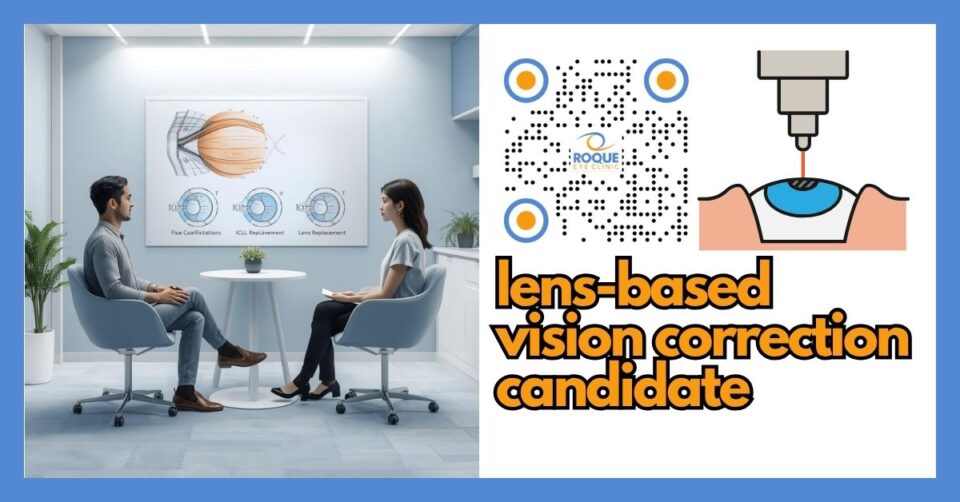
A good candidate for lens-based vision correction surgery is someone whose eyes and goals fit procedures such as ICL or lens replacement surgery better than corneal laser treatment. Candidacy depends on age, refractive error, corneal measurements, anterior chamber depth, lens status, retinal health, presbyopia needs, and willingness to accept the benefits and trade-offs of an intraocular procedure.
Lens-based vision correction surgery is an important part of modern refractive surgery. For some patients, it is not the second-best option. It is the better option. While LASIK, PRK, and SMILE reshape the cornea, lens-based procedures work inside the eye. They are often considered when the refractive error is high, the cornea is less suitable for laser surgery, presbyopia is a major concern, or the natural lens is already becoming dysfunctional.
There are two broad categories in this group. One is phakic intraocular lens surgery, such as ICL, where the natural lens stays in place and an additional lens is implanted. The other is lens replacement surgery, also called refractive lens exchange or refractive cataract surgery depending on the context, where the natural lens is removed and replaced with an intraocular lens implant.
🧩 Focus: Patient candidacy for lens-based vision correction surgery
👁 Goal: Explain who may benefit from ICL or lens replacement surgery, who may not qualify, and what factors guide procedure selection
🛡 Evidence-Based: Preferred Practice Patterns • Standards of Care • Systematic Reviews • Meta-Analyses
REFRACTIVE SURGERY Knowledge Hub
Start with the complete guide:
🔬 Lens-Based Vision Correction Anatomy Micro-Primer
- Natural lens: This is the clear lens inside the eye that helps focus light. Lens replacement surgery removes it and replaces it with an artificial lens.
- Anterior chamber: This is the space between the cornea and the iris. Its depth and angle matter greatly when evaluating ICL suitability.
- Ciliary sulcus / posterior chamber space: This is the area where a posterior chamber phakic lens such as an ICL is positioned behind the iris and in front of the natural lens.
- Retina: This is the light-sensitive tissue lining the back of the eye. Retinal health is especially important in highly myopic eyes being considered for lens-based surgery.
📘 Lens-Based Vision Correction Terminology Glossary
- ICL: Implantable collamer lens, a phakic intraocular lens placed inside the eye while the natural lens remains.
- Phakic: A term meaning the natural lens is still present.
- RLE: Refractive lens exchange, a procedure that removes the natural lens and replaces it with an artificial intraocular lens for refractive purposes.
- Presbyopia: Age-related loss of near focusing ability.
- Anterior chamber depth: The measured space inside the front part of the eye, important for ICL safety planning.
- Endothelial cell density: The number of healthy cells lining the inner cornea, important because these cells help keep the cornea clear.
Quick Navigation
Related Reading
Key Learning Points
- Lens-based vision correction usually means ICL or lens replacement surgery.
- The best candidates are chosen not just by prescription, but by age, anatomy, lens status, retinal risk, corneal suitability, and lifestyle goals.
- ICL often appeals to younger adults with high refractive error who still want to keep their natural lens and accommodation.
- Lens replacement surgery often becomes more logical in presbyopia or when the natural lens is already aging or dysfunctional.
- Not everyone who wants lens-based surgery should have it. Safety checks are essential.
What Lens-Based Candidacy Means
Being a candidate for lens-based vision correction surgery means your eyes, your age, and your visual goals may be better served by an intraocular procedure than by corneal laser surgery or by staying with glasses or contact lenses. The decision is not based on a single number. It is a pattern-recognition process. Surgeons look at refractive error, corneal thickness and shape, chamber anatomy, lens clarity, retinal status, and whether you want to preserve accommodation or are ready to trade it for a more permanent presbyopia solution.
A helpful analogy is choosing between fixing a camera’s front filter and changing the lens inside the camera itself. Corneal laser surgery works more on the “front filter” side. Lens-based surgery changes or adds a focusing lens inside the eye. That is a bigger decision, so the screening process is deeper and the trade-offs are different.
💡 Analogy
If the eye were like a camera, corneal laser surgery adjusts the front focusing surface, while lens-based surgery adds or replaces an internal lens. Some cameras do better with one approach than the other. The same is true for eyes.
The Two Main Lens-Based Pathways
1) ICL and other phakic lens options
In phakic lens surgery, the natural lens stays inside the eye. An implant is added to correct refractive error. This may be attractive in younger adults, especially those with moderate to high myopia, myopic astigmatism, or corneal factors that make laser surgery less suitable. The natural lens continues to provide accommodation, which matters in younger patients who still have useful near focusing ability.
2) Lens replacement surgery
In lens replacement surgery, the natural lens is removed and replaced with an artificial intraocular lens. This may be attractive in older patients, presbyopic patients, patients with early lens dysfunction, or patients whose goals are better served by replacing the aging lens than by leaving it in place. In the setting of cataract, the procedure is therapeutic as well as refractive. In the setting of a clear but aging lens, it is refractive lens exchange.
What Makes a Good Candidate Overall
Although the exact rules vary by procedure, good candidates for lens-based refractive surgery usually have several features in common: stable expectations, realistic goals, healthy ocular surface, careful preoperative measurements, and an eye anatomy that fits the planned implant or lens exchange strategy. The patient also needs to understand that these are intraocular procedures. That means the risks and benefits differ from flap-free or corneal-laser procedures.
In everyday language, a strong candidate is not simply someone who wants less dependence on glasses. A strong candidate is someone whose eyes and goals make the procedure both sensible and safe.
Who May Be a Good ICL Candidate
ICL candidacy often fits younger to middle-aged adults with significant refractive error who want internal lens correction but still want to keep their natural lens. It can be especially appealing when the refractive error is high, the cornea is too thin or structurally less suitable for laser ablation, or the patient wants to avoid removing the natural lens too early.
That said, not every patient qualifies. Measurements matter. A proper ICL candidate needs enough anterior chamber depth, a suitable anterior chamber angle, and adequate endothelial cell density. FDA labeling for EVO ICL also lists age under 21, pregnancy or nursing, moderate to severe glaucoma, and inadequate ocular anatomy as important contraindications. These safety rules are not optional. They are central to candidacy.
ICL may be a better fit when:
- The refractive error is high and corneal laser surgery would remove too much tissue
- The cornea is not ideal for LASIK, PRK, or SMILE
- The patient is still young enough to value natural accommodation
- The patient is comfortable with an intraocular implant and the need for long-term follow-up
Who May Be a Good Lens Replacement Candidate
Lens replacement surgery becomes more attractive as the natural lens ages. Fully presbyopic patients, especially hyperopic patients, are often discussed as good refractive lens exchange candidates because the lens is already losing accommodation and the procedure can address both refractive error and presbyopia at the same time. Patients with early cataract or dysfunctional lens changes are also logical candidates because replacing the lens solves more than one problem.
Lens replacement is not automatically ideal for every myope, especially younger high myopes. In these eyes, retinal risk deserves special attention. Reviews of refractive lens exchange repeatedly note that longer, highly myopic eyes may carry a more important retinal detachment discussion. That does not mean RLE is never appropriate in myopia. It means the surgeon must individualize the decision carefully.
Lens replacement may be a better fit when:
- The patient is fully presbyopic and wants broader spectacle reduction
- The natural lens is already aging, dysfunctional, or cataractous
- The refractive goal is better served with multifocal, EDOF, toric, or other premium IOL planning
- The patient understands that natural accommodation will be lost once the lens is removed
Important Preoperative Checks
Before calling someone a good candidate, surgeons usually review several checkpoints. These may include manifest and cycloplegic refraction when appropriate, corneal topography or tomography, pachymetry, anterior chamber measurements, endothelial cell assessment, lens status, pupil behavior, retinal examination, ocular surface evaluation, and discussion of occupation, driving, reading, sports, and tolerance for visual trade-offs such as halos or reduced night contrast.
The surgeon is also asking a practical question: Will this procedure improve life in a way that matches the patient’s priorities? A patient who values unaided near vision, one who drives at night for work, and one who is bothered most by thick glasses may all end up with different recommendations.
🚨 Emergency Warning
If your screening reveals sudden flashes, new floaters, a curtain-like shadow, marked eye pain, a red painful eye, or rapid vision loss, urgent retinal or ophthalmic care takes priority over elective refractive planning.
Who May Not Qualify—or May Need More Work-Up First
Some patients are not good candidates right now. Others may qualify only after more testing or treatment. Common reasons include:
- Age that is too young for the specific procedure
- Pregnancy or nursing, especially when refraction may still be unstable
- Shallow anterior chamber or narrow angle in a patient considering ICL
- Inadequate endothelial cell reserve
- Moderate to severe glaucoma or poorly controlled eye disease
- Retinal pathology that needs treatment first
- Unrealistic expectations about perfect vision or total glasses independence
- Myopic anatomy that makes lens exchange risk discussion more serious
- Healthy young accommodation that the patient may regret losing too early if lens exchange is chosen
How Surgeons Decide Between ICL and Lens Replacement
The decision often comes down to one central issue: Should the natural lens stay or go? If the patient is younger and still benefits from natural accommodation, the surgeon often tries to preserve the lens when safely possible. If the patient is fully presbyopic, already has lens dysfunction, or is likely to benefit more from a premium intraocular lens strategy, lens replacement may make more sense.
Another way to say it is this: ICL often fits the patient who still values the natural lens. Lens replacement often fits the patient whose natural lens is becoming part of the problem rather than part of the solution.
Questions Patients Should Ask
- Am I a better candidate for ICL or lens replacement surgery, and why?
- What features of my eye anatomy matter most in this decision?
- Will I keep my natural focusing ability, or will I lose it?
- How does my age affect the recommendation?
- What retinal risks matter in my case?
- What kind of visual trade-offs should I expect with premium lens options?
Continue Reading
🏁 Take-Home Message
The best candidate for lens-based vision correction surgery is not simply the person who wants to stop wearing glasses. It is the person whose age, anatomy, lens status, refractive error, and goals match the strengths of ICL or lens replacement surgery. A careful screening exam helps decide whether the natural lens should stay, whether it should be replaced, or whether another refractive option is safer and smarter.
FAQ
1) What is lens-based vision correction surgery?
It refers to refractive procedures that work inside the eye rather than reshaping the cornea. The two main examples are ICL and lens replacement surgery.
2) Who is usually a good ICL candidate?
ICL often suits younger adults with significant refractive error who still want to keep their natural lens and accommodation, provided the eye has safe chamber anatomy and other measurements are appropriate.
3) Who is usually a good lens replacement candidate?
Lens replacement often suits presbyopic patients, hyperopic patients, and those with early lens dysfunction or cataract who may benefit from replacing the aging lens rather than leaving it in place.
4) Can someone be a poor LASIK candidate but a good lens-based surgery candidate?
Yes. Some patients are not ideal for corneal laser surgery because of high refractive error, thin or irregular corneas, or age-related lens issues, yet may still be good candidates for ICL or lens replacement.
5) Why does age matter so much in this decision?
Age often affects accommodation and lens status. Younger patients usually benefit more from preserving the natural lens when possible, while older or fully presbyopic patients may benefit more from replacing it.
6) Why is retinal examination important before lens-based surgery?
Retinal health matters in all refractive surgery, but it is especially important in high myopia and before lens exchange because retinal risk can influence whether surgery is advisable and which option is safer.
📚 References
- American Academy of Ophthalmology. Refractive Surgery Preferred Practice Pattern®. Updated 2024.
- U.S. Food and Drug Administration. EVO/EVO+ Visian Implantable Collamer Lens. Summary of Safety and Effectiveness Data.
- U.S. Food and Drug Administration. EVO/EVO+ Visian Implantable Collamer Lens approval page.
- Baur ID, et al. Refractive Lens Exchange: A Review. 2024.
- Chan E, et al. Refractive lens exchange – the evidence behind the practice. 2024.
🤝 Roque Eye Clinic Patient Education Series
Dr. Manolette Roque | Dr. Barbara Roque
St. Luke's Medical Center Global City | Asian Hospital Medical Center
Philippines
Medical Review: Roque Advisory Council
Last Updated: March 2026
Medical Disclaimer
This article is intended for educational purposes only and does not replace professional medical consultation.