

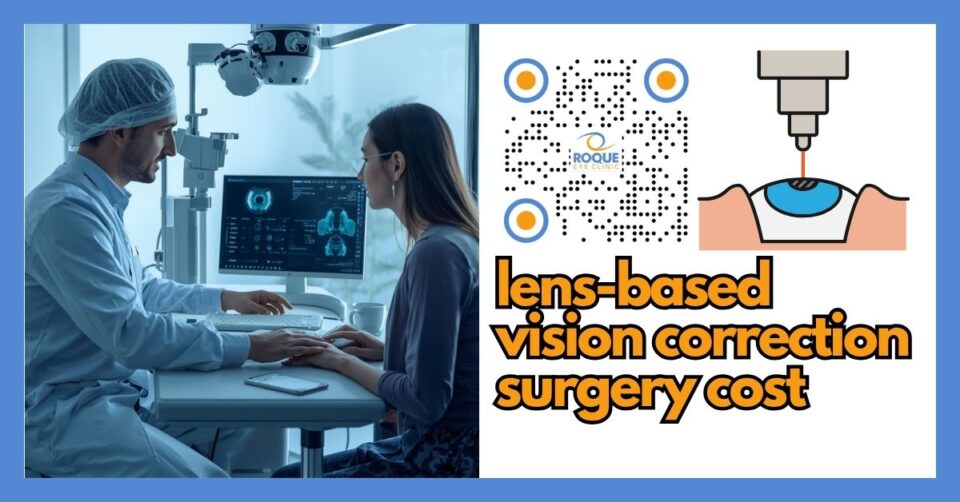
Lens-Based Vision Correction Surgery Cost Philippines
🧠 Quick Answer
Lens-based vision correction surgery cost in the Philippines varies widely because the final bill depends on the procedure, implant type, technology used, surgeon and facility fees, diagnostics, and follow-up care. In general, ICL surgery usually costs more than laser vision correction, while refractive lens exchange can become even more expensive when premium intraocular lenses and femtosecond laser technology are added.
When patients ask about the cost of lens-based vision correction surgery, they are usually trying to answer a very practical question: “How much money should I prepare, and what exactly am I paying for?”
This is an important question because lens-based procedures are not a single product with one universal price. A patient may need an implantable collamer lens (ICL), while another may be better suited to refractive lens exchange (RLE) or lens replacement surgery. Even within the same procedure, the price can change depending on whether the package includes only facility fees, surgeon’s fees, diagnostics, follow-up visits, or the actual lens implant itself.
For that reason, the most honest approach is not to promise one number for everyone. A better approach is to explain the major cost drivers, show examples from public Philippine pricing, and help patients understand why one quote may look much lower—or much higher—than another.
🧩 Focus: Cost of lens-based vision correction surgery in the Philippines
👁 Goal: Help patients understand how ICL and refractive lens exchange pricing works, what affects the total bill, and how to compare quotes safely
🛡 Evidence-Based: Preferred Practice Patterns • Standards of Care • Public clinic pricing • Patient counseling guidance
REFRACTIVE SURGERY Knowledge Hub
Start with the complete guide:
🔬 Lens-Based Vision Correction Anatomy Micro-Primer
- Cornea: The clear front window of the eye. Even though lens-based procedures focus inside the eye, the cornea still affects measurements and visual outcome.
- Anterior chamber: The space between the cornea and iris. Its depth matters in ICL planning because the lens needs enough room.
- Natural lens: The lens you were born with. In refractive lens exchange, this natural lens is removed and replaced with an artificial intraocular lens.
- Retina: The light-sensitive layer at the back of the eye. A good refractive plan still depends on a healthy retina and proper preoperative evaluation.
📘 Lens-Based Vision Correction Terminology Glossary
- ICL: Implantable collamer lens, a lens placed inside the eye without removing the natural lens.
- RLE: Refractive lens exchange, a procedure that removes the natural lens and replaces it with an artificial intraocular lens.
- Premium IOL: A more advanced lens implant, such as toric, EDOF, or multifocal, usually costing more than a standard monofocal lens.
- Facility fee: The fee charged for use of the operating room, equipment, staff, and related surgical support.
- Professional fee: The surgeon’s fee for performing the procedure and managing your care.
- Screening: The preoperative testing used to determine whether surgery is safe and suitable.
Quick Navigation
Related Reading
Key Learning Points
- Lens-based vision correction cost in the Philippines is not one fixed number.
- ICL and refractive lens exchange usually cost more than standard laser vision correction because implants and intraocular surgery are involved.
- The final quote may include screening, surgeon’s fee, facility fee, diagnostics, follow-up visits, and lens or implant charges—or only some of them.
- A low quote is not always the best value if major costs are excluded.
- For elective refractive surgery, patients should usually expect significant out-of-pocket spending, even when installment or promo options are available.
What Lens-Based Vision Correction Cost Really Means
Lens-based vision correction cost refers to the total amount a patient may need to pay for procedures such as ICL surgery or refractive lens exchange. This total is often larger than the “headline price” in an advertisement. In everyday practice, the real cost may include preoperative screening, diagnostic imaging, surgeon’s professional fee, operating room or facility fee, implant cost, medicines, and postoperative visits.
A helpful analogy is booking a flight. One airline may advertise a lower base fare, but your final payment rises once baggage, seat selection, meal fees, and taxes are added. Refractive surgery quotations can work the same way. The most useful question is not just “What is the starting price?” but “What exactly is included in that price?”
💡 Analogy
Comparing refractive surgery prices without checking inclusions is like comparing hotel rates without asking whether breakfast, taxes, parking, and Wi-Fi are already included. The cheapest-looking option on paper may not be the cheapest total bill.
Public Pricing Examples in the Philippines
Publicly available Philippine pricing shows how broad the range can be. On the ROQUE Eye Clinic service-and-pricing page, refractive screening is listed at ₱5,206, while public prices shown on the same page include LASIK femtosecond both eyes at ₱75,000, PRK both eyes at ₱75,630, and SMILE both eyes at ₱143,437. These figures show that even within corneal refractive surgery, pricing already varies substantially depending on the procedure used.
For lens-based surgery, the difference may become even more obvious. A ROQUE Eye Clinic product page for EVO Visian ICL states ₱150,000 per eye or ₱300,000 for both eyes as an “all-in” prepaid package as of January 28, 2024. A separate ROQUE Eye Clinic product page for femtosecond laser-assisted refractive lens exchange professional fee for one eye shows ₱84,000, and that figure does not automatically mean the total case cost because lens choice, diagnostics, hospital or center charges, and other items may still matter.
Other Philippine providers also show how pricing can shift according to promos and package structure. The Medical City posted a promo price of ₱69,012 for LASIK, ₱43,736 for TransPRK, and ₱39,896 for PRK in a 2024 campaign. Asian Eye Institute has posted installment and discount promos for refractive surgeries and specifically notes in some promo mechanics that ICL lens implants are not included in the discounted facility fee. This is a very important patient lesson: a promo may reduce one part of the bill without reducing the cost of the implant itself.
Third-party 2026 Philippine price guides also describe a wide market spread. One public guide listed LASIK at ₱26,000 to ₱140,000 per eye, PRK at ₱14,000 to ₱60,000 per eye, and TransPRK at ₱44,000 to ₱130,000 per eye. These broad figures are useful for orientation, but patients should still rely more heavily on a direct clinic quotation after screening because third-party roundups may mix base prices, promo rates, and package prices.
What Changes the Final Price
1) The procedure itself
ICL and refractive lens exchange are not minor variations of the same treatment. They are different surgeries. ICL places a phakic lens inside the eye while preserving the natural lens. Refractive lens exchange removes the natural lens and replaces it with an intraocular lens. Because the procedure steps, equipment, consumables, and implant costs differ, the price also differs.
2) The implant or intraocular lens
One of the biggest cost drivers in lens-based surgery is the implant. For ICL, the implant itself is a major component of the price. For refractive lens exchange, a standard monofocal lens may cost less than a premium toric, EDOF, or multifocal lens. If a patient wants presbyopia correction or astigmatism correction using a more advanced IOL, the bill usually rises.
3) Technology used
Some cases use standard phacoemulsification, while others use femtosecond laser-assisted surgery, image guidance, intraoperative aberrometry, or advanced diagnostics. More technology often means more cost, although it does not automatically mean every patient needs every upgrade.
4) Facility and surgeon fees
Hospital-based and institute-based pricing may differ. A center with higher overhead, more specialized staff, or more advanced equipment may charge more. Surgeon expertise and complexity of care also matter.
5) One eye versus both eyes
Some patients need bilateral surgery, while others only need one eye. This seems obvious, but many misunderstand quoted figures. Always confirm whether the quote is per eye or for both eyes.
6) Diagnostic work-up
Lens-based surgery planning often requires detailed measurements such as biometry, corneal topography or tomography, retinal evaluation, anterior chamber analysis, and other tests. Some clinics bundle these into the package. Others bill them separately.
What May Be Included in a Package
A package may include some or all of the following:
- Refractive screening or surgical candidacy evaluation
- Biometry and lens-power calculations
- Surgeon’s professional fee
- Facility or operating room fee
- Basic postoperative visits
- Routine eye drops or immediate postoperative medicines
- Standard implant or lens in selected packages
This is why the words package, all-in, facility fee only, and professional fee only matter so much. These labels can completely change how a number should be interpreted.
What May Not Be Included
Common exclusions can include:
- The ICL implant itself
- Premium intraocular lens upgrades
- Extra diagnostics requested after screening
- Retina or glaucoma clearance
- Management of dry eye or ocular surface disease before surgery
- Enhancement procedures if needed later
- Hospital admission or special anesthesia charges in selected cases
Patients should never assume that “promo price” means “final total cash-out.” In refractive surgery, the excluded items can be significant.
🚨 Emergency Warning
Do not choose a lens-based surgery only because it has the lowest advertised price. A cheaper quote is unsafe value if candidacy is poor, the measurements are incomplete, or the package leaves out major items you will still need to pay for.
PhilHealth, HMO, and Installment Questions
For refractive procedures, patients should usually expect significant out-of-pocket payment. Public Philippine LASIK cost guides state that PhilHealth does not cover LASIK because it is treated as an elective procedure, and the FDA also notes that refractive surgery cost remains significant and is usually not covered by medical insurance. In practice, many HMOs also exclude elective refractive surgery, although specific rules can vary by contract and by whether part of the care is considered medically necessary.
On the other hand, installment and promo arrangements are common. Asian Eye Institute has publicly posted 0% installment offers tied to specific credit card promotions. These arrangements can help patients spread the cost over time, but they do not automatically make the procedure cheaper. They mainly change how payment is scheduled.
Why ICL Often Looks Expensive
Many patients are surprised when ICL quotes are far higher than LASIK or PRK quotes. The reason is simple: ICL is an intraocular implant procedure. The implant itself is a major cost item. The surgery also depends on precise sizing, anterior chamber assessment, operating room support, and close postoperative follow-up. In other words, the patient is not paying only for “laser time” or “surgeon time.” The patient is paying for implant technology, measurements, sterile surgery, and ongoing monitoring.
Why Refractive Lens Exchange Can Cost Even More
Refractive lens exchange can become especially expensive when premium lens technology is added. A patient may move from a standard monofocal plan to a toric lens, EDOF lens, multifocal lens, or femtosecond-assisted workflow. Each upgrade can increase the total bill. That is why two patients undergoing “lens replacement surgery” may receive very different quotations even in the same institution.
How to Compare Quotations Safely
When comparing two quotes, ask these questions:
- Is this price per eye or for both eyes?
- Does it include the implant or lens?
- Does it include the surgeon’s professional fee?
- Does it include screening and diagnostics?
- Does it include follow-up visits and routine medicines?
- Is this a limited-time promo or regular pricing?
- Does the package change if I need a premium lens, toric correction, or femtosecond assistance?
A good quotation should be easy to explain. If the clinic cannot clearly tell you what is included and what is not included, the “cheap” quote may later become confusing and stressful.
Continue Reading
🏁 Take-Home Message
Lens-based vision correction surgery cost in the Philippines can look confusing because different clinics advertise different parts of the bill. The safest way to compare prices is to ask what is included, whether the implant is separate, whether the quote is per eye or both eyes, and whether diagnostics and follow-up are already covered. A clear, complete quotation is more valuable than a cheap-looking headline price.
FAQ
1) Why is lens-based vision correction usually more expensive than LASIK?
Lens-based surgery often includes an implant, more advanced diagnostics, and intraocular surgical steps. These make the total cost higher than many corneal laser procedures.
2) Is ICL usually charged per eye or for both eyes?
It can be quoted either way. Always confirm whether the posted number is per eye or both eyes before comparing prices.
3) Does a promo price always include the implant?
No. Some Philippine promo mechanics clearly state that the discount applies only to the facility fee and that the ICL lens implant is not included.
4) Does PhilHealth usually cover elective refractive surgery?
Usually no. Elective refractive procedures are commonly treated as out-of-pocket expenses, although medically necessary parts of care should still be discussed case by case.
5) Why can two refractive lens exchange quotes be very different?
The final price can change depending on the lens chosen, whether femtosecond technology is used, the diagnostics included, and the surgeon and facility fees.
6) What is the most important question to ask about cost?
Ask for the total expected cash-out and request a breakdown of inclusions and exclusions. This is usually more helpful than asking only for the lowest advertised price.
📚 References
- American Academy of Ophthalmology. Refractive Surgery Preferred Practice Pattern®. Available at: https://www.aao.org/Assets/d2a71fff-34e7-4b77-9553-f6ac33860074/638592360994900000/refractive-surgery-ppp-updated-2024-
- U.S. Food and Drug Administration. When is LASIK not for me? Available at: https://www.fda.gov/medical-devices/lasik/when-lasik-not-me
- ROQUE Eye Clinic. Eye Care Services and Prices. Accessed March 2026. Available at: https://eye.com.ph/eye-care-services/
- ROQUE Eye Clinic. EVO Visian ICL | One Eye. Available at: https://eye.com.ph/product/icl-package-one-eye/
- ROQUE Eye Clinic. Femtosecond Laser-Assisted Refractive Lens Exchange. Available at: https://eye.com.ph/product/femtosecond-laser-assisted-refractive-lens-exchange-pf-one-eye/
- The Medical City. Vision Upgrade: Get 20% Discount on LASIK, PRK, or TransPRK Surgery for a limited time only. Available at: https://www.themedicalcity.com/news/vision-upgrade-get-20-discount-lasik-prk-or-transprk-surgery-limited-time-only
- Asian Eye Institute. Promos and installment offers for refractive surgery. Available at: https://asianeyeinstitute.com/promos/
- ClinicFinderPH. LASIK Cost in the Philippines [2026 Full Guide]. Available at: https://www.clinicfinderph.com/blog/lasik-cost-philippines
🤝 Roque Eye Clinic Patient Education Series
Dr. Manolette Roque | Dr. Barbara Roque
St. Luke’s Medical Center Global City | Asian Hospital Medical Center
Philippines
Medical Review: Roque Advisory Council
Last Updated: March 2026
Medical Disclaimer
This article is intended for educational purposes only and does not replace professional medical consultation.