



The Eye Blog
The Eye Blog
  • Clear Guidance. Trusted Eye Care.
  • +639178442020
  • +639177952020
  • help@Eye.com.ph
When Red Eye Is an EmergencyWhen Red Eye Is an EmergencyWhen Red Eye Is an EmergencyWhen Red Eye Is an Emergency
Not found text See all results
  • Home
  • Start Here
  • Symptoms
  • Conditions
  • Treatments
  • Decision Guides
  • Costs
  • About
  • Book Consultation
  • Home
  • Start Here
  • Symptoms
  • Conditions
  • Treatments
  • Decision Guides
  • Costs
  • About
  • Book Consultation
✕
Not found text See all results

When Red Eye Is an Emergency

Published by Dr. Manolette Roque at April 13, 2026
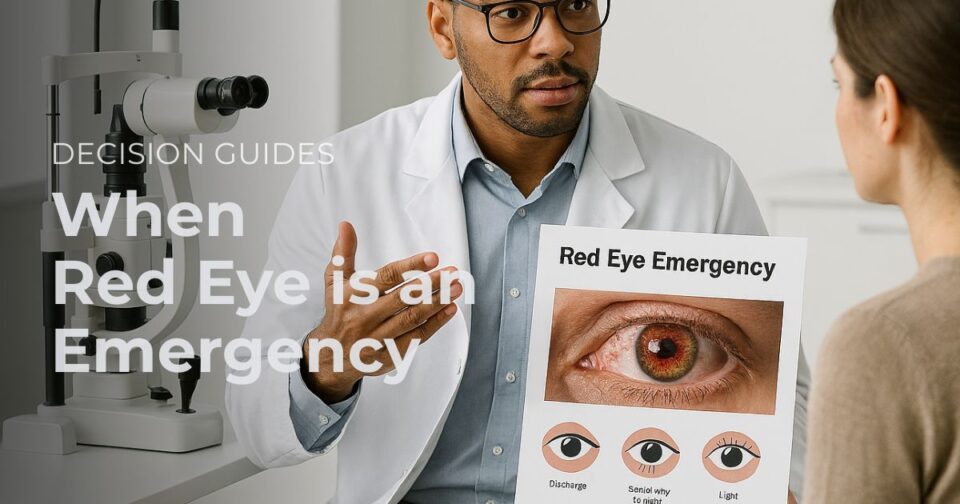
Patient educational image about when a red eye may be an emergency

Some red eyes are minor, but pain, blurred vision, light sensitivity, trauma, and chemical exposure can signal an emergency.

ROQUE Eye Clinic • Decision Guides

When Red Eye Is an Emergency

A practical patient guide to help you decide when a red eye can wait, when it needs same-day eye care, and when you should go straight to the emergency room.
🧠 Dr. Roque’s Quick Answer
A red eye is an emergency if it comes with pain, blurred vision, sensitivity to light, a recent injury, chemical exposure, a new contact lens problem, severe headache, nausea, or a suddenly very red eye. A simple pink eye usually causes irritation, tearing, or discharge, but it does not usually cause severe pain or major vision loss. When in doubt, it is safer to get the eye checked urgently.
Start Here Book Consultation
🎯 Focus
Help you recognize whether a red eye is likely minor, urgent, or a true emergency.
🧭 Goal
Reduce delay in dangerous red-eye conditions that can threaten vision.
🛡️ Evidence-Based
Built around common ophthalmic red flags used to separate conjunctivitis from sight-threatening disease.
Why this guide matters
“Red eye” sounds simple, but it is only a description, not a diagnosis. Sometimes the cause is mild, such as irritation, allergy, or conjunctivitis. Sometimes it is much more serious, such as a corneal infection, uveitis, chemical burn, acute glaucoma, or trauma. The danger is that many patients assume every red eye is “just sore eyes.” That assumption is where mistakes happen.
🚨 Dr. Roque’s Emergency Warning
Go to the emergency room immediately or seek urgent same-day eye care if you have any of the following:
  • Moderate to severe eye pain
  • Blurred vision, sudden drop in vision, or halos around lights
  • Light sensitivity that is significant or worsening
  • Chemical splash in the eye
  • Eye injury, foreign body, or trauma from metal, glass, tools, or high-speed objects
  • A red eye in a contact lens wearer, especially with pain or blurred vision
  • A very red eye with headache, nausea, or vomiting
  • A misshapen pupil, unequal pupils, or trouble opening the eye
  • New rash or blisters on the forehead, eyelid, or nose with red eye
  • Recent eye surgery or injection followed by redness, pain, or worsening vision

A simple decision rule

  1. If your vision is worse, do not treat it like routine pink eye.
  2. If the eye hurts, especially if the pain is deep or severe, do not self-treat for days.
  3. If light bothers the eye, be cautious. Photophobia often means the problem is deeper than simple surface irritation.
  4. If there was injury, chemical exposure, or contact lens use, raise the level of concern immediately.
  5. If nausea, vomiting, or severe headache comes with the red eye, think emergency until proven otherwise.

When a red eye is often less urgent

Some red eyes are uncomfortable but not usually dangerous. Examples include:
  • Mild viral conjunctivitis: watery eye, irritation, redness, often starts in one eye and spreads to the other
  • Allergic conjunctivitis: itching is often the main symptom, usually both eyes, often with tearing
  • Small subconjunctival hemorrhage: a bright red patch on the white of the eye with little or no pain and usually normal vision
  • Mild dry eye flare: burning, grittiness, fluctuating discomfort, often worse with screen use or air-conditioning
Less urgent does not mean ignore it forever. It means the problem is less likely to be immediately sight-threatening if you have normal vision, no significant pain, no major light sensitivity, and no trauma or contact lens risk.

When a red eye becomes urgent or emergent

1) Red eye with pain

Pain changes the whole triage level. Simple conjunctivitis usually causes irritation, stickiness, or scratchiness. It should not feel like a deep, aching, severe, or unbearable pain. Pain raises concern for corneal abrasion, corneal ulcer, uveitis, scleritis, acute glaucoma, or trauma.

2) Red eye with blurred vision

This is one of the most important warning signs. A patient may say, “It’s red, but I can still open it.” That is not enough. Ask the real question: Can you still see normally? If the answer is no, urgent evaluation is safer. Corneal infection, corneal swelling, uveitis, glaucoma, and internal inflammation can all reduce vision.

3) Red eye with light sensitivity

Light sensitivity matters because it often points away from simple conjunctivitis and toward corneal disease or internal inflammation. Patients commonly describe this as “I can’t stand the light,” or “It hurts more when light hits the eye.”

4) Red eye in a contact lens wearer

This is a trap that should never be minimized. A red, painful, or blurry eye in a contact lens user can mean keratitis or a corneal ulcer. That can worsen quickly and leave a scar even after treatment. Remove the lens, do not wear it again, and get checked urgently.

5) Red eye after chemical exposure

This is an emergency. Do not wait to see if it settles down. Start rinsing the eye immediately with clean running water and continue while seeking medical help. Alkali chemicals in particular can penetrate deeply and damage the eye fast.

6) Red eye after trauma

Trauma changes the story. Even if the eye looks “just red,” there may be a corneal abrasion, hidden foreign body, bleeding inside the eye, globe injury, or angle damage. High-speed metal, hammering, grinding, or mowing injuries deserve a lower threshold for urgent assessment.

7) Red eye with headache, nausea, vomiting, or halos

This pattern is especially concerning for acute angle-closure glaucoma. Patients may describe a red painful eye, blurred or misty vision, rainbow halos around lights, nausea, and sometimes vomiting. That is not something to “sleep off.”
Start Here Book Consultation

The conditions patients most often miss

Corneal ulcer / keratitis
Often causes redness, pain, tearing, blurred vision, and light sensitivity. Contact lens wearers are at special risk.
Uveitis
Often causes red eye, eye pain, photophobia, and blur. The inflammation is inside the eye, not just on the surface.
Acute angle-closure glaucoma
Usually presents with a painful red eye, blur, halos, headache, nausea, and vomiting.
Chemical injury
May look like “just redness” at first, but the damage can be severe and progress quickly.

What to do right now if your eye is red

  1. Check whether your vision is normal in each eye separately.
  2. Ask yourself whether the eye truly hurts or just feels irritated.
  3. Notice whether light makes the eye hurt more.
  4. Think about contact lens use, injury, chemical splash, or recent eye surgery.
  5. If any major red flag is present, stop self-medicating and seek urgent care.
  6. If a chemical entered the eye, rinse immediately and keep rinsing while getting help.
  7. Do not patch the eye or use leftover steroid drops without an eye doctor’s advice.
💡 Dr. Roque’s Analogy
Think of red eye the way you think of chest pain. Sometimes it turns out to be something minor. Sometimes it is the early sign of something dangerous. The mistake is not in being cautious. The mistake is in assuming all red eyes are harmless because many are common.
👁️ Anatomy Micro-Primer
The “white” of the eye is covered by a thin transparent membrane called the conjunctiva. Redness can come from this surface layer, but it can also come from the cornea, iris, internal eye structures, or drainage angle. That is why two eyes can both look red but have very different causes and very different levels of danger.
🧩 Terminology Glossary
  • Photophobia: light sensitivity
  • Keratitis: inflammation or infection of the cornea
  • Corneal ulcer: an open sore on the cornea, often from infection
  • Uveitis: inflammation inside the eye
  • Acute angle closure: sudden blockage of fluid drainage that can sharply raise eye pressure
  • Subconjunctival hemorrhage: a broken small blood vessel causing a bright red patch on the white of the eye
🧠 Dr. Roque’s Key Learning Points
  • Red eye is a symptom, not a diagnosis.
  • Severe pain, blurred vision, and photophobia are the big warning trio.
  • Contact lens wear plus red eye is never something to minimize.
  • Chemical splash requires immediate irrigation and urgent care.
  • A painful red eye with headache, nausea, or halos can be acute angle closure.
  • A bright red patch with no pain and normal vision is often less urgent, but not every red eye is that simple.
  • If you are unsure whether it is serious, it is safer to be checked early.

Who should not wait

  • Patients with only one badly affected eye
  • Patients who recently had eye surgery, laser, or an injection
  • Contact lens users
  • Children who cannot explain symptoms clearly
  • People with weak immune systems or significant medical illness
  • Anyone whose symptoms are worsening rather than improving
Book Consultation
📚 Related Reading
  • Red Eye
  • When Should I See an Eye Doctor?
  • Ocular Emergencies
  • Cornea and External Disease
  • Glaucoma
  • Book Consultation

Frequently Asked Questions

1) Is every red eye an emergency?

No. Many red eyes are mild. The problem is that some serious conditions begin with the same simple sign: redness.

2) What symptom worries you most?

A drop in vision. Severe pain and major light sensitivity are close behind.

3) Can conjunctivitis cause blurred vision?

It can cause temporary blur from discharge or tearing, but it should not cause true persistent vision loss.

4) I wear contact lenses. Should I wait a day or two?

Not if the eye is painful, red, or blurry. Contact lens-related corneal infection can worsen quickly.

5) What if a chemical splashed into my eye?

Start flushing the eye immediately with plenty of water and seek urgent medical care right away.

6) Is a painless bright red patch on the eye dangerous?

It is often a subconjunctival hemorrhage and usually less urgent if vision is normal and there is no trauma. It still deserves context if recurrent.

7) Can glaucoma make the eye red?

Yes. Acute angle-closure glaucoma can cause a painful red eye, blurry vision, halos, headache, nausea, and vomiting.

8) What should I avoid putting in the eye before I am checked?

Avoid using leftover steroid drops or random medicated drops unless specifically advised by an eye doctor.

9) Can I still drive myself if my eye is red?

Do not drive if vision is blurred, the eye is very painful, or you feel unwell.

10) When should I seek help even if I am not sure it is serious?

If you are uncertain and any red flag is present, seek urgent care. Delay causes more harm than caution in potentially sight-threatening red eyes.

✅ Dr. Roque’s Take-Home Message
Do not judge a red eye by redness alone. Judge it by pain, vision, light sensitivity, injury history, contact lens use, and associated symptoms. If the eye is red and you also have pain, blur, photophobia, trauma, or chemical exposure, treat it as urgent until an eye examination proves otherwise.
References
  1. National Eye Institute. Pink Eye.
  2. National Eye Institute. Uveitis.
  3. National Eye Institute. Corneal Conditions.
  4. American Academy of Ophthalmology. Conjunctivitis Preferred Practice Pattern.
  5. American Academy of Ophthalmology. Herpes Simplex Virus Keratitis: A Treatment Guideline.
  6. American Academy of Ophthalmology. Common Types of Eye Infections: Symptoms and Treatment.
  7. NICE Clinical Knowledge Summaries. Primary angle closure glaucoma.
  8. NHS. Eye injuries.
  9. American Family Physician. Red flags for red eye.
ROQUE Eye Clinic Patient Education Series
Reviewed by the Roque Advisory Council
Dr. Manolette Roque | Dr. Barbara Roque
St. Luke’s Medical Center Global City | Asian Hospital Medical Center
Philippines
Medical Disclaimer: This page is for patient education only and does not replace an in-person eye examination, diagnosis, or treatment. If you have severe pain, sudden vision changes, chemical exposure, trauma, or other red-flag symptoms, seek urgent medical care immediately.
Back to top ↑
Share

Dr. Manolette Roque

Dr. Manolette Roque is an ophthalmologist whose practice includes general ophthalmology (which includes cataract surgery) with subspecialty work in uveitis and ocular immunology, cornea and external disease, and refractive surgery.

Taguig

St. Luke’s Global City

2nd Floor, Unit 217
Medical Arts Building
Rizal Drive corner 5th Avenue
Bonifacio Global City, Taguig 1634
Philippines

+63 (917) 844 2020
+63 (998) 998 2020
+63 (2) 8828 2020
+63 (2) 8789 7700 loc 7217/7218
stlukes@eye.com.ph

Clinic Hours
Mon to Sat | 7 a.m. to 4 p.m.
Closed on Sundays and Holidays

Open Map

Muntinlupa

Asian Hospital

5th Floor, Unit 509
Medical Office Building
2205 Civic Drive, Filinvest City
Alabang, Muntinlupa 1781
Philippines

+63 (917) 795 2020
+63 (998) 997 2020
+63 (2) 8771 9253
+63 (2) 8771 9000 loc 7509
asian@eye.com.ph

Clinic Hours
Mon to Sat | 7 a.m. to 4 p.m.
Closed on Sundays and Holidays

Open Map

Quick Actions

Need Help Getting Started?

Book Consultation Start Here Email Us
ROQUE Eye Clinic QR code

After-hours note
Messages received after clinic hours are answered on
the next clinic day. For urgent eye concerns,
proceed to the nearest emergency room.

© 2026 ROQUE Eye Clinic | www.Eye.com.ph
Clear Guidance. Trusted Eye Care.
Terms & Conditions | Privacy | Sitemap
  • Shop