
Refractive Surgery for High Myopia
🧠 Dr. Roque's Quick Answer
Refractive surgery for high myopia can be possible, but it requires more careful screening than lower prescriptions. Some patients may qualify for LASIK, PRK, or SMILE, while others are better suited for ICL or lens-based surgery. The safest choice depends on corneal thickness, corneal shape, retinal health, dry eye status, age, and visual goals—not just the eyeglass power.
High myopia is not just “strong nearsightedness.” It is a higher-risk refractive profile that often needs deeper planning before surgery. A patient with a large minus prescription may still be a good surgical candidate, but the margin for error is usually smaller. More tissue may need to be treated, corneal safety may become more important, and the stretched eye of a highly myopic patient may carry separate retinal and glaucoma risks even if the refractive surgery itself goes well.
That is why the most important question is not “Can high myopia be treated?” The better question is “Which treatment is safest and most appropriate for this eye over the long term?”
🧩 Focus: Refractive surgery planning for patients with high myopia
👁 Goal: Explain candidacy, procedure options, risks, screening needs, and realistic expectations in high myopia
🛡 Evidence-Based: Preferred Practice Patterns • Standards of Care • Systematic Reviews • Meta-Analyses
ROQUE REFRACTIVE SURGERY Knowledge Hub
Start with the complete guide:
🔬 Refractive Surgery for High Myopia Anatomy Micro-Primer
- Cornea: This is the clear front window of the eye. Laser procedures reshape it, so thickness and shape matter a great deal in high myopia.
- Retina: This light-sensitive layer lines the back of the eye. Highly myopic eyes may have more stretching, lattice degeneration, holes, or detachment risk.
- Macula: The center of the retina responsible for sharp vision. High myopia can be associated with myopic macular changes that affect final visual quality.
- Anterior chamber: This space in the front part of the eye matters when considering phakic IOLs such as ICL, because adequate depth and sizing are needed.
📘 Refractive Surgery for High Myopia Terminology Glossary
- High myopia: Severe nearsightedness, often defined clinically around -6.00 diopters or more, though definitions vary by source.
- Residual stromal bed: The amount of corneal tissue left behind after laser treatment. Too little can raise safety concerns.
- ICL: Implantable collamer lens, a phakic intraocular lens placed inside the eye without removing the natural lens.
- Ectasia: Progressive corneal weakening and bulging that can happen when a cornea is structurally unsafe for laser surgery.
- Retinal detachment: A condition in which the retina pulls away from the back of the eye and may require urgent treatment.
- Pathologic myopia: High myopia associated with structural eye changes such as retinal, choroidal, or macular damage.
Quick Navigation
Related Reading
Dr. Roque's Key Learning Points
- High myopia can often be treated, but it needs more careful screening than lower prescriptions.
- The best procedure depends on corneal safety, retinal status, age, and lifestyle, not just spectacle power.
- Laser procedures may work for some patients, but tissue removal and ectasia risk matter more as myopia increases.
- ICL is often discussed for high myopia, especially when corneal laser treatment is less ideal.
- Highly myopic eyes still need lifelong retinal and general eye monitoring even after successful refractive surgery.
What High Myopia Means in Refractive Surgery Planning
High myopia usually means a stronger degree of nearsightedness than average. In practical surgery planning, it often signals that the eye needs a more conservative, more individualized approach. Stronger myopia may require more corneal reshaping if laser surgery is chosen. That can reduce the amount of tissue left behind and may affect long-term biomechanical safety. At the same time, high myopia can be linked to a longer eye, stretched retinal tissue, earlier cataract tendencies, and greater lifetime risk of retinal detachment, glaucoma, and myopic retinal disease.
This means refractive surgery in high myopia is never just about “getting rid of thick glasses.” It is also about choosing a procedure that respects the anatomy and risk profile of the entire eye.
💡 Dr. Roque's Analogy
Treating high myopia is like renovating a tall, older building. You can improve how the windows work, but you still have to respect the building’s structure. In the eye, the “structure” includes the cornea, retina, lens, and overall long-term stability.
Why High Myopia Is Different from Lower Myopia
Patients with low or moderate myopia may have broader procedure choices because the laser treatment is smaller and the structural stress on the cornea may be less. In high myopia, every part of decision-making becomes more important:
- More correction may mean more corneal tissue removal if laser surgery is used.
- Thin or suspicious corneas may not safely tolerate corneal laser treatment.
- Retinal examination matters more because highly myopic eyes have higher peripheral and macular risk.
- Visual expectations may be more complex, especially if there is pre-existing myopic retinal disease.
- Alternative procedures such as ICL may become more attractive.
Even when surgery achieves an excellent refractive result, it does not erase the underlying biology of a highly myopic eye. The patient may still remain a high-risk retina patient afterward.
Procedure Options for High Myopia
1) LASIK
LASIK may still be appropriate for selected patients with high myopia, but only if the cornea is thick enough, structurally regular, and expected to remain biomechanically safe after treatment. As myopia increases, some patients run out of safe corneal tissue before they run out of refractive error. In that situation, LASIK may not be the best option even if the patient likes the idea of fast recovery.
2) PRK or TransPRK
Surface ablation may be considered when a flap-free corneal procedure is preferred. However, high myopia still requires enough structural safety, and surface ablation does not remove the need for caution about undercorrection, regression, or healing variability in stronger prescriptions.
3) SMILE
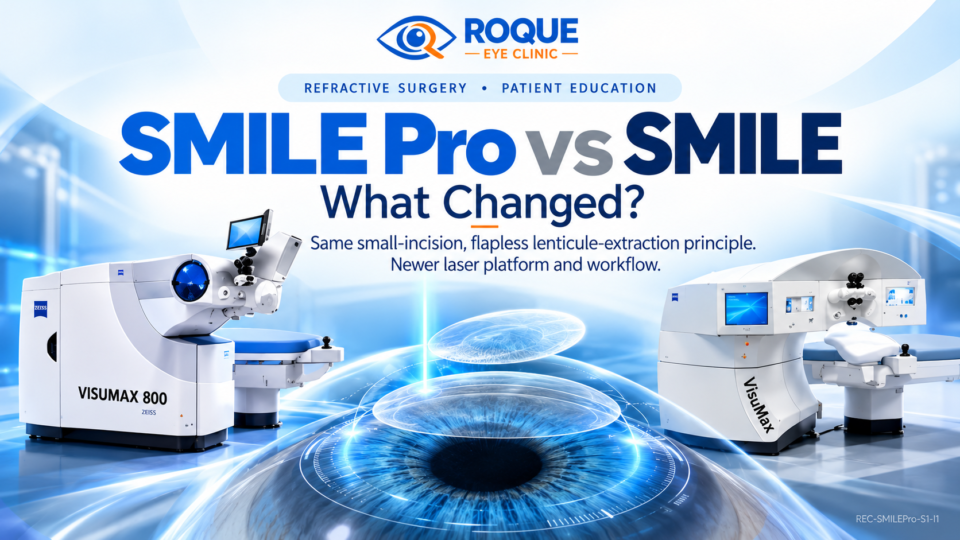
SMILE can be effective for moderate to high myopia in selected patients. It may have advantages in some cases, but outcome quality still depends on degree of myopia, residual corneal thickness, centration, and the patient’s overall anatomy. It is not automatically the best option simply because the prescription is high.
4) ICL
ICL is often one of the most important discussions in high myopia. Because it corrects refractive error with an implanted lens rather than large corneal laser tissue removal, it can be very attractive for patients with strong prescriptions, thinner corneas, or corneas that are structurally less ideal for laser treatment. Proper sizing, vault, endothelial monitoring, and anterior segment assessment remain essential.
5) Lens replacement surgery
Lens-based surgery may be considered in selected older patients, especially when presbyopia or early lens dysfunction is already present. However, refractive lens exchange in myopic eyes needs careful counseling because intraocular surgery in a highly myopic eye has its own trade-offs, including retinal considerations. Younger high myopes are often approached more cautiously when lens removal is being considered purely for refractive reasons.
Which High-Myopia Patients May Be Better Served by ICL?
Many surgeons think about ICL when the glasses power is high enough that laser treatment would remove too much corneal tissue, leave an unsafe residual bed, or produce more regression risk than desired. ICL may also be favored when the cornea is thin, topography is less reassuring, or the patient wants a non-corneal refractive solution. That does not mean ICL is “better for everyone.” It means it may fit the anatomy better in some highly myopic eyes.
Essential Screening Tests Before Surgery
High myopia deserves a more complete screening mindset. Important parts of the work-up often include:
- Detailed refraction, including confirmation of stability
- Corneal topography or tomography
- Pachymetry
- Ocular surface and dry-eye evaluation
- Pupil and optical quality review
- Intraocular pressure and optic nerve assessment
- Dilated retinal examination
- Macular evaluation when indicated
- Anterior chamber measurements and sizing studies for ICL candidates
- Lens assessment, especially in older patients or those with early dysfunctional lens change
In high myopia, skipping a retinal exam is a major mistake. The refractive plan may look perfect on the front surface of the eye while the back of the eye still has tears, holes, or myopic degeneration that changes counseling and timing.
🚨 Dr. Roque's Emergency Warning
Highly myopic patients who notice sudden flashes, many new floaters, a curtain over vision, sudden distortion, or a fast drop in vision should seek urgent ophthalmic assessment. These symptoms may suggest retinal tear, retinal detachment, or other sight-threatening retinal events.
Main Risks and Trade-Offs in High Myopia
Corneal safety concerns
For corneal laser procedures, the main concern is not just whether the treatment can be programmed. It is whether enough healthy corneal tissue will remain and whether the cornea is biomechanically safe afterward.
Regression and undercorrection
Higher corrections may have more tendency toward undercorrection or later drift, depending on the procedure and the eye’s healing pattern.
Dry eye and visual quality symptoms
Any refractive surgery can affect the ocular surface and quality of vision. High-myopia patients should be counseled carefully about glare, halos, contrast changes, and dry eye symptoms, especially if they already have heavy screen use or pre-existing surface disease.
Retinal and long-term eye-health issues
Successful refractive surgery does not remove the background risks of high myopia. The patient may still need ongoing dilated retinal care and monitoring for glaucoma, myopic maculopathy, cataract, or other complications associated with a long myopic eye.
Intraocular procedure risks
If ICL or lens-based surgery is chosen, the conversation changes from corneal safety to intraocular safety issues such as sizing, vault, lens status, endothelial health, pressure response, cataract risk, and retinal follow-up.
How Surgeons Choose the Best Option
In high myopia, procedure choice is usually a balancing act between precision, safety, recovery, and long-term eye health. A simplified way to think about it is this:
- If the cornea is thick, regular, and structurally reassuring: LASIK, PRK, or SMILE may still be discussed.
- If the prescription is very high or the cornea is less ideal: ICL often becomes a stronger candidate.
- If the patient is older or has early lens dysfunction/presbyopia: lens-based solutions may enter the discussion.
- If the retina is unstable or the cornea is unsafe: surgery may need to be deferred, redirected, or avoided.
The correct answer is highly individual. Two patients with the same glasses power may receive very different recommendations because their corneal maps, retinal findings, age, and lifestyle are different.
Realistic Expectations in High Myopia
Many highly myopic patients hope to become completely glasses-free. Some achieve that. Others still use glasses occasionally for fine-detail tasks, night driving, or future reading needs. The more important target is often not “perfect vision at all distances forever,” but rather a safer, well-matched correction strategy with excellent functional vision and a healthy long-term plan.
Patients should also understand that surgery cannot reverse myopic retinal disease, glaucoma damage, or other back-of-the-eye pathology. Refractive surgery can change how light focuses, but it cannot rebuild damaged retinal tissue.
Questions Worth Asking If You Have High Myopia
- Is my cornea safe for laser treatment?
- Would ICL be safer or more predictable for my prescription?
- Do I have any retinal findings that need treatment first?
- Am I at higher risk of regression or night-vision symptoms?
- How much long-term retinal follow-up will I still need after surgery?
- Would my age or lens status change your recommendation?
Continue Reading
🏁 Dr. Roque's Take-Home Message
High myopia does not automatically rule out refractive surgery, but it raises the importance of good screening and good judgment. The best procedure may be laser surgery for one patient, ICL for another, and no surgery yet for a third. In high myopia, the safest choice is the one that respects both the front of the eye and the back of the eye.
FAQ
1) Can high myopia be corrected with refractive surgery?
Yes, sometimes. Some patients with high myopia qualify for LASIK, PRK, or SMILE, while others are better suited for ICL or another lens-based option. The decision depends on anatomy, not just prescription strength.
2) Is ICL better than LASIK for high myopia?
Not for everyone, but ICL is often considered when the prescription is high enough that laser treatment would remove too much corneal tissue or when the cornea is less suitable for laser surgery.
3) If I have high myopia, do I still need retinal checkups after surgery?
Yes. Refractive surgery changes focusing power, but it does not remove the lifetime retinal risks associated with a highly myopic eye.
4) Does successful surgery mean my eye is no longer “high risk”?
No. You may become less dependent on glasses, but the eye can still remain anatomically highly myopic and still need long-term monitoring.
5) Why might I be rejected for LASIK even if my friend with a similar prescription qualified?
Because candidacy depends on much more than the glasses number. Corneal thickness, topography, dry eye, pupil size, retinal findings, age, and lens status can all change the recommendation.
6) Can surgery remove the risk of retinal detachment in high myopia?
No. Surgery can correct the refractive error, but it does not eliminate the retinal detachment risk that comes from having a highly myopic eye.
📚 References
- American Academy of Ophthalmology. Refractive Surgery Preferred Practice Pattern®. Updated 2024.
- National Eye Institute. Nearsightedness (Myopia).
- Du Y, et al. Complications of high myopia: An update from clinical manifestations to underlying mechanisms. 2024.
- Reinstein DZ, et al. A review of posterior chamber phakic intraocular lenses. 2024.
- Baur ID, et al. Refractive Lens Exchange: A Review. 2024.
🤝 Roque Eye Clinic Patient Education Series
Dr. Manolette Roque | Dr. Barbara Roque
St. Luke's Medical Center Global City | Asian Hospital Medical Center
Philippines
Medical Review: Roque Advisory Council
Last Updated: March 2026
Medical Disclaimer
This article is intended for educational purposes only and does not replace professional medical consultation.