



ICL Risks, Recovery, and Outcomes
🧠 Quick Answer
ICL surgery can provide excellent vision correction for many suitable patients, especially in moderate to high myopia, but it is still an intraocular procedure with real risks. Recovery is usually fast, with useful vision often improving within days, but careful follow-up is important to watch for eye pressure problems, abnormal vault, cataract formation, inflammation, lens rotation in toric cases, and rare but serious complications such as infection.
Implantable collamer lens surgery, often called ICL surgery, is one of the most important lens-based refractive procedures in modern ophthalmology. Many patients like it because the cornea is not reshaped with an excimer laser, the natural lens stays in place, and the treatment can be very effective for higher degrees of myopia and astigmatism in properly selected eyes.
Still, ICL is not a “risk-free upgrade.” It is an operation performed inside the eye. That alone makes the conversation about risks, recovery, and outcomes especially important. The right candidate can do very well. The wrong candidate can face avoidable problems. This guide explains what patients should realistically expect before, during, and after ICL surgery.
🧩 Focus: Risks, recovery, and expected outcomes after ICL surgery
👁 Goal: Help patients understand safety, healing, follow-up, common side effects, uncommon complications, and long-term expectations after implantable collamer lens surgery
🛡 Evidence-Based: Preferred Practice Patterns • Standards of Care • Systematic Reviews • Meta-Analyses
REFRACTIVE SURGERY Knowledge Hub
Start with the complete guide:
🔬 ICL Risks, Recovery, and Outcomes Anatomy Micro-Primer
- Cornea: The clear front window of the eye. Unlike LASIK or PRK, ICL surgery does not reshape the cornea to correct vision.
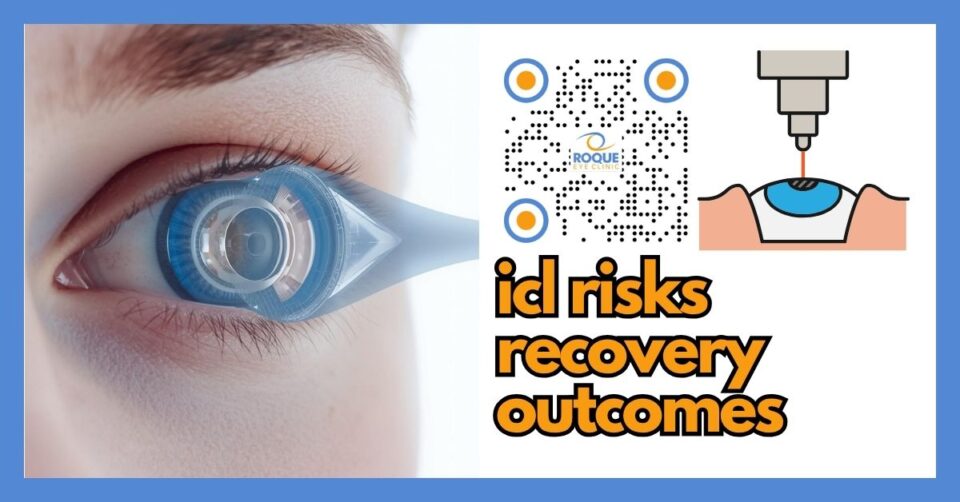
- Iris: The colored part of the eye. The ICL sits behind the iris and in front of the natural lens.
- Natural lens: Your own lens remains inside the eye during ICL surgery. This is one reason cataract formation is a specific counseling point.
- Anterior chamber: The front part of the eye where space, angle anatomy, and fluid flow matter for safe ICL positioning and pressure control.
📘 ICL Risks, Recovery, and Outcomes Terminology Glossary
- ICL: Implantable collamer lens, a phakic intraocular lens placed inside the eye while keeping the natural lens.
- Vault: The space between the ICL and the natural lens. Too little or too much vault can cause problems.
- Toric ICL: An ICL designed to correct astigmatism. It must stay properly aligned.
- Intraocular pressure: The pressure inside the eye. It can rise after surgery and requires monitoring.
- Endothelial cells: Important cells lining the inner cornea. Long-term monitoring may include watching their health.
- Cataract: Clouding of the natural lens. Although uncommon in well-selected modern ICL cases, it remains a known risk.
Quick Navigation
Related Reading
Key Learning Points
- ICL can produce excellent vision in well-selected patients, especially in moderate to high myopia and myopic astigmatism.
- Recovery is often faster than surface laser procedures, but ICL is still an intraocular surgery and requires close follow-up.
- Main counseling points include pressure spikes, vault-related problems, cataract risk, inflammation, glare or halos, and toric lens rotation.
- Most patients do well, but “doing well” depends heavily on good screening, accurate sizing, and careful postoperative monitoring.
- Patients should understand both the benefits and the fact that rare vision-threatening complications can occur.
What to Expect After ICL Surgery
Many patients notice visual improvement quickly after ICL surgery. Some describe the first day as surprisingly clear, while others notice mild blur, glare, light sensitivity, or a slightly “watery” feeling early on. Vision can fluctuate at first, especially if the pupil is still reacting to drops, if there is mild corneal swelling at the incision, or if the eye is still adjusting in the early postoperative period.
A helpful way to think about ICL recovery is this: the eye often looks calm from the outside quite early, but the inside of the eye still needs time for pressure stabilization, inflammation control, and confirmation that the ICL is sitting where it should. Good recovery is not judged by vision alone. It also depends on safe pressure, good vault, a healthy cornea, a quiet anterior chamber, and stable lens position.
💡 Analogy
ICL surgery is a bit like installing a custom lens inside a camera without removing the camera’s original focusing system. When the fit is correct, the result can be excellent. But because the new lens sits inside a very delicate space, the fit and follow-up matter just as much as the initial installation.
Early Recovery Timeline
First 24 hours
Useful vision often improves early, but blur, glare, mild discomfort, redness, or light sensitivity are still possible. The first review is important because this is when surgeons often confirm lens position and check eye pressure.
First week
Many patients feel significantly better within days. Vision usually becomes more stable, but some fluctuation can continue. Drops are commonly used to control inflammation and prevent infection. If the lens is toric, early rotation or alignment concerns may become noticeable during follow-up.
First month
By this point, many patients have a good sense of their visual result. Surgeons continue checking refraction, pressure, vault, and lens position. Residual refractive error, glare symptoms, or vault-related concerns may become clearer with time.
Longer-term follow-up
Even if early recovery is smooth, long-term monitoring still matters. The lens is inside the eye, so future visits may include checks for cataract change, pressure issues, endothelial health, and the ongoing relationship between the ICL and surrounding eye structures.
Common Side Effects That May Happen Even in Normal Recovery
- Mild redness
- Light sensitivity
- Temporary blur or fluctuating vision
- Glare, halos, or night-vision symptoms
- A foreign-body sensation from the small incision or surface dryness
- Mild discomfort rather than severe pain
These issues do not always mean something is wrong. The key question is whether symptoms are staying within the expected recovery range or becoming worse instead of better.
Main Risks and Complications of ICL Surgery
1) Eye pressure rise
One of the most important early postoperative concerns is increased intraocular pressure. This can happen from retained viscoelastic, steroid response, angle crowding, or abnormal vault. Pressure elevation may be temporary and manageable, but it can threaten the optic nerve if missed or prolonged.
2) Abnormal vault
Vault is the distance between the ICL and the natural crystalline lens. If the vault is too low, the lens may sit too close to the natural lens and raise concern for cataract formation. If the vault is too high, there may be crowding in the front of the eye, with possible pressure or angle-related problems. This is one reason sizing and follow-up are so important.
3) Cataract formation
Modern ICL design and proper patient selection have improved safety, but cataract remains a known risk in phakic lens surgery. The concern is generally greater when the lens sits too close to the natural lens or when other risk factors are present. Cataract may occur early in problematic cases or later over time.
4) Lens rotation or misalignment
This is especially relevant for toric ICLs used to correct astigmatism. If the lens rotates, the astigmatism correction becomes less accurate and visual quality can drop. Some rotations are minor, while others may require repositioning.
5) Inflammation
Because this is intraocular surgery, postoperative inflammation matters. Mild inflammation is expected and usually treated with drops. More significant inflammation needs prompt evaluation and careful management.
6) Infection
Endophthalmitis is rare, but it is one of the most serious complications of any intraocular procedure. Patients must understand that severe pain, marked redness, or rapid vision loss after surgery are emergency symptoms.
7) Glare, halos, and quality-of-vision symptoms
Some patients report halos, starbursts, or nighttime visual symptoms, especially early after surgery. In many patients these improve with time, but not every symptom fully disappears. Expectations must be realistic.
8) Residual refractive error
No refractive surgery can promise mathematically perfect vision for every patient. Some people may still need glasses for certain tasks, and some may need further management if there is meaningful residual error.
9) Endothelial cell concerns
Long-term follow-up in phakic IOL patients may include endothelial monitoring. These cells help keep the cornea clear. Their health is part of the broader long-term safety picture.
🚨 Emergency Warning
Seek urgent ophthalmic review if you develop severe pain, rapidly worsening redness, a sudden major drop in vision, marked nausea with eye pain, a curtain-like visual change, or symptoms that are clearly getting worse instead of better after ICL surgery.
How Safe Is ICL Surgery Overall?
In properly screened patients, modern EVO/Visian ICL outcomes are generally strong, and serious adverse events appear uncommon. That is why many surgeons consider ICL a very good option for selected myopic patients, especially when corneal laser surgery is less ideal. However, “uncommon” is not the same as “impossible.” Safety depends on anatomy, accurate sizing, surgical technique, postoperative care, and long-term monitoring.
Put simply, ICL is often safe when it is appropriate. It is not safe just because it is popular, premium, or reversible in theory. Good patient selection remains the foundation of good outcomes.
Expected Outcomes After ICL Surgery
Excellent uncorrected vision for many patients
Many modern studies report strong refractive predictability and high proportions of patients reaching good unaided distance vision. This is one reason ICL continues to grow in refractive practice.
Particularly valuable in higher myopia
ICL is often discussed for patients with moderate to high myopia, or for those in whom corneal laser treatment is less appealing because of corneal thickness, shape, or tissue-preservation concerns.
Possible need for long-term monitoring even when vision is good
A patient can be visually happy and still need monitoring. Good vision does not remove the need to watch vault, pressure, lens clarity, and corneal endothelial health over time.
What Affects the Final Outcome?
- Quality of preoperative screening and sizing
- Anterior chamber depth and angle anatomy
- Amount of myopia and astigmatism
- Lens alignment in toric cases
- Postoperative pressure control
- Vault behavior over time
- Patient adherence to drops and follow-up
- Age-related lens change in the future
When ICL Recovery May Feel Slower Than Expected
Not every patient has dramatic next-day clarity. Recovery may feel slower if the pupil is still reacting to medication, if there is temporary corneal edema at the incision, if the ocular surface is dry, or if the surgeon is still watching pressure or vault closely. Some patients also become very aware of nighttime halos in the first weeks and mistake that for surgical failure when it may simply be part of early neuroadaptation and healing.
When to Call Your Surgeon
- Severe pain rather than mild soreness
- Sudden drop in vision
- Persistent nausea or headache with eye pain
- Marked redness or discharge
- Halos or blur that are rapidly worsening
- Symptoms that make you feel something is clearly not normal
Continue Reading
🏁 Take-Home Message
ICL surgery can deliver excellent visual outcomes in the right patient, but it is not just a premium alternative to laser surgery—it is an intraocular procedure that needs careful screening and follow-up. Most patients recover well, often with fast visual improvement, but safety depends on proper sizing, good vault, pressure control, and long-term monitoring for uncommon but important complications.
FAQ
1) Is ICL safer than LASIK?
They are different procedures with different risk profiles. ICL avoids corneal tissue removal and flap-related issues, but it is intraocular surgery, so it carries internal-eye risks that LASIK does not.
2) How long does it take to recover after ICL surgery?
Many patients notice useful visual improvement within days, but full recovery is not judged by vision alone. Surgeons also monitor pressure, vault, inflammation, and lens position in the weeks after surgery.
3) Can ICL cause cataracts?
Cataract is a known risk, although it is uncommon in properly selected modern cases. The relationship between the ICL and the natural lens, especially vault, is one reason follow-up matters.
4) What is vault and why is it important?
Vault is the space between the ICL and your natural lens. Too little or too much space can increase the risk of complications, including cataract or pressure-related problems.
5) Can toric ICL rotate after surgery?
Yes. If a toric ICL rotates enough, the astigmatism correction may become less accurate and the surgeon may need to reposition it.
6) Will I still need checkups if my vision is already good?
Yes. Good early vision does not remove the need for long-term follow-up because the ICL remains inside the eye and needs ongoing monitoring.
📚 References
- American Academy of Ophthalmology. Refractive Surgery Preferred Practice Pattern®. Updated 2024.
- U.S. Food and Drug Administration. EVO and EVO+ Visian Implantable Collamer Lens (ICL) Patient Information Booklet.
- Albo C, et al. A Comprehensive Retrospective Analysis of EVO/EVO+ Implantable Collamer Lens Evaluating Refractive Outcomes in the Largest Single-Center Study of ICL Patients in the United States. 2024.
- Parkhurst G, et al. Three Year Results from the United States FDA Prospective Clinical Study of the EVO Implantable Collamer Lens. 2025.
- Passaro ML, et al. Potential Harms of Posterior Chamber Phakic Intraocular Lens. 2026.
🤝 Roque Eye Clinic Patient Education Series
Dr. Manolette Roque | Dr. Barbara Roque
St. Luke's Medical Center Global City | Asian Hospital Medical Center
Philippines
Medical Review: Roque Advisory Council
Last Updated: March 2026
Medical Disclaimer
This article is intended for educational purposes only and does not replace professional medical consultation.