

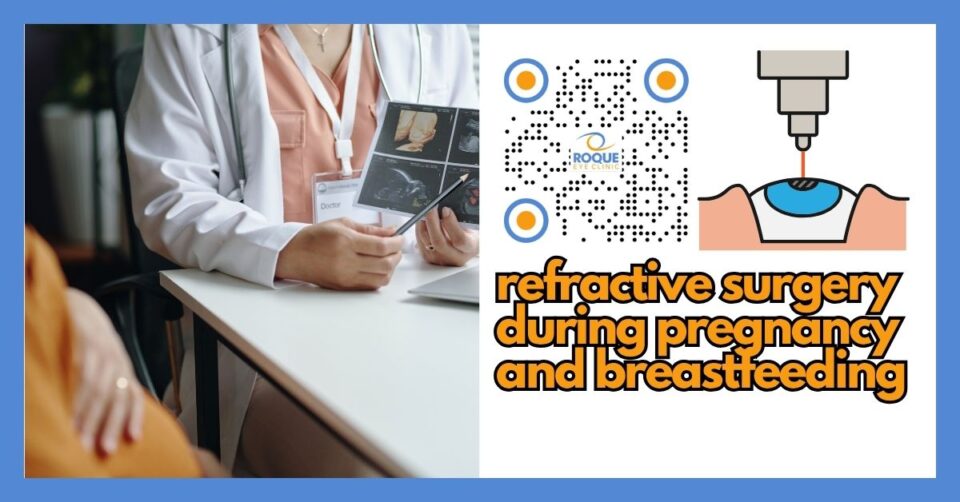
Refractive Surgery During Pregnancy and Breastfeeding
🧠 Dr. Roque's Quick Answer
Refractive surgery during pregnancy and breastfeeding is usually deferred. Hormonal changes can temporarily affect refraction, corneal thickness, tear film, and visual stability. Because laser vision correction aims to treat a stable prescription, most surgeons prefer to wait until pregnancy is over, breastfeeding has ended, and the refraction has remained stable before proceeding.
Many patients ask whether they can have LASIK, PRK, SMILE, or another refractive procedure while pregnant or breastfeeding. The short practical answer is that most refractive surgeons prefer to wait. This is not because pregnancy automatically damages the eye. It is because pregnancy and lactation can change the eye in ways that make measurements less reliable, healing less predictable, and final results less stable.
Refractive surgery is elective. That matters. When a procedure is optional, most surgeons choose the safest timing rather than the fastest timing. If your prescription may still shift, your cornea may temporarily change, or your tear film may be worse than usual, it often makes sense to postpone surgery until your body and your eyes return to a more stable baseline.
🧩 Focus: Safety, timing, and counseling for refractive surgery during pregnancy and breastfeeding
👁 Goal: Help patients understand why refractive surgery is usually deferred during pregnancy and lactation, and what should happen before surgery is reconsidered
🛡 Evidence-Based: Preferred Practice Patterns • Standards of Care • Systematic Reviews • Meta-Analyses
ROQUE REFRACTIVE SURGERY Knowledge Hub
Start with the complete guide:
🔬 Pregnancy and Breastfeeding Anatomy Micro-Primer
- Cornea: The clear front window of the eye. Pregnancy-related hormonal changes can affect corneal hydration, curvature, and thickness.
- Tear film: This thin layer of tears coats the eye surface. Pregnancy and lactation can worsen dryness, which may affect comfort, measurements, and healing.
- Lens and refraction system: Vision depends on how light is focused through the cornea and lens. Temporary refractive shifts can occur during pregnancy.
- Retina: Although refractive surgery itself works on the front of the eye, pregnancy can also be associated with retinal or vascular issues in some patients, especially when systemic disease is present.
📘 Pregnancy and Breastfeeding Terminology Glossary
- Refraction: The measured glasses or contact lens prescription.
- Refractive stability: A prescription that has remained unchanged for a reasonable period of time.
- Dry eye: A condition in which tears are not stable or sufficient, causing discomfort and blurry or fluctuating vision.
- LASIK: Laser vision correction that reshapes the cornea under a corneal flap.
- PRK: A flap-free laser vision correction procedure done on the corneal surface.
- Lactation: The period when a person is producing breast milk.
Quick Navigation
Related Reading
Dr. Roque’s Key Learning Points
- Refractive surgery during pregnancy and breastfeeding is usually postponed because eye measurements may be temporarily unstable.
- Pregnancy can affect corneal thickness, corneal curvature, dry eye symptoms, and refraction.
- Breastfeeding may also be associated with hormonal changes and tear-film instability, so many surgeons still prefer to wait.
- This timing issue applies not only to LASIK, but also to PRK, SMILE, and other elective refractive procedures.
- Most patients are best served by waiting until pregnancy is over, breastfeeding has ended, and the refraction has been rechecked for stability.
Why Refractive Surgery Is Usually Deferred During Pregnancy and Breastfeeding
Refractive surgery aims to treat a stable refractive error. Pregnancy can temporarily change the cornea, the tear film, and the measured prescription. If surgery is performed during a time of hormonal fluctuation, the treatment may be based on numbers that later shift again. That can reduce predictability and may increase the chance of dissatisfaction or the need for glasses or enhancement later.
There is also a practical medication issue. Refractive procedures usually involve eye drops before and after surgery, and some postoperative medications may not be ideal to use casually during pregnancy or lactation without careful risk-benefit review. Because refractive surgery is elective rather than urgent, the conservative choice is usually to delay it.
💡 Dr. Roque's Analogy
Planning refractive surgery during pregnancy is like tailoring clothes while your body measurements are still changing. Even if the tailor is excellent, the fit may not stay the same once your measurements settle again.
What Can Change in the Eye During Pregnancy
1) Refraction can shift
Some patients notice that their glasses prescription seems different during pregnancy. This change is often temporary. A temporary shift matters a great deal when deciding whether to reshape the cornea permanently.
2) The cornea can become thicker or change shape
Pregnancy-related hormonal changes can affect corneal hydration, curvature, and thickness. These changes may alter topography, pachymetry, and other measurements used to decide whether laser surgery is safe and how much treatment is needed.
3) Dry eye can worsen
Dry eye and tear-film instability are common concerns in refractive surgery even without pregnancy. During pregnancy and lactation, dryness may be worse. A poor tear film can reduce measurement accuracy, increase discomfort, and complicate recovery after surgery.
4) Contact lens intolerance can increase
Some pregnant patients find their contact lenses suddenly less comfortable. That symptom may signal corneal or tear-film changes. It is another clue that the eye may not be at its usual baseline.
Why These Changes Matter for LASIK, PRK, and SMILE
All corneal refractive procedures depend on careful measurements. The surgeon wants the manifest refraction, cycloplegic refraction when appropriate, corneal mapping, epithelial or stromal measurements, and ocular surface findings to reflect the patient’s usual state. If pregnancy has temporarily shifted those numbers, the planned treatment may no longer match the eye later on.
This is why the issue is bigger than simply asking, “Can a laser be used during pregnancy?” The more important question is, “Are the measurements stable enough to justify a permanent elective reshaping of the cornea?” In most cases, the answer is that it is wiser to wait.
Why Breastfeeding Still Matters
Some patients think the timing problem disappears as soon as delivery is over. In practice, many surgeons still defer surgery while the patient is breastfeeding. Hormonal influences may continue, the tear film may still be unstable, and the refraction may not yet have returned to its long-term baseline. In addition, postoperative drop use may still require extra caution during lactation.
This does not mean every breastfeeding patient has unstable vision. It means that because refractive surgery is elective, surgeons often choose the more conservative path and wait until breastfeeding has ended and the eyes have been rechecked.
Which Refractive Procedures Does This Affect?
This counseling applies broadly to elective refractive procedures, including:
- LASIK
- PRK
- TransPRK
- LASEK
- Epi-LASIK
- SMILE
- Lens-based refractive surgery when elective timing is flexible
The common theme is not the brand name of the procedure. It is the need for stable measurements, predictable healing, and careful use of perioperative medications.
Could There Be Exceptions?
In medicine, there are few absolutes. However, refractive surgery during pregnancy or lactation would be unusual because these procedures are elective. Since waiting is usually possible, most surgeons do not see enough benefit in pushing forward during a hormonally unstable period. Even if a patient is highly motivated, deferring surgery is usually the safer and more predictable choice.
🚨 Dr. Roque's Emergency Warning
Pregnancy can sometimes be associated with serious eye or systemic problems, especially in patients with hypertension, preeclampsia, diabetes, severe headaches, flashes, sudden visual loss, or retinal symptoms. These warning signs need urgent medical and ophthalmic assessment. Elective refractive surgery should not be the priority in that situation.
When Can Refractive Surgery Be Reconsidered?
Most surgeons prefer to reconsider surgery only after three things have happened:
- Pregnancy has ended.
- Breastfeeding has ended, or the surgeon is satisfied that hormonal and medication-related concerns have passed.
- The refraction has been rechecked and found to be stable.
Exactly how long to wait can vary by surgeon and by patient. There is no single universal waiting period that fits everyone. What matters most is that the eyes have returned to a reliable baseline before surgery planning begins. That usually means a fresh screening evaluation rather than relying on measurements from before pregnancy.
What the Post-Pregnancy Screening Visit Should Include
When you are ready to revisit surgery, the screening appointment should be thorough. It may include:
- Updated visual acuity and refraction
- Cycloplegic refraction when appropriate
- Corneal topography or tomography
- Pachymetry
- Ocular surface and dry-eye evaluation
- Dilated fundus examination when indicated
- Discussion of lifestyle, future pregnancies, and visual goals
This is important because some patients who were once ideal LASIK candidates may look slightly different after pregnancy, while others may return fully to their prior baseline and remain good candidates.
Practical Advice for Patients
- Do not book elective refractive surgery if you are pregnant or think you may be pregnant.
- Tell your surgeon if you are breastfeeding, even if your vision seems unchanged.
- Do not assume old screening results are still valid after pregnancy.
- Ask about ocular surface optimization if you have dryness, fluctuating vision, or contact lens intolerance.
- Wait for a fresh examination and stable refraction before making a final decision.
Why Waiting Is Usually the Better Decision
Patients sometimes worry that delaying surgery means losing their chance. In most cases, it does not. Waiting simply improves the odds that the treatment plan is based on reliable numbers and that the result will better match the eye’s long-term state. In elective refractive surgery, patience is often a form of safety.
That is especially true for patients who may want the best chance of stable, predictable, satisfying vision correction. A few extra months of waiting is usually a small trade-off when compared with the lifelong goal of getting the right treatment at the right time.
Continue Reading
🏁 Dr. Roque’s Take-Home Message
Refractive surgery during pregnancy and breastfeeding is usually deferred because the eyes may not be stable enough for permanent elective treatment. Temporary changes in refraction, corneal measurements, and tear film can make surgery less predictable. The safest plan is usually to wait until pregnancy is over, breastfeeding has ended, and a new screening exam confirms stable measurements.
FAQ
1) Can I have LASIK while pregnant?
Most surgeons advise against LASIK during pregnancy because hormonal changes can temporarily affect refraction, corneal measurements, and dry eye symptoms. Since LASIK is elective, it is usually safer to wait.
2) Why do surgeons also postpone refractive surgery during breastfeeding?
Breastfeeding can still be associated with hormonal and tear-film changes, and postoperative medication planning may also be less straightforward. Because surgery is optional, many surgeons prefer to defer it until after lactation.
3) Does pregnancy really change my glasses prescription?
It can. Some patients notice temporary refractive shifts during pregnancy. Even if the change is small, that matters when planning a permanent corneal treatment.
4) Does this timing issue apply only to LASIK?
No. The same caution generally applies to PRK, SMILE, and other elective refractive procedures because they also depend on stable measurements and predictable healing.
5) How long should I wait after pregnancy or breastfeeding before screening again?
There is no single universal rule for everyone. Most surgeons want pregnancy to be over, breastfeeding to be over or clearly no longer affecting the eye, and the refraction to be stable before moving forward.
6) What should I do if I want surgery later?
Have a fresh refractive surgery screening after pregnancy and lactation. That visit should recheck your prescription, cornea, ocular surface, and overall candidacy before any treatment is scheduled.
📚 References
- American Academy of Ophthalmology. LASIK — Laser Eye Surgery. Updated January 9, 2026.
- EyeWiki. LASIK and Pregnancy. Updated 2025.
- Zamorano-Martín F, et al. Laser refractive surgery in pregnant or breastfeeding patients: a systematic review. 2021.
- U.S. Food and Drug Administration. When is LASIK not for me?
- Jaruchowska M, et al. Pregnancy and Dry Eye Syndrome: A Review for Clinical Practice. 2025.
🤝 Roque Eye Clinic Patient Education Series
Dr. Manolette Roque | Dr. Barbara Roque
St. Luke's Medical Center Global City | Asian Hospital Medical Center
Philippines
Medical Review: Roque Advisory Council
Last Updated: March 2026
Medical Disclaimer
This article is intended for educational purposes only and does not replace professional medical consultation.