
Same-Day Screening and Surgery
🧠 Dr. Roque's Quick Answer
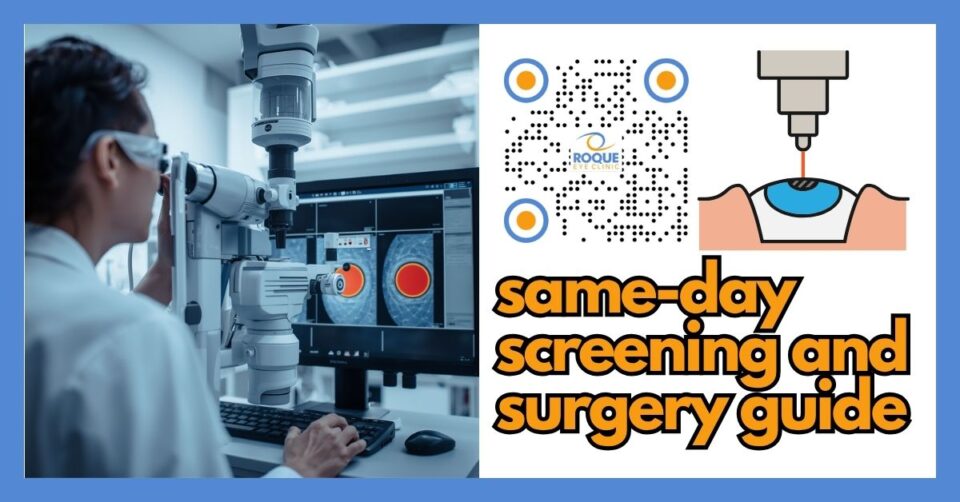
Same-day screening and surgery means your refractive surgery evaluation and your procedure happen on the same day. This can work for carefully selected patients, but only if the screening is complete, measurements are reliable, informed consent is unhurried, and no medical or eye-surface issues require treatment first. Convenience is helpful, but safety and good decision-making matter more.
Many patients like the idea of same-day screening and surgery because it saves time, travel, and repeat absences from work. For some people, especially those coming from far away or trying to minimize scheduling disruption, it can be very appealing. However, same-day screening and surgery should never mean rushed screening and surgery.
Refractive surgery is elective. That means the decision should be made with calm, complete information. A good same-day pathway is not a shortcut around proper testing, informed consent, or medical judgment. It is simply an efficient workflow for the right patient, on the right day, with the right findings.
🧩 Focus: Same-day refractive surgery screening and treatment logistics
👁 Goal: Explain when same-day screening and surgery may be reasonable, when it may not be advisable, and which safety steps should never be skipped
🛡 Evidence-Based: Preferred Practice Patterns • Standards of Care • FDA patient guidance • Peer-reviewed refractive surgery literature
ROQUE REFRACTIVE SURGERY Knowledge Hub
Start with the complete guide:
🔬 Same-Day Screening and Surgery Anatomy Micro-Primer
- Cornea: The clear front window of the eye. Refractive surgery planning depends on its shape, thickness, and structural stability.
- Epithelium and tear film: The eye surface affects measurement accuracy. Dryness, blepharitis, or recent contact lens wear can make the numbers unreliable.
- Anterior chamber and natural lens: These matter when lens-based procedures such as ICL or refractive lens exchange are being considered.
- Retina: The light-sensitive tissue at the back of the eye. Retinal tears, holes, or other disease may need attention before elective surgery proceeds.
📘 Same-Day Screening and Surgery Terminology Glossary
- Baseline evaluation: The full preoperative eye exam used to determine whether surgery is safe and suitable.
- Candidacy: Whether a patient is an appropriate match for a particular refractive procedure.
- Contact lens washout: Time spent out of contact lenses before testing so the cornea can return to its natural shape.
- Informed consent: A process in which risks, benefits, alternatives, and realistic expectations are explained before surgery.
- Ocular surface disease: Problems such as dry eye or blepharitis that can reduce comfort and distort measurements.
- Dilated exam: A retinal examination after eye drops widen the pupils.
Quick Navigation
Related Reading
Dr. Roque's Key Learning Points
- Same-day screening and surgery can be reasonable in selected patients, but it is not the best choice for everyone.
- Convenience must never replace full screening, reliable measurements, and thoughtful informed consent.
- Recent contact lens wear, dry eye, suspicious corneal findings, retinal concerns, or unclear expectations may be reasons to delay surgery.
- A good same-day pathway still includes a complete medical consultation, not a rushed sales process.
- If your surgeon advises postponement, that is often a sign of careful, safety-first care—not a problem.
What Same-Day Screening and Surgery Means
Same-day screening and surgery means that the patient arrives without a prior full preoperative refractive surgery work-up on record, completes the screening visit that day, and then proceeds to surgery later the same day if everything is favorable. This may apply to laser vision correction, and in some settings to other refractive procedures, depending on the clinic’s workflow and the procedure being considered.
It does not mean skipping the basics. The same-day model still requires a complete eye examination, candidacy review, informed consent, discussion of alternatives, and confirmation that the day’s measurements are dependable. If any key part of the evaluation is incomplete, uncertain, or concerning, surgery should be delayed.
💡 Dr. Roque's Analogy
Same-day screening and surgery is a bit like buying a suit and having the final tailoring done on the same day. It can work if the measurements are clear, the fabric behaves as expected, and the client understands the result. But if the measurements are unstable or the fit is uncertain, forcing the process can create problems that were preventable.
Who May Be a Good Fit for Same-Day Screening and Surgery
Some patients are better suited than others for a same-day workflow. A person may be a reasonable candidate when the preoperative situation is straightforward and the measurements are likely to be reliable from the start. Examples may include patients with stable spectacle use, no recent contact lens distortion, no active eye-surface disease, no major medical red flags, and realistic expectations about recovery and results.
Patients traveling from another city or country may ask for same-day scheduling for convenience. That can be understandable. Still, travel distance does not make incomplete screening acceptable. The farther a patient has traveled, the more important it becomes to manage expectations carefully and to avoid pressure-based decisions driven by logistics alone.
Signs the Same-Day Approach May Be Reasonable
- The patient has been out of contact lenses long enough for accurate corneal measurements.
- The refraction appears stable and consistent.
- The cornea looks regular and structurally suitable.
- The tear film and ocular surface are good enough for dependable testing.
- The retina and overall eye health are acceptable for elective surgery.
- The patient understands risks, benefits, alternatives, and postoperative responsibilities without feeling rushed.
- Someone is available to bring the patient home and assist as needed after surgery.
When Same-Day Screening and Surgery May Not Be Ideal
There are many situations in which separating the screening day from the surgery day is the safer and wiser choice. The most common example is recent contact lens wear. Contact lenses can temporarily change corneal shape, and FDA patient guidance specifically warns that inadequate lens washout can lead to inaccurate measurements and a poor surgical plan. In some cases, measurements may need to be repeated later. That alone may make same-day surgery inappropriate.
Other reasons to delay may include dry eye symptoms, blepharitis, suspicious corneal tomography, borderline corneal thickness, retinal findings needing treatment or clearance, unstable prescription, pregnancy or breastfeeding with fluctuating refraction, unclear expectations, or a patient who simply needs more time to think.
A same-day workflow is also a poor fit if the patient feels pressured. Informed consent in refractive surgery should be a process, not a signature collected under momentum. FDA guidance advises patients to give themselves enough time to think through the risk-benefit discussion before signing consent, and Refractive Surgery Council guidance warns against rushed evaluations and high-pressure sales tactics.
What Must Still Happen on Screening Day
If same-day surgery is being considered, the screening visit still needs to be complete and medically meaningful. That usually includes a review of medical and eye history, refraction, corneal measurements, pupil assessment, slit-lamp examination, tear-film and ocular-surface review, and appropriate retinal examination. For some patients, additional imaging or repeat testing may be needed.
The surgeon should also discuss candidacy honestly. That conversation should cover whether the patient is a good candidate, what the procedure can and cannot realistically achieve, what the alternatives are, and what responsibilities the patient will have before and after surgery. FDA patient guidance specifically notes that the doctor should discuss risks, benefits, alternatives, expectations, and patient responsibilities before surgery.
Why Contact Lens Wear Matters So Much
Many patients underestimate this point. Soft lenses, toric lenses, rigid gas permeable lenses, and hard lenses can all temporarily alter corneal shape. That matters because refractive surgery planning depends on the accuracy of corneal measurements. If the cornea is still carrying a “contact lens imprint,” the laser plan can be based on distorted data.
FDA guidance advises stopping soft lenses for about 2 weeks, toric soft or rigid gas permeable lenses for at least 3 weeks, and hard lenses for at least 4 weeks before the initial evaluation. When that washout has not happened, a same-day surgery plan may be unsafe or unreliable.
🚨 Dr. Roque's Emergency Warning
If screening uncovers sudden flashes, new floaters, a curtain over vision, painful red eye, markedly reduced vision, corneal infection, or acute retinal concerns, the plan should shift from elective refractive surgery to urgent ophthalmic care. Convenience must never take priority over urgent pathology.
Benefits of a Good Same-Day Workflow
- Fewer clinic visits
- Less travel burden
- Less time away from work or school
- Convenience for out-of-town patients
- Faster completion of the vision-correction journey when the case is straightforward
Trade-Offs and Risks of Doing Everything in One Day
- Less emotional distance between consultation and decision
- Greater risk of feeling rushed if the clinic workflow is too sales-driven
- Possible need to postpone anyway if measurements are unstable or new findings appear
- Potential disappointment if the patient expected surgery to happen regardless of findings
- More logistical stress if dilation, repeat testing, or counseling take longer than expected
Does Same-Day Mean Lower Quality?
Not necessarily. A same-day pathway can still be excellent if the screening is complete, the surgeon is selective, the patient is prepared, and the clinic culture prioritizes safety over conversion. The problem is not the calendar. The problem is rushing. Good refractive surgery care depends on careful measurements, thoughtful judgment, and honest counseling. Those standards do not change just because a patient hopes to finish everything in one day.
In fact, the best same-day programs usually have clear rules for when not to proceed. That is a good sign. A clinic that is willing to postpone surgery when the numbers are unstable or the patient needs more time is usually showing professionalism, not inefficiency.
Questions to Ask Before Agreeing to Same-Day Surgery
- Have I been out of contact lenses long enough for accurate testing?
- Will my screening include a full medical consultation and enough time for questions?
- If something looks borderline, will you delay surgery rather than proceed anyway?
- What findings would make you recommend a separate surgery day?
- Do I have time to think about the decision before I sign consent?
- What should I arrange for transportation, medications, and early follow-up?
Continue Reading
🏁 Dr. Roque's Take-Home Message
Same-day screening and surgery can be a practical option for selected refractive surgery patients, but only when the evaluation is complete, measurements are trustworthy, and the patient has enough time to make a calm, informed decision. The best program is not the fastest one. It is the one that is willing to say “not today” when safety, clarity, or judgment require more time.
FAQ
1) Is same-day screening and surgery safe?
It can be safe in selected patients, but only if the screening is complete, the eye measurements are reliable, and no findings suggest that surgery should be postponed.
2) Why might my surgeon advise against same-day surgery?
Common reasons include recent contact lens wear, dry eye, unclear or inconsistent measurements, retinal findings, suspicious corneal shape, or a need for more time to discuss the decision.
3) Can I have same-day surgery if I still wore contact lenses recently?
Often not. Contact lenses can temporarily change corneal shape, which can distort measurements and affect treatment planning. Many patients need a proper washout period first.
4) Does same-day screening mean I have to decide immediately?
No. You should not feel rushed. Refractive surgery is elective, and informed consent should include time to understand risks, benefits, alternatives, and expectations before signing.
5) Is same-day screening mainly for out-of-town patients?
It may be especially attractive for out-of-town patients, but travel convenience alone does not make it appropriate. Medical suitability still comes first.
6) If surgery is postponed after screening, does that mean something went wrong?
Not necessarily. In many cases, postponement reflects careful care. Your surgeon may want more stable measurements, treatment of the ocular surface, or more time for counseling before moving forward.
📚 References
- U.S. Food and Drug Administration. What should I expect before, during, and after surgery? LASIK patient information.
- American Academy of Ophthalmology. Refractive Surgery Preferred Practice Pattern®.
- Jacobs DS, et al. Refractive Surgery Preferred Practice Pattern®. Ophthalmology. 2023;130(3):P61-P135.
- Refractive Surgery Council. LASIK Candidacy: The Complete Screening Guide. Published June 2, 2025.
- American Academy of Ophthalmology. Informed consent and refractive surgery patient education resources.
🤝 Roque Eye Clinic Patient Education Series
Dr. Manolette Roque | Dr. Barbara Roque
St. Luke's Medical Center Global City | Asian Hospital Medical Center
Philippines
Medical Review: Roque Advisory Council
Last Updated: March 2026
Medical Disclaimer
This article is intended for educational purposes only and does not replace professional medical consultation.