



Corneal Cross-Linking Protocols: Dresden vs Accelerated
🧠 Quick Answer
Corneal cross-linking protocols strengthen the cornea to slow or stop progression of keratoconus and other ectasias. The Dresden protocol is the classic standard treatment using lower UV power over a longer time. Accelerated cross-linking uses higher UV power over a shorter time. Both can work well in suitable patients, but they are not always identical in healing pattern, depth effect, or long-term outcomes.
When patients hear the term corneal cross-linking, they often ask one simple question: Which protocol is better? The answer is not as simple as “old is better” or “newer is better.” In real clinical practice, the decision depends on the cornea being treated, the surgeon’s platform and experience, the disease stage, the patient’s age, and how strongly the surgeon wants to prioritize long-term evidence versus shorter treatment time.
This article explains the two most commonly discussed approaches: the Dresden protocol and accelerated cross-linking. Both aim to make the cornea stiffer and more stable by combining riboflavin eye drops with ultraviolet-A light. The main difference is how much UV energy is delivered over time and how quickly the treatment is completed.
🧩 Focus: Dresden versus accelerated corneal cross-linking protocols
👁 Goal: Explain how the two protocols differ, who may benefit, what patients should expect, and why protocol choice matters in progressive ectasia care
🛡 Evidence-Based: Preferred Practice Patterns • Standards of Care • Systematic Reviews • Meta-Analyses
REFRACTIVE SURGERY Knowledge Hub
Start with the complete guide:
🔬 Corneal Cross-Linking Protocols Anatomy Micro-Primer
- Corneal epithelium: This is the thin outer skin of the cornea. In classic epi-off cross-linking, it is removed so riboflavin can enter the cornea more effectively.
- Corneal stroma: This is the thick middle layer of the cornea. Cross-linking mainly works here by increasing collagen bonding and tissue stiffness.
- Collagen fibers: These are the structural strands that help the cornea hold its shape. Keratoconus weakens this framework over time.
- Corneal endothelium: This is the delicate inner cell layer of the cornea. Safe treatment planning aims to strengthen the cornea without damaging this layer.
📘 Corneal Cross-Linking Protocols Terminology Glossary
- Dresden protocol: The classic epithelium-off cross-linking protocol using lower UV intensity for a longer treatment time.
- Accelerated cross-linking: A protocol that uses higher UV intensity for a shorter treatment time while aiming to deliver a similar total energy dose.
- Riboflavin: Vitamin B2 eye drops used during cross-linking to help the cornea absorb UV light safely and effectively.
- UVA irradiation: Ultraviolet-A light used to activate riboflavin during treatment.
- Demarcation line: A visible line in the cornea after treatment that may reflect the depth of the cross-linking effect.
- Ectasia: Progressive thinning and bulging of the cornea, such as in keratoconus or post-LASIK ectasia.
Quick Navigation
Related Reading
Key Learning Points
- The Dresden protocol is the classic cross-linking standard and has the longest track record.
- Accelerated cross-linking shortens treatment time by using higher UV intensity for a shorter duration.
- Both approaches aim to stabilize progressive keratoconus or ectasia, not to provide perfect unaided vision.
- They may deliver different healing patterns, depth effects, and long-term response depending on technique and patient selection.
- Protocol choice should be individualized and should not be based on speed alone.
What These Protocols Are Trying to Do
Corneal cross-linking is designed to strengthen a weak cornea. It is most commonly used for progressive keratoconus and for some other ectatic disorders such as post-LASIK ectasia. The goal is not mainly to remove glasses or contact lenses. Instead, the main goal is to slow down or stop worsening so the cornea becomes more stable over time.
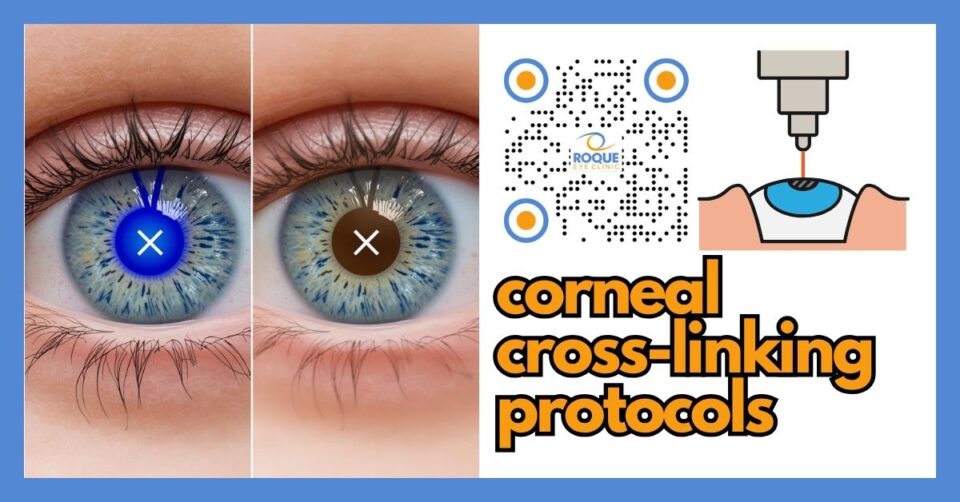
Both Dresden and accelerated protocols use the same general concept: riboflavin is placed on the cornea, then ultraviolet-A light activates a chemical reaction that increases cross-linking between collagen fibers. The difference lies in the treatment settings and timing.
💡 Analogy
Imagine trying to reinforce a weak fabric. The Dresden protocol is like applying steady heat and pressure over a longer period. Accelerated treatment is like applying stronger heat for a shorter time. Both aim to strengthen the material, but they may not behave exactly the same at a microscopic level.
What the Dresden Protocol Means
The Dresden protocol is the original standard corneal cross-linking method. In classic epi-off Dresden treatment, the corneal epithelium is removed, riboflavin is applied for saturation, and the cornea is exposed to UVA at a lower intensity over a longer period. This approach became the benchmark against which newer protocols are compared.
Patients and surgeons often trust the Dresden protocol because it has the most established long-term experience. It is the protocol most commonly linked to the earliest successful clinical studies and remains the reference standard in many discussions about efficacy and durability.
What Accelerated Cross-Linking Means
Accelerated cross-linking uses a higher UVA intensity for a shorter treatment time. The idea comes from the Bunsen-Roscoe reciprocity principle, which suggests that a similar total energy dose may produce a similar effect even when power and time are adjusted. In practical terms, this means surgeons can shorten the UV exposure portion of treatment while still aiming to strengthen the cornea.
Accelerated treatment appeals to both patients and clinics because it may reduce time under the light source. Shorter treatment can improve workflow and patient convenience. However, convenience does not automatically mean biologic equivalence in every case.
How Dresden and Accelerated Protocols Differ
1) Treatment time
The most obvious difference is speed. Dresden is slower. Accelerated treatment is faster. For many patients, this is the first difference they notice.
2) UV power and exposure pattern
Dresden uses lower UV intensity over a longer period. Accelerated protocols increase intensity and shorten exposure. Some platforms also use pulsed delivery rather than continuous delivery.
3) Depth of effect
One reason the debate continues is that the two protocols may not always create the exact same biologic effect inside the cornea. Some studies suggest the demarcation line may be deeper with standard Dresden treatment, which may reflect a stronger or deeper treatment effect in some situations.
4) Clinical outcomes over time
Both protocols can stabilize progressive disease, but some studies and registries suggest the standard protocol may provide slightly stronger flattening or visual improvement in some groups. This does not mean accelerated treatment is poor. It means the two approaches may not be perfectly interchangeable in all eyes.
Why the “Same Total Energy” Idea Is Not the Whole Story
The reciprocity principle is useful, but the cornea is living tissue, not a simple laboratory surface. Oxygen availability, riboflavin diffusion, epithelial status, pulse pattern, and stromal behavior can influence how effectively cross-linking happens. That is why many surgeons do not assume that every accelerated setting is automatically equal to the classic Dresden protocol.
In patient-friendly language: two recipes can use the same total heat, but the food may still cook differently depending on temperature, timing, and airflow. Corneal treatment works in a similar way.
Who Might Receive Dresden Protocol Cross-Linking
- Patients with clearly progressive keratoconus where the surgeon wants the most established protocol
- Eyes in which long-term evidence is prioritized over shorter treatment time
- Cases where the surgeon prefers the classic benchmark approach
- Patients who understand that cross-linking is mainly for stability, not instant visual improvement
Who Might Receive Accelerated Cross-Linking
- Patients with progressive ectasia in whom a shorter treatment session is preferred
- Settings where the surgeon has strong experience with a validated accelerated platform
- Patients in whom workflow, tolerance, or cooperation benefits from shorter exposure time
- Clinics that use evidence-supported accelerated settings rather than improvised protocols
Which May Be Better in Real Life?
There is no universal winner for every eye. The fairest summary is this: both Dresden and accelerated cross-linking can work, but the Dresden protocol still holds a special position because of its long track record and strong evidence base. Accelerated treatment is attractive because it is faster and often effective, but some studies suggest it may not always match the standard protocol in every outcome measure or every follow-up period.
For many patients, the most important question is not “Which protocol is trendy?” but “Which protocol does my surgeon trust for my cornea, using my measurements, on this platform?” That is the safer and more honest way to choose.
Recovery and Follow-Up
Recovery depends not only on Dresden versus accelerated timing, but also on whether the epithelium is removed, the riboflavin formulation used, the bandage contact lens, pain control, and the patient’s healing pattern. Most patients experience light sensitivity, watering, foreign-body sensation, and blurred vision during early healing after epi-off treatment. Vision usually improves gradually rather than overnight.
Cross-linking success is measured over months and years, not just days. Follow-up usually includes repeat refraction, corneal topography or tomography, and monitoring for stabilization rather than expecting immediate perfect vision.
🚨 Emergency Warning
Seek urgent ophthalmic review if you develop worsening pain after the expected early recovery phase, marked redness, discharge, sudden drop in vision, or a white spot on the cornea. These may suggest infection, delayed healing, or another serious complication.
Risks and Limitations
- Postoperative pain, tearing, and light sensitivity
- Delayed epithelial healing in epi-off treatment
- Corneal haze or scarring in some cases
- Infection, although uncommon, can be serious
- Persistent progression despite treatment in a minority of cases
- Need for ongoing glasses, contact lenses, or later visual rehabilitation
- Possible future need for additional procedures in advanced disease
Questions Patients Should Ask Their Surgeon
- Is my keratoconus or ectasia definitely progressing?
- Why are you recommending Dresden or accelerated treatment for my case?
- Is the treatment epi-off or another variation?
- What result are we aiming for: stabilization, flattening, or both?
- How will you monitor whether the treatment worked?
- What happens if my cornea still progresses later on?
Continue Reading
🏁 Take-Home Message
The Dresden protocol is the classic corneal cross-linking standard with the strongest long-term reputation. Accelerated cross-linking offers shorter treatment time and can still be effective, but faster does not always mean identical. For most patients, the best protocol is the one that matches the severity of disease, corneal measurements, and the surgeon’s validated treatment approach.
FAQ
1) What is the Dresden protocol in corneal cross-linking?
The Dresden protocol is the original standard cross-linking method that uses riboflavin plus lower-intensity UVA light over a longer treatment time, usually with epithelial removal.
2) What is accelerated corneal cross-linking?
Accelerated cross-linking uses higher UVA intensity over a shorter period to reduce treatment time while still aiming to strengthen the cornea.
3) Is accelerated cross-linking as good as Dresden?
It can be effective, and many studies show good stabilization, but some evidence suggests the classic Dresden protocol may still provide slightly stronger or more durable effects in some settings.
4) Which protocol is safer?
Both can be safe when used properly in appropriate patients. Safety depends on case selection, corneal thickness, epithelial status, riboflavin use, UV settings, and postoperative care.
5) Does cross-linking improve vision right away?
No. The main goal is to stop worsening. Some patients later experience better shape or better vision, but immediate perfect vision is not the main purpose of treatment.
6) Why would a surgeon still choose Dresden if accelerated is faster?
Because Dresden remains the classic benchmark with long-term evidence. Some surgeons prefer that stronger evidence base, especially in higher-risk or progressive corneas.
📚 References
- American Academy of Ophthalmology. Corneal Ectasia Preferred Practice Pattern®. 2024.
- EyeWiki. Corneal Cross-Linking.
- Yeh CY, et al. Accelerated versus conventional corneal collagen cross-linking for progressive keratoconus: systematic review and meta-analysis. 2025.
- Kandel H, et al. Five-year outcomes from the Save Sight Keratoconus Registry. Eye. 2024.
- Dervenis N, et al. Accelerated, pulsed collagen cross-linking versus the standard Dresden protocol in keratoconus. 2020.
🤝 Roque Eye Clinic Patient Education Series
Dr. Manolette Roque | Dr. Barbara Roque
St. Luke's Medical Center Global City | Asian Hospital Medical Center
Philippines
Medical Review: Roque Advisory Council
Last Updated: March 2026
Medical Disclaimer
This article is intended for educational purposes only and does not replace professional medical consultation.