

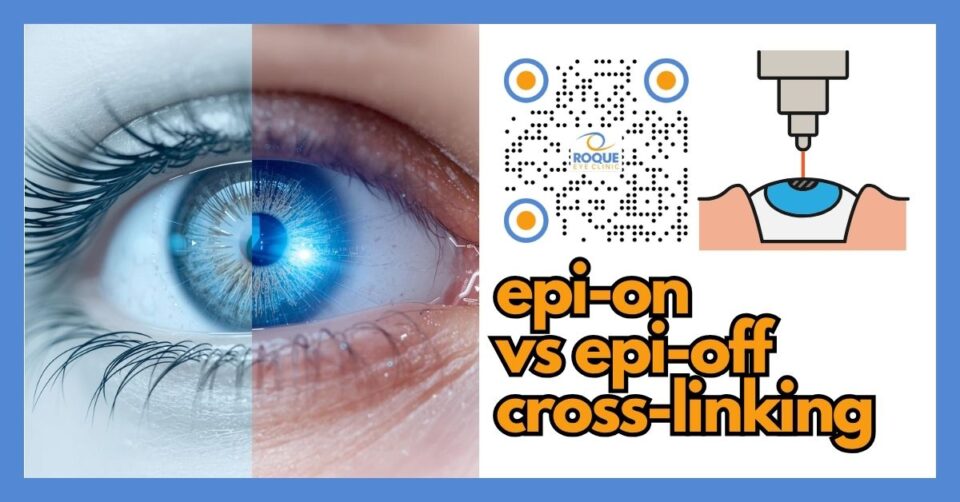
Epi-On vs Epi-Off Cross-Linking
🧠 Quick Answer
Epi-on and epi-off cross-linking are two ways to strengthen a weak cornea, usually in keratoconus or corneal ectasia. Epi-off removes the surface skin of the cornea first and usually has stronger long-term evidence, while epi-on keeps that surface layer in place and may be more comfortable early on. The best choice depends on corneal thickness, disease progression, age, comfort goals, and the exact treatment protocol available.
Corneal cross-linking helps slow or stop progressive corneal weakening. The key difference between epi-on and epi-off is whether the corneal epithelium—the thin surface skin of the cornea—is left in place or removed before riboflavin and ultraviolet-A light are used.
This may sound like a small technical detail, but it changes several important things: how well riboflavin penetrates the cornea, how much discomfort a patient feels after surgery, how quickly the surface heals, and how strong and predictable the treatment effect may be.
🧩 Focus: Comparing epi-on and epi-off corneal cross-linking
👁 Goal: Help patients understand how these two cross-linking approaches differ in comfort, healing, effectiveness, safety, and candidacy
🛡 Evidence-Based: Preferred Practice Patterns • Standards of Care • Systematic Reviews • Meta-Analyses
REFRACTIVE SURGERY Knowledge Hub
Start with the complete guide:
🔬 Epi-On vs Epi-Off Cross-Linking Anatomy Micro-Primer
- Epithelium: The very thin outer skin of the cornea. In epi-off treatment, this layer is removed. In epi-on treatment, it stays on.
- Corneal stroma: The thicker middle layer of the cornea. This is where cross-linking aims to strengthen the tissue.
- Riboflavin: Vitamin B2 eye drops used before ultraviolet-A light exposure. Riboflavin helps the cross-linking reaction happen safely and effectively.
- Ultraviolet-A light: The light source used with riboflavin to create stronger chemical bonds within the corneal collagen.
📘 Epi-On vs Epi-Off Cross-Linking Terminology Glossary
- Epi-off cross-linking: Cross-linking done after removing the corneal epithelium.
- Epi-on cross-linking: Cross-linking done while keeping the epithelium in place, also called transepithelial cross-linking in many contexts.
- Keratoconus: A condition in which the cornea becomes thinner and bulges forward, causing distorted vision.
- Corneal ectasia: Progressive weakening and bulging of the cornea, sometimes after refractive surgery.
- Progression: Worsening of corneal shape, thinning, or vision over time.
- Demarcation line: A visible corneal line seen after treatment that may suggest how deep the cross-linking effect reached.
Quick Navigation
Related Reading
Key Learning Points
- Epi-off usually has stronger and more established long-term evidence for halting progression.
- Epi-on is designed to be less invasive and may reduce early pain and surface-healing problems.
- The biggest scientific issue in epi-on treatment is whether enough riboflavin and oxygen reach the corneal stroma for a strong effect.
- Not all epi-on protocols are the same. Results depend heavily on the exact technology, riboflavin method, oxygen support, and treatment settings.
- The best choice is individualized. The question is not only “Which sounds easier?” but “Which is most likely to work well in this cornea?”
What Epi-On and Epi-Off Mean
“Epi” refers to the epithelium, the thin outer skin of the cornea. In epi-off cross-linking, that surface layer is removed before riboflavin drops and ultraviolet-A light are applied. In epi-on cross-linking, the epithelium stays in place, although some protocols use methods to help the medicine pass through the surface more effectively.
This difference matters because the epithelium acts a little like a raincoat. It protects the cornea, but it can also block medication and oxygen from entering as easily. Removing it can improve penetration, but it also causes more pain and slower healing in the first several days.
💡 Analogy
Imagine trying to waterproof a wooden table. If there is a plastic sheet tightly covering the top, the protective liquid may not soak in well. Taking the plastic off helps the liquid reach the wood better, but it also leaves the surface more exposed for a while. That is similar to the trade-off between epi-on and epi-off cross-linking.
How the Two Methods Work
Epi-Off Cross-Linking
In epi-off treatment, the surgeon removes the epithelium first. Riboflavin is then applied to soak into the cornea more directly, followed by ultraviolet-A light exposure. This approach has long been considered the classic and best-established method because it usually allows more reliable stromal penetration and a stronger biomechanical effect.
Epi-On Cross-Linking
In epi-on treatment, the surface epithelium remains intact. The main advantage is that the surface barrier stays in place, which can reduce pain, lower some healing risks, and speed up surface recovery. The main challenge is getting enough riboflavin, oxygen, and ultraviolet effect into the cornea to produce a durable strengthening response.
Modern epi-on systems may use enhanced riboflavin formulations, oxygen support, specialized light delivery, or other protocol refinements. That means epi-on should not be thought of as a single uniform procedure. Outcomes can vary depending on the exact system being used.
Main Differences Between Epi-On and Epi-Off
1) Comfort after surgery
Epi-off usually causes more discomfort because the corneal surface has to heal. Patients often experience pain, tearing, foreign-body sensation, and light sensitivity during the first few days. Epi-on is generally more comfortable early on because the surface layer stays intact.
2) Healing speed
Epi-on usually has faster surface recovery because there is no epithelial defect to close. Epi-off often needs more healing time, and a bandage contact lens is commonly used while the surface re-epithelializes.
3) Strength and consistency of effect
Epi-off has traditionally been favored when the main priority is a strong and predictable treatment effect. Many comparative studies and reviews suggest that epi-off often produces better topographic flattening and more consistent corneal stabilization than older transepithelial approaches.
4) Risk profile
Epi-off exposes the corneal surface, so there is more early pain and a greater chance of delayed epithelial healing, infectious keratitis, sterile infiltrates, haze, or transient scarring-related issues. Epi-on may reduce some surface-healing risks, but if the treatment effect is too weak, progression may continue.
Who May Fit Each Option
Patients who may lean toward epi-off
- Eyes with clearly progressive keratoconus or ectasia where stronger evidence matters most
- Cases where the surgeon wants the most established treatment pathway
- Situations in which protocol consistency and long-term data carry more weight than comfort
Patients who may be considered for epi-on
- Eyes in which epithelial removal may be less desirable
- Patients especially concerned about pain or slower surface healing
- Specific corneas that fit the available epi-on technology and protocol in that clinic
- Settings where a surgeon believes the chosen epi-on system offers an appropriate balance of comfort and disease control
Still, candidacy is never one-size-fits-all. Age, corneal thickness, amount of progression, scarring, ocular surface disease, prior surgery, and the exact technology available all affect the decision.
Recovery and Comfort
Epi-off patients usually need more pain control, more close follow-up in the first few days, and more patience while the surface heals. Vision may be blurrier early on. Epi-on often feels easier in the short term, with less pain and a quicker return to baseline comfort. However, patients should remember that a smoother first week does not automatically mean a stronger long-term treatment effect.
In other words, recovery comfort and biomechanical effect are related but not identical goals. Some patients focus on the first few days. Others focus on the strongest chance of halting progression. A good surgeon helps balance both.
Risks and Safety
Potential risks of epi-off
- More postoperative pain
- Delayed epithelial healing
- Infection risk while the surface is open
- Corneal haze or scarring
- Temporary blur, light sensitivity, and slower early recovery
Potential concerns with epi-on
- Weaker or less consistent penetration in some protocols
- Possibility of under-treatment if the effect is insufficient
- Need for careful interpretation because different epi-on systems are not equivalent
🚨 Emergency Warning
Urgent review is needed if you develop severe worsening pain, marked redness, pus-like discharge, a sudden drop in vision, or a white spot on the cornea after cross-linking. These can signal infection or serious inflammation and should not be ignored.
Does FDA Approval Change the Conversation?
Yes. Historically, epi-off had the better-established regulatory and evidence position in many markets, especially in the United States. More recently, regulatory progress has expanded the discussion around epi-on. Even so, regulatory approval does not erase the need to compare real-world performance, protocol details, and surgeon experience. Approval means a treatment pathway has reached a certain standard; it does not mean every patient should choose it.
Bottom Line: Which Is Better?
There is no single answer for every patient. If the main priority is the most established and often stronger long-term evidence, many surgeons still lean toward epi-off cross-linking. If the main priority is less pain and faster early recovery, an appropriate epi-on protocol may be attractive. The real question is not “Which is universally better?” but “Which is more suitable for this cornea, with this degree of progression, using this exact system?”
A patient-friendly way to think about it is this: epi-off is often the “stronger but tougher” option, while epi-on may be the “gentler but more protocol-dependent” option.
Questions Worth Asking Your Surgeon
- Why are you recommending epi-on or epi-off for my cornea?
- How much progression do you think I have?
- How thick is my cornea, and does that affect the choice?
- What level of pain and downtime should I expect?
- What does your clinic use for epi-on, and how is it different from older transepithelial methods?
- If the treatment effect is not enough, what would the next step be?
Continue Reading
🏁 Take-Home Message
Epi-on vs epi-off cross-linking is really a trade-off between comfort and treatment strength. Epi-off usually has the more established record for halting progression, while epi-on may be easier on the surface and more comfortable early on. The best option depends on the exact cornea, the exact protocol, and what your surgeon believes gives you the safest and most reliable long-term result.
FAQ
1) Is epi-on cross-linking less painful than epi-off?
Usually yes. Because the corneal surface stays intact, epi-on often causes less pain, less foreign-body sensation, and faster early surface recovery.
2) Is epi-off cross-linking stronger than epi-on?
In many studies and reviews, epi-off tends to show stronger and more consistent topographic or tomographic effects. However, newer epi-on systems may perform differently from older methods, so protocol details matter.
3) Why not just do epi-on for everyone if it is more comfortable?
Because comfort is only one part of the decision. The treatment also has to be strong enough to stabilize the cornea. In some eyes, surgeons may feel epi-off gives a more dependable effect.
4) Does epi-on mean the cornea does not need to heal?
The surface usually heals more easily than epi-off, but the cornea still undergoes a biological treatment response. Follow-up is still important.
5) Can epi-on and epi-off both treat keratoconus?
Yes. Both are intended to strengthen the cornea in conditions such as keratoconus or ectasia. The main difference is how the treatment is delivered and how strong or comfortable it may be.
6) Which one would most surgeons choose for progressive keratoconus?
Many surgeons still favor epi-off when the priority is the most established long-term evidence. But the best answer depends on the patient’s cornea and the exact technology being used.
📚 References
- American Academy of Ophthalmology. Safety and Efficacy of Epithelium-Off Corneal Collagen Cross-Linking for Progressive Keratoconus and Corneal Ectasia. 2024.
- EyeWiki. Corneal Cross-Linking. Updated 2026.
- Nughays RO, et al. Efficacy and Safety of Epi-On vs Epi-Off Corneal Cross-Linking in Corneal Ectasias: A Systematic Review. 2025.
- Mohammadpour M, et al. A Systematic Review and Meta-Analysis Comparing Epi-On and Epi-Off Corneal Cross-Linking. 2025.
- EyeWiki. Techniques for Corneal Collagen Crosslinking: Epi-off vs Epi-on.
🤝 Roque Eye Clinic Patient Education Series
Dr. Manolette Roque | Dr. Barbara Roque
St. Luke's Medical Center Global City | Asian Hospital Medical Center
Philippines
Medical Review: Roque Advisory Council
Last Updated: March 2026
Medical Disclaimer
This article is intended for educational purposes only and does not replace professional medical consultation.