



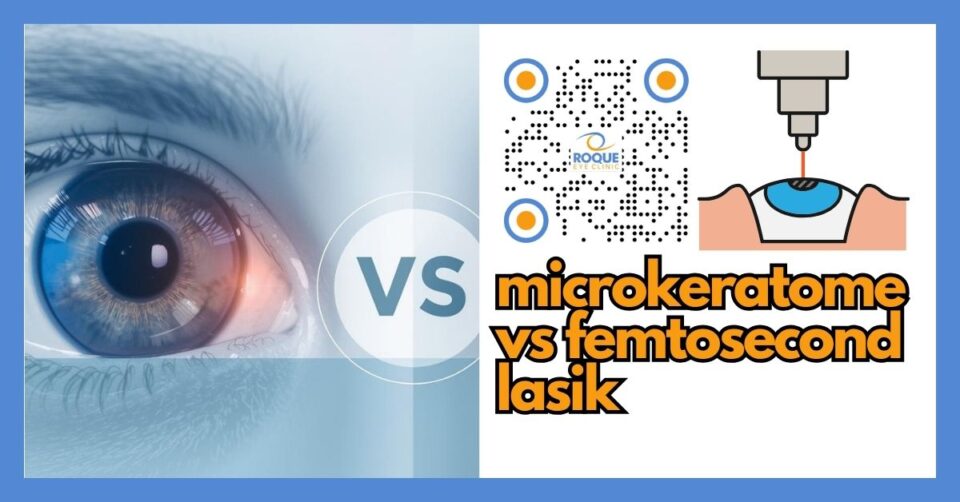
Microkeratome vs Femtosecond LASIK
🧠 Quick Answer
Microkeratome LASIK uses a mechanical blade device to create the corneal flap, while femtosecond LASIK uses a laser to make that flap. Both can work well in suitable patients, but femtosecond LASIK is generally considered more precise and more predictable for flap creation. The best choice still depends on your cornea, your surgeon’s judgment, the available technology, and overall safety screening.
Many patients think all LASIK is exactly the same. It is not. In standard LASIK, there are two major steps. First, the surgeon creates a thin corneal flap. Second, an excimer laser reshapes the underlying cornea to correct refractive error. The key difference in this article is how that flap is created.
With microkeratome LASIK, the flap is made using a mechanical instrument with a blade. With femtosecond LASIK, the flap is made using an ultrafast laser. Both approaches have been used successfully, but they are not identical in precision, biomechanics, workflow, and complication profile.
🧩 Focus: LASIK flap creation using a microkeratome versus a femtosecond laser
👁 Goal: Help patients understand the practical differences, benefits, trade-offs, and safety issues between these two LASIK approaches
🛡 Evidence-Based: Preferred Practice Patterns • Standards of Care • Systematic Reviews • Meta-Analyses
REFRACTIVE SURGERY Knowledge Hub
Start with the complete guide:
🔬 Microkeratome vs Femtosecond LASIK Anatomy Micro-Primer
- Corneal epithelium: This is the thin outer skin of the cornea. It is not the main flap layer in LASIK, but it sits over the tissue being treated.
- Corneal stroma: This is the main structural layer of the cornea. LASIK reshapes the stromal bed under the flap.
- LASIK flap: This is the thin hinged layer lifted during surgery so the excimer laser can reshape the deeper cornea.
- Corneal nerves: These tiny nerves contribute to corneal sensation and tear-film function. Flap creation can affect them and may contribute to postoperative dryness.
📘 Microkeratome vs Femtosecond LASIK Terminology Glossary
- Microkeratome: A mechanical device with a blade used to create a corneal flap in LASIK.
- Femtosecond laser: An ultrafast laser that creates the LASIK flap using tiny pulses of laser energy instead of a blade.
- Flap thickness predictability: How consistently the flap matches the intended thickness.
- Interface: The space between the flap and the underlying stromal bed after LASIK.
- Higher-order aberrations: Complex optical errors that may affect glare, halos, contrast, and night vision.
- Suction ring: A device used during flap creation to stabilize the eye.
Quick Navigation
Related Reading
Key Learning Points
- Both microkeratome and femtosecond LASIK are forms of LASIK. The main difference is how the corneal flap is created.
- Femtosecond LASIK is generally known for better flap precision and reproducibility.
- Microkeratome LASIK can still produce good results in appropriate hands and appropriate eyes.
- The final decision should not be based on marketing alone. It should be based on screening, anatomy, surgeon judgment, and safety.
- A well-chosen procedure matters more than choosing a technology label without context.
What Is the Difference Between Microkeratome and Femtosecond LASIK?
The difference is in the first step of LASIK: flap creation. In microkeratome LASIK, the surgeon uses a blade-based device that moves across the cornea to create a thin flap. In femtosecond LASIK, the surgeon uses a laser to create a plane of microscopic laser pulses that forms the flap at a programmed depth.
After the flap is lifted, both procedures usually continue in a similar way: the excimer laser reshapes the stromal bed, the flap is repositioned, and the cornea begins healing.
💡 Analogy
Imagine opening a sealed envelope. A microkeratome is like opening it with a mechanical cutting tool. A femtosecond laser is like using a programmable light-based cutter designed for more exact depth and shape control. Both can open the envelope, but the level of control may differ.
How Each Method Works
Microkeratome LASIK
A suction ring stabilizes the eye. The microkeratome then creates a corneal flap with a blade. The flap is lifted, the excimer laser reshapes the cornea, and the flap is laid back in place. Microkeratomes played a major role in the development and spread of LASIK and are part of the historical foundation of modern refractive surgery.
Femtosecond LASIK
A suction or docking system stabilizes the eye. The femtosecond laser creates the flap at a programmed depth and pattern using laser pulses. The surgeon then lifts the flap, applies the excimer laser treatment, and repositions the flap. One reason femtosecond LASIK gained popularity is that the flap can be made with high precision and good reproducibility.
What They Have in Common
- Both are LASIK procedures.
- Both usually use an excimer laser for the refractive correction itself.
- Both require careful preoperative screening.
- Both can lead to good visual outcomes in suitable patients.
- Both still carry risks, because no refractive surgery is risk-free.
Potential Advantages of Microkeratome LASIK
Microkeratome LASIK is older and has a long clinical history. Some surgeons are very experienced with it and may achieve consistently good results with carefully chosen patients. In some settings, it may also be less expensive than femtosecond-assisted LASIK because the capital and disposable costs of the laser platform may be higher.
In practical terms, this means that microkeratome LASIK should not automatically be dismissed as “bad” or “obsolete.” A well-maintained system, an experienced surgeon, and a properly selected patient can still produce a good result. The issue is not whether it can work. The issue is whether it is the best and safest choice for a particular eye today.
Potential Advantages of Femtosecond LASIK
1) Better flap thickness predictability
One of the biggest advantages of femtosecond LASIK is that flap thickness is usually more predictable. In refractive surgery, that matters because the residual stromal bed and overall corneal biomechanics affect long-term safety.
2) More uniform flap architecture
Femtosecond platforms can produce flaps with more consistent geometry, including thickness profile and edge design. This is one reason many surgeons prefer femtosecond technology when available.
3) Lower risk of certain blade-related flap problems
Because no blade is used for the flap cut itself, femtosecond LASIK avoids some blade-related issues that can occur with microkeratomes. That does not mean it has zero flap risks, but the risk profile is different.
4) Faster early visual recovery in some comparative studies
Some comparative studies have suggested quicker early visual recovery and lower induction of certain optical irregularities with femtosecond flap creation. However, the size of the clinical benefit can vary, and not every patient will notice a dramatic difference.
Does That Mean Femtosecond LASIK Is Always Better?
Not in a simplistic marketing sense. “More precise” does not automatically mean “perfect for everyone.” A femtosecond laser does not eliminate the need for excellent screening, accurate refraction, dry-eye management, proper centration, safe treatment planning, or realistic counseling. A patient with poor candidacy remains a poor candidate no matter how advanced the flap technology is.
So the honest answer is this: femtosecond LASIK is usually favored today for flap precision and predictability, but overall outcome still depends on the entire surgical plan, not just the flap tool.
Risks and Trade-Offs
Microkeratome-related concerns
- Greater variability in flap thickness
- Blade-related flap complications
- Risk of irregular or incomplete flaps
- Potentially greater induction of some optical irregularities in some comparisons
Femtosecond-related concerns
- Higher procedural cost in some clinics
- Different interface or inflammatory issues can still occur
- Suction loss or docking issues may still happen
- Technology sophistication does not remove the need for careful patient selection
Both techniques also share common LASIK risks such as dry eye symptoms, glare, halos, residual refractive error, regression, infection, flap complications, and the possibility of needing glasses for certain tasks later on.
🚨 Emergency Warning
After LASIK, urgent review is needed if you develop severe worsening pain, marked redness, sudden major drop in vision, flap displacement, or trauma to the operated eye. These are not “wait and see” problems.
Why Surgeons Still Care So Much About Flap Thickness
The flap is not just a technical detail. If the flap is thicker than expected, less untouched stromal tissue remains underneath after laser treatment. That matters because residual stromal thickness is one of the factors considered in ectasia-risk assessment. Predictable flap thickness helps the surgeon plan more confidently and protect corneal structural safety.
Which One Is Better for Patients?
In many modern practices, femtosecond LASIK is favored because of its accuracy and reproducibility. If two equally qualified centers are compared and everything else is equal, many refractive surgeons today would lean toward femtosecond flap creation. However, “better” should still be individualized.
For example, a highly experienced surgeon using a reliable microkeratome in a carefully screened patient may still deliver an excellent result. On the other hand, a poorly selected patient can have a disappointing or unsafe outcome even with the newest femtosecond platform. Technology matters, but judgment matters more.
Questions Patients Should Ask
- Do you use a microkeratome or a femtosecond laser for my LASIK flap?
- Why do you recommend that method for my eye?
- How does my corneal thickness and shape affect this choice?
- What are the flap-related risks in my specific case?
- Would PRK, SMILE, or another option be safer for me?
- Is the difference in cost matched by a meaningful difference in safety or predictability for my eyes?
A Balanced Patient-Friendly Summary
Microkeratome LASIK is the older blade-based method. Femtosecond LASIK is the newer laser-based flap method. Both can work, but femtosecond technology is generally more precise in flap creation. That is why many surgeons and patients prefer it when available. Still, the most important question is not “Which sounds newer?” but “Which is safest and most appropriate for my eyes after proper screening?”
Continue Reading
🏁 Take-Home Message
Microkeratome LASIK and femtosecond LASIK are both true LASIK procedures, but femtosecond technology is generally preferred today because flap creation is usually more precise and more predictable. Even so, no technology replaces proper screening, good surgical judgment, and realistic expectations. The safest LASIK is the one matched carefully to your eyes, not just the one with the most impressive label.
FAQ
1) Is femtosecond LASIK safer than microkeratome LASIK?
In general, femtosecond LASIK is often considered more predictable for flap creation and may lower the risk of some blade-related flap problems. However, overall safety still depends on the entire surgical plan and whether the patient is a good candidate.
2) Does microkeratome LASIK still work well?
Yes. Microkeratome LASIK can still work well in suitable patients, especially in experienced hands. The discussion is usually about precision and predictability, not whether the method can work at all.
3) Why do some clinics promote femto LASIK more heavily?
Because femtosecond technology is widely regarded as more precise and more reproducible for creating the LASIK flap. It is also newer and often easier to market. Still, patients should ask how that benefit applies to their own eyes.
4) Is femtosecond LASIK always worth the higher cost?
Not every patient values the difference in the same way. Many surgeons feel the added precision is worthwhile, but the best answer depends on your corneal measurements, risk profile, and budget.
5) Can I choose flap technology myself?
You can discuss preferences, but the final recommendation should be based on medical suitability. A surgeon should explain why one option is better for your case.
6) If my cornea is borderline, does flap precision matter more?
Often yes. When corneal thickness and residual stromal safety are important, flap predictability becomes more meaningful in the overall treatment plan.
📚 References
- American Academy of Ophthalmology. Refractive Surgery Preferred Practice Pattern®. Updated 2024.
- U.S. Food and Drug Administration. What should I expect before, during, and after surgery?
- U.S. Food and Drug Administration. 510(k) summaries for femtosecond laser systems indicated for creation of corneal flaps in LASIK.
- Pajic B, et al. Femtosecond laser versus mechanical microkeratome-assisted flap creation for LASIK: comparative outcomes review.
- European Society of Cataract & Refractive Surgeons. EuroTimes discussion on blade versus laser flap creation.
🤝 Roque Eye Clinic Patient Education Series
Dr. Manolette Roque | Dr. Barbara Roque
St. Luke's Medical Center Global City | Asian Hospital Medical Center
Philippines
Medical Review: Roque Advisory Council
Last Updated: March 2026
Medical Disclaimer
This article is intended for educational purposes only and does not replace professional medical consultation.