


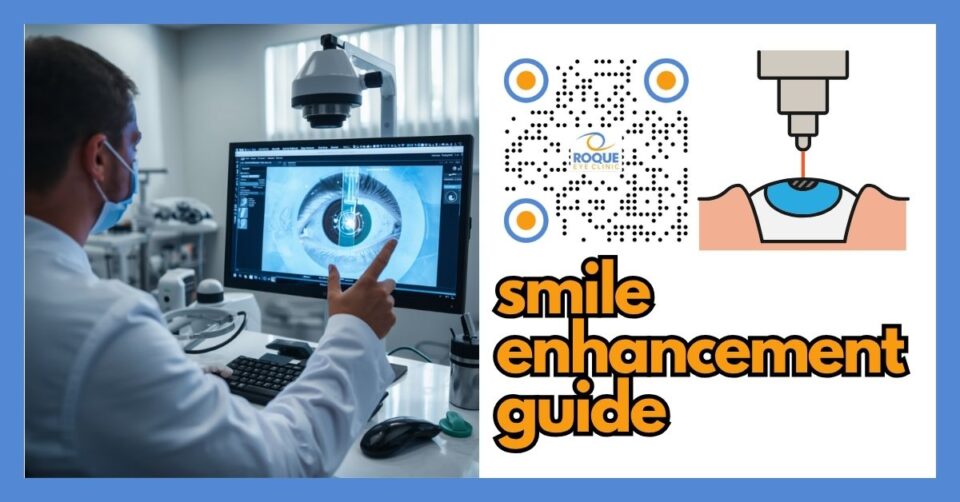
SMILE Enhancement
🧠 Dr. Roque's Quick Answer
SMILE enhancement is an additional refractive procedure performed when vision after primary SMILE is not as accurate or stable as intended. It may be considered for undercorrection, residual astigmatism, regression, or bothersome refractive surprise. Common options include surface ablation (usually PRK), CIRCLE cap-to-flap conversion with excimer laser treatment, or selected LASIK-based approaches, depending on corneal anatomy, residual error, and healing history.
Most SMILE patients do very well after surgery and never need another refractive procedure. Still, no refractive operation is perfectly immune to residual refractive error, regression, or healing variability. A small number of patients remain slightly nearsighted, slightly astigmatic, or visually dissatisfied even after technically successful SMILE.
That is where SMILE enhancement enters the conversation. Enhancement does not mean the first procedure “failed.” In many cases, it means the eye healed in a way that left a small but meaningful refractive error, and the surgeon is deciding whether a second, carefully planned correction is safe, appropriate, and worth doing.
🧩 Focus: Enhancement after primary SMILE surgery
👁 Goal: Explain why enhancement may be needed after SMILE, what the common retreatment options are, and how surgeons decide which method is safest
🛡 Evidence-Based: Preferred Practice Patterns • Standards of Care • Systematic Reviews • Meta-Analyses
ROQUE REFRACTIVE SURGERY Knowledge Hub
Start with the complete guide:
🔬 SMILE Enhancement Anatomy Micro-Primer
- Corneal cap: In SMILE, the femtosecond laser creates a cap over the lenticule rather than a LASIK flap. This cap becomes important when planning retreatment.
- SMILE interface: This is the internal surgical plane where the lenticule was created and removed. Enhancement planning must respect this prior interface.
- Corneal stroma: This is the main structural layer reshaped in corneal refractive surgery. Residual stromal thickness helps determine whether another corneal procedure is safe.
- Epithelium: The cornea’s outer skin. Surface ablation enhancement works through this layer rather than by lifting a stromal flap.
📘 SMILE Enhancement Terminology Glossary
- Enhancement: A second refractive procedure performed to improve residual refractive error after the first surgery.
- Residual refractive error: Remaining nearsightedness, farsightedness, or astigmatism after surgery.
- Regression: A gradual shift of vision away from the intended result after an initially good outcome.
- CIRCLE: A femtosecond-laser method that converts the original SMILE cap into a LASIK-style flap for enhancement.
- PRK: Photorefractive keratectomy, a surface-laser procedure often used as a flap-free enhancement option.
- MRSE: Manifest refraction spherical equivalent, a summary value used to describe refractive error.
Quick Navigation
Related Reading
Dr. Roque's Key Learning Points
- Most SMILE patients do not need enhancement, but a small percentage may require it for residual refractive error or regression.
- Common enhancement strategies after SMILE include surface ablation/PRK, CIRCLE cap-to-flap conversion, and selected LASIK-based approaches.
- There is no single best method for every eye; the safest option depends on corneal thickness, cap depth, healing history, refractive error, and surgeon experience.
- Surface ablation preserves a flap-free approach but usually has more early discomfort and slower recovery.
- CIRCLE and flap-based methods may recover faster, but they give up the original flap-free advantage of SMILE.
What SMILE Enhancement Is
SMILE enhancement is a secondary refractive treatment performed after primary SMILE when the visual result remains meaningfully off target. The patient may still have residual myopia, astigmatism, mixed blur symptoms, or regression over time. In some cases, the issue is small on paper but large in daily life—for example, a patient who drives at night, works on screens all day, or wants sharp unaided vision for a specific profession.
Enhancement should never be approached casually. It is not just “adding a little more laser.” The eye now has a prior SMILE interface, prior tissue removal, and a unique healing pattern. A second procedure must be individualized.
💡 Dr. Roque's Analogy
Think of SMILE enhancement like adjusting a tailored suit after the first fitting. The suit may already be good, but a small mismatch in one area can still matter. The tailor must work with what has already been cut. In the cornea, that means the surgeon must respect the first surgery’s planes, tissue depth, and healing response.
Why Enhancement May Be Needed After SMILE
Enhancement is usually considered for one or more of the following reasons:
- Residual myopia or astigmatism after the initial procedure
- Optical regression after an initially good result
- Refractive surprise that leaves the patient functionally dissatisfied
- Visually significant undercorrection in high-demand patients
- Irregular healing or treatment-related factors such as suction loss in selected cases
Published reviews describe enhancement after SMILE as uncommon but real, with rates often reported in the low single digits. Several reviews cite roughly 1% to 4%, while some series and broader discussions suggest a wider expected range of around 1% to 7% depending on patient mix, correction size, follow-up, and enhancement threshold.
When Surgeons Consider Enhancement
Timing matters. Surgeons usually want the refraction to stabilize before recommending enhancement. They also want to make sure the symptoms truly come from residual refractive error rather than dry eye, epithelial remodeling, healing fluctuation, ocular surface disease, or unrealistic expectations.
Before enhancement, the work-up may include repeat refraction, cycloplegic refraction when indicated, corneal topography or tomography, pachymetry, tear-film assessment, slit-lamp examination, and a review of the original SMILE parameters such as cap thickness and residual stromal bed. Enhancement should be avoided if the cornea looks unstable or if the surface is too compromised to trust the measurements.
Common Enhancement Options After SMILE
1) Surface ablation (usually PRK)
PRK is one of the most commonly discussed enhancement methods after SMILE. It works on the corneal surface and does not require converting the cap into a flap. That preserves the flap-free philosophy of the original SMILE. The main trade-offs are familiar: more discomfort in the first few days, slower visual recovery, and surface-healing issues such as haze risk in selected eyes.
Published PRK enhancement series after SMILE have reported favorable safety and efficacy at one year, including good uncorrected vision and no line loss in the reported cohort. This makes PRK an important option when the anatomy supports a surface-based approach.
2) CIRCLE cap-to-flap conversion
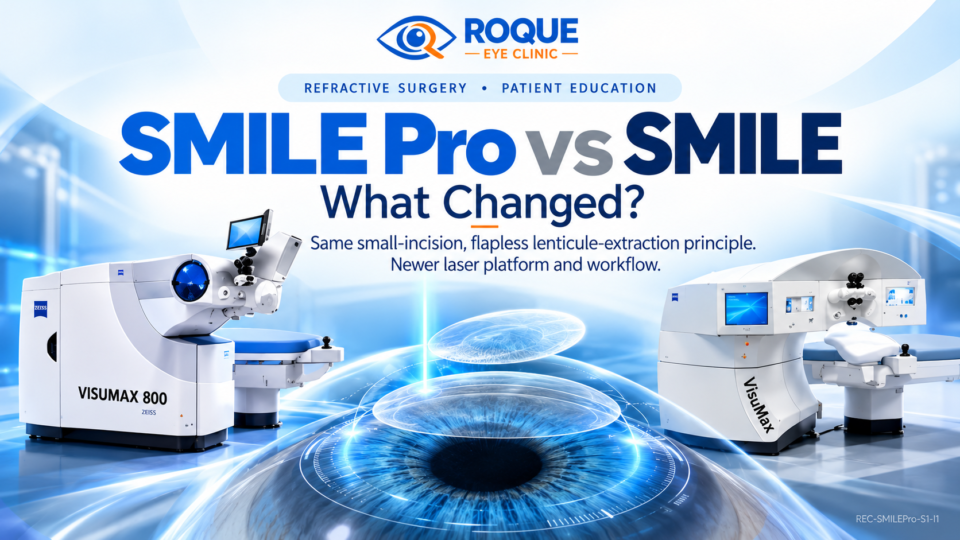
CIRCLE is a femtosecond-laser method available on the VisuMax platform that converts the existing SMILE cap into a flap. Once that flap is lifted, excimer-laser ablation can be performed similarly to a LASIK-style enhancement. A key advantage is faster visual recovery and less early pain compared with surface ablation. A key disadvantage is obvious: the cornea is no longer flap-free.
CIRCLE may be particularly attractive when quicker recovery is important or when the surgeon believes a flap-based enhancement will be more efficient for the specific residual error. Reviews and comparative reports suggest that CIRCLE can deliver strong visual outcomes and may recover faster than PRK in many patients.
3) Thin-flap LASIK after SMILE
Selected surgeons may consider a thin-flap LASIK-type retreatment after SMILE, depending on cap depth, available tissue, and surgical preference. This is not a routine decision for every eye. The surgeon must think carefully about where the flap will sit relative to the prior SMILE interface and whether the geometry is safe and predictable.
4) Repeat SMILE or cap-preserving re-SMILE
Repeat SMILE has been described in the literature, but it has historically been less common and not a standard mainstream enhancement path in many practices. It is more technically specific and less broadly adopted than PRK or CIRCLE-based retreatment. Because of that, it is usually discussed as a niche option rather than a universal answer.
How Surgeons Choose the Enhancement Method
The best enhancement option depends on the eye in front of the surgeon. Important factors include:
- Amount and type of residual refractive error
- Cap thickness from the original SMILE procedure
- Residual stromal thickness and overall corneal safety
- Ocular surface health and dry-eye status
- Speed of recovery desired by the patient
- Need to preserve a flap-free cornea versus willingness to create a flap
- Topographic regularity or irregularity
- Surgeon experience and available platform technology
A patient who values flap avoidance may lean toward PRK if the surgeon feels the cornea is a good fit. A patient who prioritizes faster recovery may be a better candidate for CIRCLE if anatomy and technology allow it. There is no one-size-fits-all algorithm.
Risks and Trade-Offs of SMILE Enhancement
Any enhancement adds another layer of surgery and another layer of risk. Common concerns include:
- Persistent residual refractive error
- Dry eye symptoms or fluctuating vision
- Corneal haze after surface ablation
- Night-vision symptoms such as glare and halos
- Flap-related issues if a flap-based enhancement is used
- Biomechanical trade-offs depending on the chosen retreatment
- Need for more healing time than the patient expects
Published discussions also note that excimer-based surface enhancement beyond the prior interface can increase concern for haze, particularly in larger corrections, which is one reason surgeons often use careful protocols including mitomycin-C in selected cases.
🚨 Dr. Roque's Emergency Warning
Urgent review is needed after enhancement if you develop rapidly worsening pain, marked redness, discharge, a sudden drop in vision, increasing light sensitivity after the expected early recovery phase, or signs of corneal infection or delayed healing.
Recovery After SMILE Enhancement
Recovery depends heavily on the enhancement method. PRK-based enhancement usually means more early discomfort and slower visual recovery. CIRCLE or flap-based enhancement usually means less pain and faster initial clarity, but that benefit comes with flap creation. Patients must be counseled about the specific recovery pattern of the chosen enhancement, not just the original SMILE experience.
Just as important, patients should understand that enhancement is usually considered only when the expected benefit is worth the added intervention. If the residual error is tiny and symptoms are minimal, observation or glasses for selected tasks may be safer than another surgery.
Questions Patients Should Ask Before Agreeing to SMILE Enhancement
- What exact residual error are you trying to correct?
- Is my vision stable enough to justify enhancement now?
- Why are you recommending PRK, CIRCLE, or another method in my case?
- How will this affect flap status, corneal tissue, and healing time?
- What result is realistic after enhancement?
- What are the chances that I will still need glasses for some tasks?
Continue Reading
🏁 Dr. Roque's Take-Home Message
SMILE enhancement can be safe and effective in carefully selected patients, but it is never automatic. The key decision is not just whether to enhance, but how. Surface ablation helps preserve a flap-free approach, while CIRCLE or other flap-based methods may offer faster recovery. The safest choice depends on stable measurements, healthy ocular surface, adequate tissue, and a clear reason to intervene.
FAQ
1) How common is enhancement after SMILE?
It is uncommon, but it does happen. Published discussions often place enhancement or retreatment rates in the low single digits, commonly around 1% to 4%, although some reports cite a broader 1% to 7% range depending on the study and enhancement criteria.
2) What is the most common enhancement method after SMILE?
Surface ablation, usually PRK, is one of the most commonly discussed methods after SMILE because it avoids flap creation. However, CIRCLE cap-to-flap enhancement is also widely discussed and may offer faster recovery in suitable eyes.
3) Is CIRCLE better than PRK after SMILE?
Not for every patient. CIRCLE may recover faster and involve less early pain, but it converts the cap into a flap. PRK preserves a flap-free approach but usually heals more slowly and can have surface-healing trade-offs.
4) Can SMILE be repeated instead of doing PRK or CIRCLE?
Repeat SMILE has been described, but it is more specialized and less commonly used than PRK or CIRCLE in many settings. It is not the default enhancement method for most patients.
5) Why not enhance immediately if vision is slightly off after SMILE?
Because vision may still be stabilizing. Dry eye, epithelial remodeling, healing fluctuation, and temporary refraction changes can all make early measurements misleading. Surgeons usually wait for stability before recommending another procedure.
6) Does needing enhancement mean SMILE failed?
No. It usually means the eye’s final healing response left a meaningful residual refractive error or regression. Enhancement is sometimes part of the long-term refinement process in refractive surgery.
📚 References
- American Academy of Ophthalmology. Refractive Surgery Preferred Practice Pattern®. 2024 update.
- Siedlecki J, Luft N, Mayer WJ, et al. Enhancement Options After Myopic Small-Incision Lenticule Extraction (SMILE): A Review. Asia Pac J Ophthalmol (Phila). 2019.
- Moshirfar M, et al. Photorefractive Keratectomy Enhancement (PRK) After Small-Incision Lenticule Extraction (SMILE). Clin Ophthalmol. 2022;16:3033-3042.
- Soundarya B, et al. Visual outcomes of early enhancement following small incision lenticule extraction versus laser in situ keratomileusis. Indian J Ophthalmol. 2023.
- Asif MI, et al. Complications of small incision lenticule extraction. Indian J Ophthalmol. 2020.
🤝 Roque Eye Clinic Patient Education Series
Dr. Manolette Roque | Dr. Barbara Roque
St. Luke's Medical Center Global City | Asian Hospital Medical Center
Philippines
Medical Review: Roque Advisory Council
Last Updated: March 2026
Medical Disclaimer
This article is intended for educational purposes only and does not replace professional medical consultation.