

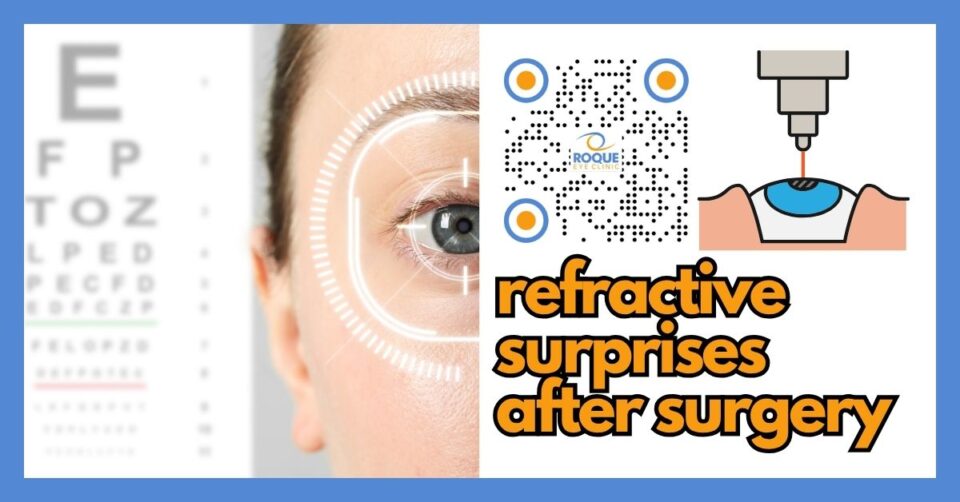
Residual Refractive Error and Refractive Surprises After Surgery
🧠 Dr. Roque's Quick Answer
Residual refractive error means some nearsightedness, farsightedness, or astigmatism remains after surgery. A refractive surprise means the final result is farther from the intended target than expected. This can happen after laser vision correction or lens-based surgery. The next step depends on the cause, size of the miss, healing stability, eye health, and how bothered the patient is.
Many patients expect refractive surgery to produce “perfect vision.” In real life, surgery aims to move vision much closer to the target, but biology, healing, measurements, and optical choices can still leave a small prescription behind. Sometimes that leftover prescription is mild and acceptable. Sometimes it is large enough to cause blur, imbalance between the eyes, glare, halos, or disappointment. That is when doctors start talking about residual refractive error or a refractive surprise.
This article explains what these terms mean, why they happen, what symptoms patients notice, and what can be done next. It also helps patients understand an important point: a refractive surprise is not always a surgical disaster. Often, it is a problem that can be measured, explained, and managed step by step.
🧩 Focus: Leftover prescription and unexpected refractive outcomes after refractive surgery
👁 Goal: Help patients understand why vision can miss the intended target after surgery and what treatment options may be considered
🛡 Evidence-Based: Preferred Practice Patterns • Standards of Care • Systematic Reviews • Meta-Analyses
ROQUE REFRACTIVE SURGERY Knowledge Hub
Start with the complete guide:
🔬 Residual Refractive Error Anatomy Micro-Primer
- Cornea: This is the clear front window of the eye. Laser procedures such as LASIK, PRK, and SMILE change its shape to alter focus.
- Lens: The natural lens or an implanted intraocular lens helps focus light. Lens-based surgery depends heavily on accurate lens power calculations.
- Retina: This is the light-sensitive tissue at the back of the eye. Even when the optics are good, retinal disease can still blur vision.
- Tear film: The smooth tear layer on the cornea matters for clear vision. Dry eye can make vision fluctuate and can mimic or worsen a refractive miss.
📘 Residual Refractive Error Terminology Glossary
- Residual refractive error: Leftover nearsightedness, farsightedness, or astigmatism after surgery.
- Refractive surprise: A result that ends up farther from the intended target than expected.
- Undercorrection: Too little correction, so some original prescription remains.
- Overcorrection: Too much correction, so the eye shifts past the intended target.
- Regression: Vision gradually drifts back toward the old prescription after an initially better result.
- Enhancement: A second procedure done to improve leftover prescription after the first surgery.
Quick Navigation
Related Reading
Dr. Roque's Key Learning Points
- A small leftover prescription after surgery is not the same as a dangerous complication.
- Residual refractive error can happen after LASIK, PRK, SMILE, ICL, refractive lens exchange, or cataract surgery.
- Causes include healing response, measurement limits, dry eye, corneal irregularity, lens calculation issues, and ocular surface or retinal problems.
- The first step is to identify the cause, not to rush into another procedure.
- Management can include observation, glasses, contact lenses, drops, laser enhancement, arcuate treatment, piggyback lens, or lens exchange depending on the case.
What Residual Refractive Error Means
Residual refractive error means some prescription remains after surgery. In plain language, the eye is still a little nearsighted, farsighted, astigmatic, or mixed. The result may still be much better than before surgery, but it does not land exactly where the patient and surgeon hoped.
A refractive surprise is a related term. It usually means the final result is more different from the intended target than expected. In a patient who wanted clear distance vision, even a modest leftover prescription can feel surprising. In a premium lens patient hoping for spectacle independence, a very small miss may feel like a big problem because expectations are high.
💡 Dr. Roque's Analogy
Think of refractive surgery like tuning a piano. The goal is to land exactly on the right note. Sometimes the note is very close but not perfectly centered. The piano still works, but a trained ear notices the difference. In the eye, that “almost right” result may still feel blurry or frustrating depending on the patient’s needs.
Why Refractive Surprises Happen
No refractive procedure is purely mathematical. Even when modern diagnostics are excellent, the final optical result depends on measurements, tissue response, healing, surgical technique, device calibration, and patient biology. That is why surgeons talk about improving odds rather than guaranteeing perfection.
Common reasons after corneal laser surgery
- Undercorrection or overcorrection from the original treatment plan
- Regression during healing
- Dry eye causing fluctuating or unstable measurements
- Irregular astigmatism or higher-order aberrations
- Epithelial remodeling or corneal healing variability
- Very high preoperative prescription or borderline corneal anatomy
Common reasons after lens-based surgery
- Biometry or IOL power calculation limits
- Unexpected effective lens position after surgery
- Pre-existing or residual corneal astigmatism
- Posterior corneal astigmatism not fully accounted for
- Toric IOL rotation or lens decentration
- Prior refractive surgery making IOL calculations harder
Patients with previous LASIK, PRK, or RK can be especially challenging during later cataract surgery because the cornea has already been altered. That does not make good outcomes impossible, but it does make accurate lens-power prediction more difficult.
Symptoms Patients May Notice
Some patients notice a refractive surprise immediately. Others notice it only after the surface settles and the expected recovery window has passed. Symptoms vary depending on whether the problem is mainly spherical error, astigmatism, irregularity, or imbalance between the two eyes.
- Blur at distance, near, or both
- Ghosting or shadowing
- Glare, halos, or starbursts
- Difficulty driving at night
- Eye strain or headache
- Feeling that one eye is sharper than the other
- Disappointment despite “good enough” chart vision
That last point matters. A patient may technically read a good line on the chart yet still feel dissatisfied because real-world vision is not matching the intended lifestyle goal.
After Laser Surgery Versus After Lens-Based Surgery
After LASIK, PRK, or SMILE
Residual refractive error after laser surgery is often discussed as undercorrection, overcorrection, induced astigmatism, or regression. In some patients, the miss is stable and small enough that glasses only for certain tasks are acceptable. In others, a corneal enhancement may be considered once refraction and corneal healing are stable.
After ICL, refractive lens exchange, or cataract surgery
In lens-based surgery, the issue may be a mismatch between the implanted lens power and the optical result, uncorrected astigmatism, lens rotation, or a target that was intentionally chosen but not well tolerated. With premium lenses, even small errors can matter because patients often expect a broader range of vision with less dependence on glasses.
How Doctors Evaluate the Problem
The correct response to an unhappy postoperative patient is not, “Let’s re-treat right away.” First, the surgeon must determine whether the complaint is truly refractive, whether it is stable, and whether another problem is contributing.
Typical evaluation includes
- History of the original procedure and target
- Manifest refraction and often repeated refraction over time
- Uncorrected and best-corrected visual acuity
- Corneal topography or tomography when needed
- Tear film and ocular surface evaluation
- Slit-lamp examination
- Assessment for cataract, posterior capsule opacity, retinal disease, or other blur causes
- IOL position, toric axis, and lens centration analysis in lens-based surgery
Dry eye deserves special attention. A patient may believe surgery “missed the target,” when in reality the refraction is fluctuating because the tear film is poor. Treating the ocular surface first can sometimes improve both symptoms and measurement reliability.
🚨 Dr. Roque's Emergency Warning
Blur after surgery is not always a simple refractive miss. Seek urgent ophthalmic review if there is severe pain, marked redness, discharge, sudden major vision loss, flashes, many new floaters, a curtain over vision, or rapidly worsening distortion.
Treatment Options
Treatment is individualized. The best option depends on the size of the residual error, the type of surgery already performed, corneal thickness and shape, lens status, healing stability, ocular surface health, and how much the patient is bothered.
1) Observation
Not every early miss needs action. After laser surgery, vision may still shift during healing. After lens-based surgery, the eye may need time to stabilize, and some symptoms may improve once inflammation, dryness, or capsule changes are addressed.
2) Glasses or contact lenses
These are often the simplest and safest solutions, especially for small residual errors or when another procedure would bring more risk than benefit. Contact lenses can be particularly useful when there is anisometropia or irregular astigmatism.
3) Ocular surface treatment
Artificial tears, prescription drops, lid treatment, punctal plugs, or dry-eye therapy may improve fluctuating blur and make repeated measurements more reliable before any decision about enhancement.
4) Corneal laser enhancement
LASIK or PRK enhancement may be considered in selected patients after both original laser surgery and some lens-based procedures. Laser enhancement is often attractive because it can be precise for residual spherical error and astigmatism, but only if the cornea, tear film, and timing are appropriate.
5) Lens-based revision
In lens surgery cases, options may include IOL exchange, toric rotation, or a secondary piggyback/add-on lens. These approaches are considered when the problem is mainly lenticular rather than corneal, or when the residual miss is too large or unsuitable for corneal treatment.
6) Treating another visual problem
Sometimes the true issue is not the refraction itself. Posterior capsule opacification, retinal disease, lens tilt, decentration, or significant dysphotopsia may be the main cause of dissatisfaction and should be addressed directly.
When Surgeons Often Wait Before Enhancing
Patients understandably want a quick fix. But an enhancement done too early can be the wrong fix. Surgeons often wait until refraction is stable, the cornea has healed, the tear film is better controlled, and the original surgery’s visual recovery window has become clearer. The exact timing varies by procedure and by eye.
Why Small Errors Can Still Feel Big
A patient with a monofocal target for distance may tolerate a small miss reasonably well. A patient with multifocal or EDOF expectations may be bothered by a much smaller error. Premium vision goals narrow the margin for dissatisfaction. In other words, the same diopter amount can feel minor in one patient and major in another.
How Surgeons Try to Prevent Refractive Surprises
- Thorough screening and accurate refraction
- Careful topography, tomography, and tear-film assessment
- Stable preoperative measurements
- Modern biometry and formula selection for lens surgery
- Special planning in post-refractive eyes
- Matching the procedure to the patient’s anatomy and goals
- Clear expectation counseling before surgery
Prevention also includes honesty. A good surgeon explains before surgery that zero risk and absolute optical perfection are not realistic promises. This counseling reduces the chance that a normal biologic variation will feel like an unexplained failure.
Questions Patients Should Ask
- Is my blur definitely from leftover prescription, or could something else be contributing?
- Has my result stabilized enough to decide on treatment?
- Would glasses or dry-eye treatment solve most of the problem?
- Am I a candidate for enhancement, and if so, what type?
- What are the risks of leaving it alone versus fixing it?
- What result is realistic after the next step?
Continue Reading
🏁 Dr. Roque's Take-Home Message
Residual refractive error and refractive surprises do happen after surgery, but they are not all the same. Some are small and manageable with glasses or time. Others need a careful work-up and a second intervention. The safest path is not to guess. It is to confirm the cause, stabilize the eye, and choose the correction method that best fits the patient’s anatomy, symptoms, and goals.
FAQ
1) Is a refractive surprise the same as a surgical complication?
No. A refractive surprise means the final optical result missed the intended target more than expected. It can happen without a dangerous complication, although a separate complication can also contribute in some cases.
2) Can a small leftover prescription still cause big symptoms?
Yes. Small errors may still matter in patients with premium lenses, high visual demands, night-driving complaints, or sensitivity to imbalance between the eyes.
3) How do I know whether I need an enhancement?
You need a full evaluation first. Surgeons usually confirm the refraction, check stability, assess the cornea and tear film, and rule out other causes of blur before recommending enhancement.
4) Can dry eye make it seem like surgery missed the target?
Yes. Dry eye can cause fluctuating blur and unstable refraction. Treating the ocular surface may improve symptoms and change the measured prescription.
5) What can be done after cataract or refractive lens surgery if the result misses the target?
Options may include glasses, contact lenses, laser enhancement, toric lens repositioning, piggyback/add-on lens implantation, or IOL exchange depending on the cause and size of the miss.
6) Can residual refractive error get worse over time?
Sometimes. Regression, dry eye fluctuation, lens rotation, capsule changes, or other ocular problems can make symptoms seem worse over time, which is why repeat examination matters.
📚 References
- Jacobs DS, Afshari NA, Bishop RJ, et al. Refractive Errors Preferred Practice Pattern®. Ophthalmology. 2023;130(3):P1-P60.
- Khoramnia R, Auffarth GU, Yildirim TM, et al. Refractive Outcomes after Cataract Surgery. Diagnostics (Basel). 2022;12(2):243.
- EyeWiki. Refractive Error After Cataract Surgery. Updated November 30, 2025.
- Moshirfar M, Hoggan RN, Muthappan V. Corrective Techniques and Future Directions for Treatment of Residual Refractive Error Following Cataract Surgery. Expert Rev Ophthalmol. 2014.
- Sáles CS, Manche EE. Managing residual refractive error after cataract surgery. J Cataract Refract Surg. 2015;41(6):1289-1299.
- EyeWiki. LASIK Complications. Updated February 13, 2024.
- Mayo Clinic. LASIK eye surgery. Updated July 16, 2025.
- U.S. Food and Drug Administration. When is LASIK not for me?
🤝 Roque Eye Clinic Patient Education Series
Dr. Manolette Roque | Dr. Barbara Roque
St. Luke's Medical Center Global City | Asian Hospital Medical Center
Philippines
Medical Review: Roque Advisory Council
Last Updated: March 2026
Medical Disclaimer
This article is intended for educational purposes only and does not replace professional medical consultation.