
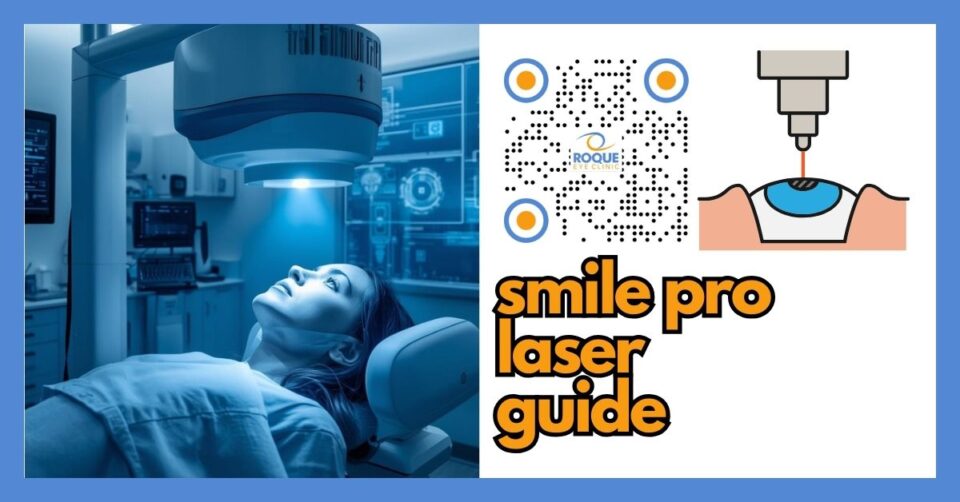
SMILE Pro
🧠 Dr. Roque's Quick Answer
SMILE Pro is the newer-generation version of SMILE laser vision correction performed on the ZEISS VISUMAX 800 platform. It is a flap-free lenticule extraction procedure that uses a femtosecond laser to create a small disc of corneal tissue, which is then removed through a tiny incision. It can be an excellent option for suitable patients, but candidacy, safety, and expected results still depend on careful screening and realistic counseling.
SMILE Pro is one of the newer developments in laser refractive surgery. Patients often hear that it is “faster,” “bladeless,” or “less invasive,” and while those descriptions can be partly true, they do not tell the whole story. The most important question is not whether a technology sounds newer. The real question is whether it is the right match for the patient’s eye anatomy, refractive error, lifestyle, healing profile, and expectations.
In simple terms, SMILE Pro is a modern form of small incision lenticule extraction. Instead of using an excimer laser on the corneal surface or creating a LASIK flap, a femtosecond laser creates a thin lenticule inside the cornea. The surgeon then removes that lenticule through a small opening. Removing that tissue changes the cornea’s shape so that light focuses more accurately on the retina.
🧩 Focus: SMILE Pro laser vision correction
👁 Goal: Explain what SMILE Pro is, how it differs from earlier SMILE and other laser procedures, who may qualify, and what patients should understand before surgery
🛡 Evidence-Based: Preferred Practice Patterns • Standards of Care • Systematic Reviews • Meta-Analyses
ROQUE REFRACTIVE SURGERY Knowledge Hub
Start with the complete guide:
🔬 SMILE Pro Anatomy Micro-Primer
- Corneal epithelium: This is the thin outer skin of the cornea. In SMILE Pro, treatment happens beneath this surface rather than by removing a large surface area as in PRK.
- Corneal stroma: This is the main supporting layer of the cornea. The lenticule is created inside this layer and then removed to reshape the eye.
- Cap and incision: In SMILE Pro, a thin cap remains over the treatment zone, and the surgeon removes the lenticule through a small side opening rather than a broad flap.
- Tear film: Even though SMILE Pro is flap-free, a healthy ocular surface still matters for accurate measurements, comfort, and visual quality.
📘 SMILE Pro Terminology Glossary
- SMILE: Small incision lenticule extraction, a flap-free corneal refractive procedure.
- SMILE Pro: The newer-generation ZEISS SMILE workflow performed on the VISUMAX 800 platform.
- Lenticule: A thin disc-shaped piece of corneal tissue created inside the cornea and removed to change focusing power.
- Femtosecond laser: A highly precise laser used to create tissue cuts inside the cornea.
- Myopia: Nearsightedness; distant objects look blurred.
- Astigmatism: Uneven focusing caused by irregular corneal or optical shape.
Quick Navigation
Related Reading
Dr. Roque's Key Learning Points
- SMILE Pro is an updated form of small incision lenticule extraction performed on the ZEISS VISUMAX 800 platform.
- It is a flap-free laser vision correction option for selected patients with myopia and astigmatism.
- Compared with earlier SMILE systems, SMILE Pro is designed to offer a faster laser phase and additional workflow tools.
- Faster technology does not remove the need for full screening, careful planning, and realistic expectations.
- SMILE Pro can be an excellent option for the right patient, but it is not automatically the best option for every eye.
What SMILE Pro Is
SMILE Pro is the newer-generation version of ZEISS SMILE technology performed on the VISUMAX 800 femtosecond laser platform. Like standard SMILE, it is a corneal refractive procedure in which the surgeon creates a lenticule inside the cornea and removes it through a small incision. Removing that small internal disc changes the cornea’s curvature and reduces refractive error.
For patients, the simplest way to understand SMILE Pro is this: it belongs to the same family as SMILE, but it uses a newer platform designed to make treatment faster and improve workflow. That can be meaningful in surgery, but it does not mean the procedure is magic, risk-free, or suitable for everyone.
💡 Dr. Roque's Analogy
Think of standard SMILE and SMILE Pro like two generations of a high-end surgical vehicle. The destination is similar, but the newer version may move faster and offer better navigation tools. The journey can improve, but the driver, the road, and whether the trip is right for you still matter.
How SMILE Pro Works
SMILE Pro uses a femtosecond laser to create a thin lenticule within the corneal stroma as well as a small access incision. The surgeon then carefully separates and removes the lenticule. Once that tissue is removed, the cornea changes shape, allowing light to focus more precisely on the retina.
Unlike LASIK, SMILE Pro does not require a large corneal flap. Unlike PRK or TransPRK, it does not treat the broad surface in the same way as surface ablation. That is why many patients and surgeons describe it as a flap-free, minimally invasive corneal refractive option.
How SMILE Pro Differs from Standard SMILE
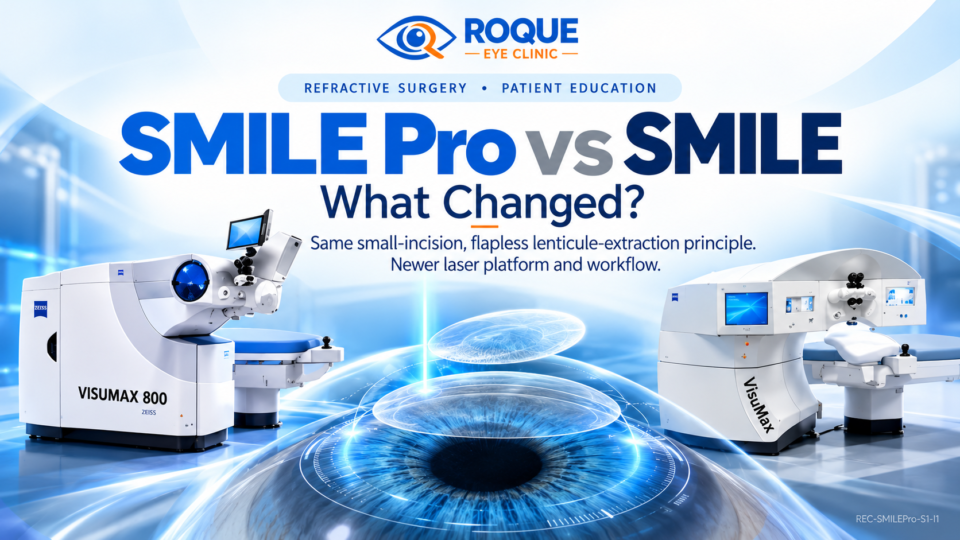
The core concept is the same: both procedures use lenticule extraction. The difference is that SMILE Pro is performed on the newer VISUMAX 800 platform with updated software and workflow tools. The newer platform is designed for a faster laser phase and incorporates features intended to help centration, cyclotorsion management, and data-guided workflow.
For patients, the most commonly discussed practical difference is speed. The laser portion is shorter than earlier SMILE systems. That may improve the patient experience for some people because shorter treatment can feel less stressful. Still, a faster laser cut does not replace the importance of suction stability, surgeon skill, corneal anatomy, or careful lenticule dissection.
What SMILE Pro May Treat
In current practice, SMILE Pro is mainly discussed for myopia and myopic astigmatism. However, exact regulatory indications and treatment ranges vary by country and platform version. That is important because what is marketed globally may not be identical to what is approved in every region. Patients should always ask what is approved and routinely used in the specific clinic and jurisdiction where surgery is being offered.
Who May Be a Candidate for SMILE Pro
A good SMILE Pro candidate is usually an adult with stable refraction, healthy corneal structure, no active eye disease, and refractive error that falls within the surgeon’s treatment parameters. A full screening exam remains essential. That screening should include manifest refraction, often cycloplegic refraction when appropriate, corneal topography or tomography, pachymetry, ocular surface evaluation, pupil assessment, and a dilated retinal examination.
Some patients who are interested in SMILE Pro are drawn to it because it is flap-free. That can be relevant for people with certain sports, work, or lifestyle priorities. However, being attracted to the idea of “no flap” does not automatically make someone the right candidate. Corneal shape, dry eye, refractive range, visual goals, and surgeon judgment still matter.
Who May Need Caution or a Different Option
- Patients with unstable prescription
- Patients with suspicious corneal tomography or ectasia risk
- Patients with significant ocular surface disease that needs optimization first
- Patients whose refractive pattern is better suited to another laser profile or to ICL
- Patients with expectations that no laser surgery can realistically meet
- Patients with retinal pathology or other eye disease needing treatment first
Potential Benefits of SMILE Pro
1) Flap-free treatment
One of the biggest attractions of SMILE Pro is that it does not involve creation of a broad LASIK flap. This means flap-related complications are not part of the procedure in the same way they are with LASIK.
2) Smaller incision
Because lenticule removal is done through a small opening, many patients like the idea of a smaller access point rather than a larger flap interface.
3) Faster laser phase on the newer platform
The newer VISUMAX 800 platform is designed for a shorter laser phase than earlier SMILE systems. That may make the treatment feel quicker and, for some patients, more comfortable.
4) Strong early clinical results in suitable patients
Published SMILE Pro studies have shown strong safety, efficacy, and predictability in properly selected myopic and myopic astigmatic eyes. That does not mean every patient gets perfect vision, but it supports SMILE Pro as a serious modern refractive option when used appropriately.
Limitations and Trade-Offs
It is not automatically better for everyone
Patients sometimes assume that newer must always mean better. In refractive surgery, that is too simple. The best procedure depends on the eye, not just the device generation. For some patients, LASIK may still make more sense. For others, PRK, TransPRK, ICL, or no surgery at all may be safer or more logical.
Enhancement planning can be more nuanced
Enhancements after SMILE are possible, but retreatment pathways are different from standard LASIK enhancements. That is one reason careful first-time treatment planning matters.
Visual symptoms can still occur
Even with excellent technology, patients may still experience dryness, glare, halos, fluctuating vision, night-vision complaints, or residual refractive error. Technology can reduce certain burdens, but it does not abolish human variation in healing and optical response.
Recovery and Aftercare
Many patients recover fairly quickly after SMILE Pro, but “quickly” should still be understood in a realistic way. Some people notice useful vision early, while others experience blur, fluctuation, dryness, or mild visual instability during the early healing period. That variation is normal.
Postoperative care usually includes antibiotic and anti-inflammatory drops, lubricating drops, activity restrictions for a short period, and scheduled follow-up visits. Patients should avoid rubbing the eyes, protect the eyes from contamination, and follow their surgeon’s instructions closely. Faster treatment time does not eliminate the need for disciplined aftercare.
What Recovery May Feel Like
- Mild discomfort or foreign-body sensation early on
- Blur or fluctuation in the first days
- Dryness or temporary visual instability
- Gradual sharpening over time
- Need for regular follow-up and drop use
🚨 Dr. Roque's Emergency Warning
Urgent review is needed if you develop rapidly worsening pain, marked redness, discharge, sudden severe drop in vision, or symptoms that are clearly getting worse rather than better. Do not assume every postoperative symptom is “normal healing.”
Risks and Complications to Discuss
- Residual refractive error or undercorrection
- Overcorrection in some cases
- Dry eye symptoms or fluctuating vision
- Glare, halos, reduced contrast, or night-vision symptoms
- Difficulty with lenticule dissection or extraction
- Epithelial issues or interface-related healing concerns
- Infection, though uncommon, can be serious
- Need for enhancement or another visual strategy later
SMILE Pro Versus LASIK and PRK
Patients often compare SMILE Pro with LASIK and PRK. A practical way to think about it is this:
- LASIK is known for fast recovery and strong outcomes, but it involves a flap.
- PRK or TransPRK are flap-free, but surface healing is slower and early discomfort is usually greater.
- SMILE Pro is flap-free and intrastromal, which appeals to many patients, but it still has its own limits, risks, and candidacy rules.
No single option wins for every patient. The “best” procedure is the one that offers the safest balance of anatomy, optics, healing, and lifestyle fit.
Questions to Ask Before Choosing SMILE Pro
- Am I a true SMILE Pro candidate, or do I just like the idea of the technology?
- Would LASIK, PRK, TransPRK, or ICL make more sense for my eye measurements?
- What is my risk of dryness, halos, or residual refractive error?
- What is your retreatment strategy if my result is not ideal?
- What visual trade-offs should I expect for work, night driving, and screen use?
- What part of my examination supports SMILE Pro as the best choice?
Continue Reading
🏁 Dr. Roque's Take-Home Message
SMILE Pro is an important modern refractive surgery option, especially for selected patients seeking a flap-free laser procedure. Its newer platform offers meaningful workflow and speed advantages, but those features do not replace proper screening, sound judgment, and honest counseling. The right question is not “Is SMILE Pro new?” but “Is SMILE Pro the safest and best fit for my eye?”
FAQ
1) Is SMILE Pro the same as regular SMILE?
They belong to the same procedure family, but SMILE Pro uses the newer VISUMAX 800 platform with updated workflow features and a faster laser phase.
2) Is SMILE Pro better than LASIK?
Not for everyone. SMILE Pro can be excellent in the right patient, but LASIK may still be the better choice in some eyes depending on corneal shape, refractive error, visual goals, and surgeon preference.
3) Does SMILE Pro involve a corneal flap?
No. SMILE Pro is a flap-free lenticule extraction procedure performed through a small incision.
4) What does SMILE Pro usually treat?
It is mainly discussed for myopia and myopic astigmatism, although treatment ranges and approvals vary by country and device version.
5) Is SMILE Pro recovery immediate?
Not always. Many patients recover well and fairly quickly, but blur, fluctuation, dryness, and gradual visual sharpening can still occur during the healing period.
6) Can SMILE Pro still have complications?
Yes. Although outcomes can be very good, no refractive surgery is risk-free. Patients still need proper screening, informed consent, and follow-up.
📚 References
- American Academy of Ophthalmology. What Is Small Incision Lenticule Extraction?
- American Academy of Ophthalmology. Refractive Surgery Preferred Practice Pattern®.
- U.S. Food and Drug Administration. Premarket Approval (P150040/S003) for VisuMax Femtosecond Laser SMILE indication.
- ZEISS. U.S. FDA Approves the VISUMAX 800 with SMILE pro software from ZEISS. January 11, 2024.
- Saad A, et al. Refractive outcomes of small lenticule extraction (SMILE) Pro® with a 2 MHz femtosecond laser. 2024.
- Cung HS, et al. Three-Month Outcomes of SMILE Pro with the VISUMAX 800 for Myopic Astigmatism in a Large Population. 2025.
🤝 Roque Eye Clinic Patient Education Series
Dr. Manolette Roque | Dr. Barbara Roque
St. Luke's Medical Center Global City | Asian Hospital Medical Center
Philippines
Medical Review: Roque Advisory Council
Last Updated: March 2026
Medical Disclaimer
This article is intended for educational purposes only and does not replace professional medical consultation.