



Capsule Tension Rings
🧠 Quick Answer
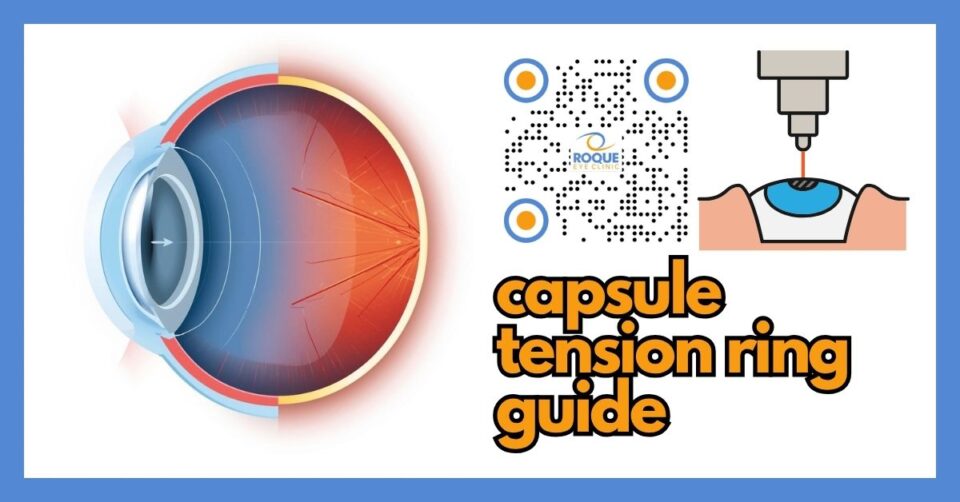
A capsule tension ring is a tiny circular implant used during cataract or lens replacement surgery to support a weak lens capsule. It helps stabilize the capsular bag when the zonules are loose or damaged, making surgery safer and helping keep the intraocular lens better centered. It does not correct vision by itself, but it can support a better surgical result in selected eyes.
Capsule tension rings are not premium lenses, and they are not refractive implants by themselves. Instead, they are support devices used inside the eye during cataract surgery or refractive lens replacement when the surgeon believes the natural lens capsule needs extra stability. In simple terms, they act like an internal support ring for a part of the eye that has become too loose, uneven, or unstable for standard surgery alone.
This matters because modern lens-based vision correction often aims for precise lens positioning. If the capsular bag is unstable, the implanted intraocular lens may not sit as safely or as accurately as planned. In the right case, a capsule tension ring can help the surgeon maintain bag shape, distribute stress more evenly, and improve control during surgery.
🧩 Focus: Capsule tension rings in cataract and lens-based refractive surgery
👁 Goal: Explain what capsule tension rings do, when surgeons use them, who may need them, and what patients should realistically expect
🛡 Evidence-Based: Preferred Practice Patterns • Standards of Care • Systematic Reviews • Meta-Analyses
REFRACTIVE SURGERY Knowledge Hub
Start with the complete guide:
🔬 Capsule Tension Rings Anatomy Micro-Primer
- Lens capsule: This is the thin clear “bag” that used to hold your natural lens. During cataract surgery, the new intraocular lens is often placed inside this bag.
- Zonules: These are tiny fibers that suspend the lens capsule in position. If they are weak or broken, the capsule can become unstable.
- Capsular bag: This is the space left after the cloudy natural lens is removed. Surgeons try to preserve this space because it is the best location for many IOLs.
- Intraocular lens (IOL): This is the artificial lens implanted after cataract removal or refractive lens exchange. Good IOL centration depends on good capsular support.
📘 Capsule Tension Rings Terminology Glossary
- Capsule tension ring (CTR): A flexible ring, usually made of PMMA, placed in the capsular bag to improve stability.
- Zonular weakness: Looseness or damage in the tiny fibers that hold the lens capsule in place.
- Zonular dialysis: A segment of broken or detached zonules, often described by clock hours.
- Capsular tension segment (CTS): A related support device often used when zonular weakness is more severe.
- Cionni ring or modified CTR: A fixation-capable support ring used in more advanced zonular problems when scleral fixation may be needed.
- Capsular contraction: Shrinkage or tightening of the capsule after surgery, which can affect lens position.
Quick Navigation
Related Reading
Key Learning Points
- A capsule tension ring is a support device, not a vision-correcting lens.
- It is used when the lens capsule needs extra stability because of zonular weakness or dialysis.
- It may help keep the capsular bag more circular and help the IOL stay better centered.
- Common situations include pseudoexfoliation, trauma, prior eye surgery, high myopia, and weak zonules found during surgery.
- A standard CTR does not solve every zonular problem. More severe instability may require other support devices or a different surgical plan.
What a Capsule Tension Ring Is
A capsule tension ring, often shortened to CTR, is a thin circular device inserted into the capsular bag during cataract surgery or refractive lens replacement. Most standard rings are made of polymethyl methacrylate, or PMMA, which is a well-known surgical material used in ophthalmology. Once placed in the capsular bag, the ring helps spread forces around the bag more evenly, rather than allowing all of the stress to fall on one weak area.
That matters because the lens capsule is supposed to stay centered and stable while the surgeon removes the cloudy natural lens and implants the new IOL. If the zonules are weak, the bag can wobble, tilt, or partially collapse. A CTR helps support the bag from the inside, much like a flexible reinforcement hoop.
💡 Analogy
Imagine a camping tent with one side of the frame becoming loose. The fabric may sag and the whole structure may become harder to manage. A capsule tension ring acts like an internal circular support that helps the “tent” of the capsular bag keep its shape while the surgeon works inside it.
Why Surgeons Use Capsule Tension Rings
The main reason is stability. When zonules are weak, surgery becomes more technically challenging. The capsular bag may move excessively during capsulorhexis, phacoemulsification, cortex removal, or IOL implantation. A CTR can help the surgeon maintain a more even contour of the bag and reduce stress concentration at the damaged area.
In the right situation, that can improve control during surgery and help with postoperative IOL centration. This can be especially relevant when the goal is not only safe cataract removal, but also more precise refractive outcomes.
That said, a CTR is not a magic solution. It can be extremely helpful in selected cases, but its value depends on when it is inserted, how much zonular weakness is present, whether the capsule itself remains intact, and whether a more advanced support device is needed instead.
Who Might Need a Capsule Tension Ring
Patients do not usually request a CTR by name before surgery. More often, the surgeon decides to use one because the preoperative evaluation or the surgical findings suggest that the capsular bag needs help. Common situations include:
- Pseudoexfoliation syndrome: This is one of the most common causes of zonular weakness in cataract surgery.
- Traumatic cataract or prior eye injury: Trauma can break or weaken zonules.
- High myopia: Some highly myopic eyes may have a larger or more vulnerable capsular system.
- Prior eye surgery: Previous vitrectomy, glaucoma filtering surgery, or older corneal surgery may increase zonular risk in some cases.
- Congenital or inherited zonular disorders: Certain eyes are born with weaker zonular support.
- Intraoperative zonular surprise: Sometimes the surgeon discovers zonular instability only during the procedure.
What Capsule Tension Rings Do Not Do
A CTR does not remove the cataract. It does not replace the intraocular lens. It does not guarantee perfect vision. It does not correct the cornea. It does not prevent every possible lens-position problem. It also does not make severe zonular loss disappear.
This is important because patients may hear that a support device was used and assume it is a premium upgrade. In reality, it is usually a surgical support tool. Its role is to help manage a more complex eye safely and give the capsular bag a better chance to support the final lens implant.
What Happens During Surgery
During cataract or lens replacement surgery, the surgeon creates a circular opening in the front of the capsule, removes the natural lens material, and places the IOL. If zonular weakness is present, the surgeon may insert the CTR before or during different stages of the case, depending on the anatomy and the surgical strategy.
In general, the ring is carefully guided into the capsular bag so it sits circumferentially inside the bag. Once in position, it helps maintain the shape of the capsular bag and distribute tension more evenly. The rest of the surgery then continues with this extra support in place.
Some eyes need more than a standard ring. If the zonular loss is more extensive, the surgeon may instead use or add a capsular tension segment, a modified scleral-fixated ring, temporary capsular hooks, or even a different IOL fixation plan entirely.
Standard CTRs vs More Advanced Capsular Support Devices
Patients often hear all of these called “rings,” but not all capsular support devices are the same.
Standard capsule tension ring
This is the classic circular ring used for mild to moderate zonular weakness when the capsule itself is intact and the surgeon believes the bag can still support an in-the-bag IOL.
Modified capsule tension ring
These devices are designed for more advanced cases and may allow scleral fixation when extra long-term support is needed.
Capsular tension segment
A capsular tension segment is often considered when zonular instability is more severe or more localized. It can also be fixated and may be used in combination with other support methods.
Capsular hooks or bag hooks
These are temporary surgical tools used during the case to stabilize the bag while the surgeon works. They are different from permanent support rings.
Potential Benefits and Important Limitations
Potential benefits
- Improves capsular bag stability during surgery
- Helps distribute tension around weak zonules
- May improve in-the-bag IOL centration in selected cases
- May help preserve the surgeon’s preferred IOL placement strategy
- Can be a valuable tool in complex cataract and refractive lens surgery
Important limitations
- It does not replace absent capsule support when damage is too severe
- It does not fix a torn posterior capsule
- It does not eliminate the risk of later capsule-bag-IOL complex instability
- It may not be enough in eyes with profound zonular loss
- It does not guarantee perfect refractive outcomes
Risks and Complications to Understand
CTR use is generally a sign that the eye is more complex than average, so the conversation should include the risks of the underlying case—not just the device itself. Risks may include:
- Intraoperative extension of zonular damage
- Difficulty inserting the ring in a fragile bag
- Capsular tears if the case is already unstable
- IOL decentration or later bag instability despite support
- Capsular contraction or phimosis in predisposed eyes
- The need for additional support devices or scleral fixation
- More complicated surgery and longer operative time than routine cases
One especially important point is that a standard CTR is generally not the right choice when there is a posterior capsule rupture or when there is no intact continuous capsulorhexis. In those situations, the surgical plan usually has to change. That is why these decisions are highly case-specific.
🚨 Emergency Warning
After surgery, urgent review is needed if you develop severe pain, rapidly worsening blurred vision, marked redness, flashes, many new floaters, or a curtain-like shadow. These are not typical “just healing” symptoms and may signal a complication that needs prompt ophthalmic attention.
Recovery and Long-Term Expectations
From the patient’s perspective, recovery after surgery with a CTR may feel similar to recovery after complex cataract surgery rather than routine cataract surgery. Some patients do very well and may never feel the device at all. In fact, most patients are not aware of it once healing is complete. The CTR stays inside the eye and is not something the patient can see or remove.
However, because these cases often begin with weak zonules, follow-up matters. The surgeon may want to watch for late capsular contraction, IOL shift, or progressive zonular instability—especially in conditions like pseudoexfoliation.
Capsule Tension Rings and Premium IOL Planning
Precise IOL centration is especially important for some premium lenses. A support ring may help preserve capsular bag shape in selected complex eyes, but a surgeon must still be cautious. The fact that a ring can support the bag does not automatically mean every premium IOL is appropriate. Sometimes the safer choice is a simpler lens design if long-term centration is uncertain.
In other words, the presence of a CTR may support the surgical plan, but the lens choice still depends on the whole eye. A patient-centered discussion should balance spectacle goals with long-term stability and safety.
Questions Patients Should Ask
- Why do you think I may need a capsule tension ring?
- Is my zonular weakness mild, moderate, or severe?
- Would a standard CTR likely be enough, or might I need another support device?
- Can my IOL still be placed safely in the bag?
- Does this affect whether I am a good candidate for a premium IOL?
- Will I need closer long-term follow-up because of zonular weakness?
Continue Reading
🏁 Take-Home Message
Capsule tension rings are small but important support devices used when the lens capsule needs extra stability during cataract or refractive lens surgery. They do not improve vision on their own, but they can help a surgeon manage weak zonules more safely and may help the capsular bag support the IOL better. The key is careful case selection: in the right eye, a CTR can be very helpful; in the wrong situation, other support methods may be safer.
FAQ
1) Is a capsule tension ring the same as an intraocular lens?
No. A capsule tension ring is a support device. It helps stabilize the capsular bag. The intraocular lens is the artificial lens implanted to replace the natural lens.
2) Will I be able to feel a capsule tension ring inside my eye?
No. Patients usually do not feel the ring once it is in place. It stays inside the eye permanently unless there is a rare reason to remove or revise it.
3) Does needing a CTR mean my surgery is more complicated?
Usually yes. A CTR is often used because the capsular bag or zonules are weaker than usual, which makes the case more complex than routine cataract surgery.
4) Can a capsule tension ring improve my refractive result?
Indirectly, it may help by stabilizing the capsular bag and supporting better IOL positioning. However, it is not a refractive treatment by itself and does not guarantee perfect vision.
5) Can every weak-zonule case be solved with a standard CTR?
No. Mild to moderate zonular weakness may be managed with a standard CTR, but more severe cases may need capsular tension segments, modified fixation-capable rings, scleral fixation, or a different IOL plan.
6) Is a capsule tension ring used before surgery or only if a problem appears during surgery?
Either is possible. Sometimes the surgeon plans it in advance based on risk factors such as pseudoexfoliation or trauma. In other cases, zonular weakness becomes obvious only during surgery.
📚 References
- American Academy of Ophthalmology. Capsular Tension Rings: When to Use Them, When to Refer.
- EyeWiki. Capsular Support Devices.
- Menapace R, Findl O, Georgopoulos M, et al. The capsular tension ring: designs, applications, and techniques. J Cataract Refract Surg. 2000;26(6):898-912.
- Hasanee K, Ahmed IIK. Capsular tension rings: update on endocapsular support devices. Ophthalmol Clin North Am. 2006;19(4):507-519.
- EyeWiki. Cataract Surgery in Pseudoexfoliation Syndrome.
🤝 Roque Eye Clinic Patient Education Series
Dr. Manolette Roque | Dr. Barbara Roque
St. Luke's Medical Center Global City | Asian Hospital Medical Center
Philippines
Medical Review: Roque Advisory Council
Last Updated: March 2026
Medical Disclaimer
This article is intended for educational purposes only and does not replace professional medical consultation.