

Monofocal vs EDOF vs Multifocal
🧠 Quick Answer
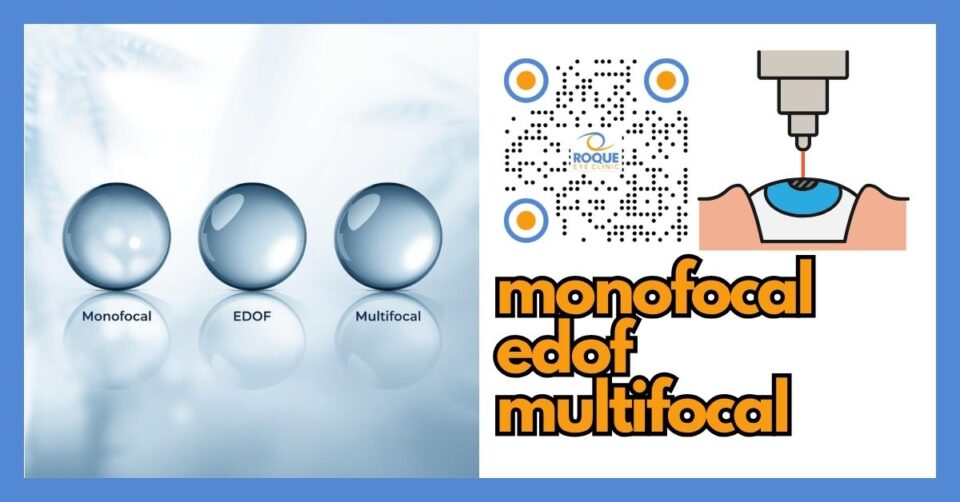
Monofocal, EDOF, and multifocal intraocular lenses each offer different trade-offs. Monofocal lenses usually give the sharpest vision at one chosen distance. EDOF lenses aim to stretch clear vision from far to intermediate. Multifocal lenses offer the greatest chance of reducing glasses use at more distances, but halos, glare, and contrast trade-offs may be more noticeable in some patients.
Choosing an intraocular lens is one of the most important decisions in cataract and refractive lens surgery. Many patients understandably ask, “Which lens is best?” The honest answer is that the best lens depends on your eye, your lifestyle, and your tolerance for visual trade-offs.
A lens that makes one patient very happy may disappoint another. Someone who prioritizes the sharpest possible distance vision and does not mind reading glasses may prefer a monofocal lens. Someone who spends hours on a computer may like the extra intermediate range of an EDOF lens. Someone who strongly wants to reduce glasses dependence for multiple distances may consider a multifocal lens, provided the eye is suitable and expectations are realistic.
🧩 Focus: Comparing monofocal, extended depth of focus, and multifocal intraocular lenses
👁 Goal: Help patients understand the range of vision, glasses dependence, contrast quality, and side-effect trade-offs of each IOL category
🛡 Evidence-Based: Preferred Practice Patterns • Standards of Care • Systematic Reviews • Meta-Analyses
REFRACTIVE SURGERY Knowledge Hub
Start with the complete guide:
🔬 Monofocal vs EDOF vs Multifocal Anatomy Micro-Primer
- Natural lens: This is the clear lens inside the eye that helps focus light. Cataract surgery removes it and replaces it with an artificial intraocular lens.
- Retina: This is the light-sensitive tissue at the back of the eye. The quality of the image formed on the retina affects how well you see.
- Macula: The central part of the retina responsible for detailed vision. Macular disease can affect how well premium lenses perform.
- Cornea: The clear front window of the eye. Astigmatism in the cornea may need separate correction, such as a toric lens design.
📘 Monofocal vs EDOF vs Multifocal Terminology Glossary
- Monofocal IOL: A lens designed to focus best at one chosen distance, usually far.
- EDOF IOL: An extended depth of focus lens designed to provide a continuous range of relatively clear vision beyond a standard monofocal lens.
- Multifocal IOL: A lens with more than one focal point, such as bifocal or trifocal, to improve vision at more than one distance.
- Contrast sensitivity: The ability to see subtle differences between light and dark, especially in dim lighting.
- Dysphotopsia: Unwanted visual effects such as halos, glare, or starbursts.
- Spectacle independence: Reduced need for glasses after surgery.
Quick Navigation
Related Reading
Key Learning Points
- Monofocal lenses usually give the clearest quality at one chosen distance but often still require glasses for other distances.
- EDOF lenses are designed to extend the range of relatively clear vision beyond monofocal, especially for distance and intermediate tasks.
- Multifocal lenses offer the best chance of reducing glasses use across more distances, especially near, but may cause more halos, glare, and contrast trade-offs.
- No IOL category is best for everyone. The right choice depends on retinal health, corneal status, night-driving demands, personality, and visual priorities.
- Patients with glaucoma, macular degeneration, diabetic retinopathy, or other diseases that reduce image quality may be less suitable for multifocal designs.
What These Lens Categories Mean
In simple terms, these lenses differ in how they focus incoming light.
Monofocal lenses focus at a single chosen distance, most commonly far. This means many patients still need glasses for reading and sometimes for computer work.
EDOF lenses try to extend the range of relatively clear vision rather than creating separate focal steps. The FDA describes an extended depth of focus intraocular lens as one that uses optical design to provide a continuous range of relatively clear vision beyond that achievable with a monofocal lens.
Multifocal lenses provide more than one focal point. They may be bifocal or trifocal. The Philippine Academy of Ophthalmology notes that trifocal multifocal lenses provide the widest range among multifocal designs by offering focal points for far, intermediate, and near vision.
💡 Analogy
Think of these three lens types like camera settings. A monofocal lens gives one strong focus setting. An EDOF lens stretches that focus into a smoother band. A multifocal lens works more like multiple preset focus zones. The trade-off is that giving more range often means sharing light in more complex ways.
Monofocal IOLs
Monofocal lenses are designed to provide the best possible vision at one distance, usually distance vision. According to the AAO’s patient guidance, monofocal lenses are the most commonly used IOLs and typically offer excellent clarity at a single chosen focal point. Patients usually still need reading glasses and often need help for intermediate tasks such as computer work, depending on the target.
Strengths of monofocal lenses
- Excellent quality of vision at the chosen distance
- Often best contrast sensitivity of the three groups
- Usually fewer halos and glare complaints than multifocal lenses
- Often a safer choice when the eye has other diseases that may reduce visual quality
Limitations of monofocal lenses
- Most patients still need reading glasses
- Intermediate tasks such as laptop work may also still need glasses
- Less spectacle independence than EDOF or multifocal designs
EDOF IOLs
EDOF stands for extended depth of focus. These lenses are designed to broaden the range of useful vision rather than split light into several distinct focal points in the same way traditional multifocal lenses do. FDA classification describes EDOF lenses as providing a continuous range of relatively clear vision beyond standard monofocal optics.
In practical terms, many EDOF lenses aim to provide strong distance vision and better intermediate function, with some near benefit depending on lens design, residual refraction, and patient factors. The Philippine Academy of Ophthalmology states that EDOF lenses provide good distance and intermediate vision, while near vision is usually less sharp than that provided by multifocal lenses.
Strengths of EDOF lenses
- Better intermediate range than a standard monofocal lens
- Usually less near-glasses dependence than monofocal for daily tasks
- Often fewer halos and less night glare than traditional multifocal designs
- A useful middle ground for patients who want more range without fully prioritizing near spectacle independence
Limitations of EDOF lenses
- Near vision may still not be strong enough for prolonged small-print reading without glasses
- Some dysphotopsia can still occur
- Visual quality may still not match the highest-contrast monofocal experience in every patient
Multifocal IOLs
Multifocal lenses provide more than one focal point. Bifocal designs provide two focal points, while trifocal designs provide three. Their main attraction is the potential to reduce dependence on glasses at multiple distances.
The AAO patient guidance notes that multifocal lenses contain corrective zones built into the lens so patients can see at different distances. The trade-off is that they may cause halos or glare around lights and are not ideal for every eye. The Philippine Academy of Ophthalmology also explains that multifocal lenses split light to provide distance, intermediate, and near vision, but this same light-splitting can reduce image contrast and make nighttime glare and halos more noticeable.
Strengths of multifocal lenses
- Highest chance of spectacle independence across more distances
- Often best option for patients strongly motivated to reduce both reading and distance glasses
- Trifocal designs can provide a broad functional range for far, intermediate, and near tasks
Limitations of multifocal lenses
- More halos, glare, and night-vision complaints in some patients
- Reduced contrast sensitivity compared with monofocal lenses is a recognized trade-off
- Usually less forgiving of corneal irregularity, dry eye, macular disease, glaucoma, or residual refractive error
Side-by-Side Comparison
| Feature | Monofocal | EDOF | Multifocal |
|---|---|---|---|
| Best-known strength | Sharpest one-distance quality | Distance + intermediate range | Most glasses reduction at multiple distances |
| Distance vision | Excellent | Excellent | Usually very good to excellent |
| Intermediate vision | Often limited without glasses | Usually better than monofocal | Often good, especially trifocal designs |
| Near vision | Usually needs glasses | Variable, often still needs help | Usually strongest of the three |
| Halos/glare risk | Lowest | Usually less than multifocal | Highest of the three |
| Contrast sensitivity | Usually best preserved | May be reduced compared with monofocal | May be reduced compared with monofocal |
| Need for glasses | Most likely for near and sometimes intermediate | Less than monofocal, especially for intermediate | Least likely overall |
Which Patient May Suit Which Lens?
Patients who may prefer monofocal
Monofocal lenses often suit patients who value image quality and predictability above spectacle independence. They are commonly preferred when the eye has glaucoma, macular disease, diabetic retinopathy, corneal irregularity, or other conditions that already challenge visual quality. They also suit patients who do a lot of night driving and want fewer lens-related light phenomena.
Patients who may prefer EDOF
EDOF lenses may fit patients who want more range than a monofocal lens, especially for computer and arm’s-length tasks, but who are more cautious about halos and glare than a typical multifocal candidate. Many patients view EDOF as a compromise lens: more freedom than monofocal, but usually fewer trade-offs than multifocal.
Patients who may prefer multifocal
Multifocal lenses usually suit patients who strongly prioritize reducing glasses for far, intermediate, and near tasks and who have healthy eyes, good tear film, low tolerance for wearing spectacles, and a clear understanding of possible night-vision trade-offs. A patient who reads often, uses the phone frequently, and hates glasses may accept halos more readily than a patient who drives long distances at night.
🚨 Emergency Warning
If you already have significant glaucoma, diabetic retinopathy, macular degeneration, unexplained blurred vision, severe dry eye, or distorted vision, lens choice should not be based on marketing alone. These conditions can affect whether premium lens technology is suitable and may need separate treatment first.
The Real-World Question: What Matters Most to You?
The monofocal-versus-EDOF-versus-multifocal decision is really a conversation about priorities.
- If you say, “I want the cleanest, crispest distance image and I do not mind reading glasses,” monofocal may fit best.
- If you say, “I want strong distance vision and better computer range, but I am cautious about halos,” EDOF may be worth discussing.
- If you say, “I really want the most freedom from glasses and I understand there may be more night symptoms,” multifocal may be reasonable if the eye is suitable.
The most important mistake to avoid is choosing based only on the promise of “no glasses” without understanding the trade-offs. In ophthalmology, range of vision, contrast, and dysphotopsia often exist in balance with one another.
Continue Reading
🏁 Take-Home Message
Monofocal, EDOF, and multifocal lenses each solve a different problem. Monofocal usually maximizes one-distance clarity. EDOF aims to broaden useful vision with fewer trade-offs than traditional multifocal designs. Multifocal offers the strongest chance of reducing glasses use at more distances, but often with more halos, glare, and contrast trade-offs. The right answer is the lens that best matches your eye health, daily activities, and expectations.
FAQ
1) Which lens gives the sharpest vision: monofocal, EDOF, or multifocal?
Monofocal lenses usually provide the sharpest quality at one chosen distance, especially distance vision. EDOF and multifocal lenses trade some optical simplicity for a broader range of vision.
2) Which lens reduces the need for glasses the most?
Multifocal lenses usually offer the greatest chance of reducing glasses use at distance, intermediate, and near. EDOF lenses often reduce glasses dependence more than monofocal, especially for intermediate tasks, but usually less than multifocal for near reading.
3) Are EDOF lenses the same as multifocal lenses?
No. EDOF lenses are designed to extend the range of relatively clear vision beyond a monofocal lens, while multifocal lenses create more than one focal point. In practice, both are considered premium options, but they work differently.
4) Which lens has the least halos and glare?
Monofocal lenses usually have the lowest risk of bothersome halos and glare. EDOF lenses often cause fewer such symptoms than traditional multifocal lenses, but neither is completely free of possible night-vision effects.
5) Who should be careful about choosing multifocal lenses?
Patients with glaucoma, macular degeneration, diabetic retinopathy, corneal irregularity, severe dry eye, or other conditions that reduce image quality may need extra caution because multifocal lenses may reduce contrast and be less forgiving.
6) Can astigmatism still be corrected with these lens types?
Yes. Toric versions of monofocal and premium lens designs may be available for suitable patients with corneal astigmatism.
📚 References
- American Academy of Ophthalmology. Factors to Consider in Choosing an IOL for Cataract Surgery.
- U.S. Food and Drug Administration. Product Classification: Extended Depth of Focus Intraocular Lens.
- Philippine Academy of Ophthalmology. A Brief Description of Intraocular Lens Categories for Purposes of PhilHealth Reimbursement. 2025.
- American Academy of Ophthalmology Editors’ Choice. Multifocal and EDOF IOLs Offer Good Visual Acuity, Reduced Spectacle Dependence.
- Cho JY, et al. Systematic review and Bayesian network meta-analysis comparing monofocal and multifocal intraocular lenses.
🤝 Roque Eye Clinic Patient Education Series
Dr. Manolette Roque | Dr. Barbara Roque
St. Luke's Medical Center Global City | Asian Hospital Medical Center
Philippines
Medical Review: Roque Advisory Council
Last Updated: March 2026
Medical Disclaimer
This article is intended for educational purposes only and does not replace professional medical consultation.