



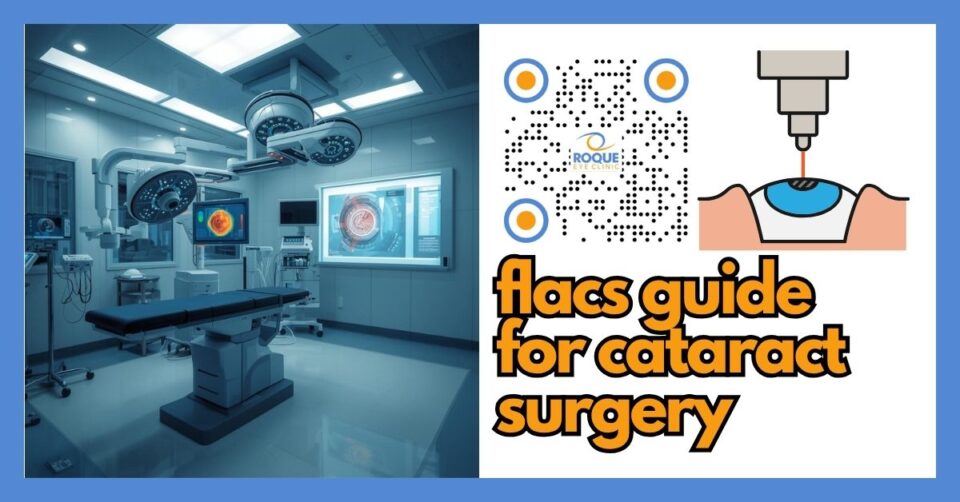
FLACS
🧠 Quick Answer
FLACS stands for femtosecond laser-assisted cataract surgery. It uses a computer-guided laser for selected parts of cataract surgery, such as corneal incisions, capsulotomy, and lens fragmentation, before phacoemulsification finishes the operation. FLACS can improve precision in some steps, but it is not automatically better for every patient, and cost, case type, and surgeon preference still matter.
FLACS is one of the best-known technology upgrades in modern cataract and refractive lens surgery. Many patients hear the words “laser cataract surgery” and assume the entire cataract is removed by laser alone. That is not quite accurate. In most cases, the femtosecond laser performs selected planned steps first, and the surgeon then completes the rest of the cataract operation using phacoemulsification and intraocular lens implantation.
For patients, the main questions are practical: What exactly does FLACS do? Is it safer? Is it more precise? Is it worth the added cost? The answer is nuanced. FLACS can offer technical advantages in selected cases, but standard modern phacoemulsification also has an excellent safety and success record. The best choice depends on the eye, the cataract, the treatment plan, and the surgeon’s judgment.
🧩 Focus: Femtosecond laser-assisted cataract surgery in refractive lens surgery planning
👁 Goal: Explain how FLACS works, what parts of surgery it can assist, who may benefit, and what patients should realistically expect
🛡 Evidence-Based: Preferred Practice Patterns • Standards of Care • Systematic Reviews • Meta-Analyses
REFRACTIVE SURGERY Knowledge Hub
Start with the complete guide:
🔬 FLACS Anatomy Micro-Primer
- Cornea: The clear front window of the eye. The laser may be used to create planned corneal incisions and astigmatism-relaxing cuts in selected cases.
- Lens capsule: This is the thin transparent bag that holds the cataract. FLACS can create a highly circular opening in its front portion, called a capsulotomy.
- Cataractous lens: The cloudy natural lens is broken into smaller segments during surgery. FLACS can pre-fragment the lens before phacoemulsification.
- Anterior chamber: The front part of the eye where many cataract surgery steps take place. Imaging helps the laser plan safe treatment depth and position.
📘 FLACS Terminology Glossary
- FLACS: Femtosecond laser-assisted cataract surgery.
- Femtosecond laser: An ultrafast laser that creates precise tissue separation using very short pulses.
- Capsulotomy: The circular opening made in the front of the lens capsule during cataract surgery.
- Lens fragmentation: Breaking the cataract into smaller pieces to help remove it more efficiently.
- Phacoemulsification: Ultrasound-based cataract removal used to complete most modern cataract operations.
- Toric planning: Surgical planning for correcting corneal astigmatism, sometimes combined with arcuate incisions or toric IOLs.
Quick Navigation
Related Reading
Key Learning Points
- FLACS uses a femtosecond laser to assist selected parts of cataract surgery, not to replace the entire operation.
- Common laser-assisted steps include corneal incisions, capsulotomy, and lens fragmentation.
- FLACS can improve the precision of some surgical steps and may reduce phaco energy in selected cases.
- Both FLACS and conventional phacoemulsification are generally effective and safe in experienced hands.
- FLACS is not automatically superior for every routine cataract case, and added cost remains an important consideration.
What FLACS Is
FLACS stands for femtosecond laser-assisted cataract surgery. It is a technology-assisted form of cataract surgery in which a femtosecond laser performs carefully planned parts of the operation before the surgeon completes lens removal and intraocular lens implantation. In most practices, FLACS is used as an enhancement to modern cataract surgery rather than a complete replacement for phacoemulsification.
It may help to think of FLACS as a highly precise assistant for selected steps. The surgeon still plans the procedure, supervises the treatment, and performs critical parts of the operation. The laser does not make the human surgeon unnecessary. Instead, it adds automation and reproducibility to parts of the case that benefit from precise geometry and image-guided placement.
💡 Analogy
If standard cataract surgery is like a skilled chef preparing a dish completely by hand, FLACS is like giving that chef a highly accurate programmable cutting tool for certain steps. The chef still controls the operation, but some steps can become more standardized and precise.
What the Laser Actually Does
In FLACS, the femtosecond laser is typically used for one or more of these steps:
- Corneal incisions: creating primary and secondary entry wounds with planned architecture
- Capsulotomy: making a circular opening in the front of the lens capsule
- Lens fragmentation: softening or segmenting the cataract before phacoemulsification
- Arcuate incisions: treating selected amounts of corneal astigmatism in some cases
After these steps, the surgeon usually moves to the operating microscope, opens the incisions, removes the lens material, cleans the capsule, and implants the intraocular lens. That is why many surgeons prefer the term laser-assisted rather than simply laser cataract surgery.
Why Surgeons Became Interested in FLACS
Some parts of cataract surgery are technically demanding and benefit from consistency. A centered, round capsulotomy can be particularly relevant in refractive cataract surgery, especially when premium IOL performance depends on lens centration and stable effective lens position. Laser pretreatment may also reduce ultrasound energy needs in selected cataracts, which can be attractive when the surgeon wants to minimize stress on the cornea and endothelial cells.
For this reason, FLACS was introduced with the promise of greater precision, greater reproducibility, and possibly gentler cataract removal in some eyes. Over time, studies have shown that while FLACS often improves certain technical metrics, those advantages do not always translate into a dramatic visual benefit for every routine case. That is where counseling becomes important.
Potential Benefits of FLACS
1) More precise capsulotomy
One of the most discussed advantages of FLACS is a more precise, reproducible, and circular capsulotomy. This can matter when the surgeon wants excellent lens positioning, especially with premium IOLs.
2) Better lens pre-fragmentation
The laser can pre-soften or segment the cataract before ultrasound removal. In some cases, this may reduce phaco energy or phaco time, which may be helpful for denser lenses or more delicate corneas.
3) Image-guided planning
FLACS platforms often use real-time imaging such as OCT or Scheimpflug-based guidance to map anatomy and plan treatment depth and location.
4) Potential role in selected complex cases
Some studies and reviews suggest that FLACS may be particularly helpful in selected eyes, such as denser cataracts or eyes where reduced endothelial stress is desirable. However, this must be individualized rather than assumed for every patient. :contentReference[oaicite:1]{index=1}
Limitations and Trade-Offs
1) It is not always clinically superior in routine cases
Even when FLACS improves technical precision, some reviews suggest that long-term visual and refractive differences compared with modern conventional phacoemulsification may be small or not clinically meaningful for many standard cataract cases. :contentReference[oaicite:2]{index=2}
2) Cost matters
FLACS usually adds cost. Economic analyses and professional discussions continue to question whether the added expense is justified for routine cases when standard phacoemulsification already performs very well. :contentReference[oaicite:3]{index=3}
3) It adds equipment and workflow complexity
FLACS is not just “press a button and finish.” It involves docking, imaging, laser treatment, and transfer to the surgical microscope. A practice needs proper workflow, staff training, and surgeon experience.
4) It still depends on surgical skill
Laser assistance does not eliminate the need for careful surgical judgment. Patient selection, capsular management, phaco technique, IOL selection, and complication handling still depend on the surgeon.
Who May Benefit Most from FLACS
There is no single “perfect FLACS patient,” but the technology may be especially appealing in cases where precise capsulotomy matters, where premium IOL planning is important, or where reducing phaco energy may be useful. Examples may include:
- Patients choosing premium IOLs where centration and effective lens position are especially important
- Eyes with denser cataracts, depending on the platform and surgeon’s experience
- Selected corneas with lower endothelial reserve, where energy reduction may be valuable
- Cases where laser arcuate incisions are part of the astigmatism plan
Still, not every patient in these groups automatically needs FLACS. Some surgeons achieve excellent results with standard phacoemulsification using manual or marker-guided techniques. The surgeon’s expertise with their preferred system remains a major factor.
Who May Not Need FLACS
Many straightforward cataract cases do extremely well with conventional phacoemulsification alone. If the eye anatomy is favorable, the surgeon is highly experienced, and the goals are well defined, standard phaco can already provide excellent safety, refractive accuracy, and visual recovery. Patients should not feel that they are receiving “inferior” surgery simply because a laser is not used.
FLACS and Astigmatism Correction
Some FLACS platforms can create arcuate corneal incisions to help reduce astigmatism. This may be useful in selected patients, especially when paired with careful biometry and refractive planning. However, astigmatism can also be treated using toric IOLs, manual limbal relaxing incisions, or a combination strategy. The best method depends on the amount and type of astigmatism, corneal measurements, and the surgeon’s nomogram.
Recovery and Patient Experience
Recovery after FLACS is often similar to recovery after standard modern cataract surgery because the laser only assists certain steps. Most patients still use postoperative drops, attend follow-up visits, and experience gradual visual improvement as the eye heals and the refractive result stabilizes.
Some patients notice pressure, suction, light effects, or unusual visual sensations during the laser docking phase. Others are more aware of the surgical sequence because FLACS can involve moving between the laser stage and the operating microscope stage. Good counseling helps reduce anxiety and makes the experience easier to understand.
🚨 Emergency Warning
After any cataract procedure, urgent review is needed for severe worsening pain, rapidly increasing redness, sudden marked vision loss, flashes with new floaters, or discharge. These symptoms are not normal “routine healing” and should not be ignored.
Risks and Complications
FLACS shares many of the same overall cataract surgery risks as conventional phacoemulsification because the operation still involves lens removal and IOL implantation. These may include:
- Infection
- Inflammation
- Corneal swelling
- Capsular tear
- Residual refractive error
- Posterior capsule opacification later on
- Retinal complications in susceptible eyes
- Need for glasses, laser enhancement, or additional procedures
FLACS also has technology-specific considerations, such as incomplete capsulotomy, incomplete fragmentation, suction-related issues, or laser docking challenges. These are not reasons to avoid FLACS automatically, but they reinforce the point that technology does not eliminate judgment and technique.
FLACS vs Standard Phacoemulsification
This is usually the most important practical comparison. In broad terms:
- Standard phacoemulsification: excellent, proven, efficient, and usually more cost-effective
- FLACS: adds image-guided laser precision to selected steps, with possible technical advantages in some cases
For many routine cataract patients, both are good options. The best choice often depends on whether the incremental precision of FLACS is meaningful enough in that specific eye to justify the added cost and workflow.
Questions Patients Should Ask
- Why are you recommending FLACS for my eye?
- Which steps of my surgery will the laser assist?
- Will FLACS change the lens option you recommend?
- Is FLACS likely to improve precision in my specific case, or is standard phaco just as appropriate?
- What added cost is involved, and what is that cost intended to achieve?
- How much astigmatism correction do I need, and how will that be addressed?
Continue Reading
🏁 Take-Home Message
FLACS is a sophisticated tool that can improve the precision of selected cataract surgery steps, especially in cases where capsulotomy quality, lens fragmentation, or refractive planning are especially important. But it is not a magic upgrade for every eye. Standard phacoemulsification remains excellent surgery. The right choice depends on your eye, your goals, and your surgeon’s judgment—not on marketing language alone.
FAQ
1) Is FLACS the same as “laser cataract surgery”?
FLACS is what many people mean by laser cataract surgery, but the laser usually assists only selected steps. The rest of the operation is still completed by the surgeon using standard cataract surgery techniques.
2) Is FLACS safer than standard cataract surgery?
Both FLACS and conventional phacoemulsification are generally safe and effective. FLACS may improve precision in some steps, but it is not automatically safer in every routine case.
3) Does FLACS give better vision than standard phacoemulsification?
Not always. Some studies show technical and early postoperative advantages, but long-term routine-case visual differences are often small or not clinically dramatic.
4) Why might my surgeon recommend FLACS?
Your surgeon may recommend it for improved capsulotomy precision, lens fragmentation, premium IOL planning, selected astigmatism management, or because it suits your specific eye and cataract characteristics.
5) Why might my surgeon not recommend FLACS?
Standard phacoemulsification may already be ideal for your case. Added cost, workflow complexity, or limited expected benefit may make FLACS unnecessary in some eyes.
6) Does FLACS replace phacoemulsification completely?
No. In most cases, the laser assists certain steps first, and phacoemulsification is still used to complete cataract removal and lens implantation.
📚 References
- EyeWiki. Femtosecond Cataract Surgery. Updated September 18, 2024.
- Song X, Li L, Zhang X, Ma J. Comparing the efficacy and safety between femtosecond laser-assisted cataract surgery and conventional phacoemulsification cataract surgery: systematic review and meta-analysis. Can J Ophthalmol. 2025.
- Salgado RMPC, et al. Update on Femtosecond Laser-Assisted Cataract Surgery. Clin Ophthalmol. 2024.
- Pichardo-Loera NS, et al. Femtosecond laser-assisted cataract surgery versus conventional phacoemulsification in dense cataracts and low endothelial cell counts. 2024.
- Yeh CY, et al. Comparison of low-energy FLACS and conventional cataract surgery: reduced phaco time and endothelial impact. 2024.
🤝 Roque Eye Clinic Patient Education Series
Dr. Manolette Roque | Dr. Barbara Roque
St. Luke's Medical Center Global City | Asian Hospital Medical Center
Philippines
Medical Review: Roque Advisory Council
Last Updated: March 2026
Medical Disclaimer
This article is intended for educational purposes only and does not replace professional medical consultation.