
ROQUE Refractive Surgery • Article 022 • Legacy SMILE reference
For patients researching the established SMILE procedure, including those who previously underwent surgery on the ZEISS VisuMax 500.
SMILE: the short answer
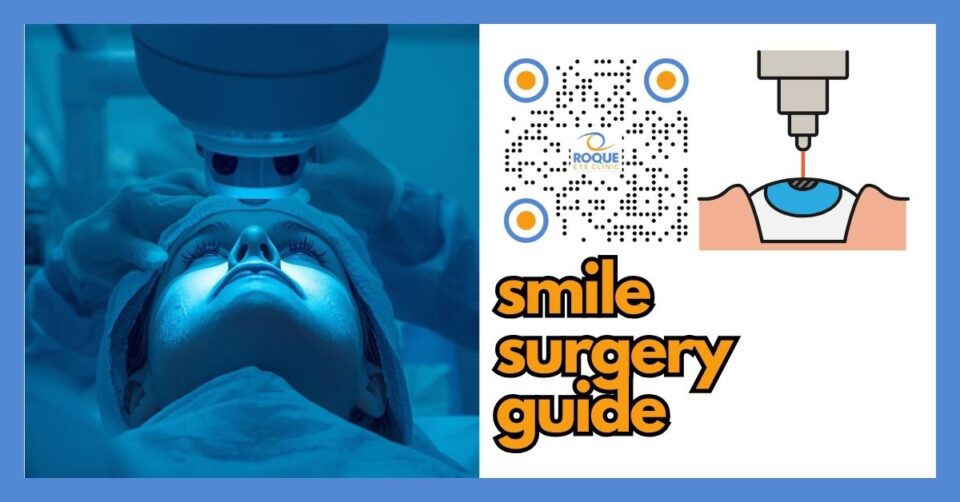
SMILE means small incision lenticule extraction. It treats suitable nearsightedness (myopia), with or without certain amounts of astigmatism, by removing a thin piece of tissue from within the cornea through a small incision. Unlike LASIK, it does not create a broad corneal flap. ROQUE Eye Clinic previously used ZEISS VisuMax 500 for SMILE and has since upgraded to SMILE Pro on ZEISS VISUMAX 800. The older technique remains relevant to medical evidence and patients who previously received it.
The purpose of this page is to explain the original SMILE approach accurately, not to suggest that older treatment is automatically unsafe or inferior. If you are considering refractive surgery now, read our current SMILE Pro patient guide.
On this page
- What is original SMILE?
- How surgery works
- Who may be suitable
- Risks and recovery
- What the evidence shows
- SMILE compared with SMILE Pro, LASIK and PRK
- Enhancement after SMILE
- SMILE video learning area
- Frequently asked questions
What is original SMILE?
The cornea is the transparent front window of the eye. In myopia, light focuses in front of the retina instead of exactly on it. SMILE changes the cornea’s focusing power by creating a thin, lens-shaped layer of tissue called a lenticule within the corneal stroma. The surgeon removes this lenticule through a small opening, rather than lifting a LASIK flap and reshaping the cornea with an excimer laser.
The earlier-generation SMILE platform often discussed in the medical literature is the ZEISS VisuMax 500. SMILE is a surgical technique; a particular laser model does not determine suitability or guarantee a result. Research on VisuMax 500 continues to inform our understanding of tissue healing, visual quality and longer-term outcomes.
Why patients considered original SMILE
- No large corneal flap, so there is no LASIK-flap dislocation risk.
- A small peripheral incision to access an internal corneal lenticule.
- Good reduction of spectacle dependence in carefully selected myopic eyes.
- A different ocular-surface and early dry-eye profile compared with LASIK in some studies.
Important: “Flap-free” does not mean risk-free. SMILE can produce dry eye, residual prescription, night-vision symptoms or uncommon sight-threatening complications.
How the original SMILE operation works
- Assessment and planning. Measurements determine whether the cornea is suitable and how much tissue would need to be removed.
- Numbing drops. The eye is anesthetized with drops. A device keeps the eyelids open while you look toward a fixation light.
- Laser docking. The laser interface contacts the eye and applies suction. It is normal to feel pressure; the doctor explains what to expect.
- Lenticule creation. Femtosecond laser pulses define the small lenticule and access incision within the cornea.
- Lenticule extraction. The surgeon separates the tissue and removes it through the incision.
- Postoperative checks. The treatment team reviews medications, protective precautions and follow-up arrangements.
The time spent in a laser treatment step is not the same as the total appointment or surgery duration. Never compare procedures using one isolated time measurement.
Who could qualify for SMILE?
SMILE has been studied primarily for myopia with or without myopic astigmatism. Appropriate patients generally have a stable prescription, healthy and sufficiently thick corneas, satisfactory corneal tomography, an adequately managed ocular surface, and realistic visual goals. Screening often includes refraction, corneal mapping, corneal thickness assessment, tear-film evaluation and examination of the retina when indicated.
United States FDA-approved ranges in historical patient booklets are not a substitute for Philippine-specific device labeling or individual planning. Do not assume that any prescription within a published study is automatically safe to treat.
When we may recommend a different plan
- Suspected keratoconus, irregular corneal maps or inadequate structural safety margin.
- Unstable eye grade, poorly controlled ocular surface disease or active eye inflammation.
- Conditions or medications that may affect healing; these require individualized review.
- Very high refractive error for which another treatment may be safer.
- Unrealistic expectations, such as never needing reading glasses later in life.
What about patients aged 40 and above?
SMILE corrects the intended refractive error but does not stop presbyopia, the gradual age-related decline in near focusing. Someone who sees clearly at distance after surgery may still need reading glasses. Cataracts and other age-related conditions can also develop later.
Original SMILE: recovery, side effects and complications
Blur, tearing, light sensitivity and a gritty sensation may be present shortly after treatment. Vision commonly improves over the first days, but individual recovery varies and visual quality can continue to settle over weeks or longer. Follow your surgeon’s instructions rather than another patient’s recovery calendar.
Commonly discussed problems
- Dryness and fluctuating blur. An unstable tear film can affect comfort and visual sharpness.
- Glare, halos, ghosting or starbursts. These can affect night driving, especially early in recovery, and occasionally persist.
- Undercorrection, overcorrection or regression. Some patients still require glasses or evaluation for enhancement.
- Suction loss or lenticule-dissection difficulty. These require operative judgment and may change the treatment plan.
- Inflammation or infection. Uncommon, but prompt treatment is important.
- Corneal ectasia. A rare but serious possibility, especially when corneal susceptibility is not recognized.
- Loss of best-corrected vision. Rarely, vision can be worse than before even with glasses.
When to seek urgent eye care
Following any refractive procedure, sudden deterioration in vision, worsening pain, marked redness, increasing light sensitivity or discharge needs urgent ophthalmic assessment. Do not rely on a routine online booking for a possible complication.
What does the scientific evidence show?
SMILE became an established refractive option after clinical studies and regulatory evaluation of VisuMax-based treatments. The American Academy of Ophthalmology’s refractive surgery guidance discusses its effectiveness, patient selection and complications. Published studies frequently report good vision outcomes in appropriately selected myopic patients, but results depend on baseline prescription, corneal health, surgeon technique and follow-up.
There is no good scientific justification for telling every patient that SMILE is “safer than LASIK” in all circumstances. Different procedures have different risks. In some studies SMILE has shown less early reduction in corneal sensation, while patient-reported dry-eye differences are not consistent across all study designs.
Some older online articles quote impressive percentages without explaining eligibility, follow-up duration or whether values represent uncorrected vision or refractive accuracy. Interpret those claims cautiously. A personalized evaluation is more useful than a single headline statistic.
Original SMILE versus SMILE Pro and other options
| Procedure | How it works | Key discussion |
|---|---|---|
| Original SMILE (VisuMax 500) | Internal lenticule removed through a small incision | Established evidence; older laser workflow |
| SMILE Pro (VISUMAX 800) | Same general lenticule extraction concept, newer laser and workflow | Much shorter laser scan; digital centration and cyclotorsion assistance |
| Femto-LASIK | Corneal flap plus excimer laser tissue reshaping | Flap-related considerations; treatment flexibility and recovery |
| PRK | Surface excimer ablation without LASIK flap | More surface healing, discomfort and recovery time in many patients |
| ICL | Implantable lens placed inside the eye | Preserves corneal tissue but has intraocular surgery risks |
The right choice depends on measurements, not a universal ranking. Read Article 023 for the complete VISUMAX 800 comparison.
What if vision changes after original SMILE?
Patients who previously had SMILE can develop residual prescription, regression, dry-eye-related blur, presbyopia or an unrelated eye disorder. These have different treatments. An enhancement is never automatic: the ophthalmologist first checks repeat refraction, corneal tomography, thickness, ocular surface and stability.
For selected patients, options may include PRK surface ablation or carefully planned flap-creation methods such as CIRCLE followed by excimer laser treatment. These are not interchangeable options, and a repeat lenticule extraction is not the standard simple answer. Some patients are best managed with glasses, contact lenses, ocular surface treatment or observation.
If you previously underwent SMILE: bring your historical prescription, operative record or corneal scans if available. A newer laser does not by itself mean that previously operated eyes should be retreated.
SMILE educational videos
The clinic may display original-SMILE surgical footage and explanations in the BeTheme Tabs element immediately below this section. Videos are educational, may show surgical tissue handling, and do not predict individual results.
SMILE educational videos: The clinic may place its native BeTheme Tabs element at this position. Video content is clinician-approved and optional.
Glossary: original SMILE in plain English
- Myopia
- Nearsightedness: distant objects appear blurry.
- Astigmatism
- Unequal focusing that can blur or distort vision.
- Lenticule
- A tiny, shaped piece of corneal tissue removed during surgery.
- Corneal cap
- The top layer over the lenticule; unlike a LASIK flap, it is not lifted as a broad flap.
- Enhancement
- Additional refractive treatment considered for a persistent or recurrent prescription after healing and safety reassessment.
Frequently asked questions about original SMILE
Is original SMILE outdated or dangerous?
No. It is an established technique with a substantial clinical evidence base. ROQUE Eye Clinic has upgraded to a newer ZEISS treatment platform, which does not make properly performed earlier surgery inherently unsafe.
Is original SMILE the same as ReLEx SMILE?
ReLEx SMILE was a ZEISS branding term commonly used with the earlier VisuMax platform. Both describe small-incision lenticule extraction.
Can SMILE cause dry eye?
Yes. A small incision does not eliminate dry-eye symptoms, and existing ocular surface disease should be assessed.
Can I have SMILE Pro if I already had SMILE?
Not automatically. Residual corneal tissue and the prior surgical interface make enhancement planning different. A comprehensive assessment is required, and another treatment or no surgery may be more appropriate.
Can original SMILE treat cataracts?
No. It reshapes the cornea and does not remove a cloudy natural lens. Cataract treatment is a different procedure.
Can SMILE eliminate reading glasses permanently?
No. Presbyopia and later eye changes can still require glasses or other care.
How long do results last?
The corneal tissue removal is lasting, but prescription changes, regression, dry eye and normal aging may affect vision over time.
Which should I choose today, SMILE or SMILE Pro?
ROQUE Eye Clinic’s current-generation lenticule extraction discussion centers on SMILE Pro, but we compare it with other refractive choices based on the safety of your specific eyes.
Find out whether SMILE Pro is right for your eyes
A consultation is the safest way to compare SMILE Pro with LASIK, PRK and ICL using your actual prescription and corneal measurements. We will explain your options, including situations in which surgery is not recommended.
Book a refractive surgery consultation | Review published eye-care costs
St. Luke’s Medical Center Global City: +63 917 844 2020 | Asian Hospital and Medical Center: +63 998 997 2020
Clinical references
Sources support the clinical information above. Regulatory indications and product features can differ by country.
- American Academy of Ophthalmology. Refractive Surgery Preferred Practice Pattern (2024)
- American Academy of Ophthalmology. SMILE patient information (2022)
- US FDA. VisuMax SMILE patient information booklet
- Li & Li. VISUMAX 800 vs 500 meta-analysis, 1,692 eyes. Front Med (2026)
- Ganesh, Brar & Swamy. Paired-eye VISUMAX 800 vs 500 study. J Refract Surg (2025)
- ZEISS. VISUMAX 800 technical and treatment description
Prepared on October 29, 2026. This article is general medical education, not an individual recommendation or guarantee.