



Cataract Surgery
🧠 Dr. Roque’s Quick Answer
Cataract surgery removes the eye’s cloudy natural lens and usually replaces it with a clear artificial lens implant. I usually recommend it when the cataract is already interfering with real life—reading, driving, work, mobility, facial recognition, or our ability to properly monitor and treat other eye problems. The goal is not just a clearer lens. The goal is safer, better, more useful vision.
Cataract surgery is one of the most commonly performed eye operations in the world. In most patients, it safely improves blur, glare, poor night vision, faded colors, and day-to-day visual function caused by cataracts. But a strong result depends on more than removing the cloudy lens. It also depends on careful diagnosis, accurate measurements, the right lens implant choice, and realistic expectations.
🎯 Focus
Explain what cataract surgery is, when it helps, how it is done, what recovery is like, and how lens choices affect vision afterward.
🧩 Goal
Help patients decide whether they may be ready for cataract surgery and what questions to ask before choosing a lens implant.
🛡️ Evidence-Based
This page follows standard cataract surgery principles from major ophthalmic patient and guideline-based references and routine clinical practice.
👁️ ROQUE Eye Clinic Treatments Knowledge Hub
Use this page as your treatment overview, then continue to the pages that help you decide timing, lens choice, and cost.
Anatomy Micro-Primer
Cornea: the clear front window of the eye that bends light first.
Lens: the natural internal lens that becomes cloudy in cataract.
Capsule: the thin transparent bag that holds the natural lens and later holds the IOL.
Retina: the light-sensitive tissue at the back of the eye that turns light into vision.
Macula: the center of the retina responsible for sharp detail vision.
Terminology Glossary
Cataract: clouding of the natural lens.
IOL: intraocular lens implant placed after cataract removal.
Phacoemulsification: the common modern technique that uses ultrasound energy to break up the cataract.
Astigmatism: uneven curvature of the eye that can blur or distort vision.
Posterior capsule opacification: clouding of the thin membrane behind the IOL after surgery; sometimes called an after-cataract.
🧠 Dr. Roque’s Key Learning Points
- Cataract surgery removes the cloudy natural lens and usually replaces it with an intraocular lens, or IOL.
- The right time for surgery depends more on how the cataract affects your daily life than on the cataract grade alone.
- Most modern cataract surgery is done as a day procedure, usually with local anesthesia and light sedation when needed.
- Different lens implants can reduce dependence on glasses, but every lens choice involves tradeoffs.
- A careful preoperative work-up matters because dry eye, macular disease, glaucoma, corneal astigmatism, and prior refractive surgery can change planning.
- Vision usually improves over days to weeks, but the full visual result depends on healing and on the health of the rest of the eye.
- Redness, discomfort, and mild light sensitivity can happen early after surgery, but severe pain or a sudden drop in vision is not normal.
- Posterior capsule opacification can cause blur months or years later and is often treated with YAG capsulotomy.
What is cataract surgery?
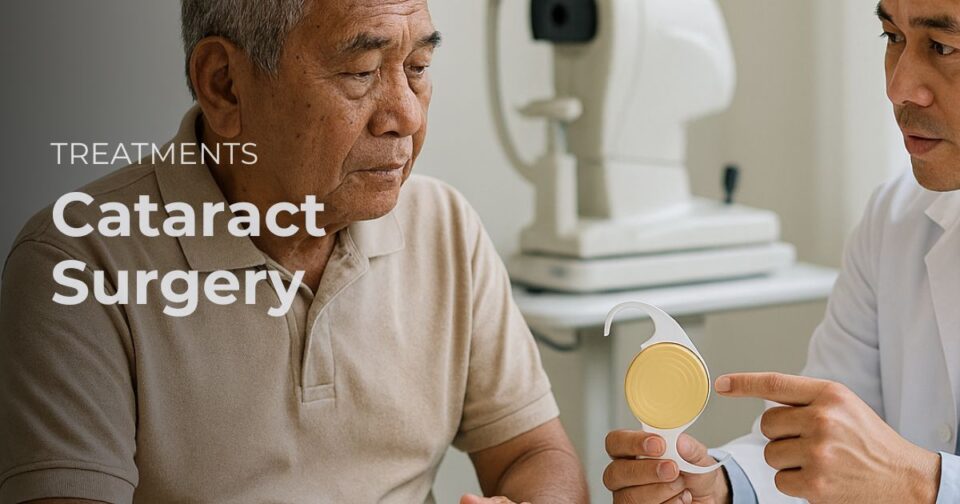
Cataract surgery removes the eye’s cloudy natural lens. In most cases, I replace that cloudy lens with a clear artificial lens implant called an intraocular lens or IOL.
Think of the natural lens like the clear lens inside a camera. When it turns cloudy, the image no longer looks crisp even if the rest of the camera is working well. Cataract surgery removes the cloudy part of the optical system and restores a clearer light path into the eye.
In modern practice, the most common approach is small-incision phacoemulsification. A tiny opening is made, the cataract is broken into smaller pieces and removed, and the new lens is placed inside the capsular bag whenever possible.
When should you consider cataract surgery?
Many patients ask the wrong first question: “Is my cataract mature enough?” The more useful question is this: “Is my cataract now limiting the way I live or the way we care for my eye?”
Cataract surgery becomes reasonable when the cataract starts causing problems such as:
- blurred or dim vision
- difficulty with night driving
- glare or halos around lights
- frequent changes in glasses that no longer solve the problem
- trouble reading, working on a computer, watching TV, or recognizing faces
- reduced confidence with walking, stairs, or mobility
- difficulty examining or treating the retina, optic nerve, or other eye disease because the cataract blocks the view
That last point matters. Sometimes surgery is recommended not just because the cataract blurs vision, but because it prevents safe monitoring of diabetic retinopathy, glaucoma, macular degeneration, or other retinal disease.
💡 Dr. Roque’s Analogy
Cataract surgery is not like cleaning the windshield. It is more like replacing the cloudy lens inside a camera with a new clear lens. That is why the result depends not only on the surgery, but also on the quality of the retina, cornea, optic nerve, tear film, and the accuracy of lens calculations.
Who is a good candidate for cataract surgery?
A good candidate is someone with a cataract that is causing meaningful visual or functional limitation, and whose expected benefit is greater than the surgical risk.
But do not oversimplify that. A proper cataract surgery consultation also looks for factors that can change expectations, timing, or lens choice:
- dry eye and ocular surface disease
- corneal scarring or irregular astigmatism
- glaucoma or optic nerve damage
- macular degeneration or diabetic eye disease
- previous LASIK, PRK, SMILE, RK, or other refractive surgery
- zonular weakness, pseudoexfoliation, small pupil, or dense cataract
- high myopia, short eyes, or unusual biometry
- history of uveitis, trauma, retinal detachment, or prior eye surgery
These do not automatically mean you should avoid surgery. They mean the planning needs to be smarter and the counseling needs to be more honest.
What tests are done before surgery?
Before surgery, a routine refraction is not enough. Cataract surgery is customized. The preoperative work-up usually includes a full eye examination plus lens power calculations and tests that help predict the best lens implant and identify risk.
- visual acuity and refraction
- slit-lamp examination of the cataract and ocular surface
- intraocular pressure measurement
- dilated fundus examination when possible
- biometry for axial length and IOL power
- keratometry or corneal topography/tomography when needed
- macular OCT when retinal disease is suspected or when premium lens planning requires it
- tear film and dry eye assessment when measurement quality is at risk
This is where many poor outcomes begin—not inside the operating room, but during weak preoperative planning.
How is cataract surgery done?
Most cataract surgery is done as an outpatient or day procedure. You usually go home the same day.
- The eye is prepared with antiseptic and local anesthesia, usually with numbing drops and sometimes additional support.
- A small incision is created.
- An opening is made in the front of the lens capsule.
- The cloudy lens is broken up and removed.
- A folded artificial lens is inserted and positioned inside the capsule.
- The incision is checked and usually seals without stitches.
Patients are often surprised by two things. First, the surgery is usually faster than expected. Second, many are awake but comfortable, seeing light and movement rather than detailed surgical steps.
What lens implant options are available?
Lens choice matters because it shapes the kind of vision you are aiming for after surgery. This is where many patients need the most careful counseling.
1) Monofocal IOL
This is the standard lens option. It usually gives the clearest single-focus vision target. Many patients still need glasses for some tasks after surgery, depending on the chosen target and whether astigmatism is present.
2) Toric IOL
This is used when corneal astigmatism is significant enough to matter. It can reduce residual blur from astigmatism and may reduce dependence on glasses, but it has to be planned and aligned properly.
3) Extended depth of focus or multifocal-range options
These lenses can reduce dependence on glasses for more than one distance, but they are not magic. Some patients experience halos, glare, reduced contrast sensitivity, or dissatisfaction if the eye surface, retina, or expectations are not ideal. Premium does not mean automatically better. It means more selective.
4) Specialty planning after prior refractive surgery
If you had LASIK, PRK, SMILE, or RK in the past, lens calculation becomes more complex. This does not make surgery impossible, but it does increase the importance of biometry quality, historical data when available, and expectation management.
Lens selection should always be matched to your eye, your visual priorities, and your tolerance for tradeoffs. A person who prioritizes crisp night driving may not choose the same lens as someone who wants the greatest chance of reading without glasses.
What are the benefits of cataract surgery?
- clearer, brighter vision
- better contrast and color perception
- less glare in many patients
- better functional independence for daily activities
- better quality of life when the cataract was the main cause of visual decline
- improved access to retinal examination and treatment when the cataract previously blocked the view
But challenge the lazy assumption here: cataract surgery does not guarantee perfect vision. It improves vision limited by cataract. If the retina, cornea, optic nerve, or tear film also has disease, the final result may still fall short of what the patient imagines.
What are the risks and possible complications?
Cataract surgery is one of the most commonly performed and most successful operations in medicine, but it is still real eye surgery. Serious complications are uncommon, not impossible.
Possible problems include:
- infection inside the eye
- bleeding
- corneal swelling
- retained lens fragments
- capsular rupture
- IOL malposition
- unexpected refractive result
- retinal tear or retinal detachment in selected eyes
- cystoid macular edema
- persistent inflammation
- posterior capsule opacification later on
The right way to discuss risk is not to frighten patients and not to minimize risk either. It is to individualize it. A routine age-related cataract with a healthy retina is different from a dense cataract in a highly myopic eye with diabetes and prior vitrectomy.
🚨 Dr. Roque’s Emergency Warning
After cataract surgery, contact your eye doctor urgently or seek immediate care if you develop:
- severe eye pain
- sudden worsening of vision
- marked increase in redness
- new flashes, many new floaters, or a curtain over the vision
- thick discharge, severe swelling, or intense light sensitivity that seems to be getting worse instead of better
What is recovery like after cataract surgery?
Recovery is usually faster than many patients expect, but it is still recovery. The eye needs time to settle. Vision may improve within days, yet the final quality can continue to sharpen over several weeks depending on the eye and the lens target.
You may notice:
- mild irritation or foreign body sensation
- temporary blur on day one
- mild redness
- light sensitivity
- awareness of color looking brighter or whiter
Most patients use postoperative eye drops, avoid rubbing the eye, protect the eye as advised, and follow activity instructions given by the surgeon. The exact drop plan and restrictions vary depending on the case.
Why can vision still be blurry after surgery?
This is one of the most important counseling points. If vision is not as clear as expected after surgery, the reason is not always that the cataract came back. True cataracts do not come back once the cloudy natural lens is removed.
Common reasons for lingering blur include:
- dry eye or surface irregularity
- corneal edema
- residual refractive error or astigmatism
- macular edema
- previously hidden retinal disease
- posterior capsule opacification developing later
That is why good postoperative follow-up matters. A patient should not assume that every suboptimal result is normal healing. Sometimes it is. Sometimes it needs treatment.
Can both eyes be operated on at the same time?
In many settings, cataract surgery is usually done on separate days, one eye at a time. That gives the first eye time to heal and allows refinement of planning for the second eye when needed. Exact scheduling depends on the surgeon, the patient’s needs, and the clinical situation.
What if you are not ready for surgery yet?
Not every cataract needs immediate surgery. Early cataracts can sometimes be managed for a time with stronger lighting, updated glasses, glare control, and activity adjustments. But those are temporary coping tools. They do not reverse the cataract.
If you are uncertain, the better next step is not endless delay. It is a proper consultation that answers three questions clearly:
- Is the cataract truly the main reason for your visual symptoms?
- Would surgery likely improve the vision you actually use in daily life?
- Which lens strategy best fits your eye and expectations?
Related Reading
✅ Dr. Roque’s Take-Home Message
Cataract surgery is usually very effective, but good outcomes do not come from surgery alone. They come from accurate diagnosis, honest expectation setting, careful lens selection, meticulous technique, and proper follow-up. If your vision is no longer serving your daily life well, it may be time to stop asking whether the cataract is ripe and start asking whether you are ready for a well-planned solution.
Frequently Asked Questions
1) Is cataract surgery painful?
Most patients do not describe it as painful. You are usually awake but the eye is numbed, and some patients also receive medication to help them relax.
2) How long does cataract surgery take?
The surgical part is usually short, but the total time at the facility is longer because of preparation and recovery.
3) Will I still need glasses after surgery?
Possibly, yes. That depends on the lens chosen, your astigmatism, your healing, and whether your goal is distance, near, or a balance of both.
4) Can cataracts come back?
The cataract itself does not come back once the cloudy natural lens is removed. But the capsule behind the lens implant can become cloudy later. That is called posterior capsule opacification and is often treated with YAG laser capsulotomy.
5) How soon will I see clearly after surgery?
Many patients notice improvement within days, but full stabilization may take longer depending on the eye and the case.
6) Is it better to wait until the cataract is very mature?
Not necessarily. Waiting too long can make surgery harder in some cases and may prolong unnecessary visual disability.
7) Can I have cataract surgery if I also have glaucoma or retina problems?
Often yes, but planning becomes more important. The surgery may still help, but the final vision depends on the other eye diseases too.
8) What is the safest lens implant?
There is no single best lens for every patient. The safest and smartest choice is the one that fits your eye health, measurements, lifestyle needs, and tolerance for tradeoffs.
9) Can cataract surgery fix astigmatism?
It can reduce it when planned properly, often with a toric lens or other astigmatism management strategy.
10) When should I call urgently after surgery?
Call urgently if you develop severe pain, sudden worsening of vision, marked redness, or new flashes, floaters, or a curtain-like shadow.
References
- American Academy of Ophthalmology. Cataract in the Adult Eye Preferred Practice Pattern. 2021 update.
- National Eye Institute. Cataract Surgery.
- National Eye Institute. Cataracts.
- NICE Guideline NG77. Cataracts in Adults: Management.
ROQUE Eye Clinic Patient Education Series
Reviewed by the Roque Advisory Council
Dr. Manolette Roque | Dr. Barbara Roque
St. Luke’s Medical Center Global City | Asian Hospital Medical Center
Philippines
Medical Disclaimer: This page is for patient education only. It does not replace a personal consultation, examination, diagnosis, or treatment plan. Cataract surgery recommendations should always be individualized after a proper eye evaluation.