



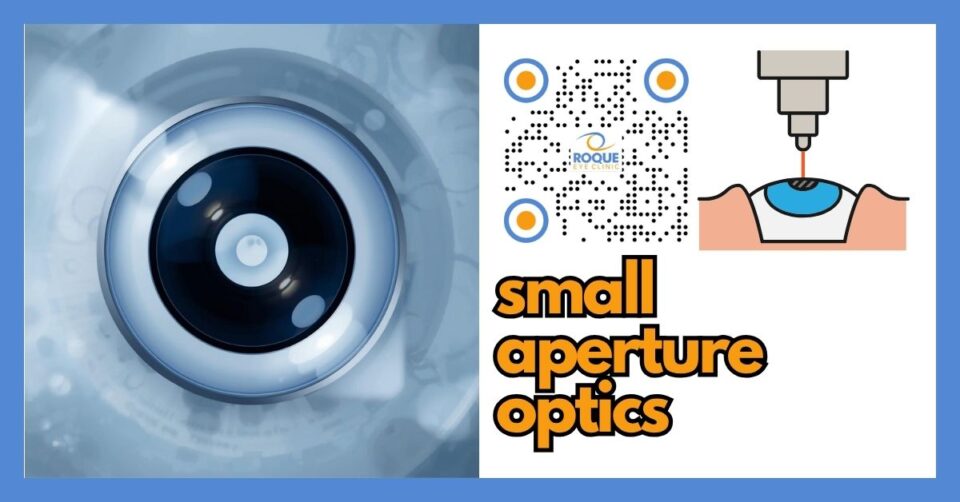
Small Aperture Optics (IC-8)
🧠 Dr. Roque's Quick Answer
Small aperture optics, such as the IC-8 Apthera lens, use a pinhole-like design to let focused central light enter the eye while filtering less focused peripheral light. This can extend depth of focus and improve range of vision in selected patients, but it is not ideal for everyone. Careful screening is essential because candidacy, retinal status, corneal quality, and expectations all matter.
Small aperture optics represent a different way of thinking about premium intraocular lens technology. Instead of splitting light into multiple focal points like a multifocal lens, the IC-8 uses a central small-aperture concept to control incoming light and improve the range over which objects can appear clear. In simple terms, it works a bit like the “pinhole effect” used during an eye exam.
This technology sits within the broader field of lens-based refractive surgery and refractive cataract surgery. It is most often discussed with patients who want greater spectacle independence but may not be ideal candidates for more traditional multifocal strategies, especially when visual quality or corneal irregularity is part of the conversation. However, the exact approved indication, surgeon experience, and patient-specific anatomy all matter.
🧩 Focus: Small aperture optics and the IC-8 Apthera intraocular lens
👁 Goal: Explain how IC-8 works, who may benefit, trade-offs, candidacy limits, and how it differs from other premium IOL strategies
🛡 Evidence-Based: Preferred Practice Patterns • Standards of Care • Systematic Reviews • Meta-Analyses
ROQUE REFRACTIVE SURGERY Knowledge Hub
Start with the complete guide:
🔬 Small Aperture Optics Anatomy Micro-Primer
- Cornea: The cornea is the front clear window of the eye. If it has irregular shape or scars, image quality can suffer, and this may affect premium lens selection.
- Pupil: The pupil is the opening in the iris that lets light enter the eye. Small aperture optics work by controlling which rays pass centrally toward the retina.
- Retina: The retina is the light-sensitive tissue at the back of the eye. Healthy retinal function is important because premium lenses cannot overcome retinal disease.
- Natural lens capsule: After cataract removal, the intraocular lens is usually placed inside the capsular bag. Proper positioning helps the lens perform as intended.
📘 Small Aperture Optics Terminology Glossary
- Small aperture optics: A lens design that uses a tiny central opening to increase depth of focus by filtering unfocused peripheral light.
- IC-8 Apthera: A small-aperture intraocular lens used in cataract surgery to help create a wider usable range of vision in selected patients.
- Depth of focus: The range over which an image stays acceptably clear without needing major refocusing.
- Monovision: A strategy in which one eye is biased more for distance and the other contributes more toward intermediate or near tasks.
- Aphakia: The state after the natural lens has been removed from the eye.
- Photic phenomena: Visual side effects such as glare, halos, starbursts, or unwanted light effects.
Quick Navigation
Related Reading
Dr. Roque's Key Learning Points
- Small aperture optics use a pinhole-like principle to improve usable range of focus.
- The IC-8 Apthera is an intraocular lens designed around this concept.
- It is not simply a “better multifocal.” It is a different optical strategy with different strengths and trade-offs.
- Approved use is specific, including unilateral implantation and patient-selection limits.
- Careful screening is essential because retinal disease, severe ocular pathology, and unrealistic expectations can reduce patient satisfaction.
What Small Aperture Optics Are
Small aperture optics are based on a familiar optical principle: when light enters through a smaller central opening, blur from unfocused peripheral rays can be reduced, and the range of acceptable focus can expand. This is why some patients temporarily see a little more clearly through a pinhole during a vision test. The IC-8 Apthera adapts that idea into an implanted intraocular lens.
Instead of creating multiple focal points by splitting light, the lens uses a central aperture and filtering design to favor higher-quality central rays. For the right patient, this can provide a broader usable range of vision with relatively low dependence on spectacle correction for certain tasks.
💡 Dr. Roque's Analogy
Think of small aperture optics like narrowing the opening of a camera to improve how much of the scene stays acceptably in focus. You let in more selective light, which can sharpen the useful image range. The trade-off is that no optical system is perfect, and patient selection still matters.
How the IC-8 Works
The IC-8 uses a small central aperture embedded within the optic to filter incoming light. By limiting the influence of more defocused peripheral rays, it can increase depth of focus and reduce the effect of certain lower-quality light paths. This gives it a different performance profile from trifocal, bifocal, and some other extended-depth-of-focus designs.
Because of this optical behavior, the lens is often discussed as a way to create functional range of vision while trying to preserve image quality. Some surgeons also discuss its potential usefulness when corneal irregularity makes other premium lens strategies less appealing. However, approved indications and off-label real-world practice are not the same, and patients should understand that distinction clearly.
Current Approved Use
In the United States, the IC-8 Apthera received FDA approval for unilateral implantation to visually correct aphakia and create monovision in appropriately selected adults with bilateral operable cataract. The approved labeling also specifies age criteria, astigmatism limits in the implanted eye, avoidance in patients with retinal disease history or predisposition, implantation in the non-dominant eye, and intended emmetropia in the fellow eye with a monofocal or monofocal toric lens.
This means the approved indication is specific and not unlimited. Patients should not assume that every person wanting spectacle independence is automatically a candidate for IC-8. Regulatory approval, surgeon judgment, and personalized anatomy all guide the final recommendation.
Why the Lens Gets Attention in Refractive Cataract Surgery
The IC-8 attracts attention because it offers a different path to functional range of vision. Many patients want fewer glasses after surgery but worry about glare, halos, or reduced quality of vision. Small aperture optics may offer a useful balance in selected cases, especially when the surgeon is trying to manage corneal irregularity, mild astigmatism tolerance, or visual-quality priorities.
That does not mean it replaces all other premium IOL technologies. Rather, it adds another tool to the discussion. The “best” lens is the one that best matches the patient’s cornea, retina, daily tasks, tolerance for trade-offs, and the surgeon’s experience.
Who May Benefit From Small Aperture Optics
Potentially suitable patients are often those who want broader functional vision after cataract surgery and are open to a monovision-based strategy. Surgeons may also consider small aperture optics when mild corneal irregularity, prior corneal surgery, or optical-quality concerns make other premium IOL designs less attractive. Published reviews and expert commentary have highlighted possible benefits in certain irregular-cornea situations, but these discussions may go beyond the official labeled indication.
As always, the final decision depends on full screening. The surgeon must assess corneal shape, ocular surface, retinal health, dominance, lifestyle, light sensitivity, and the patient’s willingness to accept trade-offs.
Who May Be a Poor Candidate
- Patients with retinal disease or meaningful retinal risk concerns
- Patients with unrealistic expectations of perfect vision at all distances in all lighting
- Patients who strongly dislike monovision concepts
- Patients with significant ocular surface disease that has not been optimized
- Patients whose visual complaints are more likely driven by macular, optic nerve, or other non-lenticular problems
Potential Advantages
1) Broader functional range of vision
The main attraction is increased depth of focus. Many patients can achieve useful vision over a wider range than with a standard monofocal strategy alone.
2) Different optical trade-off from multifocals
Because the lens does not rely on the same light-splitting concept used by multifocals, some surgeons consider it when they want a different balance between range and visual quality.
3) Tolerance for selected corneal imperfections
Small aperture technology is often discussed as being more forgiving in some eyes with mild irregularity, although not every irregular cornea is appropriate and not every such use falls within approved labeling.
Trade-Offs and Limitations
1) It is not magic
Patients can still need glasses for some tasks. Good spectacle independence is possible, but perfect freedom from glasses is never guaranteed.
2) Monovision tolerance still matters
The approved use involves a monovision strategy. Some patients adapt well to this. Others do not enjoy the imbalance and may prefer a different lens plan.
3) Visual side effects are still possible
No premium IOL is free from trade-offs. Even if the optical profile differs from multifocals, patients can still experience dissatisfaction, dimming concerns, adaptation challenges, or unexpected visual symptoms.
Risks and Important Counseling Points
Patients considering IC-8 should receive the same careful counseling expected for any premium lens discussion. This includes surgical risks common to cataract surgery as well as technology-specific trade-offs. Important counseling points include:
- Possibility of glare, halos, or other photic symptoms
- Possible need for glasses for selected tasks despite premium lens implantation
- Need for healthy retina and careful macular evaluation
- Importance of ocular surface optimization before surgery
- Potential mismatch between lifestyle goals and monovision tolerance
- Possibility that the fellow-eye plan affects the final visual experience
🚨 Dr. Roque's Emergency Warning
After cataract or refractive lens surgery, urgent review is needed for severe pain, rapidly worsening redness, sudden major drop in vision, a shower of new floaters, flashes of light, or a curtain-like shadow. These symptoms can signal retinal or postoperative complications and should not be ignored.
How IC-8 Compares With Other Premium IOL Strategies
Versus monofocal IOLs
A standard monofocal lens usually offers excellent quality at one main focal distance but less range. IC-8 is designed to widen functional range, especially when paired with an appropriate fellow-eye strategy.
Versus multifocal IOLs
Multifocals split light to create multiple focal points. Small aperture optics use a different mechanism. For some patients, that distinction matters because the pattern of trade-offs is not identical.
Versus EDOF IOLs
The IC-8 is often discussed alongside EDOF lenses because both aim to broaden range of vision. However, the optical principle differs. That is why lens selection should be individualized rather than based on label alone.
Questions Patients Should Ask
- Why are you recommending IC-8 instead of a monofocal, EDOF, or multifocal lens for me?
- Am I comfortable with a monovision strategy?
- Do I have any retinal, corneal, or surface issues that reduce my chance of satisfaction?
- What is your plan for the fellow eye?
- What visual tasks am I most likely to do without glasses, and what tasks may still need glasses?
- Are we discussing on-label use, off-label use, or both?
Continue Reading
🏁 Dr. Roque's Take-Home Message
Small aperture optics, such as the IC-8 Apthera lens, offer a distinctive way to improve functional range of vision after cataract surgery. They can be very helpful in the right patient, but they are not universal solutions. The best outcomes come from careful screening, clear discussion of on-label versus off-label considerations, realistic expectations, and choosing a lens strategy that fits the whole eye—not just the wish to reduce glasses.
FAQ
1) What is the IC-8 Apthera lens?
It is a small-aperture intraocular lens used in cataract surgery. It is designed to increase depth of focus by allowing focused central light to enter the eye while filtering less focused peripheral light.
2) Is IC-8 the same as a multifocal lens?
No. Multifocal lenses usually split light into more than one focal point. IC-8 uses a small-aperture optical principle, so it works differently and has a different trade-off profile.
3) Can the IC-8 help patients with irregular corneas?
Some surgeons discuss that possibility in selected cases, and published commentary has explored it. However, approved labeling and off-label real-world use are not the same, so each case needs individualized counseling.
4) Is the IC-8 implanted in both eyes?
The FDA-approved indication is for unilateral implantation in selected adults as part of a monovision strategy. Your surgeon will discuss whether that fits your situation.
5) Will I be completely free of glasses with small aperture optics?
Not necessarily. Many patients may reduce their dependence on glasses, but no premium lens guarantees perfect vision at all distances under all conditions.
6) Who should be cautious about choosing IC-8?
Patients with retinal disease, major ocular pathology, poor tolerance for monovision, or unrealistic expectations should be evaluated very carefully before considering this lens.
📚 References
- U.S. Food and Drug Administration. IC-8 Apthera Intraocular Lens (IOL) - P210005.
- Bausch + Lomb Surgical. IC-8® Apthera™ IOL Prescribing / Features and Specifications information.
- EyeWiki. Pinhole Intraocular Lenses.
- Vukich J, et al. Evaluating the small aperture intraocular lens: depth of focus and visual performance. J Cataract Refract Surg. 2024.
- Sánchez-González JM, et al. Small Aperture IC-8 Extended-Depth-of-Focus Intraocular Lens: clinical outcomes review. 2022.
🤝 Roque Eye Clinic Patient Education Series
Dr. Manolette Roque | Dr. Barbara Roque
St. Luke's Medical Center Global City | Asian Hospital Medical Center
Philippines
Medical Review: Roque Advisory Council
Last Updated: March 2026
Medical Disclaimer
This article is intended for educational purposes only and does not replace professional medical consultation.