



Light Adjustable Lens (RxSight LAL)
🧠 Quick Answer
The Light Adjustable Lens, or RxSight LAL, is an intraocular lens that can be adjusted after cataract surgery using office-based light treatments. This gives surgeons and patients a chance to fine-tune vision after the lens is already inside the eye. Its main advantage is customization, but it also requires extra visits, temporary UV-protective glasses, and careful follow-up.
The Light Adjustable Lens has changed how many surgeons think about premium cataract and refractive lens surgery. Traditional intraocular lenses are chosen before surgery, implanted, and then left as they are. If healing, lens position, or small calculation errors change the final result, patients may still need glasses, laser enhancement, or further planning. The Light Adjustable Lens is different because its power can be adjusted after surgery, when the eye has already started to heal and the patient has already experienced real-world vision.
That is the core idea behind the RxSight LAL: instead of making every refractive decision before surgery, some of the final customization happens after surgery. For many patients, that is very appealing. For others, the extra steps may not fit their schedule, lifestyle, or expectations. This guide explains what the Light Adjustable Lens is, how it works, who may benefit, and what trade-offs patients should understand before choosing it.
🧩 Focus: Light Adjustable Lens technology in refractive cataract and lens-based vision correction
👁 Goal: Explain how the RxSight LAL works, who may be a candidate, the benefits, limitations, recovery steps, and practical patient considerations
🛡 Evidence-Based: Preferred Practice Patterns • Standards of Care • Systematic Reviews • Meta-Analyses
REFRACTIVE SURGERY Knowledge Hub
Start with the complete guide:
🔬 Light Adjustable Lens Anatomy Micro-Primer
- Natural lens: This is the eye’s original focusing lens. In cataract surgery, it is removed because it has become cloudy.
- Capsular bag: This is the thin natural membrane that usually holds the implanted lens after cataract surgery.
- Retina: This is the light-sensitive tissue at the back of the eye. Clear focus on the retina is what gives sharp vision.
- Cornea: The clear front window of the eye. Even with a premium lens, the cornea still strongly affects final visual quality and astigmatism.
📘 Light Adjustable Lens Terminology Glossary
- IOL: Intraocular lens, the artificial lens implanted during cataract or lens replacement surgery.
- LAL: Light Adjustable Lens, a lens whose power can be changed after surgery using controlled light treatments.
- LDD: Light Delivery Device, the office-based system used to deliver the planned light treatment.
- Lock-in treatment: Final light treatments that stop further lens adjustment and preserve the chosen refractive result.
- Residual refractive error: Small leftover nearsightedness, farsightedness, or astigmatism after surgery.
- Dysphotopsia: Unwanted optical symptoms such as glare, halos, or starbursts.
Quick Navigation
Related Reading
Key Learning Points
- The RxSight LAL is designed so the implanted lens power can be adjusted after surgery.
- Its main appeal is refractive customization after healing has started, not just prediction before surgery.
- Patients usually need several postoperative visits for adjustments and final lock-in treatments.
- UV-protective glasses are a major part of the process until 24 hours after the final lock-in treatment.
- The Light Adjustable Lens is not automatically the best choice for every patient; motivation, macular health, astigmatism, lifestyle, and willingness to follow instructions all matter.
What the Light Adjustable Lens Is
The Light Adjustable Lens is a special intraocular lens implanted during cataract surgery or refractive lens replacement. Unlike a standard monofocal, toric, EDOF, or multifocal lens, its final optical power is not completely fixed on the day of surgery. After the eye heals enough, the surgeon can use a special office-based light treatment to adjust the lens and refine the final result.
This is why many surgeons describe it as “postoperative customization.” Instead of committing every detail before surgery, the refractive plan can be refined after the patient has experienced their new vision. In practical terms, it aims to reduce the chance that a small postoperative surprise will become a long-term disappointment.
💡 Analogy
Most implanted lenses are like ordering a suit before seeing the final fit. The Light Adjustable Lens is more like having the suit tailored again after you try it on. That extra fitting step is what makes it unique.
How the Light Adjustable Lens Works
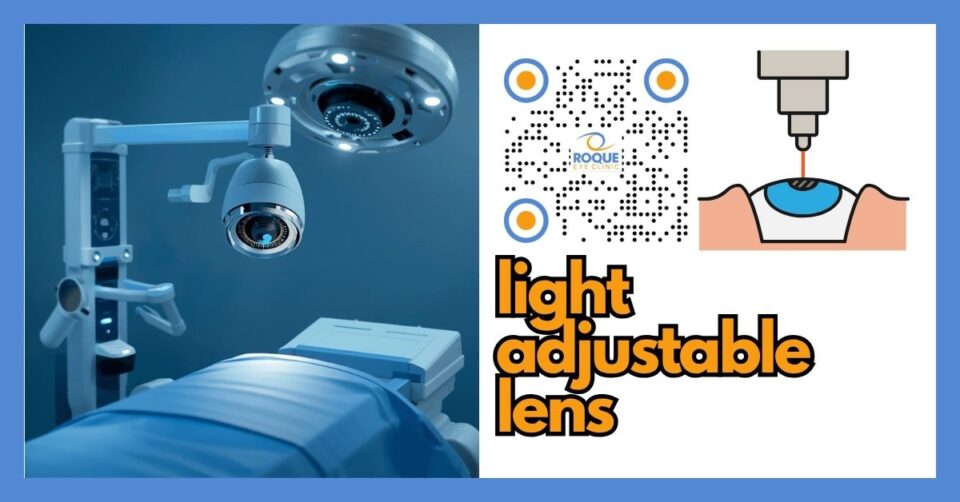
The lens is made from a photosensitive material that responds to controlled ultraviolet light. After the lens is implanted and the eye has recovered enough, the surgeon uses the Light Delivery Device to apply carefully planned light treatment in the clinic. That light changes the shape and focusing power of the lens in a controlled way. Once the desired result is reached, lock-in treatments are performed so the power stays stable.
From a patient perspective, the key message is simple: surgery is only the first step. The final refractive result may be refined after surgery through planned office visits. This feature is the major advantage of the LAL, but it also creates extra responsibility. Patients must return for follow-up, protect the lens from unintended ultraviolet exposure, and stay engaged in the adjustment process.
Why the LAL Attracts So Much Interest
One of the hardest parts of cataract and refractive lens surgery is achieving the exact refractive outcome the patient wants. Even with excellent formulas, biometry, topography, and surgical technique, tiny differences in healing or lens position can shift the final prescription. The LAL tries to solve part of that problem by moving some refractive decision-making to a time when the eye is already pseudophakic and the surgeon can see the actual postoperative result.
This can be especially interesting for patients who strongly value refractive precision, want to reduce glasses dependence, or have had prior corneal refractive surgery that makes IOL calculations less predictable. It can also be useful in patients who want high-quality monofocal-style optics without splitting light the way some multifocal lenses do.
Who May Benefit from the Light Adjustable Lens
A good Light Adjustable Lens candidate is not just someone who wants premium surgery. A strong candidate is usually someone who understands the process, can attend multiple visits, is willing to wear UV-protective glasses as instructed, and wants a customized refractive result. Patients who care deeply about minimizing residual prescription may find the LAL especially attractive.
Surgeons may also discuss the LAL in eyes where postoperative refractive precision is particularly important, including some patients with previous corneal refractive surgery. However, candidacy still depends on full preoperative screening. Corneal regularity, macular health, ocular surface quality, pupil behavior, realistic expectations, and the rest of the eye examination still matter.
Who May Not Be an Ideal Candidate
- Patients who cannot return reliably for multiple postoperative visits
- Patients who are unlikely to wear the required UV-protective glasses properly
- Patients with preexisting macular disease or other ocular conditions that reduce visual potential
- Patients who want a simple one-step process with fewer postoperative demands
- Patients who prefer a different optical strategy, such as multifocal or EDOF, after detailed counseling
Advantages of the Light Adjustable Lens
1) Postoperative customization
This is the defining advantage. The ability to adjust the refractive result after surgery allows fine-tuning based on the real postoperative eye instead of prediction alone.
2) Potentially excellent quality of vision
Because the LAL is based on a monofocal-style optical concept rather than light-splitting multifocal optics, many surgeons and patients value it for high-quality distance vision with relatively low dysphotopsia risk compared with some multifocal designs.
3) Flexibility in refractive planning
Some patients appreciate being able to experience early postoperative vision before the final adjustment is chosen. In selected cases, this can support more individualized targeting.
4) Useful in complex refractive situations
In eyes where refractive prediction is less straightforward, the concept of postoperative adjustment can be particularly appealing.
Trade-Offs and Limitations
More visits
The LAL is not a “done in one day” premium lens experience. Patients usually need additional postoperative visits for evaluation, adjustment, and lock-in.
Temporary UV-protective glasses
One of the most important counseling points is eyewear. Patients are instructed to wear the manufacturer-specified UV-protective glasses during waking hours until 24 hours after the final lock-in treatment. For some people, this is manageable. For others, it can be inconvenient enough to influence lens choice.
Not a substitute for good screening
The LAL can refine residual refractive error, but it does not bypass the need for accurate measurements, healthy ocular surface, macular evaluation, and realistic counseling.
Not the best option for everyone seeking spectacle independence
Some patients prioritize a broader range of focus over monofocal-style clarity. Those goals may shift the discussion toward other premium IOL categories. Lens choice is still individualized.
Recovery and Follow-Up
The cataract surgery recovery itself is similar in many ways to other modern lens surgeries, but the refractive journey is different because the process continues after surgery. Patients typically heal from the operation first, then undergo measurements and one or more light treatments, followed by final lock-in treatments. Vision may improve in stages, not all at once.
This means patience matters. Patients should understand that the postoperative course is more interactive than with a standard IOL. The reward for that extra effort is the chance to refine the final prescription after surgery rather than accepting the first result as permanent.
🚨 Emergency Warning
Urgent review is needed after surgery if you develop rapidly worsening pain, marked redness, sudden loss of vision, new flashes or floaters, or severe light sensitivity beyond expected healing. These problems should not be explained away as “just part of recovery.”
Safety and Precautions
The most distinctive safety issue patients need to understand is unintended ultraviolet exposure before the final lock-in. The reason for the protective glasses is to reduce the risk of unwanted lens changes from environmental UV exposure during the adjustment period. This is not a minor side note. It is one of the central responsibilities of choosing this lens.
Other counseling points are similar to those for cataract surgery more broadly: infection, inflammation, residual refractive error, need for glasses for some tasks, dry eye symptoms, and the general realities of healing. In addition, patients should understand that even a highly advanced premium lens cannot guarantee perfect vision in every lighting condition or for every visual task.
How the LAL Compares with Other Premium IOL Strategies
The Light Adjustable Lens occupies a special place in the premium IOL discussion. It is not simply a toric lens, not simply an EDOF lens, and not simply a multifocal lens. Its main innovation is adjustability after implantation. For the right patient, that can be more important than trying to expand range of focus with light-splitting optics. For another patient, a different premium lens may still be a better match.
In practical counseling, the decision often comes down to this question: does the patient value postoperative refractive customization enough to accept the extra visits and the temporary UV-glasses requirement? If yes, the LAL may be very appealing. If not, other premium IOL options may be simpler and more suitable.
Continue Reading
🏁 Take-Home Message
The RxSight Light Adjustable Lens is a premium lens option built around one major advantage: postoperative customization. For the right patient, that can be extremely valuable. But the process also demands commitment, including multiple visits and strict UV-glasses use until final lock-in. The best choice depends on your eye measurements, macular health, lifestyle, and how much you value fine-tuning after surgery.
FAQ
1) What makes the Light Adjustable Lens different from a regular cataract lens?
The biggest difference is that the LAL can be adjusted after surgery. Most implanted lenses are fixed once they are inside the eye, but the LAL allows postoperative light treatments to refine the prescription.
2) Is the Light Adjustable Lens the same as a multifocal lens?
No. The LAL is different from multifocal and EDOF designs. Its main feature is postoperative adjustability, not light-splitting optics.
3) Why do patients need UV-protective glasses after LAL surgery?
The glasses help protect the lens from unintended ultraviolet exposure before the final lock-in treatment. This is a central part of the LAL process and must be taken seriously.
4) Can the Light Adjustable Lens reduce the need for glasses?
It may reduce glasses dependence for many patients by allowing more precise refractive targeting, but it does not guarantee total spectacle independence in every situation.
5) Who should avoid the Light Adjustable Lens?
Patients who cannot attend multiple follow-up visits, cannot reliably wear the required UV-protective glasses, or have reduced visual potential from macular disease or other eye problems may not be ideal candidates.
6) Is the Light Adjustable Lens worth the extra effort?
For many motivated patients who value postoperative fine-tuning, yes. For others, a simpler premium or standard lens pathway may be a better fit. The answer depends on priorities, anatomy, and willingness to follow the process.
📚 References
- RxSight. Light Adjustable Lens from RxSight. Official patient information and important safety information.
- U.S. Food and Drug Administration. Premarket Approval database: Light Adjustable Lens and Light Delivery Device.
- U.S. Food and Drug Administration. Summary of Safety and Effectiveness Data for the Light Adjustable Lens.
- Jun JH, et al. Light adjustable intraocular lenses in cataract surgery. Curr Opin Ophthalmol. 2024.
- American Academy of Ophthalmology. Factors to Consider in Choosing an IOL for Cataract Surgery.
🤝 Roque Eye Clinic Patient Education Series
Dr. Manolette Roque | Dr. Barbara Roque
St. Luke's Medical Center Global City | Asian Hospital Medical Center
Philippines
Medical Review: Roque Advisory Council
Last Updated: March 2026
Medical Disclaimer
This article is intended for educational purposes only and does not replace professional medical consultation.