

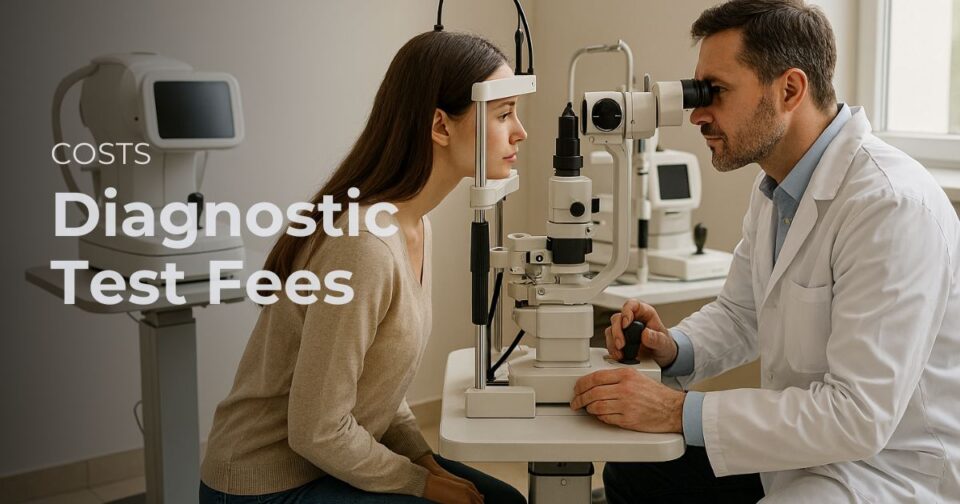
Diagnostic Test Fees for Eye Exams in the Philippines
🧠 Dr. Roque’s Quick Answer
Diagnostic test fees vary because not every patient needs the same work-up. A simple refraction is very different from an OCT scan, visual field test, corneal topography, ultrasound, or cataract diagnostics. The right question is not only “How much is the test?” but also “Which tests do I actually need, and why?” At ROQUE Eye Clinic, we recommend only the tests that are clinically appropriate for your symptoms, condition, or surgery planning.
If you are comparing eye clinic prices, it helps to know that diagnostic test fees are not one flat package for everyone. Some patients need only a consultation and refraction. Others may need imaging, corneal measurements, retinal scans, glaucoma testing, or cataract surgery planning tests. The cost depends on the clinical problem, the technology needed, and whether the tests are being done for screening, diagnosis, monitoring, or preoperative planning.
🎯 Focus
Help patients understand what diagnostic test fees cover, why prices vary, and when additional testing is medically necessary.
🎯 Goal
Reduce confusion, avoid price-shopping mistakes, and guide patients toward the right next step rather than the cheapest incomplete work-up.
🛡️ Evidence-Based
Good ophthalmic care depends on matching the test to the problem. The most useful test is the one that answers the right clinical question.
💡 Dr. Roque’s Analogy
Think of diagnostic testing the way you would think about laboratory work or imaging for other medical problems. If a patient has chest pain, one person may only need a consultation and ECG, while another may need blood tests, a chest X-ray, or more advanced studies. Eye care works the same way. A blurred vision complaint may need only refraction in one patient, but OCT, retinal imaging, or glaucoma testing in another.
Why Diagnostic Test Fees Vary
Patients often assume that an eye test is a single standardized service. It is not. Diagnostic fees vary because:
- different machines answer different clinical questions,
- some tests are simple and quick while others require imaging, interpretation, and comparison over time,
- preoperative measurements are different from disease-monitoring tests,
- one eye condition may require several complementary tests, and
- not all tests are needed at the first visit.
A cheap quote can sound attractive until you realize it excludes the tests needed to make a safe diagnosis or a surgical plan. That is why price alone is the wrong anchor.
Common Eye Diagnostic Tests and What They Are For
Refraction and Vision Testing
This checks how clearly you see and whether glasses may improve your vision. It is useful, but it does not replace a full medical eye examination when there are warning signs such as pain, redness, flashes, floaters, distortion, or sudden loss of vision.
Slit-Lamp Examination
This lets your ophthalmologist examine the front of the eye in detail, including the cornea, lens, conjunctiva, and eyelids. It is a core part of many consultations, but additional tests may still be needed depending on the findings.
Intraocular Pressure Measurement
This helps screen for glaucoma risk, but pressure alone does not diagnose glaucoma. Some patients still need optic nerve evaluation, OCT, visual field testing, pachymetry, and follow-up comparisons.
OCT Scan
Optical coherence tomography is a high-resolution retinal or optic nerve scan. It is often used for macular degeneration, diabetic eye disease, glaucoma evaluation, epiretinal membrane, vitreomacular traction, and unexplained visual symptoms.
Fundus Photography
This documents the retina and optic nerve. It is useful for baseline records, monitoring, education, and comparison over time.
Visual Field Testing
This measures side vision and helps in glaucoma, neuro-ophthalmic disease, and other conditions affecting visual pathways.
Corneal Topography or Tomography
These tests map the shape of the cornea. They are important for LASIK screening, keratoconus evaluation, astigmatism analysis, and selected cataract surgery planning.
Biometry
This measures the eye for intraocular lens power calculation before cataract surgery or lens replacement surgery. It is one of the key preoperative tests for implant selection.
Specular Microscopy
This evaluates the corneal endothelial cells. It may be important in corneal disease, prior eye surgery, and cataract surgery planning when endothelial reserve matters.
B-Scan Ultrasound or UBM
These ultrasound-based tests are used when the view inside the eye is blocked or when deeper structures need evaluation. They may be used in dense cataract, trauma, tumors, angle assessment, or other complex situations.
Dry Eye and Ocular Surface Testing
Selected patients may need meibomian gland assessment, tear film evaluation, staining, or ocular surface work-up. This can be important before refractive surgery, cataract surgery, or when symptoms and vision quality do not match a routine exam.
👁️ Anatomy Micro-Primer
The eye has several major areas that may need different tests: the cornea at the front, the lens inside the eye, the retina at the back, and the optic nerve that carries vision signals to the brain. A corneal problem, cataract, retinal problem, and glaucoma problem do not use exactly the same diagnostic tools. That is one reason test fees vary.
🧩 Terminology Glossary
- OCT: A scan that creates detailed cross-sectional images of the retina or optic nerve.
- Visual Field: A test that maps central and side vision.
- Biometry: Measurements used to calculate the lens implant power before cataract surgery.
- Topography/Tomography: Corneal shape analysis used in refractive and cataract planning.
- Fundus Photo: A photograph of the retina and optic nerve.
- UBM: Ultrasound biomicroscopy, a detailed ultrasound of the front part of the eye.
What Affects the Total Cost of Diagnostic Testing?
The total fee usually depends on five things:
- Your clinical problem. A screening visit is different from a complex diagnostic work-up.
- The number of tests needed. One complaint may require one test or several.
- Whether the test is baseline or surgical planning. Preoperative measurements are often more specialized.
- Whether both eyes need full testing. Some cases require bilateral imaging and measurements.
- Whether repeat testing is needed over time. Monitoring glaucoma, diabetic retinopathy, or macular disease is different from a one-time evaluation.
That is why a responsible clinic should avoid giving false certainty without understanding the problem first. In many cases, the correct sequence is consultation first, targeted testing second.
Cataract and Refractive Surgery Diagnostics
Patients planning cataract surgery, refractive lens exchange, LASIK, SMILE, or ICL often ask why diagnostics cost more than a routine check-up. The reason is simple: these tests are not just looking for disease. They are also helping your surgeon plan treatment accurately and safely.
Depending on the case, diagnostics may include:
- biometry for lens power planning,
- corneal topography or tomography,
- ocular surface assessment,
- macular OCT,
- fundus documentation,
- specular microscopy in selected cases, and
- additional testing when a dense cataract blocks the view or when the retina must be assessed more carefully.
In plain language, you are not paying only for a machine. You are paying for decision-grade measurements that influence safety, implant selection, expectations, and outcomes.
Important Practical Point
A diagnostic package that looks cheap but misses an important test may become more expensive later if it delays diagnosis, leads to incomplete counseling, or forces repeat work-up elsewhere. Cheap is not always efficient. Appropriate is efficient.
Are Diagnostic Tests Covered by HMO or PhilHealth?
Coverage depends on your specific plan, the hospital or clinic setting, the reason for the test, and whether prior authorization or a letter of authorization is required. Some plans cover selected diagnostics. Others cover only consultation, only part of the work-up, or none of the advanced imaging.
PhilHealth rules are also not the same as HMO rules. PhilHealth support often applies more clearly to specific hospital-based procedures than to every outpatient diagnostic test. Patients should not assume that all scans and measurements are automatically covered.
For that reason, the practical approach is:
- confirm the recommended tests first,
- ask whether pre-approval or an LOA is needed,
- check whether coverage applies to outpatient diagnostics, and
- clarify what remains out of pocket.
What We Want Patients to Understand
When patients ask about fees, they are usually asking a deeper question: “What will I likely need, and what should I prepare for?” That is the right question. A good eye clinic should explain:
- which tests are needed now,
- which tests are optional or situational,
- which tests are part of surgery planning,
- which tests may be deferred, and
- what each test is trying to answer.
That kind of transparency is more useful than giving a vague low estimate that later changes once the real problem is understood.
When You Should Not Delay Testing
Some symptoms should not be price-shopped casually or delayed just to wait for a cheaper test quote. Seek prompt ophthalmic evaluation if you have:
- sudden loss of vision,
- new flashes and floaters,
- painful red eye,
- eye injury,
- sudden distortion of central vision,
- a curtain-like shadow in your vision, or
- rapid worsening of vision after surgery or treatment.
🚨 Dr. Roque’s Emergency Warning
If your problem may be urgent, do not let a search for the lowest diagnostic fee delay proper care. In ophthalmology, delay can sometimes mean preventable vision loss.
Related Reading
Frequently Asked Questions
1. Can you give me the exact diagnostic fee before I am seen?
Sometimes we can give a range for common tests, but the exact total depends on which tests are actually needed. Giving a firm quote without understanding the clinical problem can be misleading.
2. Is a consultation fee separate from diagnostic test fees?
Often, yes. A consultation is different from imaging, measurements, or special diagnostic procedures.
3. Do all patients need OCT?
No. OCT is powerful, but it is not necessary for every patient. It is used when the symptoms, findings, or condition make it clinically useful.
4. Why do cataract patients need additional diagnostics?
Because surgery planning requires precise measurements, not just a basic eye exam. These tests help guide lens implant choice, safety decisions, and visual expectations.
5. Is the cheapest eye work-up always the best value?
No. The best value is the work-up that answers the right clinical question without unnecessary testing and without missing important disease.
6. Are HMO and PhilHealth coverage the same thing?
No. They follow different rules. Coverage depends on the plan, the setting, the indication, and the required authorizations.
7. Can I do only one test now and the rest later?
Sometimes yes, sometimes no. It depends on urgency and whether delaying the other tests would weaken diagnosis, monitoring, or surgical planning.
8. Are diagnostic tests painful?
Most are not painful. Many are quick, noninvasive, and done in the clinic. Some require dilation, bright lights, or close attention, but most patients tolerate them well.
9. Why do two patients with “blurred vision” get different tests?
Because blurred vision is a symptom, not a diagnosis. One patient may have refractive error, while another may have cataract, macular disease, glaucoma, or a corneal problem.
10. What is the best way to prepare financially?
Prepare for a consultation plus the possibility of targeted diagnostics. If you have HMO coverage, bring your card, LOA requirements, and any needed authorization details.
✅ Dr. Roque’s Take-Home Message
Diagnostic test fees matter, but the bigger issue is whether the right tests are being done for the right reason. In eye care, the safest and most cost-effective path is usually a proper consultation followed by targeted testing, not blind price shopping. If you want clarity on what you may need, let us assess the problem first and guide you properly.
References
This page is written for patient education and practical cost counseling. Specific diagnostic choices depend on ophthalmic findings, symptoms, risk factors, and treatment goals.
ROQUE Eye Clinic Patient Education Series
Reviewed by the Roque Advisory Council
Dr. Manolette Roque | Dr. Barbara Roque
St. Luke’s Medical Center Global City | Asian Hospital Medical Center
Philippines
Medical Disclaimer: This page is for general patient education only and does not replace an in-person consultation, examination, diagnosis, or treatment plan. Fees, coverage, and clinical recommendations may change depending on the problem being evaluated, the tests required, and the hospital or clinic setting.