
Presbyopia Surgery Cost
🧠 Dr. Roque's Quick Answer
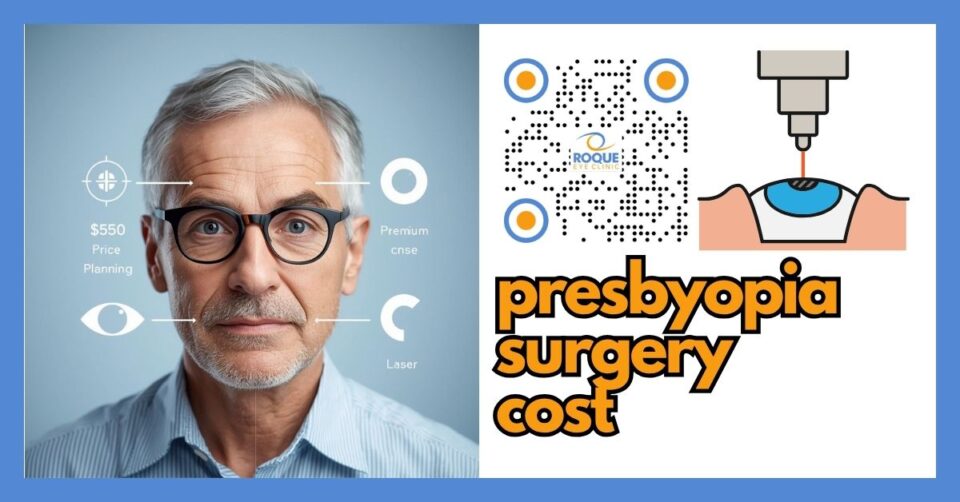
Presbyopia surgery cost depends mainly on which procedure you choose. Laser options such as PRESBYOND or monovision laser correction are usually priced differently from lens-based surgery such as refractive lens exchange with premium intraocular lenses. The final amount is shaped by screening tests, surgeon fees, hospital charges, lens technology, anesthesia, and whether discounts or insurance support apply.
Presbyopia is the age-related loss of near focusing ability that usually becomes noticeable after age 40. Many patients first manage it with reading glasses, bifocals, multifocal contact lenses, or progressive lenses. Others ask a more direct question: How much does presbyopia surgery cost, and what exactly am I paying for?
This is an important question because “presbyopia surgery” is not one single operation. It can refer to laser-based treatments such as monovision laser vision correction or PRESBYOND Laser Blended Vision, and it can also refer to lens-based surgery such as refractive lens exchange with presbyopia-correcting intraocular lenses. Because these treatments solve the problem in different ways, their cost structure is also different.
🧩 Focus: Cost of presbyopia surgery and what drives the total price
👁 Goal: Help patients understand what they are paying for, why prices vary, and how to compare laser versus lens-based presbyopia correction
🛡 Evidence-Based: Preferred Practice Patterns • Standards of Care • Systematic Reviews • Meta-Analyses
ROQUE REFRACTIVE SURGERY Knowledge Hub
Start with the complete guide:
🔬 Presbyopia Surgery Anatomy Micro-Primer
- Natural lens: This sits behind the iris and changes shape to help younger eyes focus up close. Presbyopia develops when it becomes less flexible with age.
- Cornea: This is the clear front window of the eye. Laser presbyopia procedures reshape the cornea to change how light focuses.
- Retina: This is the light-sensitive layer at the back of the eye. Whatever treatment is chosen, light still needs to focus clearly on the retina.
- Intraocular lens: In lens-based surgery, the natural lens is removed and replaced with an artificial lens that can be chosen for distance, near, intermediate, or blended visual goals.
📘 Presbyopia Surgery Terminology Glossary
- Presbyopia: Age-related difficulty focusing on near objects.
- PRESBYOND: A laser blended vision treatment designed to reduce dependence on reading glasses.
- Monovision: A strategy that sets one eye more for distance and the other more for near tasks.
- RLE: Refractive lens exchange, a lens replacement procedure used for refractive correction and presbyopia.
- Premium IOL: An intraocular lens designed to provide more than one focal range, such as multifocal, trifocal, or extended depth of focus.
- Modular pricing: A pricing model in which surgeon fees, hospital fees, lens costs, and add-ons are listed separately rather than combined into one bundle.
Quick Navigation
Related Reading
Dr. Roque's Key Learning Points
- Presbyopia surgery cost depends first on which procedure you are choosing.
- Laser presbyopia correction and lens replacement surgery have very different pricing structures.
- Screening fees, dry eye work-up, retinal imaging, and follow-up visits can affect the total amount.
- In lens-based surgery, the IOL choice is often one of the biggest price drivers.
- A cheaper quote is not always better if it excludes diagnostics, hospital costs, premium lenses, anesthesia, or postoperative care.
What Counts as Presbyopia Surgery?
Presbyopia surgery usually falls into two broad groups. The first group is laser-based correction, which changes the shape of the cornea to improve functional vision at more than one distance. This includes monovision laser correction and PRESBYOND Laser Blended Vision. The second group is lens-based correction, usually refractive lens exchange, in which the eye’s natural lens is removed and replaced with an intraocular lens selected for distance, intermediate, near, or a combination of these goals.
This matters because patients sometimes compare the price of a laser treatment against the price of a lens replacement procedure as though they were identical services. They are not. One mainly reshapes the cornea. The other replaces the natural lens and adds the cost of the implant, hospital environment, and lens technology.
💡 Dr. Roque's Analogy
Think of presbyopia surgery like upgrading vision in two different ways. Laser treatment is like reshaping the window so light enters differently. Lens replacement is like changing the camera lens itself. Both may improve function, but the parts, technology, and cost drivers are not the same.
Why Presbyopia Surgery Prices Vary So Much
The final bill is rarely based on one number alone. In real practice, several layers of cost may be involved:
- Initial consultation and suitability screening
- Dry eye testing and ocular surface optimization
- Corneal imaging, retinal imaging, OCT, and other diagnostics
- The surgeon’s professional fee
- The hospital or laser center fee
- The IOL implant, if lens-based surgery is chosen
- Anesthesia type
- Medications and disposables
- Enhancement policy or warranty terms
- Follow-up care schedule
That is why one clinic’s “package price” may look lower or higher than another clinic’s fee. Some quotes are bundled. Others are modular. Some include only the surgeon’s professional fee. Others include facility fees but not diagnostics. Some include a basic lens, while others assume a premium lens choice.
Laser Presbyopia Surgery Costs
In the currently posted 2026 laser comparison at Roque Eye Clinic’s Vision Laser Center, the refractive screening fee is listed at ₱5,845. The same posted comparison lists the PRESBYOND package at ₱92,100. The page also lists separate optional or related diagnostics such as a dry eye package, color fundus photos, and OCT, which means the total planning cost may be higher than the laser procedure alone in patients who need additional evaluation.
For patients considering laser correction for presbyopia, cost therefore often has two layers: the screening phase and the treatment phase. If the surgeon finds dry eye, unstable refraction, or a retinal issue, more testing or treatment may be needed before surgery is scheduled. This is one reason a patient should not assume that the procedure price is the same as the full journey cost.
What may be included in laser pricing
- Laser procedure itself
- Standard postoperative visits
- Basic warranty or enhancement terms in selected programs
What may still be billed separately
- Suitability screening
- Dry eye package
- Color fundus photos
- OCT or other advanced imaging
- Medicines and artificial tears
Lens-Based Presbyopia Surgery Costs
Lens-based presbyopia surgery usually means refractive lens exchange. In Roque Eye Clinic’s current 2026 modular fee structure, the published surgeon’s professional fee for phacoemulsification or refractive lens exchange is ₱56,000 per eye. If a valid Senior Citizen or PWD ID is presented, the clinic states that a mandated 32% discount reduces that professional fee to ₱40,000 per eye.
However, the clinic also clearly states that this professional fee is not the whole cost. Hospital fees, room rates when needed, medications, disposables, anesthesiologist’s fees, and especially the intraocular lens implant are billed separately. This matters greatly in presbyopia surgery because premium presbyopia-correcting IOLs are usually more expensive than standard monofocal lenses.
In other words, lens-based surgery often has a lower-looking starting number on paper for the surgeon’s fee, but the final total can rise substantially depending on the facility and the lens selected. A patient choosing a premium multifocal, trifocal, toric, or extended depth-of-focus lens is not paying only for surgery. They are also paying for the optical technology implanted in the eye.
Key cost drivers in lens-based surgery
- Whether surgery is done in one eye or both eyes
- Type of IOL: monofocal, toric, multifocal, trifocal, or EDOF
- Hospital operating room and supply fees
- Whether femtosecond laser assistance is added
- Whether surgery is done under topical anesthesia, sedation, or general anesthesia
What Is Usually Included—and What Often Is Not
This is one of the most important parts of any cost discussion. Before comparing prices, patients should ask which items are already included in the quote. A low quote may exclude several necessary items.
Usually included in a laser package
- The laser procedure
- Standard postoperative visits
- Sometimes a limited warranty
Often not included in a laser package
- Screening consultation and diagnostics
- Dry eye optimization
- Retinal work-up
- Special medicines
Usually included in the surgeon’s fee for RLE
- The surgeon’s professional service for the procedure
Often not included in the surgeon’s fee for RLE
- Hospital fees
- Room charges
- The IOL implant
- Anesthesia fees
- Diagnostics and add-on technologies
🚨 Dr. Roque's Emergency Warning
Do not choose presbyopia surgery based on price alone if you have sudden vision loss, flashes, new floaters, major glare, painful red eye, advanced dry eye, retinal disease, or uncontrolled diabetes. These problems may need treatment first, and rushing into surgery for a lower quote can be unsafe.
Why Premium Lens Choice Changes the Total So Much
The American Academy of Ophthalmology explains that presbyopia-correcting IOLs are designed to reduce dependence on eyeglasses after lens surgery. That benefit is one reason many patients choose them. But better range of focus usually comes with a higher implant cost than a standard monofocal lens. Patients are often not just buying surgery; they are choosing a long-term optical system inside the eye.
This is why two patients undergoing “presbyopia lens surgery” can receive very different quotes. One may choose a simpler lens mainly for distance. Another may choose a premium lens designed to improve distance, intermediate, and near vision with less dependence on glasses. The surgery may be similar, but the implant technology changes the price significantly.
How to Compare Presbyopia Surgery Prices Wisely
A good comparison is not just about the lowest number. It is about clarity and fairness. Ask for the quote in layers.
- Ask what procedure is being quoted. PRESBYOND and RLE are not the same thing.
- Ask whether the quote is per eye or both eyes.
- Ask whether the quote includes screening.
- Ask whether dry eye work-up, retinal imaging, or OCT may be added.
- Ask whether the lens implant is included.
- Ask whether hospital and anesthesia fees are separate.
- Ask whether the plan includes follow-up care and enhancement policy details.
Patients should also ask which treatment best matches their age, occupation, corneal status, dry eye status, and lens health. A seemingly cheaper option can become poor value if it is not the best match for the eye.
Is Presbyopia Surgery “Worth It”?
That depends on what the patient values most. For some people, reading glasses are a minor inconvenience and surgery is not worth the cost. For others—especially people who travel often, work in dynamic environments, dislike glasses, or want fewer visual limitations—the value lies in convenience, lifestyle freedom, and reduced dependence on spectacles.
Cost should therefore be discussed alongside expected visual quality, possible side effects, need for future glasses, and the permanence of the chosen treatment. The best financial decision is usually the one that balances budget, safety, and realistic visual goals.
Continue Reading
🏁 Dr. Roque's Take-Home Message
Presbyopia surgery cost is not one flat number. Laser options such as PRESBYOND usually have screening and procedure fees, while lens-based surgery adds separate costs for hospital care and the chosen intraocular lens. The most useful quote is a transparent one that tells you exactly what is included, what is separate, and why a particular procedure is being recommended for your eyes.
FAQ
1) Is presbyopia surgery cost the same as LASIK cost?
No. Presbyopia surgery may involve PRESBYOND, monovision laser correction, or refractive lens exchange. Each has its own pricing structure and different included or excluded items.
2) Why does lens-based presbyopia surgery usually cost more overall?
Because the total often includes the surgeon’s fee, hospital charges, anesthesia-related costs, and the intraocular lens implant. Premium IOL technology can significantly increase the final amount.
3) Is the screening fee separate from the surgery fee?
Often yes. Patients may need consultation, refraction, corneal imaging, retinal imaging, dry eye testing, and OCT before surgery is finalized.
4) Does a lower quote always mean better value?
No. A lower quote may exclude diagnostics, postoperative care, premium lenses, or hospital charges. Transparent pricing is more useful than a low headline number.
5) Can Senior Citizen or PWD discounts affect the cost?
Yes. In the currently posted Roque Eye Clinic modular fee structure for RLE/phacoemulsification, a valid Senior Citizen or PWD ID reduces the surgeon’s professional fee from ₱56,000 to ₱40,000 per eye.
6) Will I still need glasses after paying for presbyopia surgery?
Possibly. Some patients achieve high spectacle independence, but no procedure guarantees total freedom from glasses for all tasks and lighting conditions.
📚 References
- ROQUE Eye Clinic. LASER VISION CORRECTION. Valid from January 1, 2026 until December 31, 2026. Posted screening and package fees for SMILE, LASIK, PRESBYOND, and PRK.
- ROQUE Eye Clinic. FEES FOR PHACOEMULSIFICATION AND RLE. Published February 23, 2026.
- ROQUE Eye Clinic. Refractive Lens Exchange (RLE) | One Eye (PF only). Published service page with price and exclusions.
- American Academy of Ophthalmology. Presbyopia-Correcting IOLs. Updated January 14, 2026.
- American Academy of Ophthalmology. Refractive Surgery Preferred Practice Pattern®.
🤝 Roque Eye Clinic Patient Education Series
Dr. Manolette Roque | Dr. Barbara Roque
St. Luke's Medical Center Global City | Asian Hospital Medical Center
Philippines
Medical Review: Roque Advisory Council
Last Updated: March 2026
Medical Disclaimer
This article is intended for educational purposes only and does not replace professional medical consultation.