

Presbyopia Surgery (PresbyLASIK, Monovision Laser Vision Correction, PRESBYOND Laser Blended Vision) Guide
🧠 Dr. Roque's Quick Answer
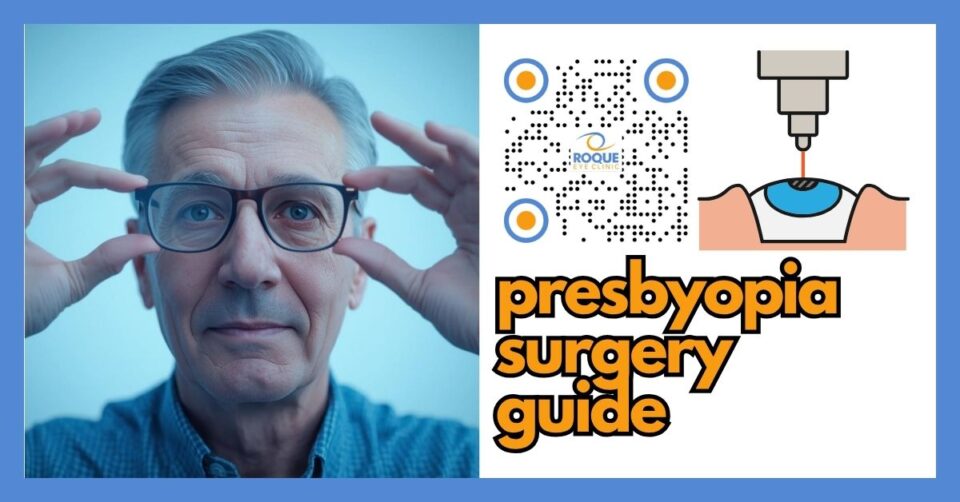
Presbyopia surgery uses laser vision correction strategies to reduce dependence on reading glasses by helping one or both eyes handle near, intermediate, and distance tasks better. Common options include PresbyLASIK, monovision laser vision correction, and PRESBYOND Laser Blended Vision. These procedures can work very well in the right patient, but success depends heavily on screening, eye dominance testing, lifestyle needs, and willingness to accept trade-offs.
Presbyopia is the age-related loss of near focusing ability that makes reading small print, checking a phone, or doing close work harder over time. Many patients first notice it in their 40s. At first, they hold reading material farther away. Later, they may need reading glasses more often, especially in dim light. Presbyopia surgery aims to reduce that dependence on glasses by changing how the two eyes work together or by increasing functional range of focus.
Unlike standard laser treatment for simple myopia or astigmatism, presbyopia correction is not just about making both eyes perfectly focused for distance. It is about balancing distance vision, intermediate function, near function, binocular cooperation, and patient satisfaction. That is why candidacy, counseling, and expectation management matter so much.
🧩 Focus: Laser surgical correction strategies for presbyopia
👁 Goal: Explain PresbyLASIK, monovision laser vision correction, and PRESBYOND Laser Blended Vision in clear patient-friendly language
🛡 Evidence-Based: Preferred Practice Patterns • Standards of Care • Systematic Reviews • Meta-Analyses
ROQUE REFRACTIVE SURGERY Knowledge Hub
Start with the complete guide:
🔬 Presbyopia Surgery Anatomy Micro-Primer
- Crystalline lens: This is the natural lens inside the eye. As it ages, it becomes less flexible, which is the main reason presbyopia develops.
- Cornea: This is the clear front window of the eye. Laser vision correction reshapes it to change focusing power.
- Retina: This light-sensitive tissue at the back of the eye receives the focused image. Clear vision depends on light landing properly here.
- Visual cortex and binocular system: Your brain combines information from both eyes. Presbyopia strategies such as monovision or blended vision depend on this teamwork.
📘 Presbyopia Surgery Terminology Glossary
- Presbyopia: The age-related loss of the eye’s ability to focus clearly up close.
- Monovision: A strategy in which one eye is set more for distance and the other more for near tasks.
- Micro-anisometropia: A small planned difference in prescription between the two eyes.
- PresbyLASIK: A LASIK-based approach that tries to improve near and distance function for presbyopic patients.
- PRESBYOND Laser Blended Vision: A ZEISS laser-based presbyopia strategy that combines mild monovision with controlled depth-of-focus concepts.
- Dominant eye: The eye the brain tends to prefer for precision distance tasks.
Quick Navigation
Related Reading
Dr. Roque's Key Learning Points
- Presbyopia surgery is not a one-size-fits-all treatment. It is a set of strategies designed to reduce dependence on reading glasses.
- Common laser approaches include PresbyLASIK, monovision laser vision correction, and PRESBYOND Laser Blended Vision.
- These procedures usually involve trade-offs between near, intermediate, and distance performance rather than giving “perfect” vision at every range.
- Success depends heavily on patient selection, eye dominance, binocular tolerance, and realistic expectations.
- Some patients with presbyopia may be better served by lens-based options, especially if early cataract or lens dysfunction is present.
What Presbyopia Surgery Is
Presbyopia surgery refers to refractive procedures designed to help patients see better across more than one distance range as near focus declines with age. In the laser surgery setting, this usually means intentionally adjusting how the two eyes contribute to vision rather than simply aiming both eyes for identical distance focus.
For many patients, the goal is not to eliminate every pair of glasses in every situation. The practical goal is to reduce dependence on reading glasses, improve day-to-day convenience, and create useful functional vision for common tasks such as phone use, dashboard viewing, computer work, and distance activities.
💡 Dr. Roque's Analogy
Presbyopia surgery is like tuning a stereo system rather than turning up a single volume knob. The surgeon is trying to balance distance, intermediate, and near performance so both eyes work together as comfortably as possible.
How Laser Presbyopia Correction Works
There are several ways to approach laser presbyopia correction. One method is monovision, in which the dominant eye is usually targeted more for distance while the non-dominant eye is left a little more myopic for near tasks. Another approach is PresbyLASIK, which uses corneal ablation strategies to increase functional range of focus. A more specific branded approach is PRESBYOND Laser Blended Vision, which combines mild anisometropia with controlled spherical aberration and binocular blending concepts.
The common theme is that presbyopia correction does not restore a young natural lens. Instead, it creates a practical visual arrangement that helps the brain and both eyes cover more daily tasks with fewer glasses.
Main Presbyopia Surgery Options
1) PresbyLASIK
PresbyLASIK is a broad term for LASIK-based presbyopia correction strategies intended to improve both near and distance function. Different platforms and surgeons may apply different profiles and planning methods. In patient terms, this means there is no single universal “PresbyLASIK” experience. Results depend on the technology used, the surgeon’s planning approach, and the patient’s visual system.
2) Monovision Laser Vision Correction
Monovision is one of the oldest and most established presbyopia strategies. The FDA explains monovision as using one eye for distance and the other for near. This idea started in contact lenses and was later applied to LASIK and other refractive procedures. Many patients can adapt well, but not everyone likes the imbalance. That is why tolerance testing and counseling are so important.
3) PRESBYOND Laser Blended Vision
PRESBYOND Laser Blended Vision is a ZEISS presbyopia solution that combines micro-monovision with depth-of-focus optimization to support binocular vision from near through intermediate to far. The concept is to soften some of the drawbacks of classic monovision by blending the visual ranges more smoothly. Even so, it still requires careful screening and adaptation, and it is not the right match for every patient.
What All Three Options Have in Common
- They are intended to reduce dependence on reading glasses, not guarantee perfect vision at every distance.
- They depend on binocular cooperation and brain adaptation.
- They require good ocular health, stable refraction, and thoughtful patient selection.
- They can improve lifestyle convenience but may involve compromises in contrast, night quality, or fine detail under some conditions.
- They work best when the patient understands the target outcome before surgery.
Who May Be a Candidate for Presbyopia Surgery
Potential candidates are usually presbyopic adults who want to reduce dependence on reading glasses and who have corneal, tear-film, retinal, and general eye findings that support laser refractive surgery. The patient should also have realistic expectations and be willing to accept that some trade-offs are part of the design.
Good screening is especially important here because presbyopia surgery is not only about refraction. It is also about lifestyle. A patient who drives at night for long hours, does highly detail-sensitive work, or is especially intolerant of imbalance between the two eyes may not be an ideal candidate for monovision-style strategies. In contrast, a patient who values convenience for everyday reading and computer tasks may be very happy with the right approach.
When a Patient May Need a Different Solution
Some patients asking about presbyopia surgery actually have early cataract, dysfunctional lens changes, significant dry eye, irregular corneas, retinal concerns, unstable refraction, or unrealistic expectations. In such cases, corneal laser presbyopia correction may not be the best path. Lens-based procedures may make more sense in some older patients or in those with lens changes that already affect visual quality.
Benefits and Practical Trade-Offs
Potential benefits
- Reduced dependence on reading glasses
- Better functional near and intermediate vision for daily tasks
- Convenience for phone use, dashboard viewing, shopping, travel, and casual reading
- High satisfaction in carefully selected, well-counseled patients
Common trade-offs
- One eye may not feel exactly the same as the other
- Fine-detail distance sharpness may be different from full bilateral distance correction
- Contrast, depth perception, glare, or halos may be more noticeable in some patients
- Adaptation may take time
- Some patients still need glasses for certain tasks
Recovery and Neuroadaptation
Physical healing after the laser procedure depends on the underlying surgical technique, such as LASIK or surface ablation. But presbyopia surgery also has another layer of recovery: neuroadaptation. This means the brain needs time to learn how to use the visual arrangement that was intentionally created.
Some patients adapt quickly. Others need more time. During this period, vision may feel “different” rather than clearly “better” right away. That does not always mean the treatment failed. It may simply mean the brain is still adjusting to the new balance between distance and near input.
🚨 Dr. Roque's Emergency Warning
Seek urgent ophthalmic review if you develop severe pain, marked redness, pus-like discharge, a sudden major drop in vision, flashes, many new floaters, or a curtain-like shadow over vision. These symptoms are not normal presbyopia adaptation and may indicate a more serious problem.
Risks and Limitations
- Dry eye symptoms or worsened ocular surface complaints
- Glare, halos, reduced contrast, or night-vision complaints
- Difficulty adapting to monovision or blended-vision strategies
- Residual refractive error or need for enhancement
- Partial rather than complete freedom from glasses
- Age-related lens changes that later reduce the benefit of corneal laser correction
How Surgeons Decide Which Strategy Fits Best
The recommendation depends on many factors: age, refractive error, corneal thickness, ocular surface health, previous contact lens experience, tolerance of monovision, pupil behavior, night-driving needs, reading demands, work profile, and the surgeon’s platform and expertise. There is no single “best” presbyopia surgery for all patients.
For example, a patient who already tolerated monovision contact lenses may adapt well to a laser monovision plan. Another patient may prefer a blended-vision approach. Another may not tolerate either well and may be better served by a different refractive strategy altogether.
Questions Patients Should Ask Before Surgery
- Am I a better candidate for monovision, PresbyLASIK, or PRESBYOND?
- What tasks do you expect I will still need glasses for?
- How might this affect my night driving or fine-detail work?
- How do you test whether I can tolerate monovision?
- Would a lens-based procedure make more sense for my age and eye condition?
- What happens if I do not adapt well after surgery?
Continue Reading
🏁 Dr. Roque's Take-Home Message
Presbyopia surgery can be a very helpful way to reduce dependence on reading glasses, but it works by creating a functional visual balance, not by restoring a young natural lens. PresbyLASIK, monovision laser vision correction, and PRESBYOND Laser Blended Vision each have a place in modern refractive surgery. The best choice depends on careful screening, realistic expectations, and selecting the option that best matches your eyes and lifestyle.
FAQ
1) What is presbyopia surgery?
Presbyopia surgery is a refractive strategy designed to reduce dependence on reading glasses by improving functional near, intermediate, and distance vision using carefully planned laser treatment patterns or visual balance between the two eyes.
2) Is monovision LASIK the same as PresbyLASIK?
No. Monovision LASIK usually sets one eye more for distance and the other more for near. PresbyLASIK is a broader term for LASIK-based presbyopia correction strategies that may use different optical designs depending on the platform.
3) What is PRESBYOND Laser Blended Vision?
PRESBYOND Laser Blended Vision is a ZEISS laser-based presbyopia correction approach that combines mild anisometropia with depth-of-focus concepts to help create useful binocular vision from near through far in selected patients.
4) Will presbyopia surgery completely eliminate reading glasses?
Not always. Many patients reduce their dependence on reading glasses, but some still need glasses for fine print, prolonged reading, dim light, or highly demanding visual tasks.
5) Can everyone adapt to monovision or blended vision?
No. Some patients adapt very well, while others find the imbalance uncomfortable. That is why screening, dominance testing, and expectation counseling are critical before surgery.
6) Could I need a lens-based procedure instead of presbyopia laser surgery?
Yes. If you have early cataract, dysfunctional lens changes, or other eye findings, a lens-based option may be more appropriate than corneal laser presbyopia correction.
📚 References
- American Academy of Ophthalmology. Refractive Surgery Preferred Practice Pattern®. Updated guidance.
- U.S. Food and Drug Administration. What are the risks and how can I find the right doctor for me?
- ZEISS. PRESBYOND Laser Blended Vision.
- Trojacka E, et al. Current Trends in Presbyopia Correction—A Comprehensive Review. J Clin Med. 2025.
- Hernández-Lucena J, et al. Outcomes of corneal compound myopic astigmatism with PRESBYOND. J Clin Med. 2024.
🤝 Roque Eye Clinic Patient Education Series
Dr. Manolette Roque | Dr. Barbara Roque
St. Luke's Medical Center Global City | Asian Hospital Medical Center
Philippines
Medical Review: Roque Advisory Council
Last Updated: March 2026
Medical Disclaimer
This article is intended for educational purposes only and does not replace professional medical consultation.