



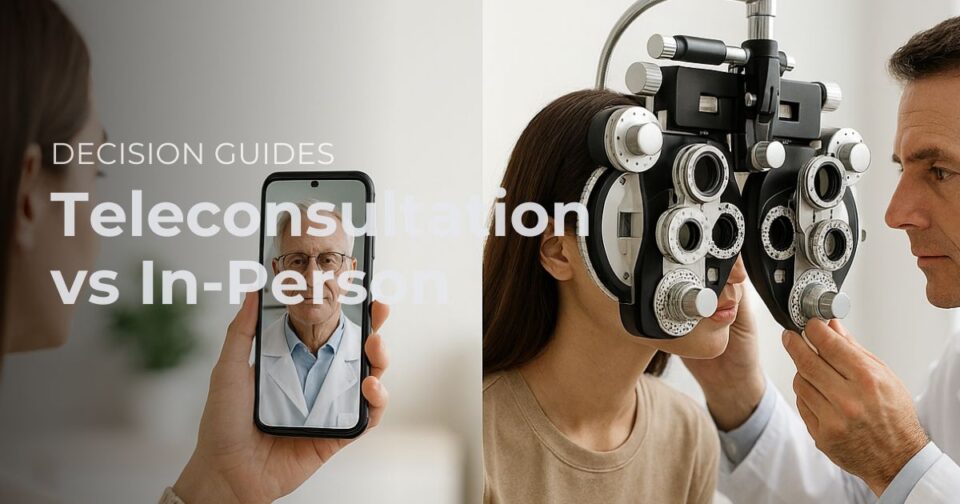
Teleconsultation vs In-Person Eye Consultation: Which One Do You Need?
🧠 Dr. Roque’s Quick Answer
Teleconsultation works best for screening, follow-up questions, medication clarification, dry eye advice, allergy symptoms, and deciding how urgently you need care. An in-person consultation is better when you need an eye examination, vision testing, eye pressure measurement, imaging, dilation, or treatment. If you have sudden vision loss, severe eye pain, trauma, flashes and floaters, or a very red painful eye, do not rely on teleconsultation alone. You need urgent in-person assessment.
🎯 Focus
Help you choose the safest and most practical consultation format for your eye concern.
🧩 Goal
Reduce delay, avoid the wrong first step, and guide you toward the right level of care.
🛡️ Evidence-Based
This guide follows common ophthalmic triage logic: use remote care for advice and routing, but use in-person care when examination or testing is needed.
Many patients ask the wrong first question. They ask, “Is teleconsultation enough?” The better question is, “What information can be gathered safely without examining the eye in person?” That difference matters.
Teleconsultation can save time, reduce unnecessary travel, and help you decide what to do next. However, it has clear limits. Your eye doctor cannot measure eye pressure through a phone call, cannot dilate your pupils through a screen, and cannot fully examine the retina, cornea, optic nerve, or lens without the proper equipment.
In other words, teleconsultation is often useful as a first filter. It is not a full replacement for an actual eye examination.
👁️ ROQUE Eye Clinic Decision Guides Knowledge Hub
Use this page as a practical decision guide, then continue to the next most relevant resource.
🧬 Anatomy Micro-Primer
Different parts of the eye require different ways of checking them. The front of the eye includes the eyelids, conjunctiva, cornea, and tear film. The inside of the eye includes the lens, vitreous, retina, and optic nerve.
During teleconsultation, some front-eye problems can sometimes be discussed using your history and photos. However, the deeper structures usually need slit-lamp examination, pressure measurement, imaging, or dilated retinal examination. That is why many important eye problems still require an in-person visit.
📘 Terminology Glossary
- Teleconsultation: A medical consultation done remotely by video call, voice call, or messaging.
- In-person consultation: A clinic visit where the doctor can examine your eyes directly and perform tests.
- Dilation: Eye drops used to widen the pupil so the retina and optic nerve can be examined better.
- Intraocular pressure: The pressure inside the eye, important in glaucoma assessment.
- Triage: Deciding how urgent a problem is and what kind of care is needed next.
When Teleconsultation Makes Sense
Teleconsultation can be the right first step when the main goal is advice, clarification, or triage rather than a full examination.
Good uses for teleconsultation
- Reviewing symptoms to decide whether you need urgent, soon, or routine care
- Discussing dry eye, mild irritation, lid inflammation, or allergy symptoms
- Clarifying medication instructions or side effects
- Discussing test results that have already been done
- Postoperative follow-up when the doctor decides a remote check is reasonable
- Second-opinion discussion after you already have records or images
- Planning the next steps before traveling to the clinic
What teleconsultation does well
- Saves travel time
- Helps patients in traffic-heavy or far locations
- Allows early guidance instead of waiting in uncertainty
- Works well for education, counseling, and routing
When In-Person Consultation Is Better
If the answer depends on what your doctor must actually see, measure, or image, you usually need an in-person consultation.
You likely need in-person care if you need:
- Visual acuity testing and refraction
- Eye pressure measurement
- Slit-lamp examination
- Dilated retinal examination
- OCT, fundus photos, corneal imaging, or other diagnostics
- Foreign body removal, laser treatment, injection, or surgery planning
- A more confident diagnosis because symptoms are not straightforward
Common examples
- Possible cataract needing full surgical evaluation
- Possible glaucoma needing pressure check and optic nerve assessment
- Possible retinal tear or detachment needing a dilated retinal exam
- Red eye with pain, light sensitivity, or blurred vision
- Eye trauma
- Sudden loss of vision
💡 Dr. Roque’s Analogy
Teleconsultation is like talking to a mechanic by phone about a strange sound in your car. That conversation may help you decide whether the problem sounds minor, needs a same-day check, or needs emergency attention. But if the engine truly needs to be inspected, the car still has to come into the shop. The same is true for eyes.
A Simple Comparison: Teleconsultation vs In-Person
Which Patients Usually Fit Teleconsultation Best?
- Patients asking whether symptoms can wait or need urgent care
- Patients who already had tests done and want interpretation
- Postoperative patients with routine questions and no warning signs
- Patients with chronic known conditions who need advice between visits
- Patients who need initial counseling before deciding to come in
Which Patients Usually Fit In-Person Consultation Best?
- First-time patients with reduced vision and no clear diagnosis
- Patients considering cataract surgery, LASIK, SMILE, ICL, or lens replacement
- Patients with glaucoma risk or possible retinal disease
- Patients with significant pain, trauma, flashes, floaters, or sudden blur
- Children who may need proper pediatric eye examination
- Anyone whose problem sounds serious, unusual, or unstable
🚨 Dr. Roque’s Emergency Warning
Do not depend on teleconsultation alone if you have:
- Sudden vision loss
- Severe eye pain
- Eye trauma or chemical exposure
- Flashes and new floaters, especially with a curtain or shadow in vision
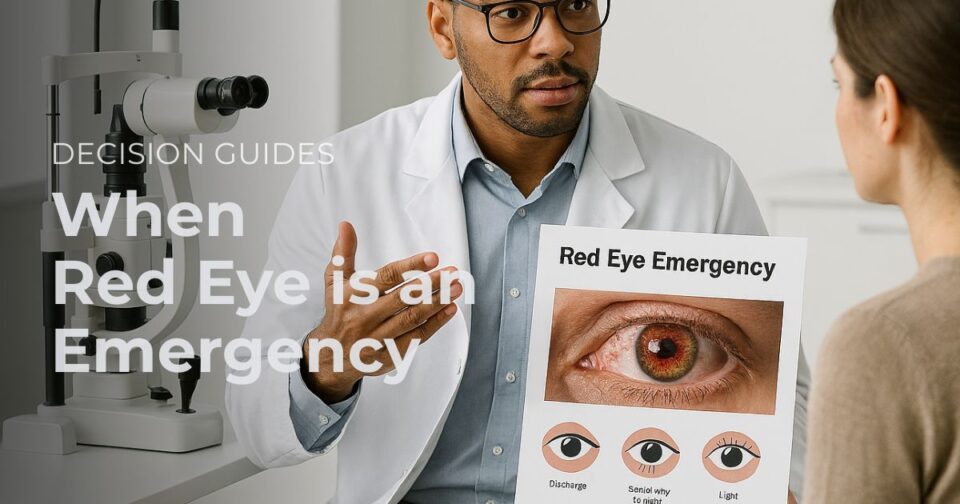
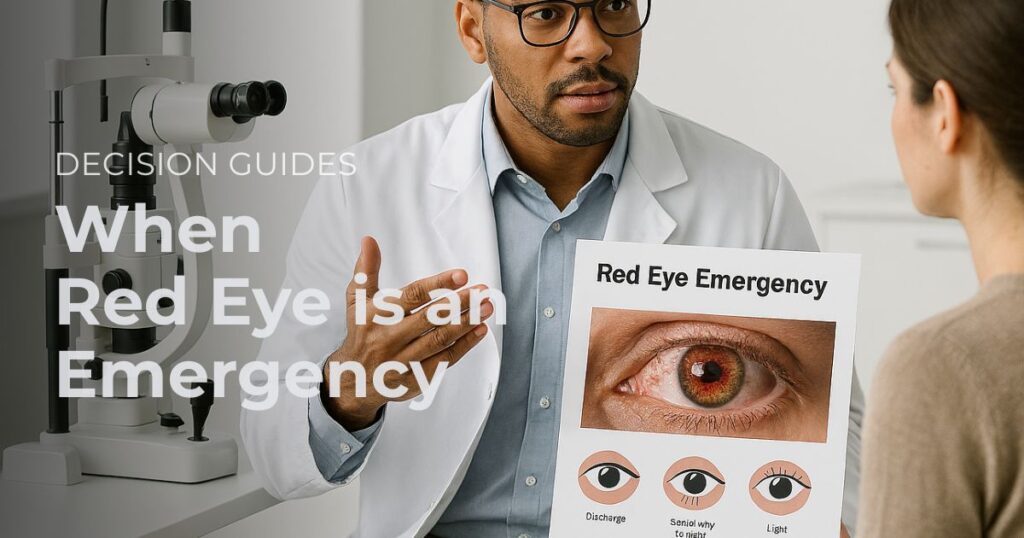
- A very red eye with pain, light sensitivity, or reduced vision
- Sudden double vision
- Sudden swelling around the eye with fever or severe pain
Those symptoms may require same-day or urgent in-person assessment.
A Practical Way to Decide
Choose teleconsultation first when:
- You need guidance, not a full work-up
- Your symptoms are mild and stable
- You mainly need to know whether the problem is urgent
- You already have records, test results, or photos to review
Choose in-person first when:
- You think you need an actual diagnosis, not just advice
- Your vision changed significantly
- You may need imaging, dilation, pressure check, or treatment
- Your symptoms are painful, sudden, or worrying
For Surgical Decisions, Teleconsultation Has Limits
Teleconsultation can help you understand your options, but it does not replace preoperative diagnostics. If you are considering cataract surgery, LASIK, SMILE, ICL, presbyopia correction, or lens replacement, the real decision depends on measurements, ocular surface status, retinal health, corneal shape, lens status, and other factors that must be checked properly.
That is why a remote discussion may help you prepare, but an in-person consultation is usually what converts uncertainty into an actual treatment plan.
🧠 Dr. Roque’s Key Learning Points
- Teleconsultation is helpful for triage, counseling, and follow-up questions.
- In-person consultation is better when you need examination, testing, imaging, or treatment planning.
- Teleconsultation can save time, but it cannot replace a full eye exam.
- Sudden vision loss, severe eye pain, trauma, flashes and floaters, and painful red eye need urgent in-person care.
- If the diagnosis depends on what must be seen or measured, remote care is not enough.
- For surgery decisions, teleconsultation may guide you, but diagnostics decide the plan.
📚 Related Reading
Frequently Asked Questions
1. Can an eye doctor diagnose everything through teleconsultation?
No. Teleconsultation can help with triage and counseling, but many eye conditions still need direct examination and tests.
2. Can I use teleconsultation for red eye?
Sometimes, yes, for initial guidance. However, if the red eye is painful, light-sensitive, or comes with blurred vision, you should usually be seen in person.
3. Can cataracts be assessed by teleconsultation alone?
No. Teleconsultation may help discuss symptoms, but cataract severity and surgical planning need an in-person examination.
4. Can glaucoma be managed by teleconsultation only?
Not reliably. Glaucoma assessment depends on pressure measurement, optic nerve evaluation, visual field testing, and imaging.
5. Are photos enough for an eye diagnosis?
Sometimes photos help, especially for lid or surface issues. Still, photos alone often miss deeper or more serious problems.
6. When is teleconsultation a good first step?
It is useful when your symptoms are mild, stable, and you mainly need advice on urgency or next steps.
7. Should I choose teleconsultation if I live far away?
It can be a smart first filter. However, if your condition sounds serious or needs testing, you may still need to travel for proper in-person care.
8. Can postoperative patients use teleconsultation?
Sometimes, yes, if the doctor feels remote follow-up is appropriate and there are no warning signs.
9. Can teleconsultation help me decide if I need surgery?
It can help you understand your options, but surgery decisions still need a full in-person work-up.
10. What is the safest rule to remember?
If your eye problem is sudden, painful, severe, or vision-threatening, do not rely on teleconsultation alone.
✅ Dr. Roque’s Take-Home Message
Teleconsultation is useful when you need guidance. In-person consultation is better when you need certainty. If your eye problem is mild and stable, a teleconsultation may be a reasonable first step. If your vision changed, your eye hurts, your eye is injured, or the diagnosis depends on examination or tests, come in for a proper in-person assessment.
📖 References
- American Academy of Ophthalmology. Preferred Practice Pattern resources relevant to comprehensive ophthalmic assessment and urgent eye care triage.
- World Health Organization guidance and telemedicine principles relevant to remote clinical care and referral escalation.
- Peer-reviewed ophthalmology literature on teleophthalmology, remote triage, and limitations of remote assessment for anterior and posterior segment disease.
- Standard ophthalmic clinical practice principles regarding slit-lamp examination, tonometry, dilation, retinal evaluation, and diagnostic imaging.
- Local clinical judgment and patient-flow realities relevant to ophthalmic care delivery in the Philippines.
ROQUE Eye Clinic Patient Education Series
Reviewed by the Roque Advisory Council
Dr. Manolette Roque | Dr. Barbara Roque
St. Luke’s Medical Center Global City | Asian Hospital Medical Center
Philippines
Medical Disclaimer: This page is for patient education and decision support. It does not replace a full medical consultation or eye examination. If you have sudden vision loss, severe eye pain, eye trauma, new flashes and floaters, or a painful red eye, seek urgent in-person eye care.