
🧠 Dr. Roque’s Quick Answer
Implantable Collamer Lens (ICL) surgery places a thin prescription lens behind the iris and in front of the natural lens to correct nearsightedness, with a toric option for astigmatism. It avoids laser removal of corneal tissue, but requires a small incision and surgery inside the eye. Suitability depends on detailed measurements and eye health. Cataract, pressure problems, infection, and other complications remain possible, so lifelong eye care matters.[2],[3]
🔑 Key Learning Points
- Your natural lens stays in place; ICL is different from cataract surgery or refractive lens exchange.
- A high prescription or thin cornea may prompt consideration of ICL, but does not establish eligibility.
- EVO’s central port usually removes the need for a preventive laser iridotomy. It does not eliminate every pressure-related risk.
- The implant can be removed or exchanged through another operation. That does not make surgery fully reversible.
- Clear distance vision does not prevent age-related reading difficulty, cataract, or the retinal risks associated with high myopia.
If you have been told that LASIK or SMILE Pro may not suit your eyes, ICL may be worth discussing. The decision starts with what your eyes can safely support and what you expect to do without glasses. Two people with the same glasses prescription can need different recommendations.
🧩 Focus, goal, and evidence
Focus: ICL for myopia with or without astigmatism.
Goal: Understand suitability, alternatives, benefits, risks, costs, and follow-up.
Evidence: The specific regulatory records, manufacturer instructions, and clinical study listed below. International labeling is identified separately from local clinical eligibility.
🔬 Anatomy Micro-Primer
- Cornea: The transparent front window. ICL avoids laser reshaping, but a small corneal incision is still made.
- Iris: The colored part of the eye. The implant sits behind it.
- Natural crystalline lens: Remains behind the ICL and provides the eye’s remaining focusing ability.
- Anterior chamber: The space between the cornea and iris. Its depth and drainage angle help determine safety; the ICL itself sits in the posterior chamber.
- Retina: The light-sensitive lining at the back. Correcting focus does not repair myopic retinal damage.
📘 Terminology Glossary
- Phakic: The eye still contains its natural lens.
- Collamer: The proprietary collagen-containing copolymer used for these lenses.
- Toric: An implant design that also corrects astigmatism.
- Vault: The gap between the ICL and the natural lens.
- Endothelial cell density (ECD): A measure of the cells lining the inner cornea that help keep it clear.
- Presbyopia: The age-related loss of near focusing ability.
🧭 Quick Navigation
What ICL does · Who may qualify · Screening and sizing · Lens models · Alternatives · Surgery day · Recovery · Risks · Evidence · Cost · FAQs
📖 Related Reading
What does ICL surgery do?
The implant changes how light focuses inside the eye. It is intended to reduce dependence on glasses or contact lenses for distance vision. It does not sit on the eye’s surface like a contact lens, and you do not remove or clean it yourself. The implant is designed to remain long term, subject to continued monitoring.
Think of it as adding an optical element to a camera while keeping the original focusing lens. The analogy explains the optical idea; it does not mean the operation leaves the eye untouched. The incision and the implant both have consequences that require follow-up.
Standard myopic EVO ICL is not a general treatment for every type of blurred vision. It does not treat cataract, amblyopia, macular disease, or the underlying elongation of a highly myopic eye. A toric model treats appropriate regular astigmatism; it does not straighten an irregular or unstable cornea.
Who may be a candidate for ICL?
ICL may be considered when a stable myopic prescription, corneal findings, and personal goals make an implanted lens a reasonable option. Some suitable patients have a high prescription or insufficient corneal tissue for the proposed laser correction. Others may qualify for more than one procedure. No single glasses grade decides the answer.
A safe assessment must establish enough internal space, acceptable drainage angles and endothelial cells, a suitable natural lens, and no eye disease that makes the operation inappropriate. Pregnancy or breastfeeding, an unstable prescription, cataract, glaucoma or pressure concerns, significant inflammation, and some corneal or retinal disorders may exclude surgery or require a different plan.[3],[7]
2026 update: age ranges are model- and country-specific
On November 14, 2025, the U.S. FDA approved expanding EVO/EVO+ ICL and toric ICL use from ages 21–45 to 21–60. This does not mean every 60-year-old is a suitable candidate, and it does not establish Philippine labeling. Natural-lens clarity, near-vision needs, anatomy, and the exact locally approved device remain decisive.[1]
For example, a younger adult with a strong stable prescription and adequate internal space may be a reasonable candidate. Someone with the same prescription but a shallow chamber or cataract may not be. Keeping glasses remains a valid choice.
What screening and sizing are needed?
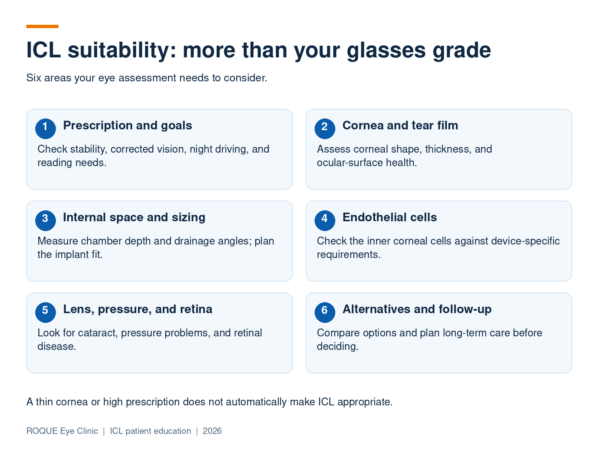
- Prescription and vision: Confirm refraction, best corrected vision, and stability; bring older prescriptions when available.
- Corneal assessment: Check shape, thickness, tear film, and surface health. Thin corneas do not automatically qualify for ICL.
- Internal measurements: Assess chamber depth, drainage angle, and the dimensions used for sizing. Additional anterior-segment imaging may help.
- Endothelial cells: Check cell density against the relevant age- and device-specific requirements.
- Lens, pressure, and retina: Look for cataract, pressure problems, and retinal disease, with a dilated examination when appropriate.
- Daily visual needs: Discuss night driving, reading, occupational requirements, contact sports, and tolerance for glasses.
Power and size are different decisions: power addresses focus; size helps determine how the implant fits. After surgery, vault and drainage-angle findings must be assessed together. Too little vault can raise concern about contact with the natural lens; excessive vault can crowd the angle. A single online “ideal vault” number cannot replace an examination.[4]
Follow the clinic’s contact-lens break instructions before testing; timing depends on lens type and measurement stability. Treat significant ocular-surface disease before relying on measurements.
EVO, EVO+, toric ICL, and EVO Viva: what differs?
- EVO / EVO+: Central-port ICL models for myopia; the optical design and available sizes differ by model. The port allows fluid flow through the lens. Routine preventive peripheral iridotomy is generally unnecessary for these models, unlike some older non-port designs.
- Toric ICL: Adds astigmatism correction. Alignment matters; significant rotation can reduce the correction and require repositioning.
- EVO Viva: A separate extended-depth-of-focus design intended to address myopia with presbyopic needs in suitable patients. It is not interchangeable with standard distance-focused EVO ICL.
Do not assume that U.S. EVO approval applies to EVO Viva or proves Philippine availability. Ask for the exact model, its locally applicable instructions, and its expected distance and near-vision trade-offs. Standard ICL preserves existing accommodation but does not stop presbyopia. Reading glasses may still be needed.[2],[8]
What are the potential benefits?
- Less dependence on distance glasses or contact lenses in suitable patients.
- Correction without laser removal of corneal tissue or creation of a LASIK flap.
- Retention of the natural lens and its remaining focusing ability.
- A lens-based option when the proposed laser correction is unsuitable but internal-eye anatomy is appropriate.
- The possibility of removing or exchanging the implant if needed, while recognizing the risks of further surgery.
The aim is useful vision for your daily activities. The achievable result depends on your starting vision, eye health, prescription, and response to surgery.
How does ICL compare with LASIK, SMILE Pro, PRK, and lens exchange?
The decision is about which tissues are treated and which risks you are willing to accept. No procedure is the safest or best for every eye.
- Glasses: Avoid surgical risks and remain a reasonable long-term option.
- Contact lenses: Avoid intraocular surgery but require appropriate fit, hygiene, and ongoing care.
- LASIK: Reshapes corneal tissue beneath a flap; suitability includes corneal strength and surface health.
- SMILE / SMILE Pro: Removes a corneal lenticule through a small incision; it still removes tissue and has its own eligibility requirements.
- PRK: Reshapes the corneal surface after removing its outer cell layer; healing and discomfort differ from LASIK and ICL.
- ICL: Adds an implant while retaining the natural lens; requires internal-space and long-term implant monitoring.
- Refractive lens exchange: Removes the natural lens. This permanently removes its remaining accommodation and needs particular caution in younger highly myopic eyes.
Discuss ICL versus lens replacement if lens aging or reading vision is central to your decision.
What happens on surgery day?
The team confirms the treatment plan, lens, and eye to be treated. Anesthesia usually includes numbing drops; additional medication depends on your circumstances. You may notice light, touch, or pressure. Tell the team immediately if you feel pain.
The surgeon makes a small corneal incision, inserts the folded lens, and positions it behind the iris. A toric implant is aligned to the planned axis. Protective gel used during the operation is removed, and the wound and lens position are checked. Your natural lens remains in place.
The procedure is usually outpatient. Arrange transport home and follow the clinic’s instructions about food, medicines, drops, and an accompanying adult. Whether both eyes are treated together or on different dates depends on the clinical plan.
Recovery and follow-up: what should you expect?
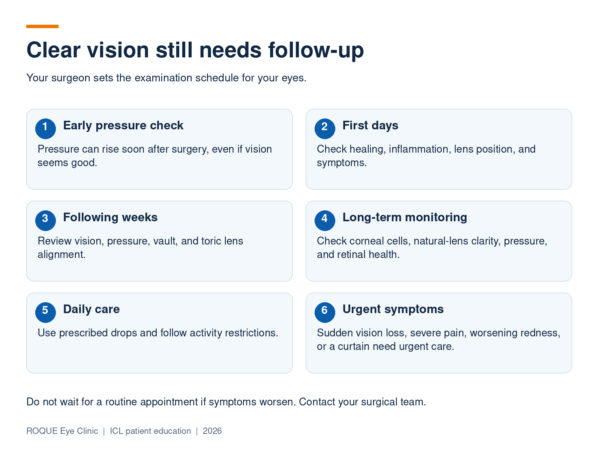
- Early checks: Eye pressure can rise soon after surgery. Manufacturer instructions call for an initial pressure check within 1–6 hours. Follow the surgeon’s arranged examination schedule even if vision seems clear.
- First days: Blur, light sensitivity, mild irritation, or halos can occur. Useful vision may improve quickly, but improvement is not a guarantee of complete healing.
- Following weeks: The team checks vision, pressure, inflammation, wound healing, lens alignment, and vault. Do not stop or change prescribed drops without instructions.
- Long term: Continue scheduled examinations for pressure, lens clarity, vault, corneal cells, and retinal health. Plan for at least annual long-term review, with earlier or more frequent visits when advised. It is not a one-time procedure with no future care.[9]
Do not rub the eye. Follow your surgeon’s timing for washing, eye makeup, swimming, strenuous exercise, and contact sports. Resume driving only after your clinician confirms that vision and recovery are adequate and you meet driving requirements. “Back to driving in 24 hours” should never be promised.[4]
What are the risks and limitations?
- Pressure rise or glaucoma: May require drops or another procedure. A central port does not make pressure checks optional.
- Cataract: The natural lens may become cloudy, sometimes requiring ICL removal and cataract surgery.
- Corneal cell loss: Endothelial damage can cause corneal swelling; severe loss may require more treatment, including transplantation.
- Fit or alignment problems: Excessive or low vault, rotation, or displacement can require repositioning, exchange, or removal.
- Visual symptoms: Glare, halos, starbursts, or difficulty in low light may persist. A good eye-chart result does not guarantee comfortable night driving.
- Residual prescription: Glasses, contact lenses, or further treatment may still be needed.
- Infection, bleeding, or inflammation: Uncommon but potentially serious. Permanent vision loss is possible.
- Retinal problems: Retinal detachment is a concern in myopic eyes and after intraocular surgery. ICL does not remove the baseline risks of high myopia.
These are important counseling topics, not a complete consent form. The likelihood and consequences depend on the patient, lens, operation, and follow-up.[4],[6]
Removable does not mean fully reversible
Removing an ICL requires another operation. It cannot guarantee restoration of the eye’s exact previous condition or undo a complication. Similarly, avoiding laser tissue removal does not mean there is no incision, no inflammation, or no possibility of dryness.
What does current evidence show?
A prospective U.S. multicenter study enrolled 629 eyes in 327 adults aged 21–45. At three years, 90.7% of assessed eyes were within 0.50 diopter of the target prescription. The investigators reported two exchanges for high vault, one anterior subcapsular cataract, and a mean 6.7% decrease in endothelial cell density. No pupillary block requiring iridotomy or iridectomy was reported.[5]
These findings support effectiveness in carefully selected patients. They are not ROQUE Eye Clinic outcome statistics, a lifetime guarantee, or direct evidence that the same results apply to every patient aged 46–60. The study was supported by STAAR Surgical and included investigators with manufacturer relationships. Its follow-up period and eligibility criteria must also be considered. Rare events can occur even when none were seen in a study.
How much does ICL surgery cost in the Philippines?
Costs vary with lens model, astigmatism correction, testing, facility, medicines, and whether one or both eyes are treated. Request a written quotation for your actual treatment plan. A professional fee alone is not the total cost of surgery.
Compare whether the quotation includes screening, the implant, surgeon and facility fees, drops, scheduled follow-up, and how additional procedures or complications would be charged. Verify any HMO or insurance benefits directly; do not assume coverage.
Use the ICL surgery cost guide and clinic costs page as starting points. Published prices can change and should be confirmed with clinic staff.
Questions to bring to your consultation
- Why does ICL suit my anatomy better than the alternatives?
- Which exact lens model is proposed, and which local eligibility criteria apply?
- What are my chamber, angle, endothelial-cell, and natural-lens findings?
- What should I expect for night driving and reading?
- What would prompt repositioning, exchange, or removal?
- Who handles urgent concerns after hours, and what follow-up is included?
ROQUE Eye Clinic sees patients at St. Luke’s Medical Center – Global City, Medical Arts Building Unit 217, Taguig, and Asian Hospital and Medical Center, Medical Office Building Unit 509, Alabang. Clinic staff can help arrange evaluation; suitability is determined by examination.
🚨 Emergency Warning
Seek urgent eye care now for sudden or worsening loss of vision, severe eye pain, increasing redness, pain with headache or nausea, new flashes or many floaters, or a curtain/shadow across vision. Contact your surgical team immediately. If they are unavailable, go to the nearest emergency department. Do not wait for a routine appointment or a social-media reply.
🏁 Take-Home Message
ICL can reduce dependence on distance glasses in suitable patients while preserving the natural lens and avoiding laser corneal tissue removal. It remains surgery inside the eye. The decision should balance anatomy, realistic visual goals, alternatives, cost, and the commitment to long-term monitoring.
Frequently Asked Questions
Is ICL the same as an implantable contact lens?
“Implantable contact lens” is a common nickname. ICL means Implantable Collamer Lens. It is placed inside the eye and is not a contact lens worn on the surface.
Is ICL safer than LASIK?
There is no universal answer. ICL avoids a LASIK flap and laser tissue removal but introduces intraocular risks. The safer choice depends on your examination and treatment goals.
Can ICL treat astigmatism?
A suitable toric ICL can treat myopic astigmatism within its approved range. The amount and type of astigmatism, sizing, and alignment matter.
Does ICL treat farsightedness or every prescription?
Do not generalize across lens families. This guide focuses on myopic EVO ICL. The exact device’s local approval and prescription range must be checked before discussing treatment for hyperopia or other refractive errors.
Does ICL prevent or cure dry eye?
No. Avoiding laser corneal reshaping may be useful in some patients, but existing dry eye still needs assessment and treatment. Irritation or surface dryness can occur after surgery.
Can the lens be removed?
Yes, if clinically indicated, through another operation. Removal carries risks and cannot guarantee a return to the eye’s preoperative state.
Will I need reading glasses later?
Possibly. Standard distance-focused ICL does not stop presbyopia. Near-vision options, including whether any presbyopia-oriented implant is appropriate and locally available, need separate counseling.
Can ICL cause cataract?
Yes. Cataract is a recognized risk, and it can also develop with aging. Follow-up checks natural-lens clarity and the implant’s relationship to it.
Can I have ICL after being refused LASIK?
Sometimes. Being unsuitable for LASIK is a reason to evaluate alternatives, not evidence that you qualify for ICL.
Do I need follow-up if I see clearly?
Yes. Pressure, endothelial-cell loss, and lens changes can require monitoring even when vision feels good.
How quickly can I work or drive?
Recovery varies. Your work demands and examination findings determine timing. Arrange transport on surgery day and wait for clinical clearance before driving.
Is ICL permanent?
It is intended to remain long term, but future removal, exchange, or cataract surgery may be necessary. Keep the implant details and continue regular eye care.
📚 References
- FDA: EVO/EVO+ ICL age indication expansion, decision November 14, 2025
- FDA: EVO/EVO+ Visian ICL approval overview (2022; age statement superseded by reference 1)
- FDA: EVO ICL patient information booklet (2022; read age range with reference 1)
- STAAR Surgical: EVO/EVO+ Visian ICL directions for use, eDFU-0001 Rev 05 (read age range with reference 1)
- Parkhurst G, et al. Three Year Results from the United States FDA Prospective Multicenter Clinical Study of the EVO/EVO+ Implantable Collamer Lens. Clinical Ophthalmology. 2025;19:3237–3248. doi:10.2147/OPTH.S537739
- FDA: Risks of phakic intraocular lenses (general safety counseling; not current model-specific incidence estimates)
- FDA: Are phakic lenses for you? (general screening considerations; older age statements do not override reference 1)
- STAAR Surgical: EVO Viva directions for use, eDFU-0013 Rev 06 EU (regional labeling, not proof of Philippine availability)
- ESCRS Recommendations for Refractive Surgery. Current online recommendations, accessed November 2, 2026.
🤝 ROQUE Eye Clinic Patient Education
Refractive surgery education for patients considering their options.
St. Luke’s Medical Center – Global City • Asian Hospital and Medical Center
About Dr. Manolette Roque
Medical review status: Prepared by Dr. Manolette Roque.
Evidence checked: November 2, 2026.
Medical disclaimer: This educational guide does not replace an eye examination, individualized advice, the applicable device information, or informed consent. Eligibility and care depend on your findings and the lens available under local regulatory requirements.