


Retinal Laser: What It Treats, How It Works, Risks, Recovery, and What to Expect
🧠 Dr. Roque’s Quick Answer
Retinal laser is a treatment that places carefully controlled laser spots on the retina at the back of the eye. It is commonly used to seal retinal tears, reduce the risk of retinal detachment, treat abnormal new blood vessels from diabetic eye disease, and manage some retinal vascular problems. It can be very helpful, but it is not the right treatment for every retinal condition, and sometimes eye injections or surgery are better options.
When patients hear the word laser, many imagine something dramatic. In reality, retinal laser is usually a focused outpatient treatment used to protect vision or reduce the risk of future vision loss. The goal is not always to make vision sharper right away. Often, the goal is more practical and more important: to stop the retina from getting worse.
This page explains what retinal laser is, who may need it, what happens during treatment, what recovery is like, and what risks you should understand before saying yes.
🎯 Focus
To explain retinal laser in plain language without overselling it.
🧭 Goal
To help patients understand when retinal laser helps, what it cannot do, and what the next step should be.
📚 Evidence-Based
This article reflects current retina guidance and patient information from major ophthalmology sources.
👁️ ROQUE Eye Clinic Treatments Knowledge Hub
Retinal laser is one part of retina care. Some patients need laser alone. Others need injections, surgery, or close monitoring instead.
🧠 Dr. Roque’s Key Learning Points
- Retinal laser treats the retina at the back of the eye, not the front surface of the eye.
- Its purpose is often to prevent worsening, not to instantly improve vision.
- Common reasons for retinal laser include retinal tears, proliferative diabetic retinopathy, and some retinal vascular complications.
- Not every retinal problem should be treated with laser. In many cases, injections or surgery are more appropriate.
- Different types of retinal laser have different goals. A tear-sealing laser is not the same as diabetic scatter laser.
- Panretinal laser can reduce side vision and night vision in some patients, so counseling matters.
- You still need follow-up after treatment because laser does not make the eye “immune” to future retinal problems.
🧩 Anatomy Micro-Primer
The retina is the light-sensitive lining at the back of the eye. You can think of it like the film or sensor inside a camera. It captures light and sends signals to the brain so you can see.
The macula is the center of the retina. It handles sharp, detailed vision, such as reading faces, texting, and driving.
The peripheral retina is the outer retina. It helps with side vision and motion awareness.
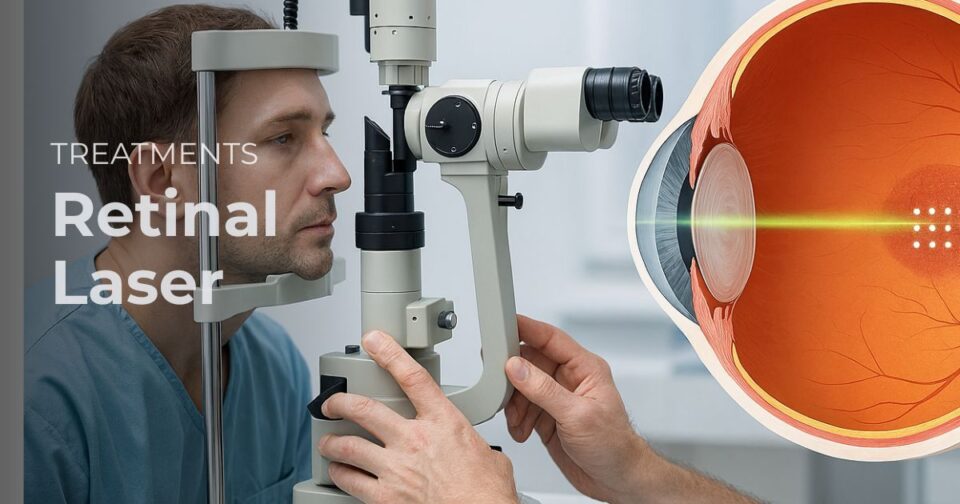
Retinal laser works by creating small, controlled spots in selected parts of the retina. These spots can help seal a tear, reduce leakage, or decrease abnormal blood vessel growth, depending on the condition.
What is retinal laser?
Retinal laser, also called retinal photocoagulation, is a treatment that directs focused light energy onto carefully chosen parts of the retina. The effect depends on where the laser is applied and why it is being used.
In simple terms, retinal laser can do one of several jobs:
- Seal a retinal tear to lower the risk of retinal detachment.
- Reduce abnormal new blood vessels that can grow in advanced diabetic eye disease or some vascular conditions.
- Treat leaking retinal blood vessels in selected cases.
- Support retina surgery when laser is used inside the eye during an operation.
That last point matters. “Retinal laser” is not one single identical treatment. It is a family of retina laser treatments used for different problems.
What conditions can retinal laser treat?
Retinal laser may be used for several retinal problems. Common examples include:
- Retinal tears or retinal holes that may lead to retinal detachment.
- Proliferative diabetic retinopathy, where fragile abnormal blood vessels grow on the retina.
- Selected cases of diabetic macular disease, although injections now often play a major role.
- Some retinal vein occlusion complications, especially when abnormal vessels develop or in selected hard-to-manage cases.
- Certain ischemic retinal conditions where the goal is to reduce the drive for abnormal vessel growth.
Just as important, some retinal conditions are not mainly treated with laser. For example, many patients with macular edema today are treated first with intravitreal injections. Others need vitrectomy surgery rather than office laser. This is why a proper retinal examination matters before treatment is recommended.
Different types of retinal laser
1) Laser retinopexy for a retinal tear
This is used when the retina has a tear or hole but is not yet fully detached, or when a specific area needs sealing. The laser creates a ring of scar tissue around the break so fluid is less likely to pass through it and lift the retina off.
2) Panretinal photocoagulation (PRP)
This is often used for proliferative diabetic retinopathy and some other ischemic retinal conditions with abnormal new vessels. The laser is applied in a scatter pattern over the peripheral retina. The purpose is to reduce the retina’s demand for oxygen and make abnormal vessels less likely to keep growing or bleeding.
3) Focal or grid retinal laser
This may be used in selected cases involving leaking vessels in or near the macula or in some retinal vascular conditions. In modern retina practice, the exact role depends heavily on the disease pattern, OCT findings, and whether injections are likely to work better.
4) Endolaser during retina surgery
This is laser applied inside the eye during an operation such as vitrectomy. Patients usually do not think of this when they hear “office retinal laser,” but it is still retinal laser.
💡 Dr. Roque’s Analogy
Think of the retina like wallpaper lining the inside back wall of the eye. If the wallpaper develops a small tear, laser can help tack the edges down so fluid does not sneak underneath and peel it away. In diabetic eye disease, laser can also act more like damage control—reducing the retina’s stress signals so fragile new vessels are less likely to keep growing and bleeding.
How do I know if I may need retinal laser?
You may be a candidate if your retina specialist or ophthalmologist finds:
- a retinal tear, hole, or weak area that looks high-risk
- abnormal new blood vessels from diabetic eye disease
- retinal bleeding or ischemia that makes neovascularization more likely
- selected leaking vessels that may respond to laser
- a surgical retina problem where endolaser is part of the repair plan
You may not be the right candidate for retinal laser if:
- your main problem is macular edema better treated with injections
- your retina is already detached and needs surgery instead
- media opacity, dense bleeding, or cataract prevents an effective laser view
- the benefit of laser is low but the risk to central or peripheral vision is meaningful
What happens before the procedure?
Most retinal laser treatments are outpatient procedures. You usually do not need to be admitted to the hospital.
Before treatment, we usually:
- review the diagnosis and explain why laser is being recommended
- dilate the pupil
- place numbing drops on the eye
- sometimes use a contact lens on the eye to focus the laser accurately
- explain realistic expectations, including that the goal may be to prevent worsening rather than improve sharpness right away
What happens during retinal laser?
You usually sit at a laser machine, similar to the position used for a detailed eye examination. The eye is numbed with drops. Bright flashes are common. Some patients feel pressure, stinging, or brief sharp sensations, especially with peripheral treatment or heavier PRP.
The procedure time varies. A small tear treatment may be fairly quick. More extensive scatter laser may take longer or may be staged over more than one session.
Is retinal laser painful?
Many patients tolerate it reasonably well, but “painless” is not the right word for everyone. Some feel only light discomfort. Others feel stinging, pressure, or aching, particularly with peripheral retinal treatment. The experience depends on the type of laser, how much retina is treated, and the sensitivity of the individual eye.
Patients do better when they know this in advance. Surprises create fear. Clear counseling reduces fear.
What should I expect after retinal laser?
After treatment, you may notice:
- blurred vision for several hours or sometimes longer
- light sensitivity
- mild aching or discomfort
- glare or afterimages from the bright laser lights
- temporary floaters or mild irritation
Some patients can return to normal light activity quickly, but this depends on the diagnosis and the amount of treatment given. Driving immediately after dilating drops or after a visually disturbing treatment is often not wise.
The most important point is this: laser does not end follow-up. Retinal problems can still progress. New tears can occur. Diabetic eye disease can still worsen. Vein occlusions can still need more treatment. The laser is part of management, not a lifelong guarantee.
🚨 Dr. Roque’s Emergency Warning
If you develop a sudden shower of floaters, flashes of light, a curtain or shadow over your vision, sudden major drop in vision, or significant worsening after retinal laser, do not assume it is “normal healing.” You need prompt reassessment because retinal detachment, new bleeding, or other complications may still occur.
What are the risks of retinal laser?
No honest retina counseling should pretend this is risk-free. The risks depend on which laser is used and where it is applied.
Possible risks and tradeoffs include:
- temporary blur after treatment
- discomfort during or after the procedure
- small blind spots or scotomas
- reduced night vision, especially after extensive PRP
- reduced side vision, especially after broader peripheral treatment
- worsening of central vision in some situations
- incomplete treatment response
- need for repeat laser, injections, or surgery
- bleeding, inflammation, or rare unintended retinal damage
That does not mean retinal laser is a bad treatment. It means the retina specialist has to balance the risk of the disease against the risk of the treatment. In many high-risk situations, not treating is the more dangerous choice.
Will retinal laser improve my vision?
Sometimes yes, but that is not the safest promise to make.
For many patients, retinal laser is done mainly to:
- prevent retinal detachment
- reduce the chance of severe bleeding
- stabilize the eye
- lower the risk of future vision loss
In other words, the best result is often stability, not a dramatic “wow” improvement. If your vision is already affected by macular damage, bleeding, ischemia, or other retinal disease, laser may help protect what remains rather than restore completely normal sight.
Retinal laser versus eye injections
This is one of the most important distinctions for patients.
Laser and intravitreal injections are not enemies. They are tools. Some eyes need one. Some need the other. Some need both.
In general:
- Retinal tears are commonly treated with laser, not anti-VEGF injections.
- Proliferative diabetic retinopathy may be treated with PRP, anti-VEGF injections, or a combination.
- Diabetic macular edema often relies heavily on injections today, though laser still has selected roles.
- Retinal vein occlusion often involves injections, with laser used in selected situations or complications.
The right question is not “Which is better?” The right question is “Which is better for this retina problem in this eye at this stage?”
Retinal laser versus vitrectomy
If the retina is already detached, if there is dense non-clearing vitreous hemorrhage, or if scar tissue is pulling on the retina, laser alone may not be enough. In those cases, vitrectomy surgery may be the more appropriate treatment. Laser can still be part of surgery, but it is no longer the whole plan.
How long does recovery take?
Initial recovery from office retinal laser is often short, but the retina’s response continues over time. Vision may fluctuate for days or sometimes longer depending on the disease being treated.
For a retinal tear, we often wait for the laser scars to mature and secure the retina. For PRP, regression of abnormal vessels is monitored over follow-up visits rather than assumed immediately.
What should I do after retinal laser?
- Follow your doctor’s specific instructions.
- Do not drive until your vision is safe and your dilating drops have worn off.
- Attend follow-up appointments even if you feel fine.
- Seek urgent review if you notice a new curtain, sudden increase in floaters, new flashes, or major worsening of vision.
- If you have diabetes, keep systemic control in mind. Good retinal care is harder when blood sugar, blood pressure, and general medical control are poor.
When should you seek urgent retinal assessment instead of waiting?
You should not casually “observe” the following:
- sudden onset flashes and floaters
- a dark curtain or shadow in the vision
- sudden marked drop in vision
- new bleeding or severe blur after recent retinal treatment
- worsening diabetic eye symptoms with known proliferative disease
Delay can cost vision. Retina problems do not always give second chances.
✅ Dr. Roque’s Take-Home Message
Retinal laser is an important vision-saving tool, but it is not a one-size-fits-all answer. In many cases, its job is to stabilize the retina and prevent worse problems rather than produce instant clearer vision. The safest decision is not to ask whether laser sounds advanced. The safest decision is to ask whether laser is the right treatment for your specific retinal condition, at this specific stage, in this specific eye.
📖 Terminology Glossary
Retina: The light-sensitive tissue lining the back of the eye.
Macula: The center of the retina responsible for detailed central vision.
Photocoagulation: Laser treatment that creates controlled spots on the retina.
Retinopexy: A procedure that seals a retinal tear or hole.
Panretinal photocoagulation (PRP): Scatter laser treatment usually applied to the peripheral retina to control abnormal blood vessel growth.
Neovascularization: Abnormal new blood vessel growth, often fragile and prone to bleeding.
Macular edema: Swelling in the central retina that can blur vision.
Vitrectomy: Surgery that removes the vitreous gel and allows the surgeon to treat retinal problems inside the eye.
Related Reading
Frequently Asked Questions
1) Is retinal laser the same as LASIK?
No. LASIK reshapes the cornea at the front of the eye to reduce dependence on glasses. Retinal laser treats the retina at the back of the eye for retinal disease.
2) Will retinal laser cure my retinal problem?
Sometimes it controls the problem very effectively, but “cure” is too simplistic. Many retinal diseases still need ongoing monitoring, and some need additional treatment later.
3) Can retinal laser stop a retinal detachment?
It can reduce the risk of detachment when used to seal certain retinal tears before a full detachment develops. Once the retina is already detached, surgery may be needed instead.
4) How long does a retinal laser procedure take?
It depends on the reason for treatment. Small tear laser may be relatively quick, while larger scatter treatment can take longer or require more than one session.
5) Is retinal laser done in the operating room?
Many retinal laser treatments are done in the clinic or laser room as outpatient procedures. Some laser is also performed inside the eye during retina surgery.
6) Can I go home right after retinal laser?
Usually yes, but you may be dilated and your vision may be blurred, so arranging someone to accompany you is often wise.
7) Why is my doctor recommending injections instead of laser?
Because some retinal conditions, especially many forms of macular edema, often respond better to intravitreal injections than to laser alone.
8) Can retinal laser make my vision worse?
There are risks. Some patients notice blind spots, worse night vision, or reduced side vision, especially after wider PRP treatment. The treatment decision should weigh those risks against the danger of not treating the disease.
9) Does retinal laser remove floaters?
No. Laser used for retinal tears aims to secure the retina. It does not reliably remove floaters that are already present.
10) If I already had retinal laser before, can I still need more treatment?
Yes. Some eyes need additional laser, injections, or surgery later. Previous treatment lowers certain risks, but it does not eliminate all future retina problems.
References
- American Academy of Ophthalmology. Diabetic Retinopathy Preferred Practice Pattern. 2024. https://www.aao.org/education/preferred-practice-pattern/diabetic-retinopathy-ppp
- American Academy of Ophthalmology. Retinal Vein Occlusions Preferred Practice Pattern. 2024. https://www.aao.org/education/preferred-practice-pattern/retinal-vein-occlusions-ppp
- American Society of Retina Specialists. Retinal Tears – Patients. https://www.asrs.org/patients/retinal-diseases/26/retinal-tears
- American Society of Retina Specialists. Branch Retinal Vein Occlusion – Patients. https://www.asrs.org/patients/retinal-diseases/24/branch-retinal-vein-occlusion
- American Society of Retina Specialists. Central Retinal Vein Occlusion – Patients. https://www.asrs.org/patients/retinal-diseases/22/central-retinal-vein-occlusion
- MedlinePlus. Laser photocoagulation – eye. Updated January 29, 2024. https://medlineplus.gov/ency/article/007664.htm
- NHS Cambridge University Hospitals. Laser treatment for diabetic retinopathy. https://www.cuh.nhs.uk/patient-information/laser-treatment-for-diabetic-retinopathy/
- University Hospitals Birmingham NHS Foundation Trust. Preparing for Retinal Laser Treatment. Review date May 2026. https://www.uhb.nhs.uk/media/opmkgrod/pi-ophthalmology-preparing-for-retinal-laser-treatment.pdf
ROQUE Eye Clinic Patient Education Series
Reviewed by the Roque Advisory Council
Dr. Manolette Roque | Dr. Barbara Roque
St. Luke’s Medical Center Global City | Asian Hospital Medical Center
Philippines
Medical Disclaimer: This page is for patient education only and does not replace an in-person eye examination, retinal imaging, diagnosis, or individualized treatment advice. If you have sudden flashes, a shower of floaters, a curtain over your vision, or sudden vision loss, seek urgent ophthalmic assessment.