
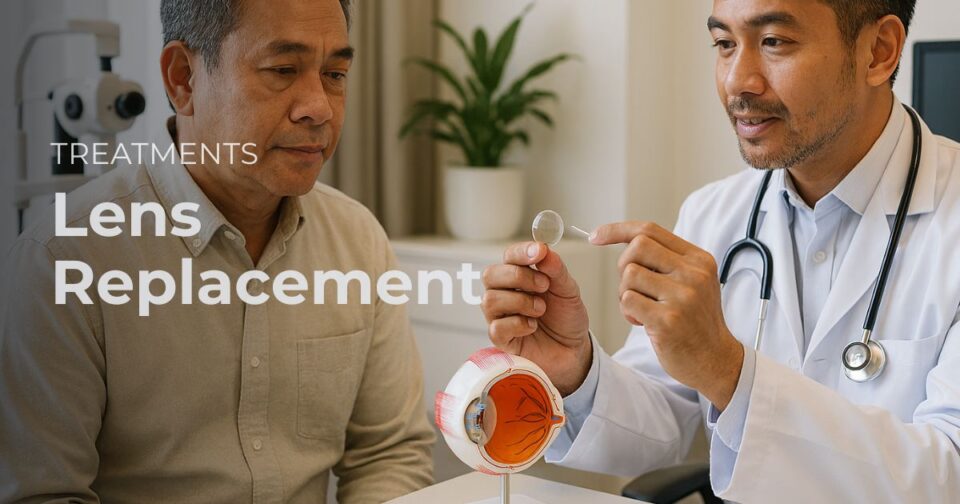
Lens Replacement Surgery: A Clear Patient Guide to Refractive Lens Exchange
🧠 Dr. Roque’s Quick Answer
Lens replacement surgery means removing your eye’s natural lens and replacing it with a clear artificial lens called an intraocular lens or IOL. If your natural lens is already cloudy, this is cataract surgery. If the main goal is to reduce dependence on glasses before a significant cataract develops, it is often called refractive lens exchange. It can correct farsightedness, nearsightedness, astigmatism, and presbyopia, but it is not the best choice for every patient.
Many patients hear the phrase lens replacement and immediately think of cataract surgery. That is partly correct, but not complete. The same basic operation can serve two different purposes.
In one patient, the natural lens has turned cloudy and is blocking vision. In that situation, removing it is cataract surgery. In another patient, the lens may still be relatively clear, but the person is highly dependent on glasses, has presbyopia, and wants a more permanent correction option. In that situation, the same type of surgery may be done as refractive lens exchange.
The mistake is to assume that lens replacement is simply “better LASIK” or that it is automatically the premium answer for everyone over 40. That is lazy thinking. In the right patient, it can be excellent. In the wrong patient, it can create disappointment, unwanted visual symptoms, or unnecessary risk.
🧠 Dr. Roque’s Key Learning Points
- Lens replacement removes your natural lens and replaces it with an artificial intraocular lens.
- If the natural lens is cloudy, the procedure is cataract surgery. If the lens is still relatively clear and the goal is refractive correction, it is usually called refractive lens exchange.
- The procedure can reduce dependence on glasses for distance, intermediate, near, or a combination of these, depending on the chosen lens strategy.
- Monofocal lenses usually give cleaner optics but often still require glasses for some tasks.
- Multifocal and some extended depth of focus lenses can reduce glasses dependence, but may increase glare, halos, or contrast complaints in selected patients.
- Not everyone is a good candidate for premium lens implants. Ocular surface disease, retinal disease, glaucoma, irregular corneas, or unrealistic expectations can be major problems.
- High myopia deserves extra caution because retinal risk matters more in that group.
- Good outcomes depend on good diagnostics, not on marketing words.
- The goal is not to sell a lens. The goal is to match the right lens strategy to the right eye and the right lifestyle.
- When the fit is wrong, patients may still see well on a chart and yet remain unhappy in real life.
🎯 Focus
Explain what lens replacement surgery is, who may benefit, what the tradeoffs are, and how patients should think about lens choices realistically.
🧩 Goal
Help patients understand whether lens replacement is a sensible option, rather than assuming it is automatically better than LASIK, SMILE, ICL, or standard cataract surgery.
🛡️ Evidence-Based
Modern lens replacement is widely performed and generally safe, but lens selection involves real tradeoffs. Better near vision with some premium lenses can come with more halos, glare, and quality-of-vision complaints in some patients.
ROQUE Eye Clinic Refractive Surgery Knowledge Hub
Lens replacement is only one path. Some patients are better served by corneal laser surgery, ICL, standard cataract surgery, or a staged decision process.
👁️ Anatomy Micro-Primer
Your natural lens sits behind the colored part of your eye and behind the pupil. Its job is to help focus light.
When you are younger, this lens changes shape easily, which helps you focus up close. As you age, the lens stiffens. That is one reason presbyopia develops and near vision becomes harder.
If the lens becomes cloudy, it is called a cataract. If the lens is removed and replaced with an artificial one, the eye loses its natural ability to change focus, so the chosen implant strategy matters a great deal.
🧾 Terminology Glossary
- IOL: Intraocular lens, the artificial lens placed inside the eye.
- Presbyopia: Age-related difficulty focusing up close.
- Monofocal lens: A lens implant designed mainly for one focal distance.
- Toric lens: A lens implant that corrects astigmatism.
- Multifocal lens: A lens implant that splits light to help with more than one viewing distance.
- EDOF lens: Extended depth of focus lens, designed to stretch the usable range of focus.
- PCO: Posterior capsule opacification, a common late clouding behind the implant that may later be treated with YAG laser.
- RLE: Refractive lens exchange, lens replacement performed mainly to reduce dependence on glasses rather than to remove a significant cataract.
What is lens replacement surgery?
Lens replacement surgery is an operation in which the eye’s natural lens is removed and replaced with an artificial lens implant. The artificial lens stays inside the eye permanently.
From a surgical standpoint, refractive lens exchange and cataract surgery are very similar. The main difference is why the surgery is being done.
- If the lens is cloudy and reducing vision, the surgery is usually called cataract surgery.
- If the lens is not yet significantly cloudy and the goal is mainly refractive correction, the surgery is usually called refractive lens exchange.
This matters because the patient mindset is different. Cataract surgery solves a disease problem. Refractive lens exchange solves more of a quality-of-vision and glasses-dependence problem. The tolerance for tradeoffs is therefore different.
💡 Dr. Roque’s Analogy
Think of your natural lens like the original lens inside a camera. When it becomes cloudy, the picture gets dull and blurred. When it stiffens with age, the camera no longer shifts focus well for near tasks. Lens replacement removes that old camera lens and installs a new one. The catch is simple: different replacement lenses are designed for different priorities. Some give cleaner contrast. Some reduce glasses use more. Very few give everything perfectly.
Who may be a good candidate?
A good candidate is not simply “someone over 40 who wants freedom from glasses.” That oversimplifies the decision.
Lens replacement may make sense in patients who:
- have a cataract that is already affecting daily life
- have significant presbyopia and want a more permanent solution
- are not ideal candidates for LASIK or SMILE because of age, lens changes, prescription, or corneal factors
- have high hyperopia or mixed refractive problems that may be better addressed inside the eye rather than only on the cornea
- want to reduce future cataract surgery needs because the natural lens is already being replaced now
Lens replacement may be a poor fit or may need extra caution in patients who:
- have untreated dry eye or ocular surface disease that can distort measurements
- have irregular corneas, significant corneal scars, or unstable corneal shape
- have macular degeneration, diabetic macular disease, epiretinal membrane, glaucoma damage, or optic nerve disease that can limit quality of vision
- have unrealistic expectations, especially about night vision or total freedom from glasses
- are young high myopes in whom retinal detachment risk deserves careful discussion
- do fine with glasses and are mainly reacting to marketing rather than actual visual need
The correct question is not “Can this surgery be done?” The correct question is “Will this surgery give this specific patient a durable, satisfying result that matches how they actually live?”
What problems can lens replacement correct?
Depending on the implant strategy, lens replacement can address:
- cataract-related blurred vision
- presbyopia
- farsightedness
- nearsightedness
- astigmatism, if a toric strategy is used
- some combinations of the above
What it cannot do is override biology completely. If the retina, optic nerve, tear film, or cornea is compromised, the sharpness and quality of vision may still be limited.
What are the main lens choices?
This is where many patients get trapped by branding. The lens name matters less than the visual strategy.
1) Monofocal lens
A monofocal lens is usually set mainly for one distance, often far vision. It often provides cleaner image quality with fewer night-vision side effects than multifocal options, but most patients still need glasses for reading and sometimes intermediate tasks.
2) Monovision or mini-monovision strategy
One eye is targeted a little more for distance and the other a little more for near or intermediate work. Some patients adapt beautifully. Others dislike the imbalance. It has to fit the patient’s brain, not just the prescription sheet.
3) Toric lens
A toric lens is used when astigmatism correction matters. If a patient has meaningful astigmatism and it is ignored, the patient may still be disappointed even after technically successful surgery.
4) Multifocal lens
Multifocal lenses can reduce dependence on glasses by distributing light across more than one focal distance. That convenience can come with tradeoffs such as halos, glare, reduced contrast sensitivity, or night-vision complaints in selected patients.
5) Extended depth of focus lens
These aim to provide a broader range of useful vision, often with a different compromise profile than traditional multifocal lenses. Some patients do very well. Others still need glasses for fine print or certain tasks.
The ruthless truth is this: there is no magic lens that gives every patient perfect distance, perfect night vision, perfect near vision, zero glare, and zero need for glasses. Anyone selling that idea is oversimplifying.
How is the surgery done?
Lens replacement is usually done as an outpatient procedure. The eye is numbed, a small opening is made, the natural lens is removed, and the new IOL is placed inside the lens capsule.
Most patients are awake but comfortable. You may see lights, movement, or bright shapes, but you should not feel sharp pain.
The surgery itself is usually quick. The bigger determinants of outcome are often not the minutes in the operating room, but the preoperative measurements, diagnosis, lens selection, ocular surface optimization, and case selection beforehand.
What tests matter before surgery?
Good lens replacement starts with good diagnostics. A rushed workup can sabotage an otherwise elegant surgery.
- refraction
- corneal measurements and astigmatism analysis
- biometry to calculate IOL power
- tear film and ocular surface assessment
- retinal and optic nerve evaluation
- macular assessment when indicated
- screening for glaucoma, corneal disease, or retinal pathology
- realistic lifestyle discussion, including reading habits, driving, computer work, and night vision needs
In practical terms, a patient who says “I just want the best lens” has not yet asked the right question. The right question is: “What lens strategy best fits my eye health, my work, my night driving, my hobbies, and my tolerance for visual compromises?”
🚨 Dr. Roque’s Emergency Warning
Seek urgent ophthalmic care right away if you develop severe eye pain, rapidly worsening vision, marked redness, increasing light sensitivity, a curtain over your vision, many new floaters, or flashing lights after lens replacement surgery.
Do not dismiss these symptoms as “normal healing.” Some are expected after surgery, but some can signal infection, retinal problems, pressure spikes, or other serious complications.
What are the benefits?
- clearer vision if cataract is present
- reduced dependence on glasses in properly selected patients
- correction of astigmatism when a toric plan is used appropriately
- potential improvement in distance, intermediate, and sometimes near function depending on lens strategy
- no future cataract growth in the treated eye, because the natural lens has already been removed
What are the risks and tradeoffs?
Every intraocular surgery has risk. Lens replacement is generally safe in the right setting, but “safe” does not mean trivial.
- infection inside the eye
- bleeding
- inflammation
- residual refractive error
- dry eye symptoms becoming more noticeable
- halos, glare, or waxy vision with some premium lens designs
- posterior capsule opacification later on
- lens rotation or decentration in selected cases
- retinal complications, especially in predisposed eyes
- need for additional procedures or enhancement in some patients
High myopia deserves special respect. These patients may already carry more retinal risk even before surgery. That does not automatically rule out lens replacement, but it does mean counseling must be more disciplined and not casual.
Lens replacement vs LASIK, SMILE, and ICL
Lens replacement vs LASIK or SMILE
LASIK and SMILE reshape the cornea. Lens replacement changes the lens inside the eye. Corneal laser surgery usually leaves the natural lens in place, so presbyopia and future cataract changes still matter later. Lens replacement removes that future cataract issue but is more invasive because it is inside the eye.
Lens replacement vs ICL
ICL adds a lens inside the eye while keeping the natural lens in place. Lens replacement removes the natural lens completely. In younger patients, especially myopes who still have a relatively healthy natural lens, ICL may preserve natural accommodation better than lens replacement. That is why age, lens status, and goals matter so much.
In plain language: if a patient is younger and still has a useful natural lens, removing that lens too early may be a bigger decision than many marketing materials admit.
Related reading: LASIK, SMILE, ICL, LASIK vs SMILE vs ICL
What is recovery like?
Recovery is often smooth, but smooth is not the same as instant perfection.
- Most patients notice visual improvement early, but fine stabilization can take longer.
- Eye drops are usually prescribed to control inflammation and reduce infection risk.
- You may need to avoid rubbing the eye, getting dirty water into the eye, or heavy strain during early recovery, depending on your surgeon’s instructions.
- Night vision, reading performance, and neuroadaptation to a premium lens may take time.
- Some patients still need glasses for certain tasks even after premium lens surgery.
The wrong promise is “You will throw away your glasses forever.” The better promise is this: “We will aim to reduce your dependence on glasses as much as your eyes and lens choice safely allow.”
How do we decide if lens replacement is right for you?
At ROQUE Eye Clinic, the decision should be based on four things:
- Your eye health — not just your glasses prescription.
- Your age and lens status — especially whether presbyopia or early cataract is already changing the equation.
- Your visual priorities — reading, computer use, driving, sports, night driving, or fine print.
- Your tolerance for tradeoffs — especially halos, glare, contrast sensitivity changes, and possible continued need for glasses in some situations.
A patient with perfect expectations does not exist. A patient with informed expectations does. That is the target.
📚 Related Reading
Frequently Asked Questions
1) Is lens replacement the same as cataract surgery?
The surgical steps are very similar. The difference is the reason for surgery. Cataract surgery removes a cloudy lens. Refractive lens exchange removes a lens mainly to reduce dependence on glasses.
2) Can lens replacement fix presbyopia?
It can help address presbyopia, but the result depends heavily on the chosen lens strategy. Some patients still need reading glasses for certain tasks.
3) Will I never need glasses again?
Not necessarily. Many patients reduce their dependence on glasses, but some still need them for fine print, prolonged reading, very dim lighting, or certain detailed tasks.
4) Is lens replacement better than LASIK?
Not automatically. It depends on age, lens status, prescription, corneal health, retinal status, and goals. These procedures solve different problems in different ways.
5) What is the downside of multifocal lenses?
They can reduce glasses dependence, but some patients notice halos, glare, or decreased quality of vision in certain conditions. Patient selection is critical.
6) Is the surgery painful?
Most patients describe it as uncomfortable rather than painful. The eye is numbed, and the procedure is usually brief.
7) Can high myopes have lens replacement?
Sometimes yes, but they need careful retinal evaluation and more disciplined counseling because retinal detachment risk can be more relevant in that group.
8) What if I already have an early cataract?
That may actually strengthen the case for lens-based surgery, because the natural lens is already part of the problem.
9) How long does the artificial lens last?
The implanted lens is designed to stay in the eye permanently. However, the eye itself can still develop other issues over time, such as retinal disease or capsule clouding behind the implant.
10) What is the most important step before surgery?
The preoperative evaluation. Good measurements, good diagnosis, realistic counseling, and correct lens selection are what usually separate a strong result from a disappointing one.
✅ Dr. Roque’s Take-Home Message
Lens replacement surgery can be an excellent option for the right patient, especially when cataract, presbyopia, or complex refractive needs are pushing vision beyond what glasses, contact lenses, or corneal laser surgery can comfortably solve. But it is not a vanity shortcut and not a one-size-fits-all premium upgrade. The right decision depends on your eye health, your age, your lifestyle, and your willingness to accept the tradeoffs that come with each lens strategy.
📖 References
- American Academy of Ophthalmology. IOL Implants: Lens Replacement After Cataracts. Updated October 30, 2024.
- National Eye Institute. Cataract Surgery. Updated December 5, 2024.
- de Silva SR, Evans JR, Kirthi V, et al. Multifocal versus monofocal intraocular lenses after cataract extraction. Cochrane Database Syst Rev. 2016;CD003169.
- ESCRS Recommendations for Cataract Surgery. European Society of Cataract and Refractive Surgeons.
- The Royal College of Ophthalmologists. Refractive Lens Exchange: Patient Information.
ROQUE Eye Clinic Patient Education Series
Reviewed by the Roque Advisory Council
Dr. Manolette Roque | Dr. Barbara Roque
St. Luke’s Medical Center Global City | Asian Hospital Medical Center
Philippines
Medical Disclaimer: This page is for patient education and decision support. It does not replace a complete eye examination, diagnostics, or individualized treatment advice. Treatment decisions should be based on a full consultation, refraction, ocular surface assessment, retinal and optic nerve evaluation, and lens selection counseling tailored to your eye health and lifestyle.