



CATARACT & LENS · PATIENT GUIDE
🧠 Dr. Roque’s Quick Answer
Cataract surgery removes the cloudy natural lens and usually replaces it with a clear artificial lens called an intraocular lens (IOL). In phacoemulsification, the surgeon uses ultrasound through a small incision to break up and remove the cloudy lens. Surgery is worth discussing when cataract interferes with activities such as reading, driving or working, or when another eye condition makes lens removal advisable. Lens choice, recovery and how much your vision can improve depend on your eye health and what you need to see. [1] [2]
🔑 Key Learning Points
- You can have bothersome glare even when you read the eye chart fairly well. Tell your doctor which tasks have become harder.
- New glasses and better lighting may help while symptoms are mild. Surgery is the treatment that removes a cataract.
- Choose your implant around your daily tasks, eye measurements and tolerance for glasses or glare.
- Dry eye, retinal disease, glaucoma and previous laser vision correction can change the plan and what you can expect.
- After surgery, sudden vision loss, worsening pain, increasing redness, new flashes, many new floaters or a curtain in the vision need urgent assessment.
🔬 Anatomy Micro-Primer
- Cornea: The clear window at the front of the eye. Its shape helps determine the implant power.
- Natural lens: Sits behind the iris and focuses light. A cataract is clouding of this lens.
- Lens capsule: The thin bag around the lens. It usually stays in the eye and supports the implant.
- Retina and optic nerve: These receive and carry visual information. Their health helps determine how much vision can improve.
📘 Terminology Glossary
- Phacoemulsification (phaco): Small-incision cataract removal using ultrasound.
- Biometry: Eye measurements used to calculate implant power.
- Astigmatism: Uneven focusing that can cause blur or ghosting. A toric implant can correct suitable regular corneal astigmatism.
- Refractive target: The focus you and your surgeon plan for an eye after surgery.
- Posterior capsule opacification (PCO): Clouding of the thin membrane behind the implant, sometimes months or years after surgery.
🧭 Quick Navigation
When to consider surgery · Assessment · Lens choice · Surgery day · Phaco and laser · Videos · Complex cases · Recovery · Risks · Urgent signs · Cost · FAQs · Book
📖 Related Reading
🚨 After cataract surgery, get help right away
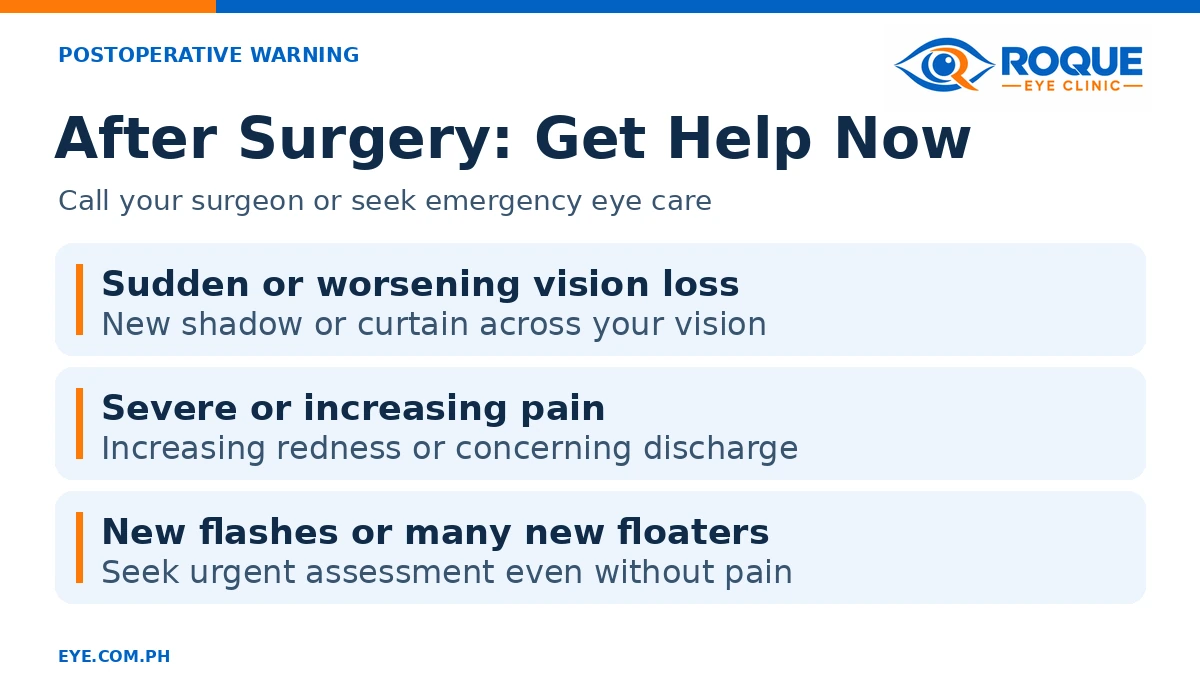
Call your surgeon immediately or go to an emergency department that can arrange urgent eye assessment for sudden or worsening vision loss, severe or increasing pain, increasing redness, concerning discharge, new flashes, a sudden shower of floaters, or a curtain or shadow in your vision. Seek help even if the eye does not hurt. If you cannot reach the clinic promptly, seek emergency care. [2]
When should you consider cataract surgery?
Start with what you can no longer do comfortably. Can you read medicine labels? Do headlights make night driving feel unsafe? Does glare interfere with work? Your surgeon checks how much of that difficulty comes from cataract and how much comes from another condition. The decision takes your day-to-day vision, eye health and preferences into account. A cataract does not have to become “ripe” before you discuss surgery. [1] [3] [5]
If updated glasses, brighter task lighting and glare control give you adequate vision, observation can be reasonable. Ask when to return if you choose to wait. A very dense cataract may make surgery more difficult, so discuss the effects of waiting in your case. An earlier operation may be recommended when the lens contributes to an eye-pressure problem or blocks the examination or treatment of retinal disease. Sudden vision loss or severe eye pain merits urgent assessment.
Planning for both eyes: When both eyes have cataracts, discuss which eye to treat first and the plan between operations. This guide covers adults. A suspected cataract in a child needs prompt pediatric ophthalmology assessment. Your surgeon may use the first eye’s result to help plan the second. Tell the team if a temporary difference in focus would affect driving, work or balance. [3]
Your cataract assessment and preparation
- Confirm the cause of blur. Your doctor checks vision with your best glasses correction and examines the lens, cornea, pressure, optic nerve and retina as appropriate. A retinal scan (OCT) may help when macular disease is suspected or the vision is worse than expected.
- Measure the eye. Biometry measures the length of your eye and the shape of the cornea. Ultrasound measurements may be useful when a dense cataract blocks the optical scan. Your team may repeat measurements after treating dry eye or after a contact-lens break. Topography or tomography can help plan astigmatism correction.
- Share your medical history. Bring your medication list, allergies and any records from previous eye surgery. Mention blood thinners, aspirin, clopidogrel, current or past tamsulosin and medicines for diabetes or weight management. Tamsulosin can affect how the iris behaves during surgery, even if you took it in the past. Blood thinners may need different planning depending on the anesthesia and your medical history. Follow the instructions from your surgeon, anesthesia team and prescribing clinician for any changes. Keep taking your medicines as prescribed unless your care team gives you a specific plan.
- Plan your day. Confirm arrival time, fasting instructions if applicable, transport home and who can help you with drops or follow-up. Tell the team ahead of time if you have trouble lying flat, a persistent cough, anxiety or difficulty hearing instructions.
Bring your glasses and think about how far away you hold your phone, books and computer screen. If one eye has had surgery, bring the implant record if available. [3] [4] [5]
Which cataract lens implant suits you?
Start with your visual priorities. A person who drives at night may value fewer nighttime visual effects. Someone who reads on a desktop all day may prioritize computer distance. Your surgeon will discuss which options suit your measurements and eye health and when you may still need glasses.
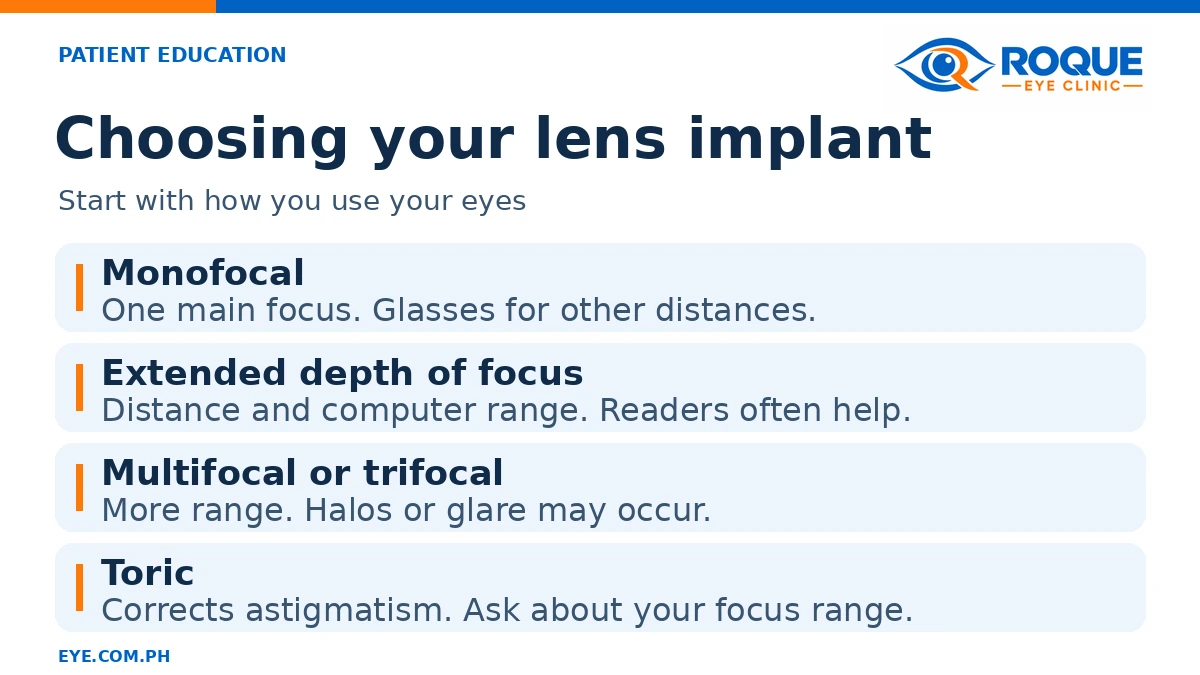
- Monofocal: One main focus. If set for distance, you will usually need reading glasses. A near target can make close work easier and usually means wearing glasses for distance.
- Enhanced monofocal: Some designs extend useful focus modestly toward computer range. Near reading still commonly needs glasses.
- Extended depth of focus (EDOF): A broader range, commonly from distance toward intermediate work. Small print often needs readers. Halos, glare and image quality vary by design and by eye.
- Multifocal or trifocal: Designed to provide more than one range of focus and reduce the need for glasses for more tasks. Halos, glare or reduced contrast can matter, particularly at night. Eye health and realistic expectations guide suitability.
- Toric: A feature that corrects suitable regular corneal astigmatism. It can be combined with different focus designs. The lens must align with the planned axis, and significant rotation may require repositioning.
- Monovision or mini-monovision: The eyes are planned for different distances. Ask how this may affect depth perception, night driving and whether a contact-lens trial is practical.
For suitable eyes, the surgeon may also consider corneal relaxing incisions to reduce astigmatism. Ask how the planned correction compares with a toric implant or glasses for your measurements.
Implant-power calculations are estimates. Residual prescription, healing, implant position or underlying eye disease may affect the result. Ask which tasks are likely to need glasses and what your options would be if the result misses the planned target. [1] [4]
What happens during phacoemulsification?
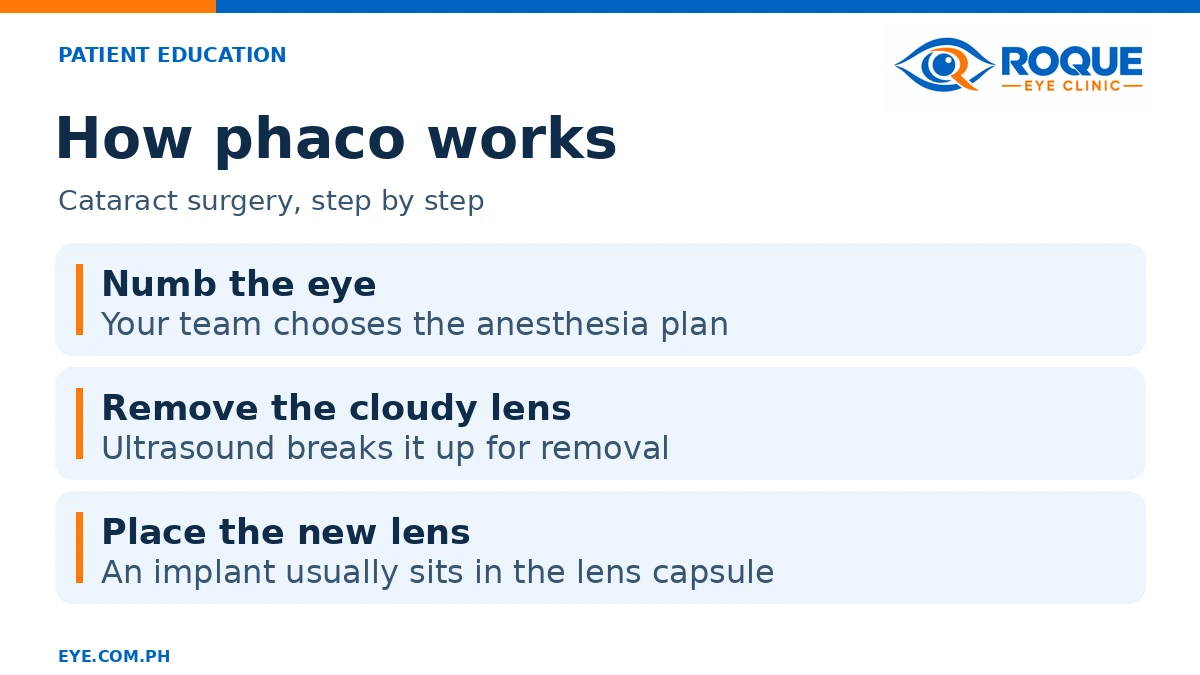
- The team confirms your eye and implant plan. You usually receive local anesthesia, often with numbing drops. Some patients need an injection around the eye, sedation or general anesthesia depending on their needs and the surgical plan. You may notice light, motion or pressure. Tell the team if you feel pain or need to move.
- The surgeon removes the cloudy lens. Through a small incision, the surgeon makes an opening in the front of the lens capsule. An ultrasound probe breaks up the cataract, and the fragments are suctioned out.
- The surgeon inserts the implant. A foldable lens usually opens inside the remaining capsule. If the capsule needs extra support or cannot safely hold the implant, the surgeon may adapt the plan. Small incisions commonly seal on their own. A stitch may be used when needed.
Cataract surgery is commonly an outpatient procedure. Allow time for preparation and recovery and arrange for someone to bring you home. [1] [2] [4]
Standard phaco, laser assistance and other techniques
Standard phaco uses ultrasound to break up the lens. In femtosecond laser-assisted cataract surgery (FLACS), a laser can perform selected steps, such as creating the opening in the lens capsule and softening or fragmenting the lens. The surgeon still removes the fragments and inserts the IOL. Ultrasound may still be used. For routine cases, evidence shows comparable visual outcomes between the approaches. Ask which part of your surgical plan laser assistance would address. [4]
Phaco systems use irrigation and suction to maintain space in the eye. The surgeon adjusts fluid control and ultrasound energy to the cataract and the eye’s anatomy. Model names or lower-pressure settings alone cannot predict your recovery. A particularly dense lens or other findings may make manual small-incision or extracapsular surgery appropriate. If the cataract is very hard or the capsule has weak support, ask whether the team may need to change techniques during surgery. [4] [5]
Cataract surgery videos
Choose a topic to see the animation or patient video. Your surgeon’s instructions guide your preparation and recovery.
Cataract and surgery
What is a cataract? (Captiv8)
Cataract overview (AAO)
Laser-assisted cataract surgery (Captiv8)
Cataract surgery risks (Captiv8)
Lens choices
Intraocular lens options (Captiv8)
Intraocular lens options (AAO)
Cataract surgery with a monofocal implant
Cataract surgery with a toric implant
Cataract surgery with a multifocal implant
Before surgery
Before cataract surgery (Captiv8)
After surgery
After cataract surgery (Captiv8)
When the plan needs extra care
- Diabetes and diabetic retinopathy: Check whether retinal swelling or bleeding is limiting vision. Cataract removal can improve the view of the retina, and the timing of retinal treatment and surgery may need to be coordinated. See the guide to cataract surgery with diabetes.
- Glaucoma or macular degeneration: The cataract may account for only part of the blur. Ask about the likely benefit, the implant choice and any changes needed in monitoring or treatment.
- Dry eye or Fuchs corneal dystrophy: An unstable tear film can alter measurements. A cornea with limited ability to stay clear may need additional testing, a separate procedure or a combined surgical plan.
- Previous LASIK, PRK or other corneal refractive surgery: Bring your old records if possible. Special calculations help estimate implant power, and the result may be less predictable. See cataract surgery after laser vision correction.
- High myopia, trauma, uveitis or a very dense cataract: These may change retinal risk, capsule support, inflammation control or the technique. Discuss whether your eye needs additional assessment, equipment or follow-up.
Each eye can need a different plan, even in the same patient. [3] [4]
Recovery and follow-up
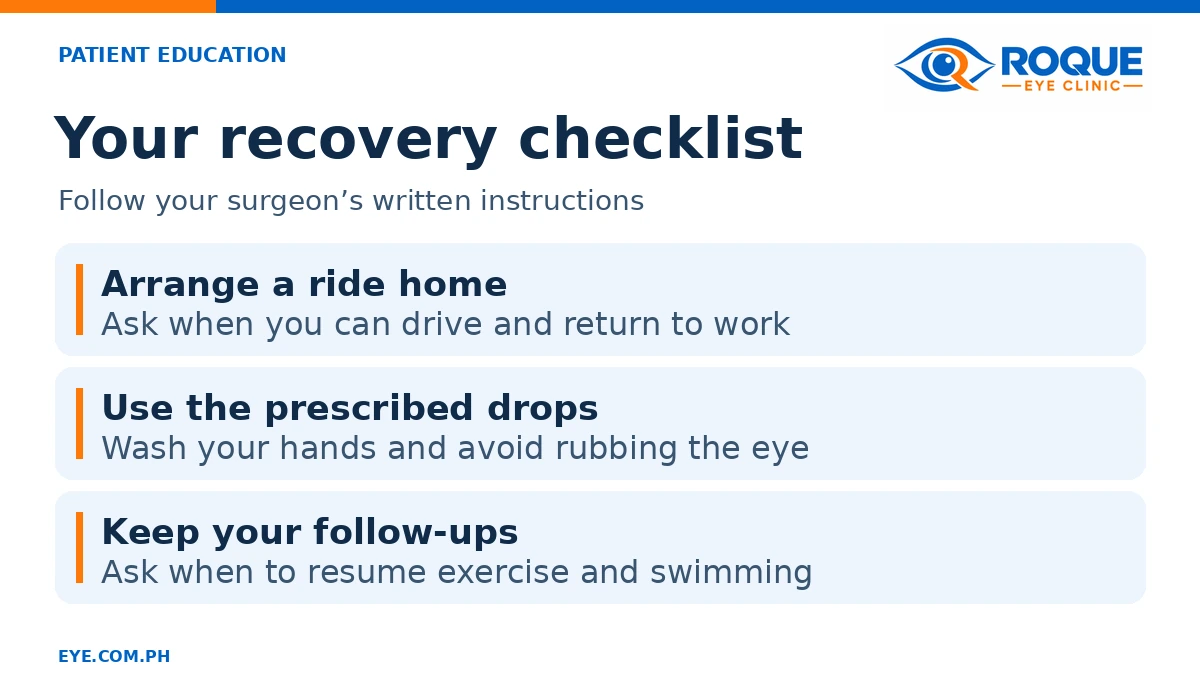
- Surgery day and the first few days: Vision may fluctuate. Mild watering, a scratchy feeling or light sensitivity can occur. Follow the written drop and shield instructions. Use clean hands and avoid rubbing or pressing the eye.
- Over the next several weeks: Keep scheduled visits even when you feel well. Ask when to drive, exercise, lift heavy objects, swim or return to dusty work. Call the clinic if you are unsure how to use your drops or are having difficulty putting them in. Follow your own discharge instructions, since restrictions vary by case.
- Once the eye settles: The team can check whether you need new glasses. Ask when to order glasses if the second eye is scheduled separately. Continue care for diabetes-related eye disease, glaucoma or other ongoing conditions.
Some people notice improvement within days. Full healing can take several weeks or longer in some eyes. Call promptly if your vision gets worse or any warning sign develops. [1] [2]
Risks and what can limit the result
Many people see better after surgery. Possible problems include a tear in the lens capsule, retained lens fragments, corneal swelling, inflammation, pressure changes, swelling in the center of the retina, implant movement, residual blur and troublesome light effects. Infection inside the eye, bleeding and retinal detachment can threaten sight. Some complications need medicine, laser or further surgery. Your surgeon can explain which risks matter most for your eye. [1] [2] [4]
Can a cataract come back? Once the natural lens is removed, the cataract cannot grow back. The capsule behind the implant can cloud later. If your doctor confirms that posterior capsule opacification is causing symptoms, an outpatient YAG laser procedure may help. If your vision changes suddenly, get it checked urgently.
Warning signs after cataract surgery
Seek urgent eye assessment for sudden or worsening vision loss, severe or increasing pain, increasing redness, concerning discharge, flashes, many new floaters, or a curtain or shadow across your vision. Contact your surgeon immediately. If you cannot reach the team, use an emergency department that can arrange urgent eye assessment. [2]
How much does cataract surgery cost in the Philippines?
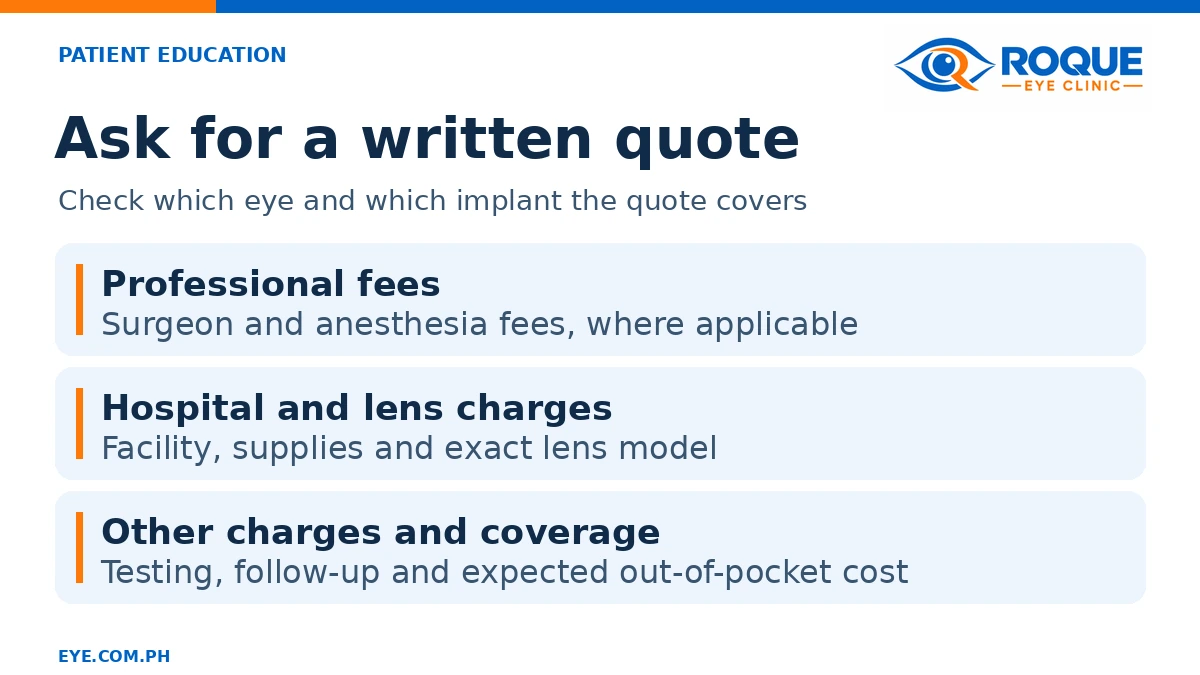
Ask for a written, itemized estimate per eye. Check the surgeon’s fee, hospital and operating-room charges, implant model, tests, supplies, anesthesia, medicines and follow-up. Ask which items are included, which are billed separately and when the estimate expires. Start with the cataract surgery cost guide.
Ask the hospital billing team to confirm your expected PhilHealth benefit, any applicable senior citizen or PWD entitlement, and HMO approval before you rely on an out-of-pocket figure. Eligibility, facility accreditation, procedure, implant and billing rules matter. Tell the clinic if you need a written estimate for your insurer or to plan treatment for both eyes. [6]
💬 Dr. Roque’s Take-Home Message
Decide whether the cataract is getting in the way of your daily life, then discuss which lens and surgical plan fit your eyes. Bring a list of the tasks you want to see more clearly and ask what you can realistically expect with and without glasses.
Frequently asked questions
Can drops or vitamins clear a cataract?
There are no proven drops or supplements that clear an age-related cataract. Glasses and better lighting may help with early symptoms. Surgery removes the cloudy lens. [5]
Is phacoemulsification painful?
The eye is numbed. Some patients notice light, pressure or movement. Tell the team if you feel pain. Your anesthesia plan depends on your medical history, comfort and the procedure.
When can I drive or go back to work?
Arrange a ride home on surgery day. Resume driving when your surgeon clears you and you can drive safely and meet the applicable vision requirements. Return to work depends on your vision, duties and the conditions at work.
Will I still need glasses?
Possibly. A distance-focused monofocal usually leaves a need for reading glasses. Other implants may reduce the need for glasses for more tasks. The result depends on the implant, the accuracy of the planned focus and your eye health.
Can I have cataract surgery after LASIK or PRK?
Yes, when otherwise suitable. Tell your surgeon what procedure you had. Bring previous measurements if you have them so they can be considered alongside current tests and specialized implant calculations.
Can both eyes have surgery on the same day?
Many patients have separate operations. Same-day bilateral surgery may be considered in selected patients where local protocols support it. Ask how the timing affects safety, support at home and lens planning. [3] [4]
Can cataract surgery and refractive lens exchange use the same technique?
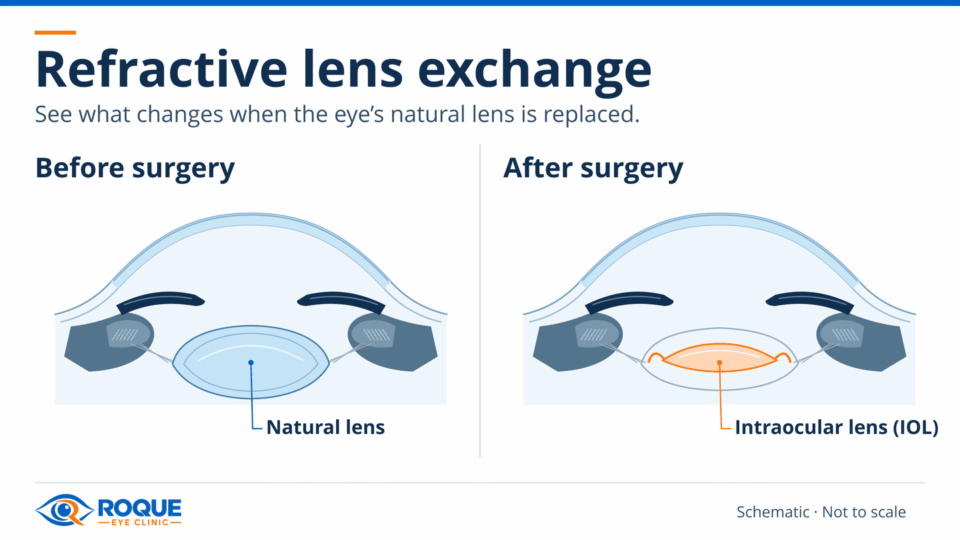
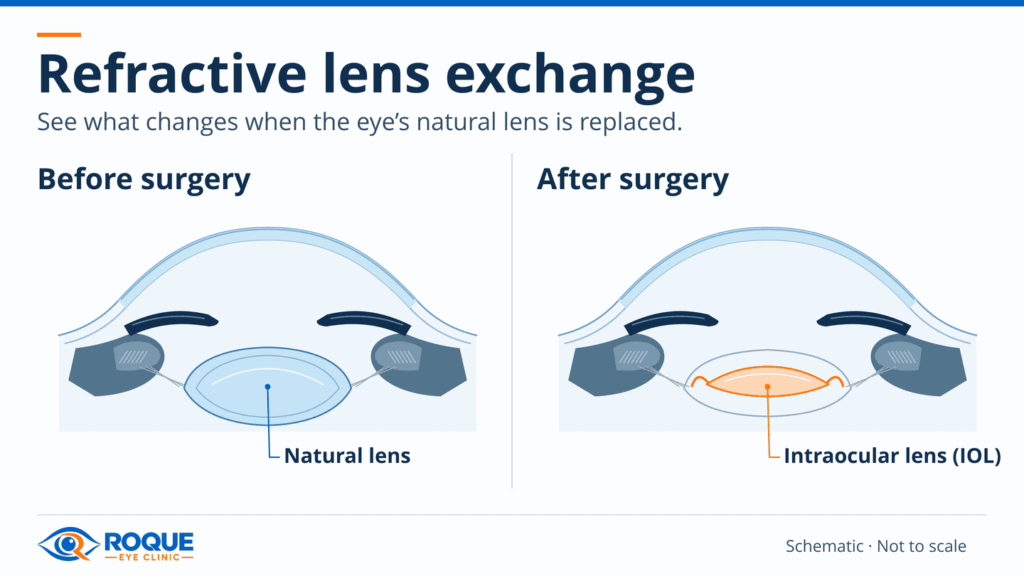
Yes. Both remove the natural lens and insert an implant. Cataract surgery treats a cloudy lens. Refractive lens exchange is primarily planned to change focus in a selected eye with a clear or relatively clear lens. The benefit and risk discussion depends on why you are considering surgery.
What if the surgery was successful but I still see poorly?
There are several possible causes. An examination can check for a remaining glasses prescription, a dry eye surface, implant issues, capsule clouding or retinal disease. If vision suddenly declines, seek urgent care.
Book a cataract consultation
Bring your current glasses, medication list, prior eye records and the tasks you want to see more clearly. An assessment can tell you whether cataract explains your symptoms and help you choose the next step.
ROQUE Eye Clinic sees patients at St. Luke’s Medical Center – Global City, MAB 217 and Asian Hospital and Medical Center, MOB 509.
References
- American Academy of Ophthalmology. Cataract Surgery: Risks, Recovery, Costs.
- National Eye Institute. Cataract Surgery.
- NICE. Cataracts in adults: management (NG77).
- European Society of Cataract and Refractive Surgeons. Recommendations for Cataract Surgery.
- PhilHealth Circular 2025-0010. Quality standards for uncomplicated adult cataract.
- PhilHealth Circular 2025-0001. Cataract extraction with intraocular lens benefit package.
About this guide
Dr. Manolette Roque is an ophthalmologist at ROQUE Eye Clinic whose practice includes cataract and refractive surgery. This patient guide draws on ophthalmology guidelines and Philippine cataract care standards.
Medical review Dr. Manolette Roque, MD, MBA, DPBO, FPAO, FPCS
Medical disclaimer This guide provides general education. Your ophthalmologist’s examination and written instructions guide your individual care. For urgent symptoms after surgery, seek immediate eye assessment.