



Strabismus Surgery
🧠 Dr. Roque’s Quick Answer
Strabismus surgery is an operation on the eye muscles that helps straighten the eyes. It does not mean the eye is taken out. Instead, the surgeon weakens, tightens, repositions, or sometimes adjusts one or more eye muscles to improve alignment. In the right patient, surgery may reduce double vision, improve head posture, help the eyes work together better, and improve appearance and confidence.
Strabismus surgery is one of the most important treatments we use when the eyes are misaligned and glasses, patching, prisms, exercises, observation, or botulinum toxin are not enough. Some patients need surgery because the eyes are obviously crossed or drifting. Others need it because the misalignment causes double vision, abnormal head posture, eye strain, poor binocular function, or social and functional difficulties.
Think of the eye muscles like the guide wires that control the direction of a camera. If one side pulls too strongly, too weakly, or in the wrong balance, the camera points off target. Strabismus surgery changes that muscle balance so the eyes point more accurately together.
🎯 Focus
Explain what strabismus surgery is, who may benefit, how recovery usually goes, and what realistic expectations should look like.
🧩 Goal
Help patients and families decide whether surgical realignment is the next logical step after proper evaluation and non-surgical treatment planning.
🛡️ Evidence-Based
Current guidance supports surgery as an established treatment for selected children and adults with strabismus, while also recognizing that some patients need more than one procedure over time.
👁️ Anatomy Micro-Primer
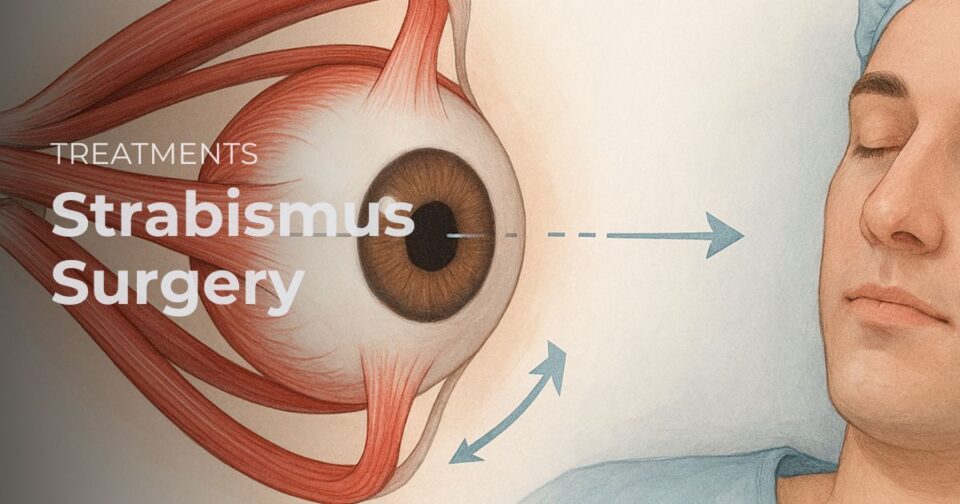
The eyeball is moved by six extraocular muscles. These muscles pull the eye up, down, left, right, and in rotational directions. For the eyes to stay straight, those muscles must work in a balanced way. If the balance is off, one eye may turn inward, outward, upward, or downward. Strabismus surgery works by changing the position or tension of specific muscles on the outside of the eye.
🧩 Terminology Glossary
Strabismus: eye misalignment.
Esotropia: an eye turns inward.
Exotropia: an eye turns outward.
Hypertropia: an eye sits higher than the other eye.
Diplopia: double vision.
Binocular vision: the ability of both eyes to work together.
Adjustable suture: a technique that may allow fine-tuning of alignment after surgery in selected cases.
Recession: moving a muscle back to weaken its pull.
Resection or plication: tightening or strengthening a muscle.
Who may need strabismus surgery?
Not every patient with strabismus needs surgery. First, we make sure the diagnosis is correct and that we are not missing a more serious cause such as a nerve palsy, thyroid eye disease, trauma, restrictive disease, previous surgery issues, or a neurologic problem. In children, we also look carefully for refractive error, amblyopia, and associated pediatric eye conditions. In adults, we pay close attention to the type of double vision, how long the problem has been present, whether the angle is stable, and whether prisms or observation may still help.
You may be a surgical candidate if:
- your eyes remain misaligned despite appropriate glasses or other treatment,
- you have bothersome double vision from eye misalignment,
- you have an abnormal head turn or tilt to keep vision single,
- the eye drift is cosmetically significant and affects quality of life,
- the eyes are not working together as well as they should, or
- the type of strabismus is unlikely to improve adequately without surgery.
What strabismus surgery can do
Done for the right reason, strabismus surgery can provide major benefits. These may include:
- better eye alignment,
- reduced or eliminated double vision in some patients,
- better head posture,
- improved comfort during daily activities,
- better binocular function in selected cases,
- improved appearance, confidence, and quality of life.
What strabismus surgery cannot promise
This is where many patients make the wrong assumption. Surgery is powerful, but it is not magic. It does not guarantee perfect alignment in every gaze position, perfect depth perception, or permanent one-and-done success in every case. Some patients need more than one operation over their lifetime. Others still need glasses, prisms, patching, amblyopia treatment, or continued follow-up after surgery.
That does not mean surgery failed. It means strabismus is a muscle-balance and sensory problem, and some cases are inherently complex.
Strabismus Surgery vs Other Treatments
Many patients want a clear comparison. Therefore, this table shows what each option typically does best.
| Treatment | Best For | Limitations |
|---|---|---|
| Glasses / Refraction Correction | Focusing-related misalignment (selected cases) | May not correct moderate to large deviations |
| Prism Lenses | Selected stable deviations with double vision | Less effective for large or changing angles |
| Amblyopia (Lazy Eye) Treatment | Children with reduced vision in one eye | Improves vision, but does not always straighten eyes alone |
| Strabismus Surgery | Moderate to severe misalignment | Some cases may need repeat surgery over time |
💡 Dr. Roque’s Analogy
Imagine the eyes as two headlights that should point the same way. Strabismus surgery helps aim the headlights more accurately. But if the mounting system is complicated, or if the imbalance changes over time, one adjustment may not be the final adjustment forever.
How the operation is done
Strabismus surgery is performed on the outside of the eyeball, not inside the eye. The surgeon reaches the eye muscles through the thin tissue covering the eye and then changes how strongly one or more muscles pull. Depending on the problem, a muscle may be weakened, strengthened, moved, shortened, folded, or repositioned. Some patients have surgery in one eye. Others need surgery in both eyes.
In selected cases, especially in adults, an adjustable suture technique may be considered. This can allow fine adjustment of alignment after the main surgical step. Not everyone is a candidate for this, and the choice depends on the type of deviation, age, cooperation, and surgical plan.
Children versus adults: the goals are not always identical
In children, the goals often include straighter eyes, better binocular development when possible, improved head posture, and a healthier visual pathway. In adults, the goals often include reducing double vision, restoring comfortable single vision, improving alignment, improving function at work and driving, and improving social confidence.
Another bad assumption to discard: adult strabismus surgery is not merely cosmetic. In many adults, it is reconstructive and functional because misalignment can interfere with reading, work, walking, driving, and social interaction.
Before surgery: what I want sorted out first
Before recommending surgery, I want a careful eye examination and a stable, defensible diagnosis. Depending on the case, this may include:
- visual acuity and refraction,
- ocular alignment measurements at distance and near,
- binocular vision and sensory testing,
- assessment for amblyopia in children,
- cycloplegic refraction when appropriate,
- dilated fundus examination when indicated,
- evaluation for neurologic, restrictive, or thyroid-related causes,
- review of prior surgery, trauma, or imaging if relevant.
A rushed strabismus surgery workup is bad medicine. Operating on the wrong diagnosis, the wrong muscles, or the wrong target angle is how avoidable disappointment happens.
What to expect on the day of surgery
Most strabismus procedures are done as day surgery. Children commonly have general anesthesia. Adults may also have general anesthesia, although anesthesia planning varies by patient and by surgeon. The surgery itself often takes less than an hour, but the full hospital stay is longer because of preparation, anesthesia, and recovery time.
After surgery, the eye is usually red, sore, watery, and mildly swollen. The white of the eye can look quite bloodshot for days to weeks. That appearance can be alarming if nobody warned you, but it is commonly expected.
Recovery after strabismus surgery
Recovery is usually straightforward, but expectations matter. Most patients improve steadily over the first days and weeks. Temporary blur, foreign-body sensation, mild pain, tearing, and redness are common early on. Some adults notice temporary double vision while the brain adjusts. Follow-up is important because early healing does not tell the whole story. Alignment may continue to settle over time.
Your postoperative plan may include:
- antibiotic and/or anti-inflammatory eye drops or ointment,
- pain control instructions,
- activity restrictions for a short period,
- guidance about washing, swimming, school, work, and sports,
- scheduled alignment checks.
🚨 Dr. Roque’s Emergency Warning
After strabismus surgery, do not assume that severe pain is “normal.” Seek urgent medical review if you develop marked pain, rapidly worsening redness or swelling, pus-like discharge, fever, sudden drop in vision, marked nausea with severe eye pain, or unusual protrusion of the eye.
If a child or adult has new strabismus together with droopy eyelid, unequal pupils, severe headache, vomiting, trauma, or neurologic symptoms, that needs urgent assessment even before surgery is being considered.
Risks and limitations
Strabismus surgery is generally safe, but every operation has risk. Possible problems include undercorrection, overcorrection, persistent or new double vision, recurrence over time, scarring, suture or tissue issues, infection, slipped muscle, lost muscle, anesthesia-related problems, and rarely more serious complications. The exact risk profile depends on age, diagnosis, prior surgery, anatomy, and overall health.
The most common disappointment is not a catastrophe. It is this: the eyes improve, but not as perfectly or as permanently as the patient imagined. That is why realistic preoperative counseling matters so much.
Who may need more than one surgery?
Patients with large-angle deviations, paralytic strabismus, restrictive strabismus, thyroid eye disease, longstanding sensory strabismus, trauma, complex vertical deviations, developmental conditions, or prior failed surgery may need staged management or more than one operation. This is not unusual in complex strabismus care.
Practical questions to ask before saying yes
- What exact type of strabismus do I have?
- What is the main goal of surgery in my case: function, double vision relief, head posture, appearance, or several of these?
- What non-surgical options have already been exhausted?
- Will I still need glasses, prisms, or amblyopia treatment after surgery?
- Is adjustable suture relevant in my case?
- What would success realistically look like?
- How likely is repeat surgery in a case like mine?
✅ Dr. Roque’s Take-Home Message
Strabismus surgery is a well-established treatment that can meaningfully improve eye alignment, double vision, head posture, and quality of life in the right patient. The key is not to rush into it blindly. Get the diagnosis right, define the goal clearly, and go into surgery with realistic expectations. Straightening the eyes is often achievable. Perfection in every gaze and every case is not guaranteed.
🧠 Dr. Roque’s Key Learning Points
- Strabismus surgery works on the eye muscles, not inside the eye.
- It may be done for children or adults.
- Adult strabismus surgery is often functional, not merely cosmetic.
- Common goals include straighter eyes, less double vision, and better head posture.
- Not every patient with strabismus needs surgery.
- A careful diagnosis before surgery is essential.
- Some patients still need glasses, prisms, or other treatment afterward.
- Some cases require more than one surgery over time.
- Temporary redness, soreness, and watering are common after surgery.
- Severe pain, worsening vision, or marked swelling after surgery needs urgent review.
Frequently Asked Questions
1. Is strabismus surgery painful?
Most patients have soreness, scratchiness, and redness rather than severe pain. Discomfort is usually manageable with the medicines and drops prescribed after surgery.
2. Is the eye removed during strabismus surgery?
No. The eye is never taken out of the socket. The surgery is performed on the muscles attached to the outside of the eye.
3. Can adults still benefit from strabismus surgery?
Yes. Adults can benefit at many ages, especially if surgery may improve alignment, double vision, comfort, function, or confidence.
4. Will one operation always fix the problem permanently?
No. Many patients do well with one operation, but some need additional treatment or later surgery, especially in more complex cases.
5. Will I still need glasses after surgery?
Possibly, yes. Surgery aligns the eyes, but it does not automatically remove refractive error or the need for all other visual treatment.
6. How long will the eye stay red?
Redness often improves over days to weeks, but it can last longer in some patients. Mild redness early on is common.
7. Is strabismus surgery only for cosmetic reasons?
No. In many patients it is functional. It may reduce double vision, improve head posture, and help the eyes work together better.
8. Can children need patching or glasses even after surgery?
Yes. Surgery is only one part of treatment in some children. Glasses, amblyopia treatment, and follow-up can still be important.
9. What is an adjustable suture?
It is a surgical technique that may allow fine adjustment of the eye muscle position after surgery in selected patients, especially some adults.
10. When should I call urgently after surgery?
Call urgently if there is severe pain, sudden drop in vision, marked swelling, fever, heavy discharge, or rapidly worsening redness.
🔎 Related Reading
References
- American Association for Pediatric Ophthalmology and Strabismus. Strabismus Surgery. Patient resource.
- American Association for Pediatric Ophthalmology and Strabismus. Adult Strabismus (Adult Eye Misalignment). Patient resource.
- American Academy of Ophthalmology. Adult Strabismus Surgery. Clinical statement.
- National Health Service. Surgery: Squint. Patient information.
- Huang YT, et al. Incidence, Risk Factors and Management of Postoperative Complications in Strabismus Surgery. Review article.
ROQUE Eye Clinic Patient Education Series
Reviewed by the Roque Advisory Council
Dr. Manolette Roque | Dr. Barbara Roque
St. Luke’s Medical Center Global City | Asian Hospital Medical Center
Philippines
This page is for patient education and decision support. It does not replace an in-person ophthalmology evaluation. Surgical recommendations depend on the exact type of strabismus, age, sensory status, general health, prior treatment, and examination findings. The safest next step is a proper consultation and alignment workup.