


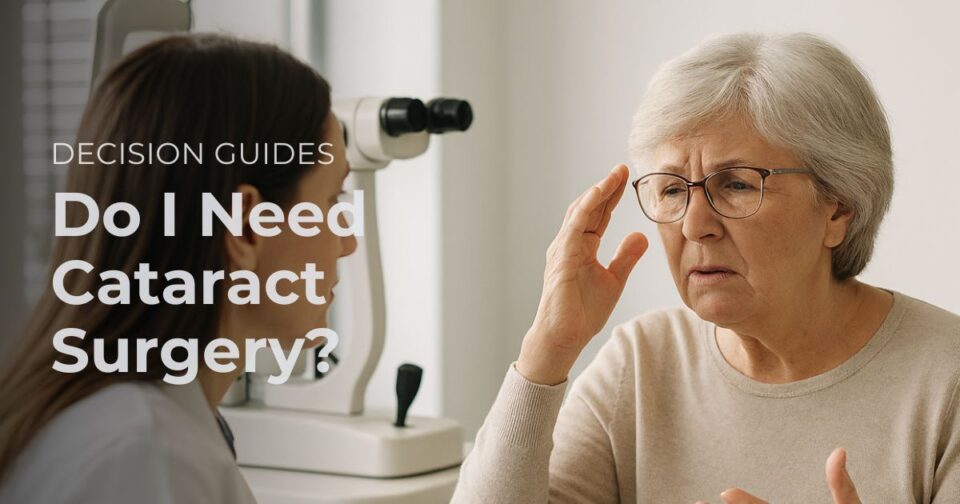
Do I Need Cataract Surgery?
🧠 Dr. Roque’s Quick Answer
You may need cataract surgery when your cataract is no longer just “there” but is already getting in the way of your life. If it is making reading, driving, work, stairs, glare tolerance, independence, or retina monitoring harder, it may be time to seriously consider surgery. The decision should be based on function, safety, and your goals—not on visual acuity alone.
Many patients ask me this too early or too late. Too early, and they are worrying about surgery before the cataract is truly affecting them. Too late, and they have already spent months or years struggling with glare, blurred vision, poor night driving, repeated prescription changes, and reduced independence.
The right question is not simply, “Do I have a cataract?” The better question is, “Is this cataract now affecting my vision, my safety, my daily life, or my ability to monitor and treat other eye problems?”
🎯 Focus
Help you decide whether your cataract is still watchable or already important enough to treat.
🧩 Goal
Clarify function, safety, timing, and the next step instead of relying on guesswork or fear.
🛡️ Evidence-Based
Modern cataract decisions are based on visual function, quality of life, risk, and eye-health needs—not Snellen alone.
How I Usually Explain It to Patients
A cataract is like a dirty windshield or a camera lens that has slowly gone cloudy. At first, you can still manage. You clean your glasses more often. You ask for brighter light. You avoid driving at night. You move text farther away or closer. You adapt.
Surgery becomes worth discussing when you are no longer simply adapting—but already compromising your safety, your work, your comfort, or your quality of life.
When Cataract Surgery Usually Makes Sense
- Your vision is blurry enough that reading, driving, work, cooking, shopping, stairs, or medication handling are becoming difficult.
- Night driving has become stressful because of glare, halos, starbursts, or poor contrast.
- You need brighter and brighter light just to do ordinary tasks.
- Your eyeglass prescription keeps changing, but your vision still feels unsatisfactory.
- You are no longer seeing well enough for the kind of life you want to live.
- The cataract is making it harder for your ophthalmologist to examine or treat the retina, macula, or optic nerve properly.
- The lens is becoming problematic medically, not just optically—for example, causing lens-induced crowding, inflammation, or pressure problems.
- You understand the tradeoffs, your expectations are realistic, and you are ready to proceed.
When It May Be Reasonable to Wait
- Your cataract is present, but it is not yet bothering you in any meaningful way.
- You still function safely and comfortably in daily life.
- Your main complaint is mild blur that still improves well with glasses.
- You are not having significant glare, night vision difficulty, or loss of independence.
- Your eye doctor can still monitor the retina and optic nerve adequately.
- There is no lens-induced pressure, inflammation, or other cataract-related complication.
🚨 Dr. Roque’s Emergency Warning
A routine age-related cataract is usually not an emergency. But do not casually assume all blur is “just cataract.”
Seek urgent eye assessment if vision drops suddenly, the eye becomes red and painful, you have severe headache or nausea with blur, you notice flashes and floaters, or the vision loss seems much worse than what a typical gradual cataract would explain.
What Matters More Than the Eye Chart Alone
Many patients assume there is one magic number on the chart that tells them when surgery is “allowed.” That is overly simplistic.
Two people can have the same visual acuity and very different real-world disability. One person may still function comfortably. Another may be unable to drive at night, read under ordinary lighting, see facial detail clearly, or work safely on a computer. Cataract decisions should match your lived function, not just a clinic number.
A Practical Decision Checklist
You may be leaning toward cataract surgery if you answer “yes” to several of these:
- Do you avoid driving at night because of glare or fear?
- Do you need much brighter light than before to read?
- Are colors looking dull, yellowish, or less vivid?
- Do faces, steps, curbs, or fine print look less clear even with updated glasses?
- Has your independence decreased because of your vision?
- Do you feel your current vision is no longer acceptable for your lifestyle?
- Has your doctor said the cataract is limiting retinal or optic nerve evaluation or treatment?
- Are you more bothered by the cataract now than you were six to twelve months ago?
💡 Dr. Roque’s Analogy
Cataract surgery is not like replacing a tire only after it completely explodes. It is more like replacing a windshield when it has become cloudy enough that driving is no longer safe or comfortable. You do not have to wait for disaster. But you also do not replace it just because a tiny mark exists and causes no real problem.
You May Need Surgery Sooner Than You Think If…
- You have diabetes, macular disease, glaucoma, or another problem that must be monitored carefully, but the cataract is blocking a clear view.
- You are losing confidence in daily mobility, especially stairs, curbs, or uneven lighting.
- You are still “coping,” but only by giving up activities you value.
- You are delaying treatment because of fear, even though the cataract is already clearly affecting function.
- You are waiting for the cataract to become “mature,” which is usually not the goal in modern cataract care.
You May Not Be Ready Yet If…
- You are seeing well enough for your actual needs.
- Your symptoms are mild and not progressing meaningfully.
- Your main problem is dry eye, glasses mismatch, retinal disease, or another issue that surgery will not fix by itself.
- You expect surgery to create “perfect vision” regardless of other eye conditions.
- You have not yet had proper counseling about lens choices, risks, and realistic outcomes.
What Cataract Surgery Can and Cannot Do
It can: remove the cloudy lens, improve clarity, reduce blur from cataract, and often improve glare and functional vision.
It cannot: reverse macular degeneration, diabetic macular edema, optic nerve damage, amblyopia, severe corneal disease, or every cause of poor-quality vision.
Translation: if another eye disease is present, cataract surgery may still help a lot—but the final result depends on the whole eye, not just the cataract.
What Usually Happens Before the Final Decision
- We confirm that cataract is truly the main reason for your symptoms.
- We check whether other problems such as dry eye, retinal disease, glaucoma, or corneal irregularity are also contributing.
- We assess the impact on your life, not just the chart.
- We discuss lens implant options based on your goals and eye findings.
- We review benefits, limitations, and risks in a realistic way.
- We decide whether it is reasonable to proceed now, monitor, or first treat another issue.
👁️ Anatomy Micro-Primer
The natural lens sits behind the iris and helps focus light onto the retina. When this lens becomes cloudy, light no longer passes through cleanly. That is why cataracts can cause blur, glare, faded colors, and poor night vision.
🧾 Terminology Glossary
Cataract: clouding of the eye’s natural lens.
Visual acuity: the sharpness of vision measured on the eye chart.
Glare: discomfort or reduced vision from bright light, especially headlights or sunlight.
Retina: the light-sensitive tissue at the back of the eye.
Lens implant or IOL: the clear artificial lens placed in the eye after the cataract is removed.
🧠 Dr. Roque’s Key Learning Points
- You do not need cataract surgery just because a cataract exists.
- You should consider surgery when the cataract affects function, safety, or quality of life.
- Visual acuity alone should not be the sole basis for deciding.
- Glare, night driving difficulty, and loss of independence matter.
- Cataract surgery may also be needed if the lens prevents proper examination or treatment of another eye problem.
- Modern cataract care usually does not require waiting until the cataract becomes “mature.”
- The best timing depends on symptoms, exam findings, goals, and the rest of the eye.
Related Reading
Frequently Asked Questions
1. Do I need to wait until the cataract is “ripe” or “mature”?
Usually no. In modern practice, we generally prefer timing based on function, safety, and surgical planning rather than waiting unnecessarily.
2. Is poor night driving a valid reason to consider surgery?
Yes. Night glare, halos, and reduced contrast are common real-life reasons to move from observation to treatment.
3. My vision is still “okay” on the chart. Can I still need surgery?
Yes. You may still struggle significantly in daily life even if the chart number looks better than expected.
4. Can cataracts be treated with eye drops or medicine?
No proven medicine removes an age-related cataract. Surgery is the treatment that removes it.
5. Will new glasses solve the problem?
Sometimes temporarily. But if the cataract is the main issue, stronger glasses eventually stop being enough.
6. What if I also have retinal disease or glaucoma?
You may still benefit from surgery, but the expected visual result must be judged in the context of the whole eye.
7. Is cataract surgery always urgent?
No. Most cataracts are elective. But some lens-related situations and some unexplained changes in vision deserve faster assessment.
8. If I can still function, is it okay to monitor?
Yes. Observation is reasonable when the cataract is not yet causing meaningful disability or medical problems.
9. Does surgery guarantee perfect vision?
No. Surgery can remove the cataract, but final vision also depends on the retina, optic nerve, cornea, tear film, and chosen lens implant.
10. What is the best next step if I am unsure?
Have a full cataract consultation and diagnostic workup so the decision is based on evidence, not guesswork.
✅ Dr. Roque’s Take-Home Message
You need cataract surgery when the cataract is no longer just visible to your doctor, but is already meaningful to your life. If it is affecting your safety, independence, comfort, or eye-health management, it is time to seriously discuss surgery. If it is not yet affecting those things, careful monitoring may still be appropriate.
References
- American Academy of Ophthalmology. Cataract in the Adult Eye Preferred Practice Pattern. 2021.
- National Institute for Health and Care Excellence. Cataracts in adults: management. NICE Guideline NG77.
- National Institute for Health and Care Excellence. Referral for cataract surgery. Serious eye disorders Quality Standard QS180.
- National Eye Institute. Cataract Surgery.
- National Eye Institute. Cataract: What You Should Know.
ROQUE Eye Clinic Patient Education Series
Reviewed by the Roque Advisory Council
Dr. Manolette Roque | Dr. Barbara Roque
St. Luke’s Medical Center Global City | Asian Hospital Medical Center
Philippines
Medical Disclaimer: This page is for patient education only. It does not replace a full eye examination, diagnosis, or individualized treatment advice. If your vision drops suddenly, or if you have pain, flashes, floaters, severe glare, or redness, seek prompt eye care.