
LASIK
LASIK is a laser vision correction procedure that reshapes the cornea to reduce dependence on glasses or contact lenses. It can work very well in properly selected patients, but it is not the right treatment for everyone. The real issue is not whether LASIK is popular. The real issue is whether your eyes are suitable for LASIK safely.
🧠 Dr. Roque’s Quick Answer
LASIK can be an excellent option for the right patient, especially if your prescription is stable, your cornea is healthy, your tear film is good enough, and your expectations are realistic. However, LASIK is not automatically the best choice just because you want freedom from glasses. In some patients, SMILE, ICL, or lens replacement may be safer or more appropriate.
🎯 Focus
This page explains what LASIK is, who may qualify, what it can and cannot fix, what the risks are, and what recovery usually looks like.
🧭 Goal
The goal is not to sell LASIK. The goal is to help you decide whether LASIK deserves serious consideration, or whether another refractive option may fit you better.
🛡️ Evidence-Based
Good LASIK outcomes depend heavily on proper screening, realistic counseling, accurate measurements, and disciplined postoperative care.
🧠 Dr. Roque’s Key Learning Points
- LASIK can be excellent, but suitability matters more than enthusiasm.
- A proper screening is a safety tool, not a sales formality.
- Cycloplegic refraction and dilated fundus examination should not be ignored when indicated.
- Dry eye, abnormal corneal shape, and unrealistic expectations are major causes of dissatisfaction or risk.
- LASIK does not fix every visual complaint.
- Presbyopia and lens changes can shift the best treatment option away from LASIK.
- SMILE, ICL, and lens replacement may be better choices in selected patients.
- Postoperative care and follow-up still matter even when surgery seems easy.
LASIK is one part of the broader refractive surgery pathway. For the bigger picture, visit the ROQUE Eye Clinic Refractive Surgery decision pathway.
👁️ Anatomy Micro-Primer
The cornea is the clear front window of the eye. It helps focus light, much like the front lens of a camera. In LASIK, the laser reshapes the cornea so that light focuses more accurately on the retina. If the cornea is too steep, too flat, too thin, irregular, or biomechanically weak, LASIK may become less predictable or less safe.
Think of the cornea like the windshield and front focusing lens of the eye combined. LASIK changes that front surface very precisely. That is why corneal health matters so much.
🧩 Terminology Glossary
- Myopia: Nearsightedness. Distant objects look blurry.
- Hyperopia: Farsightedness. Near work may be difficult, and distance may also blur.
- Astigmatism: Irregular focusing caused by different curvatures of the eye’s optical system.
- Presbyopia: Age-related loss of near focusing ability, usually becoming noticeable in the 40s.
- Flap: The thin corneal layer created during LASIK before laser reshaping.
- Excimer laser: The laser that reshapes the cornea.
- Dry eye: A condition in which the tears are unstable, insufficient, or poor in quality.
- Ectasia: Progressive weakening and bulging of the cornea after surgery. This is uncommon, but serious.
- Cycloplegic refraction: A refraction done after relaxing the eye’s focusing muscle to reveal hidden prescription or focusing spasm.
- Dilated fundus examination: A retinal examination done after pupil dilation to check for retinal tears, holes, degeneration, or other pathology.
What is LASIK?
LASIK stands for laser-assisted in situ keratomileusis. In simple terms, it is a procedure that creates a thin corneal flap, reshapes the tissue underneath with an excimer laser, and then repositions the flap. The aim is to reduce or sometimes eliminate your need for glasses or contact lenses.
LASIK is commonly used to treat myopia, hyperopia, and astigmatism within suitable treatment ranges. However, suitability is not defined by prescription alone. Corneal thickness, corneal shape, tear quality, pupil size, age, lens status, retinal condition, occupation, hobbies, expectations, and tolerance for risk all matter.
The common mistake is to ask, “Can LASIK remove my grade?” The better question is, “Is LASIK the safest and smartest option for my eyes and my goals?”
Who may be a good candidate for LASIK?
- Your prescription has been reasonably stable.
- Your corneal thickness and shape are suitable.
- You do not have suspicious topography or tomography for keratoconus or ectasia risk.
- Your ocular surface is healthy enough, or can be optimized before surgery.
- You have realistic expectations about what LASIK can and cannot do.
- You understand that perfection is not guaranteed.
- You accept that night vision symptoms, dry eye symptoms, or enhancement may still occur.
- You are not better served by another option such as SMILE, ICL, Presbyond, or lens replacement.
💡 Dr. Roque’s Analogy
Imagine your eye is like a camera. LASIK changes the front focusing lens so the image lands more clearly on the sensor. That can work beautifully, but only if the lens material is healthy and strong enough to be reshaped safely. If the lens material is weak or the rest of the camera system has another problem, changing the front lens may not solve the real issue.
Who may not be a good candidate for LASIK?
LASIK is often a poor fit or at least a more cautious discussion in the following situations:
- Corneas that are too thin for the planned treatment.
- Abnormal corneal topography or tomography.
- Keratoconus or forme fruste keratoconus suspicion.
- Significant dry eye disease or unstable tear film.
- Very high refractive errors better suited to other procedures.
- Unstable prescription.
- Unrealistic expectation of “superhuman” vision or guaranteed perfection.
- Presbyopia, if the patient expects excellent unaided near and distance vision without tradeoffs.
- Lens changes or early cataract, especially in older patients.
- Retinal pathology that requires attention first.
- Occupations or sports with significant flap-related trauma concerns.
What should a proper LASIK screening include?
This matters more than many patients realize. A weak screening process creates a weak surgical decision. A proper LASIK work-up should not stop at a quick refraction and corneal scan.
- Detailed refraction, ideally including repeatability and stability review.
- Cycloplegic refraction when indicated, especially in younger patients or when accommodative spasm may hide the true prescription.
- Corneal topography or tomography.
- Pachymetry and residual stromal bed planning.
- Tear film and ocular surface evaluation.
- Pupil assessment.
- Corneal and anterior segment examination.
- Dilated fundus examination to assess the retina properly, especially in myopic eyes.
- Expectation counseling, lifestyle review, and discussion of alternatives.
If a LASIK screening fails to perform cycloplegic refraction when needed, or fails to perform a dilated fundus examination, that is not a small omission. That can change decision quality.
What does LASIK correct well, and what does it not fix?
LASIK can reduce dependence on glasses for distance vision in suitable myopia, hyperopia, and astigmatism. It does not fix every visual problem. If you have dry eye, irregular corneal optics, retinal disease, amblyopia, early cataract, or unrealistic visual expectations, your satisfaction may be limited even if the laser treatment itself is technically accurate.
LASIK also does not stop the normal aging of the eye. If you are entering presbyopia, you may still need reading glasses unless you choose a presbyopia strategy and accept its tradeoffs. In older patients, the bigger issue may no longer be the cornea. It may be the lens.
This is why age alone does not decide treatment, but age absolutely changes the decision frame.
What happens during LASIK?
- Numbing drops are placed in the eye.
- A thin corneal flap is created.
- The flap is gently lifted.
- The excimer laser reshapes the underlying corneal tissue.
- The flap is repositioned.
- The surface is checked for alignment and smoothness.
The actual laser treatment is usually quick. The bigger determinant of long-term satisfaction is not how fast the procedure is. It is whether the case was selected well in the first place.
Benefits patients often hope for
- Less dependence on glasses or contact lenses.
- Convenience for work, sports, travel, and daily life.
- Fast visual recovery in many cases.
- Predictable outcomes in well-selected eyes.
- High satisfaction when expectations are realistic and ocular surface quality is good.
Risks, side effects, and tradeoffs
- Dryness, burning, or fluctuating vision after surgery.
- Glare, halos, starbursts, or reduced quality of night vision.
- Residual refractive error or undercorrection/overcorrection.
- Need for enhancement in selected cases.
- Flap-related complications.
- Inflammation or infection.
- Epithelial ingrowth in uncommon cases.
- Corneal ectasia, which is rare but serious.
- Dissatisfaction because the visual quality does not match preoperative expectations.
The lazy sales pitch says, “LASIK is quick and easy.” That is incomplete. LASIK can be excellent, but it remains real surgery on a real cornea.
How LASIK compares with other refractive options
LASIK is not the only modern refractive solution:
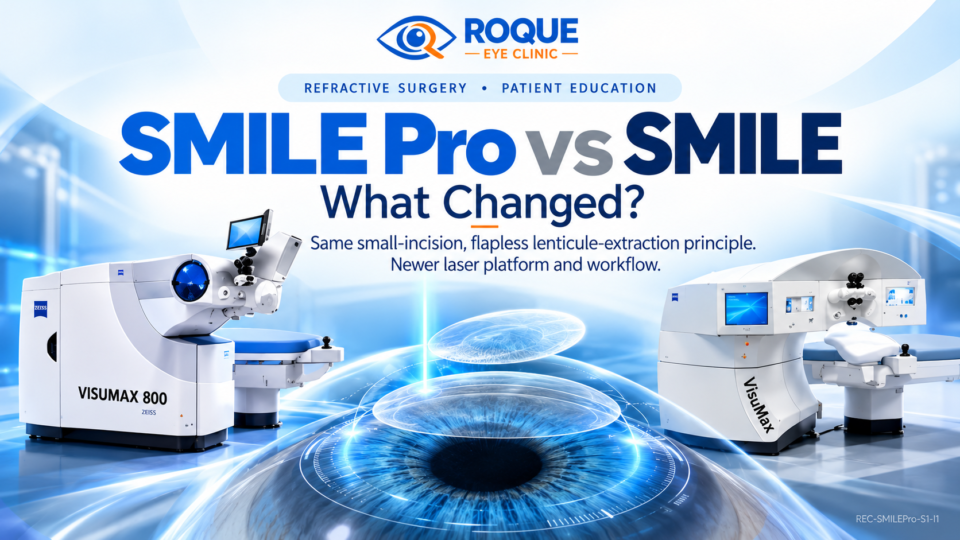
- SMILE may be attractive in some myopic patients, especially when a flapless corneal approach is preferred.
- ICL may be more suitable in higher prescriptions or in eyes where corneal tissue preservation matters.
- Lens replacement may make more sense in older patients, especially if presbyopia or lens dysfunction is becoming the bigger issue.
- Presbyopia strategies may be considered when near vision goals matter, but tradeoffs must be discussed honestly.
The strongest refractive surgeon is not the one who says yes to every LASIK request. It is the one who knows when LASIK is not the best answer.
Recovery after LASIK
Many patients see better quite quickly, sometimes within a day. However, “seeing better” does not mean healing is complete. Vision may still fluctuate during the early recovery period. Mild discomfort, light sensitivity, tearing, grittiness, and dryness are common early on.
Postoperative care often includes:
- Using the prescribed antibiotic and anti-inflammatory drops correctly.
- Using lubricants as instructed.
- Avoiding eye rubbing.
- Protecting the eyes during sleep if instructed.
- Avoiding contaminated water exposure during the early healing period.
- Attending follow-up visits on schedule.
🚨 Dr. Roque’s Emergency Warning
Seek urgent eye evaluation if, after LASIK, you develop severe pain, rapidly worsening vision, marked redness, light sensitivity that is getting worse instead of better, pus-like discharge, obvious flap displacement, or new flashes and floaters. Do not dismiss serious symptoms as “normal healing.”
Delay is how manageable complications become harder problems.
Questions that matter before choosing LASIK
- Is my cornea truly suitable for LASIK, not just technically treatable?
- Is my tear film good enough, or do I need dry eye treatment first?
- Was cycloplegic refraction necessary in my case, and was it done?
- Was a proper dilated fundus examination performed?
- Would SMILE, ICL, Presbyond, or lens replacement fit me better?
- What visual compromises should I realistically expect?
- How likely am I to need enhancement?
- How will age and presbyopia affect my long-term satisfaction?
Related Reading
✅ Dr. Roque’s Take-Home Message
LASIK is a powerful option, but it is not a shortcut around careful thinking. The right question is not whether LASIK is available. The right question is whether LASIK is right for your eyes. Good refractive surgery begins with good judgment.
Frequently Asked Questions About LASIK
1. Is LASIK permanent?
The corneal reshaping is permanent, but your eyes can still change with age. Presbyopia, lens changes, and other eye conditions can still affect your vision later.
2. Can LASIK remove astigmatism?
Yes, LASIK can treat many forms of astigmatism when the measurements are suitable and stable.
3. Is LASIK painful?
The procedure itself is usually not painful because numbing drops are used. Mild discomfort, burning, tearing, or grittiness may happen afterward.
4. How soon can I see after LASIK?
Many patients notice improvement quickly, but the quality of vision may still fluctuate during the early healing phase.
5. Can I still need glasses after LASIK?
Yes. Some patients still need glasses for selected tasks, especially night driving, fine detail work, or near work as presbyopia develops.
6. What is the biggest risk of LASIK?
There is no single “biggest” risk for every patient. Dry eye symptoms, visual quality symptoms, residual refractive error, and rare corneal ectasia are all important considerations.
7. Is LASIK better than SMILE?
Not automatically. Each has strengths, limitations, and best-fit scenarios. The right procedure depends on your anatomy, refractive error, ocular surface, and goals.
8. Am I too old for LASIK?
Age alone does not answer that question. In older patients, the main issue may be presbyopia or lens dysfunction rather than corneal suitability alone.
9. Why does dry eye matter so much before LASIK?
Because dry eye can reduce visual quality, worsen symptoms after surgery, and lower satisfaction even if the refractive correction is accurate.
10. What if LASIK is not the best option for me?
That is not a failure. It is a good screening result. A proper work-up should guide you toward the safest and most suitable option, not force you into one procedure.
References
- American Academy of Ophthalmology. Refractive surgery guidance and patient education resources.
- U.S. Food and Drug Administration. LASIK patient information and risk discussion resources.
- National Eye Institute. Refractive errors and refractive surgery educational materials.
- Peer-reviewed refractive surgery literature on LASIK outcomes, dry eye, ectasia risk, and patient selection.
- Society guidance and major review literature relevant to corneal refractive surgery evaluation and counseling.
ROQUE Eye Clinic Patient Education Series
Reviewed by the Roque Advisory Council
Dr. Manolette Roque | Dr. Barbara Roque
St. Luke’s Medical Center Global City | Asian Hospital Medical Center
Philippines
Medical Disclaimer
This page is for patient education and decision support. It does not replace a full eye examination, refractive surgery work-up, or individualized medical advice. This educational material is intended to help patients understand LASIK and related refractive surgery decisions. It is not a diagnosis, treatment plan, or emergency service. If you have worsening pain, sudden loss of vision, severe redness, new flashes or floaters, or another urgent eye problem, seek prompt professional care.