

Center-Involving DME: What It Means and Why It Matters
🤖 Quick Answer: Center-involving diabetic macular edema (center-involving DME) means swelling from diabetes has reached the center of the macula, the part of the retina used for sharp reading and driving vision. Because this area controls detailed sight, center-involving DME is more likely to blur vision and often needs closer monitoring and treatment.
Not all diabetic macular edema behaves the same way. Some swelling stays away from the center of vision. However, when the swelling reaches the middle of the macula, it becomes more important because that small central area is responsible for reading, recognizing faces, and seeing fine detail.
This article explains what center-involving DME means, how eye doctors diagnose it, what symptoms patients may notice, and why the treatment plan is often more urgent than in milder forms of retinal swelling.
🧩 Focus: Center-involving diabetic macular edema (DME)
👁 Goal: Protect central vision by identifying swelling that reaches the center of the macula
🛡 Evidence-Based: Preferred Practice Patterns • Standards of Care • Systematic Reviews • Meta-Analyses
🧠 Diabetic Eye Disease Knowledge Hub
Start with the complete guide:
Diabetic Eye Disease: The Complete Patient Guide
🔎 Quick Navigation
- What Is Center-Involving DME?
- Why It Matters More Than Mild Swelling
- Common Symptoms
- How Doctors Confirm It
- Treatment Options
- How to Protect Your Vision
Related Reading
- Diabetic Eye Disease: The Complete Patient Guide
- Diabetic Macular Edema Explained
- OCT for Diabetic Macular Edema
- Anti-VEGF for Diabetic Macular Edema
- Why Vision Blurs with Diabetes
📌 Key Learning Points
- Center-involving DME means retinal swelling has reached the center of the macula, the part responsible for sharp central vision.
- It usually matters more than peripheral or non-center-involving swelling because it is more likely to affect reading, driving, face recognition, and fine detail.
- OCT scanning is the main test used to confirm whether the center of the macula is involved.
- Treatment often includes anti-VEGF injections, and in selected patients, doctors may consider steroid treatment or other retina-directed care.
- Controlling blood sugar, blood pressure, and cholesterol remains an important part of protecting vision.
👁 What Is Center-Involving DME?
DME stands for diabetic macular edema. It happens when diabetes damages retinal blood vessels and causes them to leak fluid into the macula. The macula is the central part of the retina that gives you your sharpest, most detailed vision.
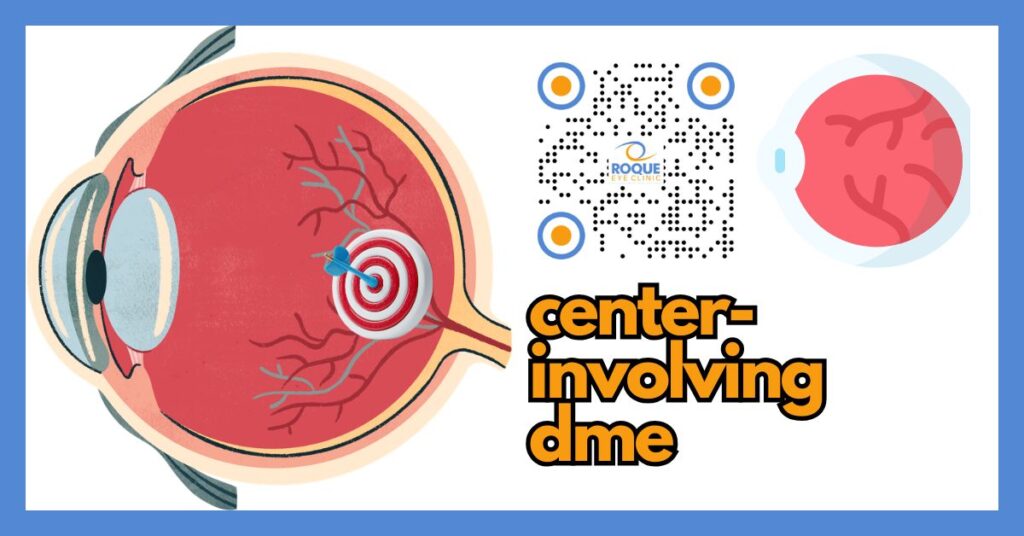
When doctors say the DME is center-involving, they mean the swelling has reached the middle of the macula, often called the foveal center or the center of the central subfield on OCT imaging. This is clinically important because the very center of the macula is the part you depend on for reading text, identifying faces, threading a needle, using a phone, or seeing road signs clearly.
By contrast, some diabetic swelling stays outside that central zone. That swelling can still matter, but it may not affect vision as quickly or as severely as center-involving DME.
Why It Matters More Than Mild Swelling
Center-involving DME matters because it threatens central vision. Central vision is the part you use when looking directly at something. It is different from side vision, which helps you notice movement or navigate your surroundings.
Patients with center-involving DME may struggle with daily tasks such as:
- Reading books, text messages, or medication labels
- Seeing faces clearly across a room
- Driving, especially when reading signs or in low light
- Doing office work or computer tasks
- Judging fine detail for sewing, writing, cooking, or hobbies
Another reason it matters is that swelling in the center often reflects more clinically meaningful leakage. Therefore, the retina specialist usually monitors it more closely, even when the patient still feels “not too bad.”
Importantly, not every eye with center-involving DME needs the exact same treatment. Doctors also look at vision level, how much swelling is present on OCT, how active the leakage appears, whether cataract is also present, whether the patient is already receiving injections, and whether other diabetic retina problems are happening at the same time.
👀 Common Symptoms
Some patients with center-involving DME notice symptoms quickly. Others are surprised to learn it is present during a routine exam. Common symptoms include:
- Blurred central vision
- Distorted vision — straight lines may look bent or wavy
- Difficulty reading, especially fine print
- Faces looking less sharp
- Color or contrast looking less crisp
- One eye seeing worse than the other
Patients sometimes describe it as “smudged,” “foggy,” or “like there is a drop of water in the center.” Because the change can happen gradually, many people do not realize how much they are relying on the better eye until both eyes are tested separately.
Center-involving DME does not usually cause pain. That is one reason some people delay consultation. Painless vision decline can still be serious.
Center-involving DME usually causes gradual blur, not sudden blindness. However, if you develop sudden vision loss, a sudden shower of floaters, flashes of light, or a dark curtain in your vision, seek urgent ophthalmologic evaluation right away. Those symptoms may suggest bleeding, retinal detachment, or another urgent retinal complication.
How Doctors Classify the Severity
Center-involving DME is not usually staged in the same simple way as diabetic retinopathy itself. Instead, doctors look at several practical factors:
| Feature | What doctors assess | Why it matters |
|---|---|---|
| Center involvement | Whether swelling reaches the center of the macula on OCT | Central involvement is more likely to reduce sharp vision |
| Visual acuity | How well the patient sees on testing | Helps guide whether observation or treatment is more appropriate |
| OCT thickness | Amount and pattern of swelling | Shows treatment response and disease activity over time |
| Associated retinopathy | NPDR, PDR, ischemia, hemorrhage, exudates | Coexisting diabetic retinopathy changes affect urgency and overall plan |
So, when a doctor says “center-involving DME,” that is already an important classification. The next question is usually: How much is it affecting vision, and what is the best next step?
🧪 How Doctors Confirm It
The main test used to confirm center-involving DME is optical coherence tomography (OCT). OCT is a painless imaging scan that creates a cross-sectional picture of the retina. It allows doctors to see exactly where the fluid is and whether the center is involved.
A full evaluation may include:
- Dilated retinal examination — to look directly at the retina and macula
- OCT — to measure retinal swelling and determine center involvement
- Visual acuity testing — to see how much central vision is affected
- OCT angiography or fluorescein angiography in selected cases — to study blood flow, leakage, ischemia, or abnormal vessels
OCT matters greatly in this condition because symptoms alone are not enough. A patient may say, “My vision is only slightly blurred,” yet the OCT may already show significant central swelling. On the other hand, another patient with mild OCT thickening may still see very well. That is why treatment decisions are individualized.
If you want to understand the imaging part better, see:
- OCT for Diabetic Macular Edema
- OCT Angiography for Diabetic Retinopathy
- Fluorescein Angiography in Diabetic Retinopathy
💊 Treatment Options
Treatment for center-involving DME depends on whether the swelling is affecting vision, how severe the OCT changes are, and whether other diabetic retina problems are present.
Anti-VEGF injections
Anti-VEGF injections are often a main treatment for vision-threatening center-involving DME. These medicines reduce leakage and help dry the macula. They do not “cure diabetes,” but they can reduce swelling and help preserve or improve vision in many patients.
Common anti-VEGF options discussed in diabetic macular edema include:
Steroid treatment in selected patients
Some patients may be candidates for steroid-based retina treatment, particularly in selected cases such as incomplete response to anti-VEGF, pseudophakia, or situations where inflammation-related pathways are also important. One example is discussed here:
Laser treatment
Laser is still important in diabetic retinopathy, but for center-involving DME, treatment strategy is more nuanced. If the swelling directly involves the center, doctors are usually careful because central retina is visually critical. Laser may still have a role in selected cases, but it is not simply a “one-size-fits-all” answer.
Systemic diabetes control
Retina treatment works best when the body is treated as well. High blood sugar, uncontrolled blood pressure, and poor lipid control can all worsen retinal leakage. Therefore, eye care should work together with diabetes care.
Observation in selected patients
Not every eye with center-involving DME is treated immediately in the exact same way. In some cases, if vision remains good and the OCT findings are mild or stable, the doctor may discuss close observation instead of instant treatment. That is one reason regular follow-up is important. The safest decision depends on the whole picture, not just a single OCT scan.
How to Protect Your Vision
- Keep your diabetes follow-up appointments even when vision feels “good enough”
- Do not skip dilated retinal examinations and OCT when recommended
- Work on long-term blood sugar control, not just short-term numbers before clinic visits
- Control blood pressure and cholesterol with your physician’s guidance
- Report new blur, distortion, or one-eye vision change early
- Follow the treatment schedule if injections or retina follow-up are advised
In practical terms, prevention means not waiting until central vision drops badly. Center-involving DME is often much easier to manage when it is tracked early.
Continue Reading
- Diabetic Macular Edema Explained
- OCT for Diabetic Macular Edema
- What Happens During an Anti-VEGF Injection
- Anti-VEGF Treatment Schedule
- Diabetic Eye Treatment in the Philippines
🏁 Take-Home Message
Center-involving DME means diabetic swelling has reached the center of the macula, the part responsible for sharp central vision. Because that area is visually critical, this finding deserves careful attention and often closer follow-up or treatment.
If you have diabetes and your vision becomes blurrier, more distorted, or harder to read with, do not wait. A retina evaluation and OCT scan can show whether the center of the macula is involved.
❓ Frequently Asked Questions
What does “center-involving” mean in DME?
It means diabetic swelling has reached the center of the macula, the most important area for sharp central vision.
Is center-involving DME more serious than mild swelling away from the center?
It is often more important clinically because it is more likely to reduce reading and driving vision.
How do doctors know if the center is involved?
OCT imaging is the main test used to show whether the swelling reaches the center of the macula.
Does center-involving DME always need injections?
Not every case is managed identically, but anti-VEGF injections are often a key treatment when center-involving DME is affecting vision or threatening central sight.
Can center-involving DME improve?
Yes. Many eyes improve or stabilize with timely treatment and better systemic diabetes control, although the response varies from patient to patient.
Does center-involving DME cause pain?
No. It usually causes blur or distortion, not eye pain.
📚 References
- American Academy of Ophthalmology Preferred Practice Pattern: Diabetic Retinopathy
- American Diabetes Association Standards of Care
- National Eye Institute: Diabetic Retinopathy and Macular Edema Resources
- DRCR Retina Network clinical trials on diabetic macular edema
- Peer-reviewed retina literature on anti-VEGF therapy in center-involved diabetic macular edema
🤝 Roque Eye Clinic Patient Education Series
Reviewed by the Roque Advisory Council
Dr Manolette Roque | Dr Barbara Roque
St Luke’s Medical Center Global City | Asian Hospital Medical Center
Philippines
Medical Review: Roque Advisory Council
Last Updated: March 2026
This article is intended for educational purposes only and does not replace professional medical consultation.
BOOK AN APPOINTMENT
It takes less than 5 minutes to complete your online booking. Alternatively, you may call our BGC Clinic, or our Alabang Clinic for assistance.