


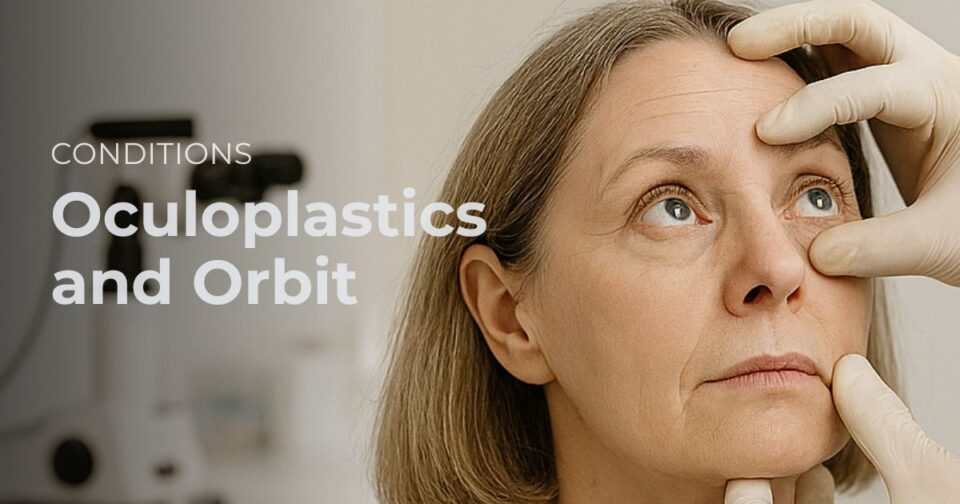
Oculoplastics and Orbit: Eyelid, Tear Duct, Eye Socket, and Facial Eye Problems Explained
🧠 Dr. Roque’s Quick Answer
Oculoplastics and orbit is the part of ophthalmology that deals with the eyelids, tear drainage system, eye socket, and the tissues around the eye. It includes common concerns such as drooping eyelids, eyelid lumps, tearing, thyroid eye disease, eyelid turning in or out, orbital infections, fractures, and tumors. Some problems are mainly cosmetic, but others can threaten vision, eye movement, or even life if treatment is delayed.
Many patients hear the word oculoplastics and think it refers only to cosmetic eyelid surgery. That is too narrow. In real practice, this field covers both appearance and function. In other words, it treats problems that affect how the eyelids look, how they protect the eye, how tears drain, how the eye moves, and how much space the eye has inside the socket.
This page gives a patient-friendly overview of the conditions usually handled by an oculoplastics and orbit specialist. It is not meant to replace a full examination. Instead, it helps you understand what kinds of problems belong in this area and when you should seek help urgently.
🎯 Focus
Eyelids, tear drainage, orbit, and the tissues around the eye.
🧩 Goal
Help patients recognize common eyelid and orbital problems, warning signs, and next steps.
🛡️ Evidence-Based
This overview follows mainstream ophthalmic principles and uses cautious patient counseling language.
ROQUE Eye Clinic OCULOFACIAL PLASTIC AND ORBITAL SURGERY Knowledge Hub
This page is an overview. It helps patients understand the major eyelid, tear duct, and orbital problems usually handled in oculoplastics and orbit.
👁️ Anatomy Micro-Primer
The eyelids protect the front of the eye and help spread tears when you blink. The tear drainage system carries tears from the inner corner of the eyelids into the nose. The orbit is the bony eye socket that contains the eyeball, muscles, nerves, blood vessels, and fat around the eye. If any of these structures become inflamed, infected, injured, blocked, or crowded, patients may develop swelling, tearing, pain, bulging, double vision, or vision loss.
🧾 Terminology Glossary
- Ptosis — drooping of the upper eyelid.
- Entropion — eyelid turns inward, so lashes rub the eye.
- Ectropion — eyelid turns outward, exposing the inner lid surface.
- Epiphora — overflowing tears or watery eyes.
- Dacryocystitis — infection of the tear sac.
- Proptosis — forward bulging of the eye.
- Orbit — the eye socket and its contents.
- Thyroid eye disease — inflammation and swelling in the tissues around the eye related to thyroid autoimmunity.
What does oculoplastics and orbit include?
This field usually includes four big groups of problems:
- Eyelid problems — droopy lids, excess eyelid skin, in-turning or out-turning lids, eyelid lumps, lid scars, lid trauma, and tumors.
- Tear drainage problems — watery eyes, blocked tear ducts, infected tear sacs, and poor tear drainage.
- Orbital problems — thyroid eye disease, orbital cellulitis, fractures, inflammation, bleeding, cysts, and tumors.
- Periocular facial issues — concerns around the brows, canthus, and tissues surrounding the eyelids that affect eye comfort, function, protection, or symmetry.
Common eyelid conditions patients ask about
Drooping eyelids
A droopy eyelid can make a person look sleepy, but the bigger issue is function. If the lid blocks the visual axis, it can reduce the superior field of vision and make reading, driving, or climbing stairs more difficult. Some cases are age-related. Others are caused by nerve problems, prior surgery, trauma, muscle disease, or congenital lid weakness.
Eyelid turning in or out
When the eyelid turns inward, lashes may scrape the cornea and cause irritation, tearing, redness, or even ulceration. When the eyelid turns outward, the eye may become dry, exposed, and chronically irritated because tears no longer spread or drain properly. Patients often assume these are minor age-related changes. That assumption is dangerous when the cornea is already suffering.
Eyelid lumps and bumps
Some eyelid lumps are common and harmless, such as a chalazion. Others may represent infections, cysts, or skin cancers. A persistent lump, recurrent lesion in the same spot, lash loss, bleeding, crusting, ulceration, or distortion of the lid margin deserves proper evaluation. The mistake many patients make is treating every lid lump as “just a stye.” That is not safe.
Excess eyelid skin
Some people develop heavy upper lids because of extra skin and soft tissue. In mild cases, this is mostly cosmetic. In other patients, it becomes functional and interferes with the visual field. The critical distinction is whether the problem is mainly appearance, mainly lid droop, or a combination of both. Those are not the same operation.
💡 Dr. Roque’s Analogy
Think of the eyelids and tear drainage system like the windshield wipers and drainage channels of a car. The eyelids must close, blink, and protect properly. The tears must spread smoothly, then drain away. If the wipers are bent, the edge is rubbing, or the drainage is blocked, the “windshield” of the eye becomes blurry, irritated, or flooded.
Common tear duct and tearing problems
Watery eyes do not always mean you are producing too many tears. Sometimes the eye is dry and irritated, so it reflexively overproduces tears. In other cases, the drainage system is partly or completely blocked. That distinction matters because the treatment is completely different.
Blocked tear ducts
Patients may complain of constant tearing, sticky discharge, recurrent infection, or swelling near the inner corner of the eyelids. Adults can develop tear duct blockage over time. Babies may also have congenital blockage. Some cases improve with conservative care, while others need a procedure to create or restore drainage.
Infected tear sac
An infected tear sac can cause redness, pain, swelling, pus, and fever. This is more than a nuisance. Delay can allow infection to spread. Recurrent episodes often mean the drainage system has a structural blockage that needs definitive treatment, not repeated temporary treatment alone.
Common orbital conditions patients should know
Thyroid eye disease
This condition can cause bulging eyes, pressure, lid retraction, dryness, redness, double vision, and, in severe cases, optic nerve compression. The key error is assuming all “bulging eyes” are cosmetic. Some cases are sight-threatening. Patients may need lubrication, smoking cessation, medical treatment, imaging, or orbital surgery depending on severity and activity.
Orbital cellulitis
This is a serious infection behind the orbital septum. Patients may develop fever, painful eye movements, swelling, redness, double vision, reduced eye movement, and sometimes decreased vision. This is an emergency. It is different from a more superficial eyelid infection. Confusing the two can delay lifesaving treatment.
Orbital fractures
After facial trauma, the bones of the orbit can break. Some patients develop double vision, numbness of the cheek, sunken eye position, swelling, bruising, or movement restriction. Not every fracture needs surgery, but some do. The trap is assuming the swelling alone tells the full story. Careful examination and imaging usually guide management.
Orbital tumors and masses
The orbit can develop cysts, benign tumors, inflammatory masses, vascular lesions, or malignant tumors. Symptoms vary. Patients may notice bulging, lid swelling, pain, asymmetry, double vision, reduced eye movement, or gradual vision changes. Some lesions are slow and quiet. That does not automatically make them harmless.
Orbital inflammation
Inflammatory orbital disease can mimic infection or tumor. Patients may develop pain, swelling, redness, bulging, or double vision. Because the differential diagnosis is wide, this is not an area for casual guessing. Imaging and examination matter.
🚨 Dr. Roque’s Emergency Warning
Seek urgent eye care or emergency care now if you have any of the following:
- sudden bulging of one eye
- painful eye movement
- fever with severe eyelid or orbital swelling
- double vision after trauma
- loss of vision or dimming of vision
- an eyelid wound after injury
- a rapidly growing eyelid mass
- a swollen, red, tender area near the inner corner of the eye with discharge
How are oculoplastic and orbital problems evaluated?
The evaluation depends on the complaint. It may include:
- careful eyelid and ocular examination
- measurement of lid position and blink function
- tear drainage testing
- visual acuity and pupil assessment
- eye movement testing
- visual field testing in selected patients
- photographs for documentation
- orbital imaging such as CT or MRI when indicated
- biopsy for suspicious masses or tumors
The ruthless point: do not jump straight from symptom to surgery. First define the problem correctly. A watery eye may be dryness, drainage obstruction, eyelid malposition, inflammation, or a combination. A droopy lid may be skin excess, ptosis, brow descent, nerve disease, or all four together.
How are these conditions treated?
Medical treatment
Some problems respond to lubricants, antibiotics, anti-inflammatory treatment, thyroid-related management, wound care, or observation. This is common in early or milder cases, but it is not universal.
Office-based procedures
Certain lesions can be treated in the clinic. Examples include selected lid procedures, biopsy, drainage of specific lesions, or botulinum toxin use in appropriate cases.
Surgery
Surgery may be needed for ptosis, entropion, ectropion, eyelid tumors, reconstruction, tear duct blockage, orbital decompression, orbital fracture repair, mass biopsy, or tumor removal. The exact approach depends on the diagnosis, not on the patient’s guess about the diagnosis.
When is it cosmetic and when is it medical?
This is where patients often oversimplify. The same eyelid can have both cosmetic and functional issues. For example, an upper lid may look heavy, but the patient may also have true ptosis, brow descent, lash malposition, dry eye, or a blocked superior field. Treating the wrong layer gives the wrong result. Good oculoplastic planning separates appearance from function, then solves the right problem.
Who should consider consultation?
- patients with drooping lids that interfere with vision
- patients with persistent tearing or recurrent tear sac infection
- patients with eyelids that rub the eye or turn away from it
- patients with eyelid lumps that do not resolve or keep recurring
- patients with bulging eyes, thyroid eye disease, or asymmetry
- patients with orbital swelling, pain, double vision, or post-traumatic deformity
- patients needing reconstruction after tumor removal or trauma
🧠 Dr. Roque’s Key Learning Points
- Oculoplastics and orbit is not just cosmetic eyelid surgery.
- It covers eyelids, tear drainage, orbit, and surrounding tissues.
- Watery eyes may come from dryness, poor drainage, or eyelid malposition.
- A persistent eyelid lump should not automatically be dismissed as a stye.
- Bulging eyes, painful eye movement, or fever with orbital swelling can be serious.
- Thyroid eye disease can affect comfort, appearance, eye movement, and vision.
- Trauma around the eye can involve hidden fractures, tear drainage injury, or deeper orbital damage.
- The right treatment depends on the correct diagnosis, not symptom labels alone.
📚 Related Reading
Frequently Asked Questions
1. What is the difference between oculoplastics and general ophthalmology?
General ophthalmology covers the whole eye. Oculoplastics and orbit focuses on the eyelids, tear drainage system, orbit, and tissues around the eye.
2. Is oculoplastics only for cosmetic surgery?
No. Many cases are functional or medically important, including lid malposition, blocked tear ducts, thyroid eye disease, trauma, infection, and tumors.
3. Why do my eyes water all the time?
Common reasons include dry eye, poor tear drainage, eyelid malposition, inflammation, and irritation of the ocular surface.
4. When is a droopy eyelid a medical problem?
It becomes a medical problem when it blocks vision, causes eye strain, affects symmetry significantly, or suggests an underlying nerve or muscle issue.
5. Should I worry about a recurrent “stye”?
Yes, especially if it keeps returning in the same spot, bleeds, distorts the lid margin, causes lash loss, or does not improve as expected.
6. What symptoms suggest thyroid eye disease?
Bulging eyes, lid retraction, dryness, pressure, redness, double vision, and changes in appearance are common warning signs.
7. Can orbital problems affect vision?
Yes. Severe inflammation, infection, bleeding, tumors, or thyroid eye disease can affect the optic nerve, eye position, or eye movement and may threaten vision.
8. Do all tear duct blockages need surgery?
No. Some cases can be observed or treated conservatively, but persistent blockage or recurrent infection often needs a procedure.
9. What happens if an eyelid turns inward?
The lashes may rub the cornea, causing pain, tearing, redness, and potentially corneal damage.
10. When should I seek emergency help?
Go urgently if you have painful eye movement, fever with severe swelling, sudden bulging, double vision after injury, or any decrease in vision.
✅ Dr. Roque’s Take-Home Message
Oculoplastics and orbit is the field that protects the structures around the eye that many patients ignore until something becomes obvious. Do not trivialize persistent tearing, a droopy lid, a recurring eyelid lump, bulging eyes, or swelling after trauma. Some problems are straightforward. Others are vision-threatening or demand urgent treatment. The win comes from correct diagnosis first, not fast assumptions.
📖 References
- American Academy of Ophthalmology. Oculoplastics/Orbit. American Academy of Ophthalmology website.
- American Academy of Ophthalmology. Basic Ophthalmology Lectures: Eyelid, Orbital, and Lacrimal Disease. American Academy of Ophthalmology website.
- National Eye Institute. Graves’ Eye Disease. National Institutes of Health website.
- EyeWiki. Imaging in Orbit and Oculoplasty. American Academy of Ophthalmology EyeWiki.
- EyeWiki. Eyelid Laceration. American Academy of Ophthalmology EyeWiki.
ROQUE Eye Clinic Patient Education Series
Reviewed by the Roque Advisory Council
Dr. Manolette Roque | Dr. Barbara Roque
St. Luke’s Medical Center Global City | Asian Hospital Medical Center
Philippines
Medical Disclaimer: This page is for patient education only. It does not replace an in-person consultation, examination, diagnosis, or treatment plan. If you have pain, sudden swelling, double vision, trauma, fever, or vision loss, seek urgent medical care.