

Strabismus: A Clear Patient Guide to Misaligned Eyes
Strabismus means the eyes are not pointing in the same direction. One eye may turn inward, outward, upward, or downward. In some people it is mild and occasional. In others it is constant and obvious. The important point is this: strabismus is not just a cosmetic issue. It can affect visual development, depth perception, comfort, confidence, and sometimes signal a deeper medical problem.
🧠 Dr. Roque’s Quick Answer
Strabismus is eye misalignment. It can happen in children or adults. Some cases are related to focusing problems and can improve with glasses. Other cases need patching, prisms, vision therapy for selected situations, botulinum injection in selected cases, or eye muscle surgery. Sudden new strabismus, especially with double vision, drooping eyelid, headache, weakness, or other neurologic symptoms, needs urgent medical evaluation.
🎯 Focus
Explain what strabismus is, why it matters, and what patients and parents should do next.
🧩 Goal
Help readers recognize common patterns, understand treatment options, and avoid dangerous delay.
🛡️ Evidence-Based
This article follows current guidance from major ophthalmology sources and keeps the language patient-friendly.
ROQUE Eye Clinic Strabismus Surgery Knowledge Hub
This page is an overview. It helps patients understand the condition first, then move to the most useful next page.
👁️ Anatomy Micro-Primer
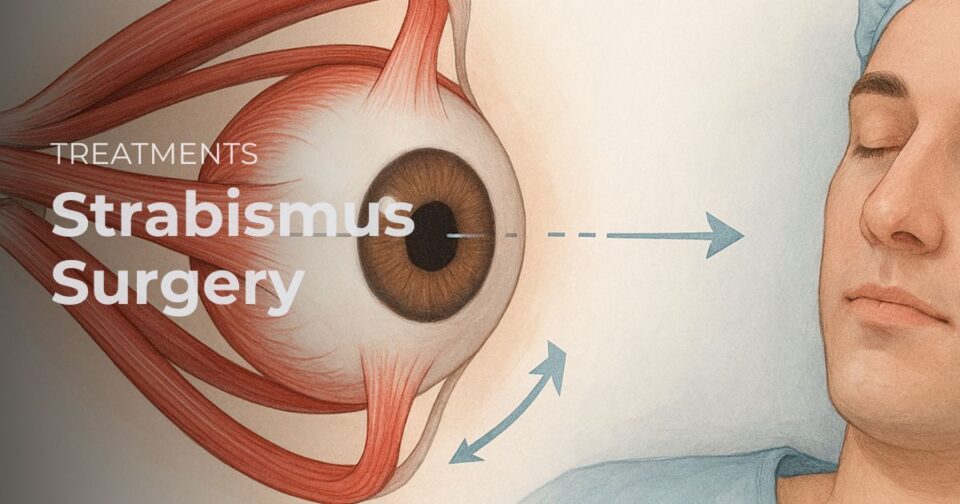
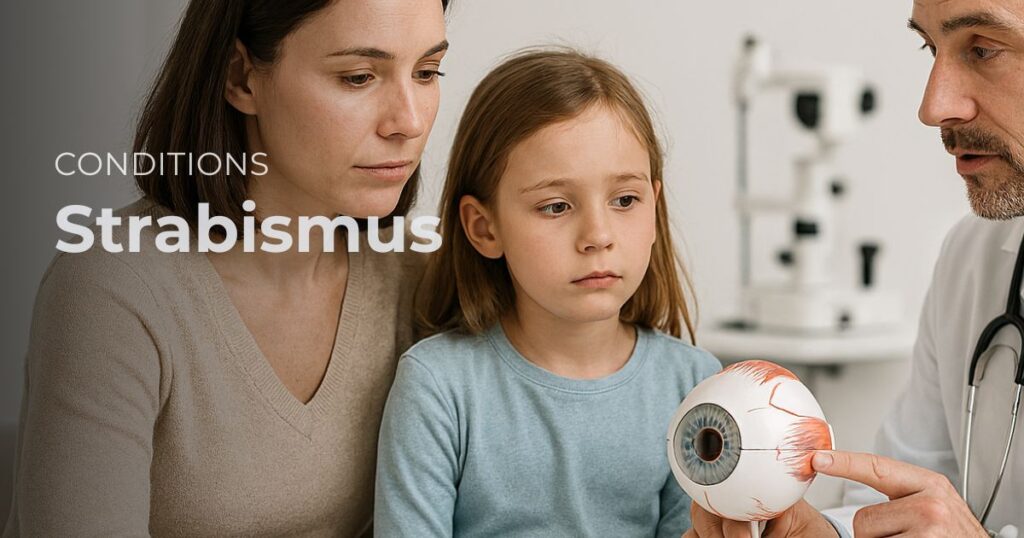
Each eye moves because of six small muscles attached to the outside of the eyeball. These muscles work like a carefully balanced team. The brain also helps both eyes point together at the same target.
If the muscles, nerves, focusing system, or brain control are not working in sync, the eyes can become misaligned. That misalignment is called strabismus.
🧾 Terminology Glossary
- Strabismus: misalignment of the eyes.
- Esotropia: one eye turns inward.
- Exotropia: one eye turns outward.
- Hypertropia: one eye sits higher than the other.
- Amblyopia: reduced vision development in one eye, often called “lazy eye.”
- Binocular vision: both eyes working together as a team.
- Prism: a lens feature that can help align the images seen by the two eyes.
What Is Strabismus?
Strabismus is a condition where the eyes do not line up properly. One eye may look straight while the other turns in, out, up, or down. The misalignment may be constant, or it may come and go. It may affect the same eye all the time, or it may alternate between the two eyes.
Some parents first notice it in photographs. Some adults notice double vision, eye strain, or a drifting eye when tired. Others feel that one eye “does not work with the other.”
Why Strabismus Matters
Do not dismiss strabismus as “just a cosmetic problem.” In children, untreated eye misalignment can interfere with normal visual development and may lead to amblyopia, poor depth perception, or both. In adults, strabismus can cause double vision, reading fatigue, poor depth judgment, social discomfort, and reduced quality of life.
Just as important, a new eye turn in an adult can sometimes signal a nerve problem, thyroid eye disease, myasthenia gravis, trauma, or another neurologic issue. That is why context matters.
🚨 Dr. Roque’s Emergency Warning
Seek urgent evaluation if strabismus starts suddenly, especially in an older child or adult.
- Sudden double vision
- Drooping eyelid
- Unequal pupils
- Severe headache
- Facial weakness, body weakness, or numbness
- Recent trauma
- Vomiting, imbalance, or other neurologic symptoms
Common Types of Strabismus
Esotropia
This is when one eye turns inward toward the nose. In children, some cases are related to uncorrected farsightedness and improve with the right glasses. This is often called accommodative esotropia.
Exotropia
This is when one eye drifts outward. It may be intermittent at first, especially when the child is tired, daydreaming, sick, or looking far away in bright sunlight.
Vertical Strabismus
This is when one eye drifts upward or downward. Patients may develop head tilt, face turn, or closing one eye to compensate.
Constant vs Intermittent
A constant deviation is present most or all of the time. An intermittent deviation appears only sometimes. Intermittent does not always mean harmless. If control is getting worse, it still deserves proper assessment.
Symptoms of Strabismus
- Eyes that look crossed, wandering, or uneven
- Double vision
- Closing one eye in sunlight
- Head tilt or face turn
- Poor depth perception
- Reading difficulty or eye strain
- Frequent blinking or squinting
- A child who seems clumsy or avoids near tasks
Small children often do not complain of double vision because the brain may suppress the image from one eye. That suppression can protect the child from seeing double, but it can also increase the risk of amblyopia.
What Causes Strabismus?
Strabismus is not one disease with one cause. It is a final pattern that can happen for different reasons.
- Focusing problems: especially farsightedness in children
- Congenital or early childhood muscle control issues
- Amblyopia or poor vision in one eye
- Nerve palsies affecting the eye muscles
- Thyroid eye disease
- Myasthenia gravis
- Trauma
- Stroke, brain lesions, or other neurologic disease
- Scarring or restriction around the eye muscles
That is why proper diagnosis matters. Two people can both have “crossed eyes” but need completely different treatment.
💡 Dr. Roque’s Analogy
Think of the two eyes like two camera crews filming the same event. If both cameras point at the same target, the brain can combine the images well. If one camera points somewhere else, the brain receives mismatched pictures. In children, the brain may start ignoring one camera. In adults, the mismatch often causes double vision.
How Eye Doctors Diagnose Strabismus
A proper strabismus workup usually includes much more than simply looking at the eyes.
- Visual acuity testing
- Refraction to check for glasses power
- Cover testing to measure the deviation
- Eye movement testing in different gaze positions
- Sensory testing and binocular vision assessment
- Evaluation for amblyopia in children
- Dilated eye examination when needed
- Further workup if the pattern suggests a neurologic or restrictive cause
In some cases, imaging, blood tests, or neurologic assessment may be necessary. In other cases, the diagnosis is straightforward and can be made clinically.
Treatment Options for Strabismus
Treatment depends on the cause, the age of the patient, the size and pattern of the deviation, and whether binocular vision can still be improved.
1) Glasses
For some patients, especially children with accommodative esotropia, the right glasses can greatly improve alignment. In these cases, the glasses are not a minor detail. They are the main treatment.
2) Amblyopia Treatment
If one eye has become weaker during childhood, treatment may include patching or atropine penalization, depending on the case. Straightening the eyes alone does not automatically fix amblyopia.
3) Prism Glasses
Prisms can help selected patients, especially some adults with double vision. They do not cure every form of strabismus, but they can reduce symptoms in the right case.
4) Botulinum Injection in Selected Cases
Some patients may benefit from injection-based treatment, depending on the diagnosis and treatment plan.
5) Strabismus Surgery
Surgery adjusts the eye muscles to improve alignment. The surgery is performed on the muscles attached to the outside of the eye, not inside the eyeball. In many cases it is day surgery. Some patients need one operation. Others may need staged or repeat surgery depending on the complexity and long-term control.
Surgery can improve alignment, binocular cooperation, abnormal head posture, and appearance. It can also reduce or eliminate double vision in selected adults. But it is important to set expectations properly: surgery does not automatically remove the need for glasses, and it does not directly treat every cause of reduced vision.
When Is Strabismus Surgery Worth Considering?
- If the eye turn remains significant despite proper glasses or non-surgical treatment
- If the misalignment is affecting binocular vision or visual development
- If the patient has persistent double vision
- If there is abnormal head posture
- If appearance and social function are significantly affected
- If the drifting is becoming more frequent or harder to control
Strabismus in Children vs Adults
Children
In children, timing matters because the visual system is still developing. Delay can increase the risk of amblyopia and weaker binocular vision. That does not mean every child needs immediate surgery, but it does mean every persistent misalignment deserves proper assessment.
Adults
Adults can also benefit significantly from strabismus treatment. A common mistake is assuming that nothing can be done once a person is older. That is false. Adults may improve comfort, alignment, function, confidence, and quality of life with proper treatment. New adult-onset strabismus, however, requires careful evaluation for the underlying cause.
Can Strabismus Go Away on Its Own?
Sometimes brief intermittent drifting in very young infants can settle during early development. But persistent misalignment, worsening control, head tilt, or a deviation noticed after infancy should not be brushed aside. In older children and adults, true strabismus usually does not simply “disappear” without explanation.
What Parents Should Watch For
- One eye that turns in or out repeatedly after early infancy
- Frequent head tilt
- One eye closing in bright light
- Bringing objects too close to the face
- Apparent poor depth judgment
- A family history of strabismus or amblyopia
- Unequal vision on screening
If you are not sure whether your child has a true eye turn or only the appearance of one, an examination is still the right move. Pseudostrabismus exists, but guessing is a poor strategy when visual development is on the line.
🧠 Dr. Roque’s Key Learning Points
- Strabismus means the eyes are not aligned properly.
- It can happen in children or adults.
- It is not just cosmetic. It can affect vision and quality of life.
- Some cases improve with glasses, especially accommodative esotropia.
- Amblyopia must be addressed separately when present.
- Exercises help only selected types. They are not a cure-all.
- Prisms, injections, and surgery all have roles in the right patient.
- Sudden new strabismus needs urgent evaluation.
- Adults can still benefit from treatment.
- Early assessment in children helps protect visual development.
Related Reading
Frequently Asked Questions
1) Is strabismus the same as lazy eye?
No. Strabismus is eye misalignment. Lazy eye, or amblyopia, is reduced visual development in one eye. Strabismus can cause amblyopia, but they are not the same thing.
2) Can glasses fix strabismus?
Sometimes, yes. Some children with accommodative esotropia improve significantly with the correct glasses. But not every form of strabismus responds to glasses alone.
3) Does every child with strabismus need surgery?
No. Some need glasses, amblyopia treatment, or observation with structured follow-up. Others do need surgery. The plan depends on the type and cause.
4) Can adults still have strabismus surgery?
Yes. Adults can benefit from treatment, including surgery, when it is appropriate.
5) Is strabismus surgery done inside the eye?
No. The surgery is done on the muscles attached to the outside of the eye.
6) Will surgery remove the need for glasses?
Not necessarily. Surgery improves alignment. Glasses may still be needed for focusing or clarity.
7) Can eye exercises cure all strabismus?
No. That is a common misconception. Exercises help only selected problems and are not the answer for every misalignment.
8) Is intermittent exotropia harmless?
Not always. It may be mild at first, but it can worsen over time. Control, symptoms, and binocular function matter.
9) When should I worry about new strabismus in an adult?
You should worry immediately if it starts suddenly, especially with double vision, headache, drooping eyelid, weakness, numbness, or recent trauma.
10) Can strabismus come back after treatment?
Yes, it can. Some patients remain stable long term. Others may drift again and need further treatment or follow-up.
✅ Dr. Roque’s Take-Home Message
If you or your child has a wandering, crossed, or uneven eye, do not guess and do not wait too long. Strabismus is common, treatable, and important. Some cases are straightforward. Others point to a deeper problem. The right next step is a proper eye examination so the diagnosis is clear and the treatment plan matches the real cause.
References
- American Association for Pediatric Ophthalmology and Strabismus (AAPOS). Strabismus. Updated November 7, 2024.
- American Association for Pediatric Ophthalmology and Strabismus (AAPOS). Adult Strabismus. Accessed April 8, 2026.
- American Academy of Ophthalmology. Strabismus in Children. Updated January 20, 2026.
- American Academy of Ophthalmology. Esotropia and Exotropia Preferred Practice Pattern. 2022.
- National Health Service (NHS). Squint. Accessed April 8, 2026.
ROQUE Eye Clinic Patient Education Series
Reviewed by the Roque Advisory Council
Dr. Manolette Roque | Dr. Barbara Roque
St. Luke’s Medical Center Global City | Asian Hospital Medical Center
Philippines
Medical Disclaimer: This page is for patient education and does not replace an in-person medical examination. Eye alignment problems can have many causes. Treatment depends on the diagnosis, age, visual status, and overall clinical context.