


ROQUE EYE CLINIC • PROFESSIONAL BIOGRAPHY
Manolette R. Roque, MD, MBA, DPBO, FPAO, FPCS
Ophthalmologist | Cataract and Refractive Surgery | Cornea and Dry Eye Care | Medical Retina | Ocular Immunology and Uveitis
🧠 Dr. Roque's Quick Answer
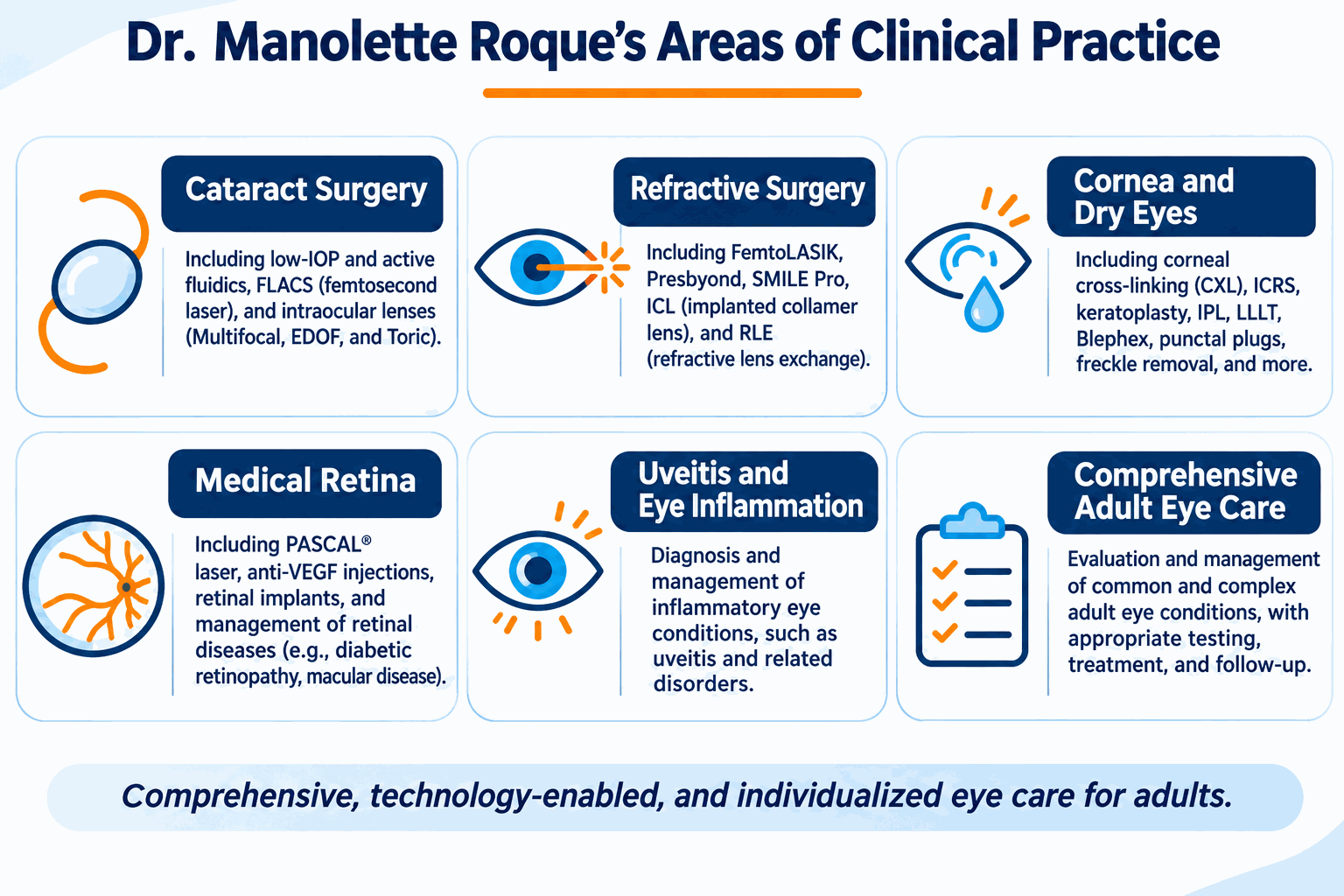
Dr. Manolette R. Roque is a Filipino ophthalmologist practicing at ROQUE Eye Clinic in Bonifacio Global City, Taguig, and Alabang, Muntinlupa. His clinical practice encompasses six major areas: cataract surgery, refractive surgery, cornea and dry eye care, medical retina, uveitis and ocular inflammation, and comprehensive adult ophthalmology.
His medical background includes ophthalmology residency training at Philippine General Hospital, research fellowship training in ocular immunology and uveitis at Massachusetts Eye and Ear Infirmary, additional observership training in cornea and refractive surgery, and an MBA in Health from Ateneo Graduate School of Business.
🔑 Key Learning Points
- Dr. Roque is the Managing Partner of ROQUE Eye Clinic.
- His cataract surgery practice includes modern fluidics technologies, femtosecond laser-assisted surgery, and advanced intraocular lens options.
- His refractive surgery practice includes FemtoLASIK, PRESBYOND, SMILE Pro, ICL, and refractive lens exchange.
- His cornea and ocular surface practice includes corneal treatment and dry eye management.
- Medical retina care includes retinal diagnostic assessment, laser treatment, intravitreal injections, and selected sustained-release intraocular medications.
- He evaluates uveitis and other ocular inflammatory conditions.
- Consultations are available at St. Luke's Medical Center Global City and Asian Hospital and Medical Center.
Quick Navigation
- Professional Profile
- Education and Postgraduate Training
- Six Clinical Areas of Practice
- Cataract Surgery
- Refractive Surgery
- Cornea and Dry Eyes
- Medical Retina
- Uveitis and Eye Inflammation
- Comprehensive Adult Eye Care
- Approach to Patient Care
- Professional Qualifications
- Clinic Locations
- Frequently Asked Questions
Professional Profile
Dr. Manolette R. Roque is an ophthalmologist whose clinical work includes the diagnosis, medical treatment, surgical management, and continuing care of adult eye conditions.
His practice covers a broad range of ophthalmic services, from routine visual assessment and comprehensive examination to advanced cataract surgery, laser vision correction, corneal procedures, medical retina treatment, and care for ocular inflammatory conditions.
As Managing Partner of ROQUE Eye Clinic, he maintains clinical practices at St. Luke's Medical Center Global City and Asian Hospital and Medical Center.
His approach combines clinical evaluation, appropriate diagnostic testing, discussion of treatment alternatives, and individualized follow-up.
Education and Postgraduate Training
Doctor of Medicine
University of the Philippines College of Medicine, through the Integrated Liberal Arts and Medicine (INTARMED) program.
Ophthalmology Residency
Department of Ophthalmology, Philippine General Hospital, University of the Philippines Manila.
Ocular Immunology and Uveitis
Research fellowship at Massachusetts Eye and Ear Infirmary, affiliated with Harvard Medical School, Boston, Massachusetts, USA.
Cornea and Refractive Surgery
Post-residency observership at Massachusetts Eye and Ear Infirmary.
Health Administration
Master of Business Administration in Health, Ateneo Graduate School of Business, Makati, Philippines.
Six Clinical Areas of Practice
Dr. Roque provides evaluation and treatment across six complementary areas of adult ophthalmology. The appropriate treatment depends on each patient's examination findings, visual needs, ocular anatomy, medical history, and individual circumstances.
1. Cataract and Intraocular Lens Surgery
Cataracts develop when the eye's natural lens becomes cloudy, causing blurred vision, glare, reduced contrast, or difficulty with everyday activities.
Dr. Roque evaluates cataract severity, visual function, ocular health, and the potential benefits and risks of surgery. His cataract practice includes modern surgical techniques and individualized intraocular lens selection.
Cataract Surgery Techniques and Technologies
- Low-IOP cataract surgery: Surgical strategies intended to minimize unnecessary intraoperative pressure elevation while maintaining a stable operating environment.
- Active fluidics: Systems that help regulate irrigation pressure and fluid dynamics during phacoemulsification.
- FLACS: Femtosecond laser-assisted cataract surgery, which can automate selected surgical steps in suitable patients.
- Conventional phacoemulsification: Ultrasound-assisted removal of the cloudy natural lens through a small incision.
Intraocular Lens Options
- Monofocal IOLs: Generally designed to provide a primary focal distance.
- Toric IOLs: Designed to correct appropriate amounts of corneal astigmatism.
- Multifocal IOLs: Designed to provide vision at more than one distance, with optical trade-offs that require discussion.
- Extended Depth of Focus (EDOF) IOLs: Designed to extend the functional range of vision, although reading glasses may still be necessary.
Not every patient is suitable for a premium intraocular lens. Corneal health, retinal status, ocular measurements, lifestyle, and expectations are important considerations.
2. Refractive Surgery
Refractive surgery aims to reduce dependence on glasses or contact lenses by correcting nearsightedness, farsightedness, astigmatism, or selected age-related focusing problems.
Dr. Roque evaluates patients for several corneal and lens-based procedures.
Available Refractive Surgery Approaches
- FemtoLASIK: Laser vision correction using a femtosecond laser to create a corneal flap and an excimer laser to reshape the cornea.
- PRESBYOND: A laser blended vision strategy intended to improve functional vision across different distances in appropriately selected patients with presbyopia.
- SMILE Pro: Small-incision lenticule extraction performed using the ZEISS VisuMax 800 femtosecond laser platform.
- Implantable Collamer Lens (ICL): A phakic intraocular lens implanted while retaining the natural crystalline lens.
- Refractive Lens Exchange (RLE): Removal of the natural crystalline lens and implantation of an intraocular lens primarily to address refractive needs in selected patients.
Other corneal refractive approaches, including PRK, may also be considered according to the individual clinical situation.
Refractive surgery candidacy requires examination of prescription stability, corneal topography or tomography, corneal thickness, ocular surface health, anterior segment anatomy, and retinal health when indicated.
No refractive procedure guarantees complete independence from glasses or freedom from future ocular disease.
3. Cornea and Dry Eye Care
The cornea is the transparent front surface of the eye. It plays a major role in focusing light and maintaining clear vision. Disorders of the cornea and ocular surface can cause blurred vision, irritation, light sensitivity, irregular astigmatism, and chronic discomfort.
Dr. Roque evaluates corneal disorders, dry eye disease, and selected ocular surface conditions.
Corneal Procedures and Treatments
- Corneal Cross-Linking (CXL): A treatment intended to strengthen the cornea and slow or halt progression of selected ectatic disorders, including progressive keratoconus.
- Intracorneal Ring Segments (ICRS): Corneal implants used in selected cases to modify corneal shape and improve optical regularity.
- Keratoplasty: Corneal transplantation procedures for selected corneal diseases when medically indicated.
- Ocular Surface Evaluation: Assessment of tear film quality, eyelid function, corneal staining, and ocular surface inflammation.
Dry Eye and Eyelid Treatments
- Intense Pulsed Light (IPL): Light-based treatment that may benefit selected patients with meibomian gland dysfunction or evaporative dry eye.
- Low-Level Light Therapy (LLLT): Light-based treatment used in selected ocular surface and meibomian gland dysfunction protocols.
- BlephEx: Mechanical eyelid margin cleaning intended to remove debris and biofilm in selected blepharitis cases.
- Punctal Plugs: Small devices placed in the tear drainage openings to help retain tears when appropriate.
- Other Dry Eye Management: Lubricants, eyelid hygiene, treatment of inflammation, and management of contributing conditions.
Ocular Surface Freckles and Pigmented Lesions
Pigmented spots or freckles on the ocular surface may require examination to distinguish benign pigmentation from lesions needing documentation, monitoring, biopsy, or treatment.
Removal may be considered in selected circumstances after appropriate evaluation. A changing or suspicious pigmented lesion should not be treated as a routine cosmetic concern.
4. Medical Retina
The retina is the light-sensitive tissue lining the back of the eye. Retinal diseases can affect central vision, peripheral vision, or both, and some may progress without obvious early symptoms.
Dr. Roque's medical retina practice includes evaluation and treatment of diabetic retinal disease, macular disorders, and other retinal conditions requiring medical management.
Medical Retina Diagnostics
- Dilated retinal examination
- Retinal fundus photography
- Widefield retinal imaging using available imaging platforms
- Optical Coherence Tomography (OCT)
- OCT Angiography (OCT-A)
- Fluorescein angiography when indicated
Medical Retina Treatments
- PASCAL Retinal Laser: Pattern-scanning laser treatment used in selected retinal vascular diseases, including diabetic retinopathy.
- Anti-VEGF Intravitreal Injections: Medications used to treat selected retinal conditions involving abnormal blood vessel growth or leakage, including certain forms of diabetic macular edema and neovascular age-related macular degeneration.
- Intravitreal Corticosteroid Implants: Sustained-release intraocular medications used in selected cases of retinal edema or inflammation.
- Long-Term Retinal Disease Monitoring: Follow-up using examination and imaging to assess disease activity and response to treatment.
Treatment selection depends on the retinal diagnosis, severity of disease, previous treatment response, associated medical conditions, and medication-related risks.
Not all retinal diseases require injections or laser treatment. Some require observation, systemic disease control, or referral for vitreoretinal surgery.
5. Uveitis and Eye Inflammation
Uveitis is inflammation involving the uveal tract and may also affect adjacent eye structures, including the retina, vitreous, or optic nerve.
Symptoms can include redness, pain, light sensitivity, floaters, or blurred vision. Some forms of uveitis may produce few symptoms, particularly in patients with certain systemic inflammatory conditions.
Dr. Roque's clinical background includes research fellowship training in ocular immunology and uveitis.
Clinical Management May Include
- Detailed ocular examination and assessment of inflammatory activity
- Evaluation for infectious, autoimmune, or systemic associations when indicated
- Anti-inflammatory treatment based on the diagnosis
- Monitoring for complications such as cataracts, glaucoma, or macular edema
- Coordination with rheumatologists, internists, or other specialists when appropriate
Different causes of uveitis require different treatments. Infectious causes must be considered before treatments that suppress immune activity.
6. Comprehensive Adult Eye Care
Comprehensive ophthalmology involves evaluating vision and eye health as a whole rather than concentrating exclusively on a single procedure or subspecialty.
Dr. Roque assesses common and complex adult eye concerns and determines whether observation, medication, optical correction, surgery, additional testing, or referral is appropriate.
Common Reasons for Consultation
- Blurred or fluctuating vision
- Changes in eyeglass prescription
- Cataract symptoms
- Eye redness or discomfort
- Dry eye symptoms
- Floaters or other visual disturbances
- Diabetic eye screening
- Assessment before eye surgery
- Second opinions regarding diagnosis or treatment
- Follow-up after ophthalmic procedures
Examination findings determine which tests are necessary and whether further subspecialty evaluation is indicated.
Approach to Patient Care
Good ophthalmic care begins with an accurate diagnosis, thoughtful interpretation of clinical findings, and clear communication.
Dr. Roque emphasizes explaining the patient's condition, discussing reasonable alternatives, and reviewing the expected benefits, limitations, uncertainties, and risks of treatment.
Although modern technology contributes to ophthalmic diagnosis and surgery, the choice of treatment should be based on clinical need rather than the availability of a particular device or procedure.
Some patients benefit from surgery, while others may be better served by glasses, medication, treatment of ocular surface disease, observation, or multidisciplinary care.
Follow-up is an essential part of treatment, particularly for chronic conditions such as diabetic retinal disease, uveitis, and dry eye disease.
Professional Qualifications
- Doctor of Medicine — University of the Philippines College of Medicine
- Master of Business Administration in Health — Ateneo Graduate School of Business
- Diplomate — Philippine Board of Ophthalmology
- Fellow — Philippine Academy of Ophthalmology
- Fellow — Philippine College of Surgeons
View Dr. Manolette Roque's Curriculum Vitae
Clinic Locations
St. Luke's Medical Center Global City
ROQUE Eye Clinic
Medical Arts Building, Room 217
Bonifacio Global City, Taguig, Philippines
Asian Hospital and Medical Center
ROQUE Eye Clinic
Medical Office Building, Room 509
Filinvest City, Muntinlupa, Philippines
View Clinic Schedule and Appointment Details
Frequently Asked Questions
Does Dr. Manolette Roque perform cataract surgery?
Yes. His cataract surgery practice includes phacoemulsification, selected femtosecond laser-assisted approaches, modern fluidics technologies, and intraocular lens selection according to patient needs.
What is the difference between multifocal, EDOF, and toric IOLs?
Multifocal and EDOF intraocular lenses are designed to provide different ranges of functional vision. Toric lenses correct selected amounts of corneal astigmatism. These properties can be combined in some lens designs. Suitability depends on ocular measurements, eye health, visual priorities, and tolerance for possible optical side effects.
Can Dr. Roque evaluate me for FemtoLASIK, PRESBYOND, SMILE Pro, or ICL?
Yes. A refractive surgery assessment determines whether the patient is eligible for laser or lens-based vision correction and which options may be appropriate.
What is refractive lens exchange?
Refractive lens exchange involves replacing the natural crystalline lens with an intraocular lens primarily to address refractive needs. It may be considered in selected patients, but it carries intraocular surgical risks and is not appropriate for everyone.
Does Dr. Roque treat keratoconus?
His cornea practice includes evaluation of corneal ectatic conditions and selected treatment options such as corneal cross-linking, intracorneal ring segments, and keratoplasty when indicated.
What treatments are available for dry eyes?
Management depends on the cause and severity of dry eye disease. Options may include lubricants, eyelid hygiene, anti-inflammatory treatment, IPL, LLLT, BlephEx, and punctal plugs in selected cases.
Can eye freckles be removed?
Some ocular surface pigmented lesions can be treated or removed, but the first priority is accurate diagnosis. Any changing, elevated, or suspicious lesion requires appropriate evaluation before a treatment decision.
Does Dr. Roque treat diabetic retinopathy?
His medical retina practice includes diabetic eye assessment, retinal imaging, PASCAL laser treatment, intravitreal injections, and continuing monitoring when clinically indicated.
What are anti-VEGF eye injections?
Anti-VEGF injections deliver medication into the eye to reduce abnormal blood vessel activity or leakage in selected retinal diseases. The need for treatment and injection frequency depend on the diagnosis and response.
What are retinal implants?
In the context of this clinic's medical retina treatments, the term refers to selected intravitreal sustained-release medication implants, such as corticosteroid implants. These are different from electronic retinal prostheses intended to provide artificial visual stimulation.
What is uveitis?
Uveitis is inflammation affecting structures inside the eye. It may occur independently or in association with infections, autoimmune disorders, or systemic inflammatory conditions. Treatment depends on the underlying cause.
Can I request a second opinion?
Yes. Patients seeking a second opinion should bring previous prescriptions, examination findings, retinal or corneal imaging, surgical records, and a list of current medications when available.
Where can I book an appointment?
Consultations may be requested at ROQUE Eye Clinic in St. Luke's Medical Center Global City or Asian Hospital and Medical Center, subject to appointment availability.
Related Reading
- Dr. Manolette Roque — Curriculum Vitae
- Clinic Schedule and Locations
- SMILE Pro Surgery Guide
- ICL Surgery Guide
- Meet Our Ophthalmologists
Take-Home Message
Dr. Manolette Roque's ophthalmology practice covers a wide range of adult eye conditions, from routine examinations to cataract and refractive surgery, corneal disease, dry eye management, medical retina, and uveitis.
The most appropriate treatment is determined by a careful eye examination, an accurate diagnosis, and a discussion of the patient's individual needs.
Book Consultation
If you are experiencing visual symptoms, considering eye surgery, or seeking a second opinion, an ophthalmology consultation can help clarify your diagnosis and available options.
Book an Eye Consultation at ROQUE Eye Clinic
Medical Review
Physician profile: Manolette R. Roque, MD, MBA, DPBO, FPAO, FPCS.
Content revision prepared: November 16, 2026.
Medical Disclaimer
This professional biography is intended for general information and patient education. The procedures and treatments described are not appropriate for every patient. A personal ophthalmic examination is required to determine diagnosis, treatment suitability, potential benefits, and risks.