

Macular Degeneration: Symptoms, Causes, Treatment, and What Patients Need to Know
🧠 Dr. Roque’s Quick Answer
Macular degeneration is a disease that damages the macula, the part of the retina responsible for sharp central vision. It does not usually cause total blindness, but it can make reading, driving, recognizing faces, and seeing fine detail difficult. The two main forms are dry macular degeneration and wet macular degeneration. Dry AMD is more common. Wet AMD is less common but can damage vision faster and often needs urgent treatment.
Many patients hear the words “macular degeneration” and immediately think, “Am I going blind?” That is the wrong first question. The better question is: what kind of macular degeneration is it, how advanced is it, and what should we do next?
Macular degeneration mainly affects the center of vision. That means you may still keep your side vision, but everyday tasks can become frustrating. Straight lines may look bent. Letters may look distorted or missing. Faces may become harder to recognize. Colors and contrast may feel less sharp.
🎯 Focus
Explain what macular degeneration is, what symptoms matter, and how patients should think about dry versus wet disease.
🏁 Goal
Help patients recognize warning signs early and understand why prompt retinal evaluation can protect useful vision.
🛡️ Evidence-Based
Dry AMD is more common, wet AMD causes faster central vision loss, and management depends on stage, imaging, and timely follow-up.
🧠 Dr. Roque’s Key Learning Points
- Macular degeneration affects central vision, not usually total peripheral vision.
- There are two main forms: dry and wet.
- Dry AMD is more common, but wet AMD is usually the more urgent form.
- New distortion, a dark spot, or sudden worsening of central vision should not be ignored.
- Early diagnosis helps with monitoring, treatment planning, and visual rehabilitation.
- Even when vision cannot be fully restored, many patients can still function well with treatment, monitoring, and low-vision support.
Quick Navigation
ROQUE Eye Clinic Conditions Knowledge Hub
This page belongs to the Conditions pathway on Eye.com.ph.
Start with the main hub: Conditions
👁️ Anatomy Micro-Primer
The retina is the light-sensitive tissue at the back of the eye. The macula is the small central part of the retina that gives you the sharp vision needed for reading, recognizing faces, and seeing fine detail.
If the macula becomes damaged, central vision becomes blurred, distorted, dim, or patchy. Side vision may still remain relatively normal.
🧩 Terminology Glossary
- Macula: the central part of the retina responsible for detailed vision.
- AMD: age-related macular degeneration.
- Dry AMD: the more common form, often linked to drusen and gradual retinal damage.
- Wet AMD: a more aggressive form where abnormal blood vessels leak fluid or blood under or into the retina.
- Drusen: yellow deposits under the retina that may be seen in AMD.
- Geographic atrophy: an advanced form of dry AMD where retinal cells are lost.
- Anti-VEGF injection: a medicine injected into the eye to treat wet AMD by reducing abnormal vessel leakage and growth.
- Amsler grid: a simple grid used to monitor distortion or missing areas in central vision.
What Is Macular Degeneration?
Macular degeneration is a condition that damages the macula over time. The most common form is age-related macular degeneration, often shortened to AMD. It is more common as people get older.
The disease mainly affects central vision. So patients may still walk around the house and see objects at the side, but struggle with reading a menu, threading a needle, recognizing faces, or seeing road signs clearly.
The biggest mistake is treating all macular degeneration as one single disease. It is not. Stage, type, activity, imaging findings, and symptoms all matter.
💡 Dr. Roque’s Analogy
Think of your vision like a camera. The macula is the part that gives you the sharp, high-definition center of the picture. If that center becomes damaged, the whole scene may still be there, but the most important part becomes blurred, warped, or missing.
Dry Macular Degeneration vs Wet Macular Degeneration
Dry AMD
Dry AMD is the more common type. It often develops gradually. Early or intermediate disease may cause few symptoms at first. Over time, patients may notice blur, reduced contrast, slower reading, trouble in dim light, or mild distortion.
In more advanced dry AMD, there may be thinning and loss of retinal tissue, sometimes called geographic atrophy. This can create blind or blurry spots in the center of vision.
Wet AMD
Wet AMD is less common, but it is the form that often causes faster and more severe central vision loss. In wet AMD, abnormal blood vessels grow under or into the retina and may leak fluid or blood.
Patients often notice new distortion, a new dark or blurry spot, or a sudden drop in reading or face recognition ability. This is why wet AMD deserves faster evaluation and treatment planning.
Symptoms Patients May Notice
- blurred central vision
- straight lines looking bent or wavy
- difficulty reading
- trouble recognizing faces
- needing brighter light for near tasks
- a dark, gray, or empty area in the center of vision
- colors looking less vivid
- slower adaptation in dim environments
Some patients have disease in one eye and do not realize it at first because the other eye compensates. That is why routine eye exams still matter even when the patient “sees fine.”
🚨 Dr. Roque’s Emergency Warning
Seek prompt eye evaluation if you notice any of the following:
- sudden new distortion of straight lines
- a new dark or blurry central spot
- rapid decline in reading vision
- a sudden difference between the two eyes
- new central blur after previously stable vision
These symptoms can suggest conversion to wet AMD, which often needs faster treatment.
Who Is More Likely to Develop Macular Degeneration?
Risk is not random. Several factors increase the chance of AMD or progression:
- older age
- family history
- smoking
- cardiovascular risk factors
- some genetic influences
- possibly obesity and other lifestyle factors
Here is the ruthless truth: smoking is one of the most important modifiable risk factors. If a patient with AMD is still smoking, that problem needs to be confronted directly, not politely ignored.
How Macular Degeneration Is Diagnosed
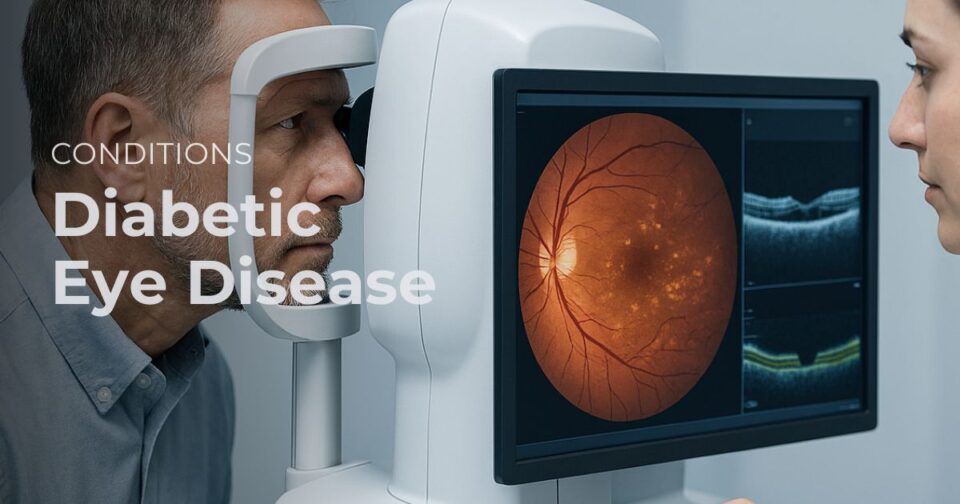
Diagnosis starts with a proper retinal examination, but good care does not stop there. Imaging matters because it tells us whether the disease is dry, wet, stable, active, or progressing.
The evaluation may include:
- dilated fundus examination
- optical coherence tomography or OCT
- retinal photography
- other retinal imaging when needed
- Amsler grid monitoring in selected patients
A patient should not leave the consultation only knowing the label “macular degeneration.” The patient should understand:
- which type is present
- how advanced it is
- whether there is fluid or bleeding
- what symptoms require urgent review
- what the follow-up plan is
Treatment Options
Treatment for Dry AMD
Dry AMD treatment depends on stage and severity. In many patients, management focuses on monitoring, risk reduction, and counseling. Some patients with intermediate AMD or advanced AMD in one eye may benefit from specific nutritional supplements based on AREDS2-style criteria, but supplements are not a universal substitute for proper retinal care.
Patients also need realistic counseling. Dry AMD may remain stable for a while, but some patients progress. Others may eventually develop wet AMD. Monitoring is not passive. It is part of treatment strategy.
Treatment for Wet AMD
Wet AMD is commonly treated with intravitreal anti-VEGF injections. These medicines help reduce leakage and slow damage from abnormal blood vessels. Some patients maintain useful vision for years with timely treatment and follow-up.
Here is the key strategic point: wet AMD treatment often depends on timing and consistency. Missing follow-up or delaying treatment can cost vision that may not fully return.
Visual Rehabilitation
Patients with central vision loss should not be abandoned with the phrase “nothing more can be done.” Even when cure is not possible, there is often still a lot that can be done:
- reading aids
- magnification devices
- better lighting
- contrast adjustments
- low-vision training
- practical home and mobility strategies
Living With Macular Degeneration
AMD affects more than eyesight. It affects confidence, independence, mood, reading, driving, work, and social interaction. Patients often feel frightened because the damage is in the very part of the eye needed for detail.
The right mindset is not denial. It is structured adaptation:
- keep follow-up visits
- report sudden changes quickly
- monitor central vision when advised
- optimize lighting at home
- use larger print and accessibility tools
- ask early about low-vision support
What Patients Often Get Wrong
- They think AMD means total blindness. Usually, it mainly affects central vision.
- They assume slow symptoms mean no urgency. Wet conversion can still occur.
- They believe vitamins alone solve the problem. They do not replace retinal diagnosis and follow-up.
- They wait too long after new distortion appears. That delay can be costly.
- They think one good eye means the problem can be ignored. It cannot.
When to Book a Consultation
Book an eye consultation if you have central blur, distortion, reduced reading vision, difficulty recognizing faces, a family history of macular degeneration, or any sudden change in central vision. Patients already diagnosed with AMD should return earlier than scheduled if symptoms worsen.
✅ Dr. Roque’s Take-Home Message
Macular degeneration is a disease of the central retina that can make reading, face recognition, and detailed vision difficult. Dry AMD is more common. Wet AMD is more urgent. The smartest next step is not fear and not delay. It is proper retinal evaluation, clear follow-up, and fast action if new distortion or sudden central vision loss appears.
Frequently Asked Questions
Is macular degeneration the same as blindness?
No. AMD mainly affects central vision. Many patients keep side vision, but central tasks can become difficult.
What is the difference between dry AMD and wet AMD?
Dry AMD is more common and often progresses more slowly. Wet AMD involves abnormal leaking blood vessels and can damage vision faster.
Can macular degeneration happen in one eye only?
Yes. It may start in one eye, but the other eye can also become affected over time.
What symptoms should make me worry about wet AMD?
New distortion, a new central dark spot, or sudden worsening of central vision should be assessed promptly.
Can vitamins cure AMD?
No. Supplements may help selected patients, but they do not cure AMD and do not replace proper retinal care.
Is smoking really that important?
Yes. Smoking is one of the major modifiable risk factors for AMD progression.
How is wet AMD treated?
Wet AMD is often treated with intravitreal anti-VEGF injections and close retinal follow-up.
Can vision come back after treatment?
Some patients improve, some stabilize, and some still lose vision despite treatment. Early detection gives the best chance of protecting useful vision.
Do I still need follow-up if my symptoms feel stable?
Yes. Stable symptoms do not always mean stable disease. Imaging and examinations remain important.
Can patients with AMD still function independently?
Often, yes. Many patients do well with monitoring, treatment when needed, lighting changes, visual aids, and low-vision support.
📚 Related Reading
📖 References
- American Academy of Ophthalmology. Understanding Macular Degeneration.
- American Academy of Ophthalmology. Age-Related Macular Degeneration Preferred Practice Pattern.
- National Eye Institute. Age-Related Macular Degeneration (AMD).
- Mayo Clinic. Dry macular degeneration: symptoms, causes, diagnosis, and treatment.
- Mayo Clinic. Wet macular degeneration: symptoms, causes, diagnosis, and treatment.
- NHS. Age-related macular degeneration (AMD): overview, symptoms, diagnosis, and living with AMD.
ROQUE Eye Clinic Patient Education Series
Reviewed by the Roque Advisory Council
Dr. Manolette Roque | Dr. Barbara Roque
St. Luke’s Medical Center Global City | Asian Hospital Medical Center
Philippines
Medical Disclaimer: This page is for patient education only and does not replace an eye examination, diagnosis, or treatment plan. If you notice new distortion, a new central dark spot, or sudden worsening of central vision, seek prompt ophthalmic evaluation.