

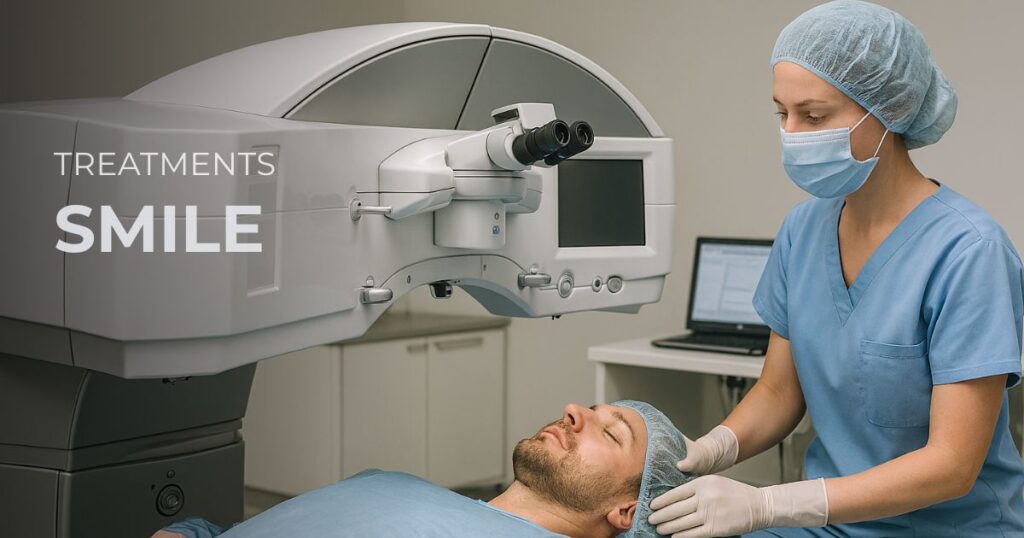
SMILE in the Philippines: A Clear Patient Guide to Small Incision Lenticule Extraction
SMILE is a flap-free laser vision correction procedure that mainly treats nearsightedness, with or without astigmatism, in properly screened patients. It can reduce dependence on glasses or contact lenses, but it is not the right choice for everyone. The safest way to decide is a full refractive surgery work-up, including corneal mapping, dry eye assessment, cycloplegic refraction when needed, and a dilated retinal examination.
SMILE, short for small incision lenticule extraction, is one of the main laser vision correction options for patients with myopia. Many people hear that it is “bladeless,” “minimally invasive,” or “better than LASIK.” That is too simplistic. In real practice, SMILE is an excellent option for the right eye, the right prescription, and the right patient goals. It is not automatically the best option just because it is newer or sounds more advanced.
This page explains what SMILE is, who may qualify, what the surgery can and cannot do, what recovery usually feels like, and when another option such as LASIK, PRK, ICL, Presbyond, or refractive lens replacement may fit better.
Explain SMILE in plain language so patients understand candidacy, benefits, tradeoffs, risks, recovery, and realistic expectations.
Help the reader decide whether to proceed with proper screening, ask better questions, and choose the safest next step.
This guide reflects current patient education principles, FDA labeling history, major ophthalmic guidance, and recent comparative refractive surgery literature.
Start with the broader hub if you are still deciding where to begin.
Explore all treatment guides
- SMILE mainly treats myopia, with or without astigmatism, in appropriately screened adults.
- It removes a small corneal lenticule through a tiny incision instead of creating a LASIK flap.
- SMILE may reduce flap-related problems and may be gentler on the ocular surface in some patients, but it is not risk-free.
- Not every patient with dry eye, thin corneas, irregular topography, or presbyopic goals is a good SMILE candidate.
- Good screening matters more than marketing claims.
- The goal is reduced dependence on glasses, not perfection under every lighting condition for every task.
- Retreatment after SMILE is possible, but enhancement planning can be more complex than many patients expect.
- If you are over 40, presbyopia planning is just as important as distance vision correction.
What is SMILE?
SMILE is a type of laser refractive surgery that changes the shape of the cornea to correct nearsightedness. A femtosecond laser creates a thin disc-shaped piece of tissue inside the cornea, called a lenticule. The surgeon then removes that lenticule through a very small opening. By removing that tissue, the cornea changes shape and focuses light more accurately on the retina.
Think of the cornea as the eye’s front window and main focusing surface. If that window is too steep for your prescription, light focuses in front of the retina and distance vision looks blurry. SMILE reshapes the window from within.
Imagine a dome-shaped tent that is slightly too steep. SMILE removes a carefully measured thin layer from inside the material, so the dome relaxes into a better curve. The outside surface changes less dramatically than in a flap-based procedure, but the focusing power still changes.
How is SMILE different from LASIK?
The simplest answer is this: LASIK creates a flap, while SMILE does not create a traditional flap. In LASIK, the cornea is opened like a hinged cover before the laser reshapes the tissue underneath. In SMILE, the treatment happens inside the cornea and the lenticule is removed through a much smaller side opening.
That structural difference leads to practical tradeoffs:
- SMILE avoids flap-related complications because there is no large corneal flap.
- Some patients experience less dryness or less nerve disruption after SMILE, although dry eye can still happen.
- Visual recovery can be very fast with both procedures, but some patients feel LASIK clears a bit faster in the very early period.
- Fine-tuning astigmatism and handling enhancements may sometimes be more straightforward with LASIK.
So the correct question is not “Which is better?” The correct question is “Which is better for this specific eye and this specific patient?”
Cornea: the clear front surface of the eye that does most of the focusing.
Epithelium: the thin outer skin of the cornea.
Stroma: the thick middle layer of the cornea where SMILE creates and removes the lenticule.
Retina: the light-sensitive layer at the back of the eye that receives the focused image.
Lens: the natural lens inside the eye. SMILE does not replace this lens and does not stop future presbyopia or cataract formation.
Myopia: nearsightedness; distance vision is blurry.
Astigmatism: uneven focusing due to an irregular corneal shape.
Lenticule: the thin piece of tissue removed during SMILE.
Topography/Tomography: scans that map the shape of the cornea.
Residual refractive error: leftover prescription after surgery.
Enhancement: an additional procedure done later if more correction is needed.
Who may be a good candidate for SMILE?
A good SMILE candidate usually has stable myopia, with or without astigmatism, healthy corneas, and realistic expectations. That sounds obvious, but many patients get screened too loosely. A proper evaluation should not stop at refraction and a quick topography printout.
In real-world practice, I look at the whole eye and the whole person:
- Age and prescription stability
- Manifest and, when needed, cycloplegic refraction
- Corneal thickness and shape
- Tomography and ectasia risk profile
- Dry eye and meibomian gland status
- Pupil size and night-vision complaints
- Occupation, sports, and lifestyle
- Retinal status after dilated examination
- Presbyopia goals if the patient is in midlife
A patient can have a prescription that looks “SMILE-able” on paper and still be a poor candidate once the rest of the eye is properly assessed.
Who may not be a good candidate?
SMILE may be the wrong choice if you have suspicious corneal topography, thin residual corneal tissue, significant dry eye that is not controlled, unstable refraction, pregnancy-related refractive fluctuation, untreated ocular surface disease, certain autoimmune or healing problems, or retinal issues that need attention first.
It may also be the wrong fit if your main complaint is presbyopia rather than myopia, or if another procedure matches your visual goals better.
SMILE is an elective procedure. If your screening is incomplete, rushed, or missing key steps such as dilated retinal examination, dry eye work-up, or careful corneal risk assessment, do not let speed or sales pressure push you forward. Elective surgery should slow down when the data are incomplete.
What does SMILE treat well?
SMILE is strongest as a treatment for myopia, with or without astigmatism, in well-selected patients. It is not a cure for every type of blurry vision. It does not treat cataract. It does not stop age-related near blur from presbyopia. It does not remove the need for future reading glasses in a patient whose natural lens is already aging.
That matters because many people in their 40s and 50s ask for “laser to remove glasses forever.” That promise is not medically honest. In that age group, we often need a more nuanced discussion that may include monovision strategies, blended vision planning, lens-based surgery, or accepting that near tasks may still require help.
What happens during the procedure?
- Numbing drops are placed in the eye.
- You look at a fixation light while the laser is docked to the eye.
- The femtosecond laser creates the lenticule inside the cornea.
- A small side incision is made.
- The surgeon removes the lenticule through that small opening.
- The cornea settles into its new shape.
The treatment itself is quick, but good surgery includes more than laser time. Preoperative marking, centration, suction quality, tissue dissection, lenticule extraction, and postoperative judgment all matter.
What are the main advantages of SMILE?
- No large LASIK flap
- Small incision rather than wide flap creation
- Strong effectiveness for many myopic patients
- Possible reduction in some flap-related concerns
- Potential ocular surface and corneal nerve advantages in selected patients
- Fast return to functional vision for many people
Those are real advantages, but they should not be exaggerated. “Less dry eye” does not mean “no dry eye.” “Flap-free” does not mean “complication-free.” “Modern” does not mean “automatically superior.”
What are the limitations and tradeoffs?
- It still requires excellent screening and precise centration.
- Early visual recovery can vary.
- Very fine astigmatism planning and enhancement strategy require careful thought.
- Residual prescription can still happen.
- Night symptoms such as glare or halos can still occur.
- Dry eye symptoms can still develop or worsen.
- Ectasia remains rare but serious and is the reason risk screening matters so much.
Patients sometimes think the small incision means the surgery is somehow “light” or “minor.” That is false reassurance. SMILE is less invasive in one structural sense, but it is still corneal refractive surgery.
What is recovery like after SMILE?
Most patients notice meaningful improvement early, but recovery is not identical for everyone. Vision may be usable quite quickly, yet fine sharpness, contrast, surface comfort, and stability can continue to improve over days to weeks.
Common early experiences include:
- mild foreign-body sensation
- watering or light sensitivity
- temporary blur or haziness
- fluctuation in sharpness
- temporary dryness
Healing is not just about “seeing the chart better.” It also includes ocular surface recovery, stable tear film, and making sure the final quality of vision matches the patient’s daily life needs.
What should patients do after SMILE?
Follow the drop schedule exactly, avoid rubbing the eyes, use lubricants as instructed, attend follow-up visits, and report any unexpected pain, worsening blur, marked redness, or drop in vision right away. If the ocular surface was already weak before surgery, postoperative surface management matters even more.
For patients in the Philippines, one practical point matters: do not disappear after surgery because the eye feels “okay.” Follow-up is part of the procedure, not an optional extra.
How does SMILE compare with ICL and lens replacement?
SMILE reshapes the cornea. ICL places a lens inside the eye. Refractive lens replacement removes the natural lens and replaces it with an intraocular lens. Those are very different procedures with different strengths, tradeoffs, and long-term consequences.
If you have high myopia, borderline corneas, dry eye concerns, presbyopia goals, or early lens changes, SMILE may not be the best answer. That is why a refractive surgery consultation should not be a one-procedure sales funnel.
What questions should you ask before deciding?
- Am I a good SMILE candidate, or just an acceptable one?
- What did my corneal scans show?
- Do I have dry eye or meibomian gland disease that should be treated first?
- Was my retina checked with dilation?
- What are my alternatives and why are they not better for me?
- What is the plan if I have residual prescription later?
- How will presbyopia affect my satisfaction if I am over 40?
Related Reading
SMILE is a strong refractive surgery option for many properly screened myopic patients, but it is not a magic upgrade over every other procedure. The real win is not choosing the newest-sounding operation. The real win is matching the right procedure to the right eye after complete testing, honest counseling, and realistic expectations.
Frequently Asked Questions
1. What does SMILE stand for?
It stands for small incision lenticule extraction, a laser vision correction procedure that reshapes the cornea by removing a lenticule through a small opening.
2. Is SMILE better than LASIK?
Not automatically. Some patients fit SMILE better, while others fit LASIK better. The better procedure is the one that best matches your eye measurements, prescription, ocular surface, and visual goals.
3. Is SMILE painful?
The eye is numbed with drops, so significant pain during surgery is not expected. Mild pressure, awareness, irritation, or scratchiness can happen around the procedure and early recovery period.
4. Can SMILE treat astigmatism?
Yes, SMILE can treat many cases of myopia with astigmatism, but treatment planning still needs careful screening and centration.
5. How long does SMILE take?
The laser portion is brief, but the full visit and surgical process take longer because preparation, docking, dissection, extraction, and postoperative checks all matter.
6. Will I still need glasses after SMILE?
Many patients greatly reduce their dependence on glasses, but some may still need glasses for certain tasks or later in life, especially as presbyopia develops.
7. Can dry eye still happen after SMILE?
Yes. SMILE may have surface advantages in some patients, but it does not eliminate dry eye risk. Pre-existing dryness should be identified and treated seriously.
8. Can SMILE be done if I am over 40?
Sometimes, yes. But at that age, presbyopia planning becomes very important. A patient may technically qualify for SMILE and still be disappointed if near-vision expectations are not discussed honestly.
9. What if there is still leftover prescription after SMILE?
An enhancement may be possible, but retreatment planning after SMILE can be more complex than many patients expect. That is one reason proper screening and conservative planning matter.
10. What is the most important part of getting good SMILE results?
Proper patient selection. Good technology cannot rescue poor screening, poor indication, or unrealistic expectations.
References
- American Academy of Ophthalmology. What Is Small Incision Lenticule Extraction? Updated September 30, 2024.
- American Academy of Ophthalmology. Refractive Surgery Preferred Practice Pattern. 2022, updated 2024.
- U.S. Food and Drug Administration. VisuMax SMILE Summary of Safety and Effectiveness Data. Original approval and subsequent labeling supplements.
- Liu J, et al. Meta-analysis of efficacy, safety, stability and predictability of SMILE for myopia. Lasers in Medical Science. 2024.
- Ramirez-Miranda A, et al. Visual and refractive outcomes after SMILE versus FS-LASIK. 2024.
- Zou H, et al. Comparison of objective visual quality between SMILE and FS-LASIK. 2024.
- Brar S, et al. Incidence of ectasia after SMILE from a high-volume center. 2021.
- Moshirfar M, et al. Small Incision Lenticule Extraction. StatPearls. Updated 2024.
Reviewed by the Roque Advisory Council
Dr. Manolette Roque | Dr. Barbara Roque
St. Luke’s Medical Center Global City | Asian Hospital Medical Center
Philippines