

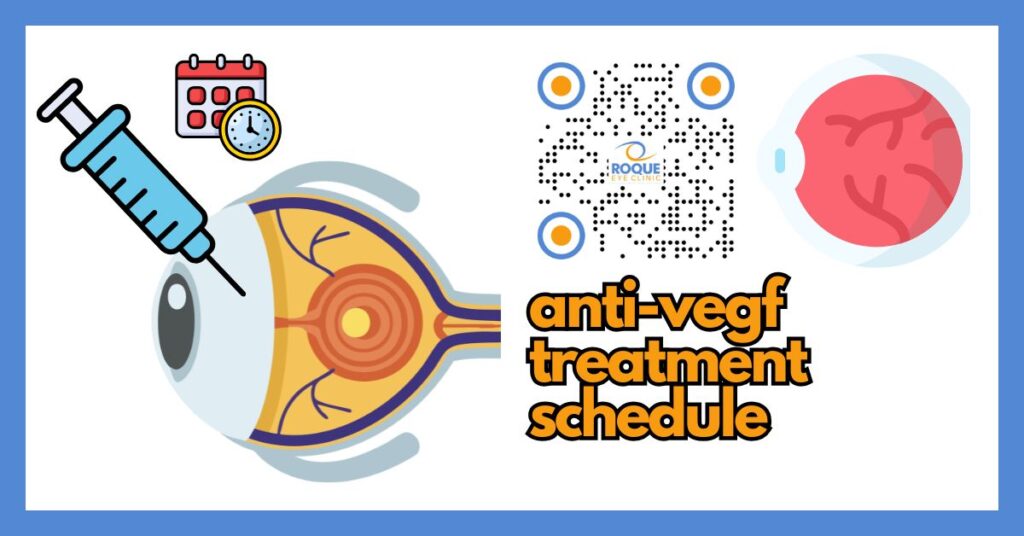
Anti-VEGF Treatment Schedule for Diabetic Macular Edema
🤖 Quick Answer: The anti-VEGF treatment schedule for diabetic macular edema usually starts with frequent eye injections, often monthly at first, followed by longer intervals only if the retina responds well. Your exact schedule depends on OCT scans, vision, the medicine used, and whether swelling returns. Missing visits can reduce treatment success.
If your doctor recommends anti-VEGF injections for diabetic macular edema, one of the first questions you will probably ask is: “How often will I need these injections?”
That is an excellent question. Anti-VEGF treatment helps reduce retinal swelling, protect central vision, and in many patients improve sight. However, treatment is not usually a one-time event. Instead, it follows a schedule based on the medicine chosen, how your retina looks on OCT, how your vision responds, and whether swelling comes back.
🧩 Focus: Treatment timing and follow-up for anti-VEGF injections in diabetic macular edema
👁 Goal: Help patients understand why anti-VEGF is often frequent at the start and more flexible later
🛡 Evidence-Based: Preferred Practice Patterns • Standards of Care • Systematic Reviews • Meta-Analyses
🧠 Diabetic Eye Disease Knowledge Hub
Start with the complete guide:
Diabetic Eye Disease: The Complete Patient Guide
🔎 Quick Navigation
- What is an anti-VEGF treatment schedule?
- Why injections are often monthly at first
- What happens after the loading phase
- How schedules differ by medicine
- Why follow-up visits matter
- What happens if you miss an injection
- How long treatment may continue
- Questions to ask your retina doctor
Related Reading
- Diabetic Macular Edema
- Anti-VEGF for Diabetic Macular Edema
- What Happens During the Injection Procedure
- Vabysmo for Diabetic Macular Edema
- Eylea for Diabetic Macular Edema
- Lucentis for Diabetic Macular Edema
📌 Key Learning Points
- Anti-VEGF treatment for diabetic macular edema often begins with frequent injections, commonly monthly at first.
- Your schedule is guided by OCT scans, vision, and the drug used—not by a one-size-fits-all calendar.
- Some medicines have label-based options to extend the interval once the retina improves.
- Even when injections become less frequent, regular monitoring is still necessary.
- Missed visits may allow swelling to return and can reduce the benefit of treatment.
👁 What Is an Anti-VEGF Treatment Schedule?
An anti-VEGF treatment schedule is the plan your retina specialist uses to decide when you receive each injection and when you return for re-checks.
Anti-VEGF medicines work by reducing abnormal leakage from retinal blood vessels and helping the macula dry out. In diabetic macular edema, the goal is not only to reduce swelling on scans but also to protect the sharp, central vision you need for reading, driving, faces, and daily tasks.
The schedule matters because these medicines do not “cure” diabetic macular edema permanently after one dose. Instead, they control the disease over time. Your doctor looks for:
- How swollen the macula is on OCT
- Whether your vision improves, stays stable, or worsens
- Whether fluid has fully resolved or is still present
- Whether swelling returns after a longer gap between injections
👀 Why Injections Are Often Monthly at First
Many patients are surprised when they hear that treatment often starts once a month. This early phase is sometimes called a loading phase. The reason is simple: the medicine needs enough early treatment to reduce retinal swelling and stabilize the macula.
The National Eye Institute explains that most people who get anti-VEGF injections will need injections once a month at first. Over time, some people need injections less often, while others still need ongoing treatment to protect vision.
Starting aggressively is often important because undertreating early disease may leave the retina swollen longer than necessary. A macula that stays swollen for too long may not recover as well.
In practical terms, this means the beginning of treatment often includes:
- A visit every 4 weeks or about every 28 days
- An eye exam and usually an OCT scan
- An injection if the plan calls for it
- A decision about whether the same interval should continue
This does not mean every patient stays monthly forever. It simply means many schedules begin that way because the retina needs close early control.
What Happens After the Loading Phase?
After the first several injections, your doctor reassesses whether the schedule can change. This is the point where many patients ask, “Can I come less often now?”
The answer depends on your response. There are three common real-world possibilities:
1) The macula dries and vision stabilizes
If OCT shows strong improvement and vision is stable, the interval between injections may be extended in selected patients, depending on the medication and your doctor’s judgment.
2) The macula improves but still has persistent fluid
In this case, your doctor may continue frequent treatment for longer because the eye still needs more control.
3) The swelling returns when the gap gets longer
Some eyes do well only while injections remain frequent. If fluid comes back after extension, the schedule may be shortened again.
That is why anti-VEGF schedules are best understood as response-based schedules, not simply calendar schedules.
💊 How Schedules Differ by Medicine
Different anti-VEGF medicines have different approved dosing patterns. That does not mean one schedule is “right” for every patient. It means the medicine itself influences what intervals are reasonable to consider.
Aflibercept (Eylea)
For diabetic macular edema, FDA labeling for Eylea 2 mg recommends injections every 4 weeks for the first 5 injections, followed by every 8 weeks. The label also notes that some patients may still need monthly treatment after the first 20 weeks.
Faricimab (Vabysmo)
FDA labeling for Vabysmo allows two label-based approaches in diabetic macular edema. One approach starts with at least 4 monthly injections and then adjusts the interval based on OCT and vision, potentially extending to every 8, 12, or even 16 weeks in selected patients. Another label-based approach uses 6 monthly doses followed by every 8 weeks.
Ranibizumab (Lucentis)
FDA labeling for Lucentis 0.3 mg for diabetic macular edema recommends monthly injections. In practice, your retina specialist may still individualize follow-up and related decisions based on your response and the broader clinical picture.
Bevacizumab (Avastin)
Avastin is widely used in retina care, but patients should understand that dosing schedules are often individualized in real-world practice. Because this article focuses on schedule principles, the most important point is that your retina specialist will choose a plan based on how your eye responds on OCT and vision testing.
This is why it is useful to read the medication-specific guides as well:
- Vabysmo for Diabetic Macular Edema
- Eylea for Diabetic Macular Edema
- Lucentis for Diabetic Macular Edema
- Avastin for Diabetic Macular Edema
- Ozurdex for Diabetic Macular Edema
🧪 Why Follow-Up Visits Matter So Much
Patients sometimes think the “treatment schedule” refers only to injections. In reality, it also includes the monitoring schedule.
A follow-up visit allows your doctor to answer several important questions:
- Is the macula drier or still swollen?
- Has vision improved, plateaued, or dropped?
- Is the medicine lasting long enough?
- Can the interval be safely extended?
- Should the drug or treatment strategy be changed?
This is why OCT is so important. The treatment schedule for diabetic macular edema is not based only on symptoms. Some patients feel better before the OCT is fully dry. Others may not notice worsening until the swelling has already returned. The scan helps doctors adjust treatment before avoidable visual decline occurs.
Learn more here: OCT for Diabetic Macular Edema.
What Happens If You Miss an Injection?
Missing one appointment does not always cause disaster—but it can matter. Diabetic macular edema is a chronic disease, and anti-VEGF treatment works best when the retina receives treatment and monitoring on time.
If you miss injections or stretch visits too far without your doctor’s approval, several problems can happen:
- Macular swelling can return
- Vision gains may be lost
- The doctor may need to shorten the interval again
- Long-term control may become harder
This does not mean patients should panic over a single delay caused by illness or travel. It means you should contact your retina clinic, reschedule promptly, and avoid making schedule changes on your own.
Anti-VEGF injections are usually scheduled, planned treatments. However, if you develop suddenly worse vision, a dramatic rise in floaters, increasing pain, marked redness, or light sensitivity after an injection, seek urgent ophthalmic evaluation. Those symptoms are not a normal “wait until next month” problem.
How Long Might Treatment Continue?
This is one of the most important expectations to set correctly. Anti-VEGF treatment for diabetic macular edema is often a long-term management strategy, not a one-time cure.
The NEI notes that many people require monthly injections for the first 6 months, and afterward injections are often needed less frequently. Over the longer term, some people need few or none, while others continue to need treatment to keep vision stable.
In simple language, there are three broad paths:
- Shorter course: strong early response, durable dryness, long gaps possible
- Intermediate course: improvement occurs, but occasional recurrence requires maintenance treatment
- Longer course: chronic or stubborn edema needs regular ongoing treatment
Your doctor cannot always predict this on day one. The retina often reveals its “behavior” only over time.
Questions to Ask Your Retina Doctor About the Schedule
Patients do better when they understand the treatment plan clearly. Helpful questions include:
- What is my expected starting schedule?
- How many injections do you usually give before reassessing?
- Will you decide based on OCT, vision, or both?
- What would make you extend my interval?
- What would make you shorten it again?
- How likely is long-term maintenance in my case?
- What happens if travel or work makes me miss a visit?
Asking these questions helps you plan your calendar, finances, transportation, and expectations more realistically.
Continue Reading
- What Anti-VEGF Does in Diabetic Macular Edema
- What Happens During the Injection Procedure
- Diabetic Macular Edema Explained
- Vabysmo Scheduling Basics
- Eylea Scheduling Basics
- Lucentis Scheduling Basics
🏁 Take-Home Message
Anti-VEGF treatment schedules are usually frequent at the start and become less frequent only if your retina responds well. The right schedule depends on your OCT results, vision, medicine, and whether swelling comes back.
Do not judge the success of treatment only by how your eye feels. Keep your follow-up visits, ask how your schedule is being decided, and contact your doctor promptly if you miss an appointment or notice sudden changes in vision.
❓ Frequently Asked Questions
Will I need anti-VEGF injections every month forever?
Not always. Many patients start monthly, but some can extend to longer intervals if OCT scans improve and remain stable. Others still need ongoing frequent treatment.
What is a loading phase?
A loading phase is the early part of treatment when injections are given more frequently, often monthly, to bring retinal swelling under control.
Can my treatment interval be extended if my vision improves?
Possibly. Doctors usually look at both vision and OCT. Better vision alone is not enough if the retina is still swollen.
What if my OCT looks better but fluid comes back later?
Your doctor may shorten the interval again. Anti-VEGF schedules are often adjusted up and down based on recurrence.
Is the schedule the same for every anti-VEGF medicine?
No. Different medicines have different approved dosing patterns, and your retina specialist may personalize the plan further based on your response.
Why do I still need visits even when injections become less frequent?
Because diabetic macular edema can return quietly. Monitoring helps catch recurrence before you lose more vision.
📚 References
- National Eye Institute. Injections to Treat Eye Conditions.
- National Eye Institute. Treating Diabetic Retinopathy: What You Should Know.
- FDA Prescribing Information. EYLEA (aflibercept) injection.
- FDA Prescribing Information. VABYSMO (faricimab-svoa) injection.
- FDA Prescribing Information. LUCENTIS (ranibizumab injection).
🤝 Roque Eye Clinic Patient Education Series
Reviewed by the Roque Advisory Council
Dr Manolette Roque | Dr Barbara Roque
St Luke’s Medical Center Global City | Asian Hospital Medical Center
Philippines
Medical Review: Roque Advisory Council
Last Updated: March 2026
This article is intended for educational purposes only and does not replace professional medical consultation.
ANIMATION
BOOK AN APPOINTMENT
It takes less than 5 minutes to complete your online booking. Alternatively, you may call our BGC Clinic, or our Alabang Clinic for assistance.